
Snell golf balls review (2026): is the MTB Black LTD worth it?
As an Amazon Associate I earn from qualifying purchases.
CERTAIN CONTENT THAT APPEARS ON THIS SITE COMES FROM AMAZON. THIS CONTENT IS PROVIDED ‘AS IS’ AND IS SUBJECT TO CHANGE OR REMOVAL AT ANY TIME.
If you buy through links on this page we may earn a commission, at no extra cost to you.
You are standing over a 40-yard pitch to a tucked pin and wondering whether the ball you paid less for will check up like the one your playing partner paid full whack for. That is the real question behind every review of a Snell ball, and in 2026 it comes down to one ball: the MTB Black LTD.
Short version: buy a dozen if you want cast urethane spin and feel for well under Pro V1 money and you can live with a limited run from a brand whose recent quality record is patchy. Skip it if you need the same ball in your bag all season, or if your swing speed is slow enough that a softer, cheaper two-piece ball would serve you just as well.
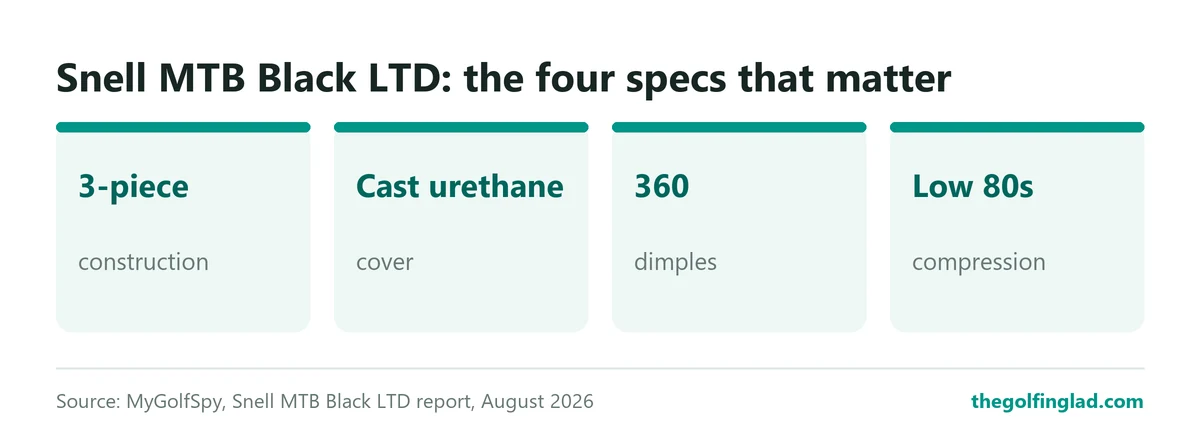
The MTB Black LTD brings back Snell’s best-loved ball with a proper cast urethane cover, a three-piece build and compression in the low 80s. The original MTB Black ran the Pro V1 close in an independent launch-monitor test. The catch is supply and consistency: it is a while-supplies-last release, and Snell’s newer balls have not done well in independent quality checks.
Best for: mid-to-low handicappers who want tour-style greenside spin at a mail-order price. Skip it if: you need a ball you can reorder for years, or you want the lowest-risk premium option.
The cover is the whole point of this ball
Snell has spent the last few seasons selling the PR3 and PR4. Both use what Snell calls TPU-X, a thermoplastic urethane that is injection moulded. The MTB Black LTD goes back to cast urethane, poured as a two-part liquid and cured around the ball.
Why care? In MyGolfSpy’s write-up of the LTD, Tony Covey explains that casting allows a thinner, softer cover without giving up durability. On the course, a thinner soft cover is what lets the grooves grab the ball on a half wedge, so you get one hop and stop rather than one hop and release to the back fringe.
In the golf ball business, cast urethane isn’t just a feature. It’s kind of an address.
Tony Covey, MyGolfSpy
The rest of the recipe is familiar. It is a three-piece ball with 360 dimples and a newly tuned core, sold under a “Heritage Tour Series” banner and available in white only. MyGolfSpy suggests the name hints at more to come, possibly an MTB X LTD, but for now the Black is the only one.
How it differs from the old MTB Black and the MTB-X
The original MTB Black arrived in January 2018, replacing Snell’s first MTB, according to Golf.com’s launch coverage. It was built at the Nassau factory in Korea. MyGolfSpy notes TaylorMade bought that plant in 2021 and third-party production wound down, which pushed Snell to new suppliers.
The LTD’s core is described as newly tuned, and MyGolfSpy speculates the ball may again come from that same plant, now TaylorMade Golf Ball Korea. Snell has not published a side-by-side spec comparison, so treat “same as the old one” as a hope, not a fact.
The MTB-X was the firmer sibling. GolfLink’s review of both says the X used a smaller core with a thicker mantle, and that the Black had 7% lower compression, so it felt softer and gave up a little distance. The X itself was Snell’s fix for the MTB Red: Practical Golf measured it cutting total wedge spin by more than 700 rpm compared with the Red, which players had found spun too much in wind.
Worth knowing: the independent performance data on the MTB Black comes from the original ball. The LTD shares the name, the construction and the cast cover, but nobody has published robot or launch-monitor numbers on the 2026 version yet.
Spin with irons: a touch less than a Pro V1, and that may suit you
Any honest look at this ball starts with the best head-to-head on record, MyGolfSpy’s Pro V1 vs MTB Black test: ten golfers from 0 to 10 handicap, driver speeds of 85 to 120 mph, all hitting both balls on a Foresight GCQuad.
With a 6-iron, the Snell spun at 4,004 rpm against 4,424 rpm for the Pro V1. That is a 420 rpm gap. In plain terms, the Snell launched a fraction higher (18.66° against 17.94°) and went a little further, 183.02 yards against 179.35 yards total.
What does that mean on a par 3? Slightly less spin and slightly more distance per club. If you are a player who tends to balloon irons into the wind, that is no bad thing. If you rely on irons stopping dead on firm greens, you will notice a bit more release than a Pro V1 gives you.
Wedges: close enough that most of us cannot tell
With a sand wedge the gap shrinks. The MTB Black produced 9,876 rpm against 10,102 rpm for the Pro V1, a difference of around 2%. Distance was 88.71 yards against 89.55 yards.
For a 15 handicap, strike quality will move spin far more than that. A slightly thin pitch costs you thousands of rpm, which is why our guide on how to put backspin on a golf ball starts with the strike, not the ball.
Practical Golf’s own launch-monitor sessions landed in the same place: the MTB Black and the Pro V1 “had very similar results,” with the biggest differences showing up in short irons and almost none with mid-irons or driver.
Off the tee it keeps up
MyGolfSpy found the Snell’s driver ball speed was 0.25 mph higher than the Pro V1’s, with near-identical launch and similar spin. A quarter of a mile an hour is nothing you could feel, but it does mean you are not trading tee distance for the urethane cover.
GolfLink also describes both MTB models as designed to reduce ballooning in wind. That fits the iron data: lower spin, a more boring flight.
Feel: soft, but not marshmallow
MyGolfSpy puts the LTD’s compression in the “low 80s”; Snell has not published an exact figure. That is softer than the firm tour balls in the 90s and 100s, and firmer than the 50- to 70-compression distance balls many mid-handicappers play. If the numbers on the box confuse you, our explainer on what the numbers on golf balls mean covers compression properly.
GolfLink called the old Black the softer of the two MTBs. For most club golfers with a driver around 90 to 100 mph, low-80s compression is a comfortable middle: you can compress it without it feeling dead off the putter.
The real worry is consistency
This is where the story gets uncomfortable. Snell’s recent balls have not done well in MyGolfSpy’s Ball Lab. Its PR4 Ball Lab scored the 2026 PR4 76/100, a C grade and Not Recommended, and the headline says every ball in its 36-ball sample had the same manufacturing flaw.
Earlier, the Prime 3.0 test found 20 of 36 balls over the USGA weight limit and compression varying by 17.8 points. A ball that changes 17 points of compression from one sleeve to the next will not fly the same distance twice.
None of that is data on the LTD itself. But if the LTD really does come from the old Nassau plant, it would be the strongest argument for it: a return to the factory that made Snell’s reputation.
Snell MTB Black LTD specs at a glance
| Spec | MTB Black LTD |
|---|---|
| Construction | Three-piece |
| Cover | Cast urethane |
| Dimples | 360 |
| Compression | Low 80s (not published by Snell) |
| Colour | White only |
| Price | Just under $40 a dozen, a little less in 2-plus and 5-plus dozen orders |
| Availability | Limited, while supplies last |
What’s good
- Cast urethane cover, the same type of cover used on tour balls, rather than Snell’s injection-moulded TPU-X.
- The original MTB Black matched the Pro V1 closely on driver, 6-iron and sand wedge in an independent test.
- Low-80s compression suits a wide band of club swing speeds.
- Clearly cheaper per dozen than the big-brand premium balls, with bulk discounts.
What’s not
- Limited release: once it is gone, you are switching balls mid-season.
- Snell’s recent quality data in Ball Lab testing has been poor, and no one has tested the LTD yet.
- White only, no yellow option.
- Sold mainly direct, so you cannot pick up a sleeve to try before committing to a dozen.
What owners keep saying
Snell’s quality data since leaving Nassau has been rough.
Tony Covey, MyGolfSpy
Long-time Snell players are a loyal bunch. One Practical Golf forum member describes nearly five years of playing the MTB Black and then the MTB-X.
The flip side shows up in the comments under MyGolfSpy’s LTD story, where several readers say quality slipped after the factory change and that they stopped buying. Others recall the X as the longer ball and the Black as the spinnier one. The mood is cautious goodwill: people want the old MTB Black back, and they want proof it really is the old ball.
Who should buy the Snell MTB Black LTD, and who should not
Buy it if you are roughly a 5 to 18 handicap, you already know you score better with a urethane ball, and you are tired of paying top-tier prices for one. Order several dozen at once: the bulk price is lower, and it protects you from the limited run ending mid-summer.
Skip it if you lose a ball a hole. At this price, you are better off with something from our list of the best golf balls under $30. Skip it too if you need a ball you can reorder for years without a change.
The alternatives worth weighing
The usual reasons to look elsewhere are the limited supply, Snell’s quality question, or simply wanting a softer or more proven ball. These three cover those bases.
| Snell MTB Black LTD | Vice Pro Soft | Titleist Pro V1 | Callaway Chrome Soft X (2022) | |
|---|---|---|---|---|
| What you get | Three-piece, cast urethane, 360 dimples | Three-piece, thin cast urethane, 318 dimples | Cast urethane, 388 dimples | Four-piece, SoftFast core, Triple Track lines |
| Who it suits | Mid swing speeds wanting spin | Driver speeds under 95 mph | Anyone wanting the benchmark | Better players with quicker swings |
| Price band | Value premium | About the same, sold direct | A clear step up | Big-brand premium tier |
| The catch | Limited run | No published compression figure | Cost per lost ball | An older model year |
Vice Pro Soft: the mail-order rival for slower swings
Vice is the other big direct-to-consumer name, and the Vice Pro Soft is its urethane ball for gentler swings. Vice lists a three-piece build with an extra-thin cast urethane cover, an enlarged high-energy speed core and a 318-dimple pattern. It calls the ball low compression and aims it at medium and lower swing speeds, under 95 mph with the driver.
It sits in about the same value tier as the Snell. Where it wins: it is an ongoing line rather than a limited run, and if your driver speed sits in the 80s it is built for you more directly than the Snell’s low-80s compression. Where it loses: Snell has the independent Pro V1 head-to-head behind the MTB name, and Vice publishes no compression number for the Pro Soft. Take it if you swing on the slower side and want urethane spin you can reorder all year. The catch: “low compression” is a description, not a spec.
Titleist Pro V1: the benchmark, for more money
The Titleist Pro V1 is the ball every Snell is measured against. Titleist describes a cast thermoset urethane cover, a high-flex casing layer to keep long-game spin low, and a spherically tiled 388-dimple tetrahedral pattern. The latest version adds a faster high-gradient core that Titleist says brings more speed and more iron and wedge spin.
It is a clear step up in price. In MyGolfSpy’s head-to-head with the original MTB Black, the Pro V1 spun about 420 rpm more with a 6-iron and slightly more with a sand wedge, which matters if you want irons to stop quickly on firm greens. It lost a few yards of 6-iron distance in the same test. Take it if you want consistency you can count on every box and you rarely lose balls. The catch is every ball in the water hurts more.

- Softer Feel and Performance Characteristics: Pro V1 has a softer feel, less spin and flatter trajectory than Pro V1x, which makes it the preferred model for players who like exceptionally long distance, the ability to flight shots, and score with precision and touch
- Advanced Core Technology: New faster high gradient core delivers more speed and iron and wedge spin for more control
- Low Long Game Spin: Low long game spin from a speed amplifying high-flex casing layer
- Consistent Flight Pattern: Penetrating and consistent flight from a spherically-tiled 388 tetrahedral dimple design
- Superior Greenside Control: Excellent greenside spin from a soft cast urethane elastomer cover

Callaway Chrome Soft X (2022): the big-brand ball for faster swings
The 2022 Chrome Soft X Triple Track is Callaway’s firmer tour ball. Callaway lists a Hyper Elastic SoftFast core for more driver speed and soft feel around the green, a Tour Aero design, and what it calls Precision Technology, with a spin profile tuned for tour pros and better players. Callaway’s own blog describes it as four-piece, and the Triple Track lines are there to help you aim putts.
It sits in the big-brand premium tier, above the Snell. Where it wins: a major maker’s quality control, and an alignment aid the Snell lacks. Where it loses: it is pitched at better players, so a 90 mph swinger gets less from it than from the low-80s Snell. Take it if you are quick off the tee and like a line on the ball. The catch: it is the 2022 model, not Callaway’s latest. Our Callaway Chrome Soft review covers the softer sibling.
Is the cheaper PR3 or PR4 the smarter buy? No
Snell’s current mainline balls are cheaper per dozen, but the test data is weak. MyGolfSpy scored the 2026 PR3 80, a B-minus, and the PR4 76, a C grade and Not Recommended. A BallCaddie round-up also notes MyGolfSpy put the PR3 last for distance at mid speed.
Spend the extra few dollars on the LTD while it lasts. If you cannot get it, go to one of the alternatives above rather than settling for the PR4. For more options in the same bracket, see our guide to the best golf balls for mid handicappers.
Buyer questions
Is the Snell MTB Black LTD the same ball as the original MTB Black?
Same name, same three-piece cast urethane recipe and 360 dimples, with a newly tuned core. Snell has not published a direct comparison, and the factory has not been confirmed.
Is a Snell MTB ball as good as a Pro V1?
The original MTB Black came very close in MyGolfSpy’s test: slightly faster off the driver, about 420 rpm less spin with a 6-iron, and about 2% less spin with a sand wedge. For most club golfers, that gap is smaller than the gap between a good strike and a poor one.
What swing speed suits the MTB Black LTD?
At low-80s compression, it suits a wide middle band. MyGolfSpy’s original test group ran from 85 to 120 mph with the driver, and the ball held up across that range.
Can I still buy the MTB-X?
The current release is the MTB Black LTD in white. MyGolfSpy suggests an MTB X LTD could follow, but nothing has been confirmed.
Final verdict on Snell golf balls
The MTB Black LTD is the Snell to buy in 2026, and the only one we would recommend. The cast urethane cover and low-80s compression are the right ingredients, and the original MTB Black’s showing against the Pro V1 is real evidence. What holds the score back is supply and Snell’s recent quality record. Buy a few dozen now if you want it; if you need certainty, the Pro V1 or the Vice Pro Soft is the safer bet.
Our rating: 3.5/5 (editorial)
How we rated it: this is a research-based review. It draws on Snell’s published specs as reported by MyGolfSpy, named third-party tests from MyGolfSpy, Practical Golf and GolfLink, and owner reports from golf forums and comment threads. We make no hands-on claim.
By The Golfing Lad
2 thoughts on “Snell golf balls review (2026): is the MTB Black LTD worth it?”
Comments are closed.