Member’s Mark golf ball review (2026): Sam’s Club’s urethane deal
As an Amazon Associate I earn from qualifying purchases.
CERTAIN CONTENT THAT APPEARS ON THIS SITE COMES FROM AMAZON. THIS CONTENT IS PROVIDED ‘AS IS’ AND IS SUBJECT TO CHANGE OR REMOVAL AT ANY TIME.
If you buy through links on this page we may earn a commission, at no extra cost to you.
You are standing in the golf aisle at Sam’s Club, holding a box of 24 urethane balls that costs less than a single dozen of most tour models. The question is simple: is this the Kirkland killer, or a bargain you will regret on the first chip?
Straight answer: the Member’s Mark 3-piece ball is a properly good full-swing ball for the money, and a weaker one around the greens. Buy it if you lose balls, play in the 10 to 25 range and want urethane without the bill. Skip it if your short game is the strongest part of your round.
A three-piece, urethane-covered ball around 90 compression, sold in 24-packs for under $30 and only through Sam’s Club. Off the tee and with irons it holds its own against the Kirkland. Around the greens, independent testing and reviewers agree it falls behind.
Best for: mid handicappers who lose a sleeve a round and want a firmer, lower-spinning urethane ball with the long clubs. Skip it if: you want soft feel and grab on chips, or you have no Sam’s Club membership and no patience for the non-member fees.
Where to buy it: Member’s Mark is the Sam’s Club house brand, and the ball is sold through Sam’s Club’s own listing in white, with a yellow 24-pack alongside it. It is not sold on Amazon. Used dozens turn up at golfballs.net.
What Sam’s Club actually built
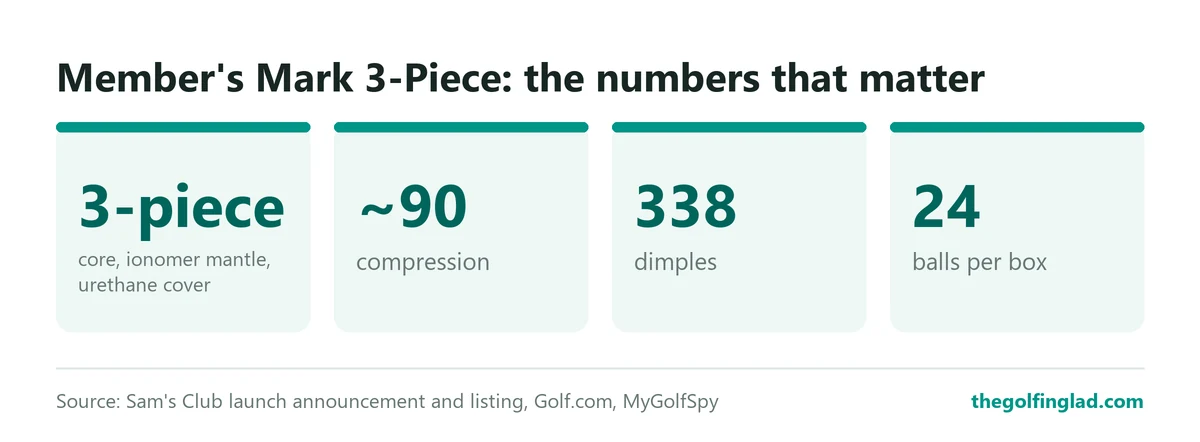
Sam’s Club launched the ball in March 2025. The launch announcement describes three layers: a core for long-game distance, a mantle for accuracy and control, and a responsive polyurethane cover for spin around the greens. It promises higher ball speed, lower long-game spin and a mid-to-high trajectory.
The listing fills in the rest. A polybutadiene rubber core, an ionomer mantle and a 338-dimple cover, per the Sam’s Club page and MyGolfSpy’s first look, which also notes Sam’s Club has two balls on the USGA conforming list. Sam’s sometimes calls it the Pro Series 2.
The number that matters most is compression. Golf.com reports it at “around 90”, the same neighbourhood as the Pro V1, TP5 and Chrome Tour. That is not a soft ball, and it explains most of what owners report.
Where it differs from the Kirkland
The obvious rival is Costco’s Kirkland Signature Performance+, the ball that made warehouse urethane a thing. Both are three-piece urethane balls sold by the two dozen. The differences are small but real.
Firmness first. MyGolfSpy’s 2025 ball test put the Kirkland at 97 compression, so the Member’s Mark at around 90 is a touch softer on paper. Golf.com describes the Member’s Mark cover as “blended urethane”, and a MyGolfSpy reader comment pegged it as thermoplastic urethane (TPU). That matters, because cheaper TPU covers rarely grab the way cast urethane does on a half wedge.
Then the head-to-head. In MyGolfSpy’s robot test of the two, run with CoolClubs largely outdoors in Arizona, the Kirkland averaged about half a mile per hour more ball speed and edged it in carry and total distance. The bigger gap in total came from the Member’s Mark’s steeper descent angle: it lands and stops sooner.
Off the driver, the Kirkland had a meaningfully tighter dispersion. With a 7-iron, the Member’s Mark flipped it, with a dispersion area about 7.4% smaller. MyGolfSpy’s bottom line was that the two are more like each other than either is like a Pro V1.
| MyGolfSpy robot test | Member’s Mark | Kirkland Performance+ |
|---|---|---|
| Driver ball speed | About 0.5 mph slower | Slightly faster |
| Carry and total | Slightly shorter | Slightly longer |
| Descent angle | Steeper | Shallower |
| Driver dispersion | Wider | Tighter by a meaningful margin |
| 7-iron dispersion | About 7.4% smaller area | Larger |
On the course, that reads as a wash for most players. Half a mile per hour of ball speed is too small a gap for most golfers to notice. A steeper landing with the irons is useful when you are firing at a green with a front bunker.
Off the tee it plays like a firmer, lower-spin ball
Sam’s promise of lower long-game spin seems to hold up. Driving Range Heroes found it low-spinning and responsive, easy to control off the tee and with long irons, and easy to get airborne even without a noticeably higher launch.
The catch is feel. The same reviewer said the core firms up at higher speeds, especially with woods. Golf Monthly found it seemed firmer than premium balls and put some of that down to a slightly harsher sound at impact.
For a 15 handicapper with a slice, lower driver spin is the good news here. Less sidespin means the miss curls less, and a ball that curls less finishes in the light rough rather than the trees.
Iron play is its quiet strength
The 7-iron result is the best case for this ball. A smaller dispersion area than the Kirkland, plus that steeper descent, means approach shots that land closer to where you aimed and roll out less once they get there.
Driving Range Heroes found it softer on the scoring clubs than off the driver, though full short-iron shots felt merely fine. Nobody is calling it a tour ball into greens. For a mid handicapper hitting 7-iron into a par 4, though, a predictable landing matters more than feel.
Around the greens it is ordinary
This is where it loses buyers. MyGolfSpy’s buyer’s guide on golf balls you may regret buying said the warehouse ball “lagged in the areas that matter around the green” in its test group.
Driving Range Heroes agrees. Wedge spin was fair, but chips and pitches did not feel satisfying, and putting was acceptable without inspiring confidence. A firm-ish ball with a blended cover is never going to check up like a Pro V1 on a 30-yard pitch.
If you want to know what cover and strike do to spin, our guide on how to put backspin on a golf ball explains why the ball is only one part of it.
The cover held up well and the ball stayed consistent with regular use.
Driving Range Heroes, Member’s Mark review
Durability and value are the reason it exists
The cover holds up, according to Driving Range Heroes, which matters more than it sounds. A cheap urethane ball that scuffs on one cart path is no bargain.
Price is the headline. At launch the 24-pack sat under $30, so each ball costs a fraction of a Pro V1. One wrinkle: Driving Range Heroes worked out that a non-member buying online pays a good deal more once the fee, shipping and tax land, which pushes it toward the $40 tier. If you already hold a membership, it is cheap. If you do not, it is merely fair.
Golf.com adds that the dimple pattern is meant to “generate a powerful flight in windy conditions.” No independent test has measured that, so treat it as a claim. The lower driver spin does point the same way.
Member’s Mark golf balls vs Pro V1
Owners on the Sam’s Club review pages make big claims, from matching the Pro V1 off the tee to feeling better than it. No head-to-head lab test backs that up. MyGolfSpy’s own framing, before testing the two warehouse balls, was that neither would dethrone the Pro V1.
The specs show why. The 2025 Pro V1 is also three-piece with a urethane cover and sits in the high 80s for compression, but it uses 388 tetrahedral dimples (up from 352, per Golf Business News) and a high-gradient core, and Titleist’s pitch for the new model is more spin with irons and wedges. That short-game spin is exactly what the Member’s Mark lacks.
So you are paying for the last 40 yards. If you three-putt and duff chips anyway, that money buys you very little.
The spec sheet
| Spec | Member’s Mark 3-Piece |
|---|---|
| Construction | Three-piece |
| Core | Polybutadiene rubber |
| Mantle | Ionomer |
| Cover | Polyurethane (Golf.com: blended urethane) |
| Dimples | 338 |
| Compression | Around 90 |
| Pack | 24 balls, white or yellow |
| Sold at | Sam’s Club only |
If compression numbers and dimple counts read like code, our explainer on what the numbers on golf balls mean covers it.
What’s good
- Urethane cover and three-piece build for under $30 a two-dozen box
- Low driver spin, so slices curve less
- Tighter 7-iron dispersion than the Kirkland in MyGolfSpy’s robot test
- Steep descent helps approach shots stop
- Cover holds up to regular play
What’s not
- Short-game spin and chip feel trail better urethane balls
- Firm off the driver with a slightly harsh sound
- Wider driver dispersion than the Kirkland
- Sam’s Club only, and non-member fees eat into the value
What owners keep saying
The Sam’s Club owner reviews lean positive and nearly all of them start with value. One owner said it performed every bit as well as the TaylorMade Tour Response they had been playing. Another found it softer than the Kirkland, which fits the numbers: around 90 compression against the Kirkland’s 97.
Feel is where owners split, and the split is about what they compare it with. Softer than the Kirkland, yes, but firm next to premium balls: one owner compares it to hitting a rock, and one who had played Kirkland said the newer Costco ball is better. Golf Monthly and Driving Range Heroes both call it firm with the long clubs, so take firm as the typical verdict.
Who should buy it, and who should not
Buy it if you already have a Sam’s card, you lose two or three balls a round, and you want something that spins less off the tee and lands steeply on approach shots without hurting to lose. It is a sensible ball for the golfers in our best balls for mid handicappers guide.
Skip it if you would have to pay non-member fees, your short game earns your score, or you swing slowly and want something genuinely soft. A 90-compression ball is not that.
The alternatives worth weighing
Most people who pass on the Member’s Mark do so for one of three reasons: no Sam’s card, a short game that needs more spin, or a swing that wants a softer ball. Each of these answers one of them.
| Member’s Mark | Kirkland Performance+ | Titleist Pro V1 | Titleist TruFeel | |
|---|---|---|---|---|
| What you get | 3-piece urethane, 24 balls | 3-piece urethane, 24 balls | 3-piece urethane, 388 dimples | Soft ionomer-covered ball |
| Who it suits | Mid handicappers on a budget | Value hunters who swing a bit faster | Anyone who scores with wedges | Slower swings wanting soft feel |
| Price against Member’s Mark | Baseline | About the same per ball at Costco | A big step up | Pricier per ball |
| The catch | Ordinary around greens | Firmer still | Cost | No urethane grab |
Kirkland Signature Performance+: the like-for-like rival
Costco’s ball is a three-piece design with a soft urethane cover, sold by the two dozen. MyGolfSpy’s 2025 ball test measured it at 97 compression and called the latest version the best ball Kirkland has released since the 2016 original. At Costco it costs about the same per ball as the Member’s Mark; through Amazon resellers it sits higher.
It beats the Member’s Mark on driver dispersion by a meaningful amount and edges it on ball speed and distance in MyGolfSpy’s head-to-head. It loses on 7-iron dispersion and feels firmer still. Take it instead if you hold a Costco card rather than a Sam’s one, or if keeping the driver in play is your biggest problem. The catch: at 97 compression, slower swingers will find it hard.

- 3 Piece Golf Balls, USGA Certified
- CORE - Soft, high elastic core provides distance
- Mantle - Soft-cover interaction generates proper spin for irons and wedge shots
- Cover - Durable urethane cover for spin and greenside control
Titleist Pro V1: the step up for players who score around the greens
The 2025 Pro V1 is a three-piece urethane ball with 388 tetrahedral dimples and a high-gradient core that is softer in the centre and firmer toward the outside. Compression sits in the high 80s, close to the Member’s Mark, and Titleist’s stated goal for this version is more spin with irons and wedges.
That is the gap. Where the Member’s Mark goes ordinary on chips, the Pro V1 is the benchmark every test measures against. It costs several times as much per ball, in the $60 tier for a single dozen, so it only makes sense if you rarely lose one.
Take it instead if you are under 12 or so, keep a ball for several holes and want your 40-yard pitch to check. The catch is obvious: every ball in the lake is an expensive one.

- Pro V1 has a softer feel, less spin and flatter trajectory than Pro V1x, which makes it the preferred model for players who like exceptionally long distance, the ability to flight shots, and score with precision and touch.
- New faster high gradient core delivers more speed and iron and wedge spin for more control
- Low long game spin from a speed amplifying high-flex casing layer
- Penetrating and consistent flight from a spherically-tiled 388 tetrahedral dimple design
- Excellent greenside spin from a soft cast urethane elastomer cover

Titleist TruFeel: the soft choice for slower swings
TruFeel is Titleist’s softest ball, built on a TruTouch core and an ionomer TruFlex cover. Titleist says the newer core is larger (1.600 inches), faster and low compression, an upgrade on the old DT TruSoft. It sells by the dozen in the under-$30 band, so it costs more per ball than the Member’s Mark.
It beats the Member’s Mark on feel for players who find a 90-compression ball clicky, and it suits swing speeds that never compress a firm ball properly. It loses on short-game grab, because an ionomer cover does not spin like urethane, and it is not built to stop iron shots the same way.
Take it if you swing slowly and the Member’s Mark’s firmness is the reason you are looking elsewhere. The catch: you are giving up urethane entirely.

- For players who prioritize soft feel and who trust the Titleist brand.
- Long distance and soft feel from a new TruTouch core
- Low penetrating ball flight from unique 376 tetrahedral dimple design
- Increased greenside spin and control from a softer 3.0 TruFlex cover
- Ultra-soft feel
More options in this price range are in our roundup of the best golf balls under $30.
White or yellow: which box to pick
Sam’s Club also sells a yellow Member’s Mark 3-Piece in the same 24-ball box. There is no previous model to hunt for at a discount; this is still the first generation.
Buy the yellow if you play in flat light or lose balls in leaves, where a coloured ball is easier to find. Buy the white if you prefer a traditional look. It is the same three-piece ball, so pick on eyesight, not performance.
Questions buyers ask
Who makes Member’s Mark golf balls?
Sam’s Club has not said. MyGolfSpy and others report that SM Global is rumoured to make them, and that Sam’s may source from two different ball plants. Treat any single factory name as unconfirmed.
Is the Member’s Mark ball tournament legal?
MyGolfSpy reports that Sam’s Club has two balls on the USGA conforming list, so it is fine for club competitions and handicap rounds.
Is it better than the Kirkland?
Not clearly. In MyGolfSpy’s robot test the Kirkland was slightly longer and tighter with the driver, while the Member’s Mark was tighter with the 7-iron. Buy whichever warehouse you already belong to.
Is it too firm for a slow swing?
At around 90 compression it is firm, and owners split on feel. Driving Range Heroes reckons it suits slower swingers better than very fast ones. If you swing slowly and hate a firm click, look at the TruFeel instead.
Can I buy it without a membership?
Sam’s Club does sell to non-members online, but the extra fee, shipping and tax push the cost up considerably, by Driving Range Heroes’ reckoning.
Final verdict
The Member’s Mark 3-piece is a solid full-swing ball for very little money, with a slightly better iron game than its Costco rival and a weaker short game than any premium urethane ball. For a Sam’s member who loses balls, it is an easy buy. For anyone chasing spin around the greens, it is the wrong place to save. Our rating: 3.5/5 (editorial).
For a broader list of options, see our picks for the best golf ball for the average golfer.
How we rated it. This is a research-based review. The rating draws on Sam’s Club’s published specifications, independent coverage and testing from MyGolfSpy, Golf.com, Golf Monthly and Driving Range Heroes, and owner reports on the Sam’s Club review pages. We make no hands-on claim.
By The Golfing Lad
One thought on “Member’s Mark golf ball review (2026): Sam’s Club’s urethane deal”
Comments are closed.