
How many clubs in a golf bag: 14 max, 10 is plenty (2026)
As an Amazon Associate I earn from qualifying purchases.
CERTAIN CONTENT THAT APPEARS ON THIS SITE COMES FROM AMAZON. THIS CONTENT IS PROVIDED ‘AS IS’ AND IS SUBJECT TO CHANGE OR REMOVAL AT ANY TIME.
If you buy through links on this page we may earn a commission, at no extra cost to you.
You are standing on the first tee, the starter is chatting to the group in front, and you suddenly wonder if the bag on your shoulder is legal. Or you are staring at a box set online and asking whether 10 clubs is enough to play a proper round.
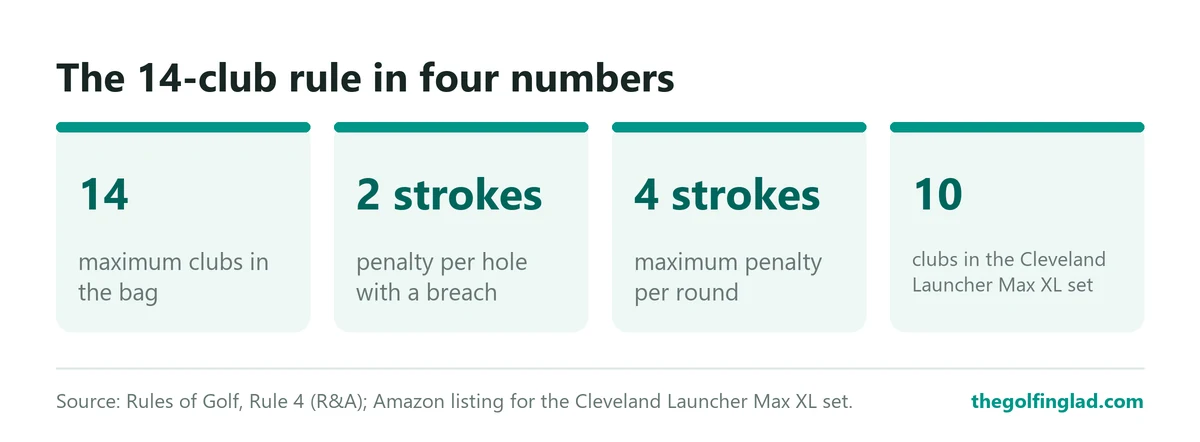
Short answer: You can carry up to 14 clubs, and the number is a ceiling, not a target. Starting a round with more than 14 costs two penalty strokes for each hole where the breach happened, capped at four. Most beginner sets hold 10 or 12 clubs, and that is plenty to start with.
That is the whole rule. The useful part is what to do with it: which clubs earn a slot, how many empty slots a starter set leaves you, and when carrying fewer than 14 is the smarter move.
How full is your bag? A quick slot count
Here is the table nobody gives you: how many of your 14 slots each common setup uses, and what you can still add. The 14 comes from Rule 4 of the Rules of Golf on the R&A site. The open-slot column is simple subtraction.
| Setup | Clubs | What is in it | Open slots |
|---|---|---|---|
| Typical 10-club starter set | 10 | Driver, fairway wood, 5-iron to 9-iron, pitching wedge, sand wedge, putter | 4 |
| Typical 12-club set | 12 | Driver, fairway wood(s), hybrid(s), mid-irons through 9-iron, pitching wedge, sand or gap wedge, putter | 2 |
| Full bag | 14 | Whatever mix you choose | 0 |
The 10-club line matches the Cleveland Launcher Max XL listing, which names a 10.5-degree driver, a 3HL fairway wood, 5-iron through 9-iron, pitching and sand wedges, and a Huntington Beach putter. The 12-club line is the usual shape of a bigger starter set, with a hybrid or two added.
What the 14-club rule says, and what it does not
The rule is short. You must not start a round with more than 14 clubs, and you must not have more than 14 during the round. It has been in place since 1938, when the USGA and the R&A set the cap.
What it does not say matters more to a buyer. There is no required mix. Nothing says you need a driver, a set number of irons, or even a putter. You can carry three wedges and no fairway wood if that is how you play.
It also works in one direction only. If you start with fewer than 14, you can add clubs during the round up to the limit, as long as you do not unduly delay play. Glenmuir’s explainer covers the same ground.
The penalty, with real numbers
The penalty in stroke play is two strokes for each hole where you broke the rule, with a maximum of four strokes for the round. MyGolfSpy’s rundown lays it out the same way.
Say you find a 15th club, a spare putter someone threw in, after you finish the 5th hole. You started with it, so you took it through five holes. The sum is 2 x 5 = 10 strokes, but the cap cuts it to 4.
Four strokes is not the end of the world, though it is plenty to lose over a bag you could have checked in half a minute.
Worth knowing: In four-ball or foursomes, partners can share clubs, but the total carried by everyone on the side must not exceed 14. Two friends each carrying a full bag and sharing one wedge is a problem.
How many clubs in a golf set: why 10 and 12 are the norm
If you are wondering how many clubs come in a golf set, the honest range is roughly 8 to 12 for a complete beginner package, with 10 and 12 the two most common. A full 14 is the exception in beginner packages, and a starter set that stops short leaves you room to buy the clubs you turn out to need.
A starter set aims at the shots a new player actually faces: off the tee, a long approach, a mid-iron, a chip, a putt. Everything beyond that is fine-tuning that you cannot use until your contact is consistent.
Which is why a 10-club set is not a compromise. Look at what it covers.
- Driver for the tee on par 4s and 5s.
- A fairway wood for the second shot, or a tee shot on a tight hole.
- 5-iron to 9-iron for everything from long approaches to short ones.
- Pitching and sand wedges for chips, pitches and bunkers.
- A putter, because every hole ends with one.
That is a full round, and you have four slots to spare while you work out where the gaps are.

- 11239771
- Cleveland
This is the set to look at if you want a 10-club package with a cart bag included. The 10 clubs come in the 14-way cart bag from the listing, so you leave with a bag that already has a divider for every slot you have not filled yet.
An 11-piece set is not a 14-club bag
Watch the counting on listings. A set sold as “11-piece” may include headcovers or a bag in the count, so check the club list rather than the headline number.
The KVV listing below is described as an 11-piece set with a driver, a fairway wood, a hybrid and irons from 5 to pitching wedge. Read the item list on the page before you order, and count the heads yourself.

- Men's 11-Piece Complete Golf Clubs Set: The set comes with a 1# driver, a 3# fairway wood, a 5# hybrid, and irons ranging from 5# to P#, along with a putter. This awesome set is specially designed for left-handed male golfers and is an outstanding choice.
- 460CC 1# Oversized Driver: With a sleek and aerodynamic head shape, this driver enables long and high-flying shots that effortlessly soar through the air. It provides stability during impact and allows for greater control over trajectory.
- 3# Fairway Wood & 5# Hybrid: The 3# Fairway Wood and 5# Hybrid are two essential clubs in a golfer's bag. The fairway wood is designed to hit long shots from the fairway, while the hybrid club combines the best features of both irons and woods, making it versatile for various situations on the course.
- 7 Well-made & High-performance Irons: These irons are equipped with advanced technology that maximizes distance while maintaining forgiveness and control. Made from stainless steel, they offer durability and consistency in every shot you take on the fairway or rough.
- Mallet Putter with Visual Cue: This putter features visual alignment aids that assist in improving accuracy during each putting stroke. Whether it's aligning your eyes with the target line or ensuring proper face angle at address, this mallet putter enhances your ability to sink those crucial putts.
My rule here is blunt: pay for clubs you will hit, not for a bigger number on the box. If a set pads its count with a second fairway wood and a duplicate hybrid, you are carrying weight for a gap that is not there.
Our box set versus used clubs comparison goes through the maths of when a new package beats building a bag from second-hand pieces.
Which clubs earn the first 10 slots
When you are building rather than buying a set, fill the bag in this order. Each step ends where a beginner usually loses a shot.
- Putter. You use it more than any other club, so it gets the first slot.
- Pitching wedge and sand wedge. Short game and bunkers cost a high handicapper more than a missed drive.
- Mid-irons, 6 through 9. These are the clubs you can learn to hit.
- Driver, because the tee shot sets up the hole.
- A fairway wood or hybrid, to replace the long irons that are hard to hit.
The long irons are the ones to skip. A 4-iron is harder to launch than a hybrid of similar distance, which is why most starter sets swap it out. Our guide on what clubs a beginner should buy first follows the same order, and what makes a club forgiving explains why the hybrid usually wins.
Worth knowing: Check the gaps, not just the count. If your pitching wedge and sand wedge are far apart in yardage, the clubs you add in slots 11 to 14 should close that gap. Our golf club distance chart shows how far each club should carry.
The four spare slots: what to add and in what order
You bought 10 clubs and have 4 slots free. Resist the urge to fill them all in one weekend. Add one club at a time and play two or three rounds with it before the next.
Here is the order I would use.
- A hybrid, if your set did not include one. It is the easiest club to hit from a poor lie.
- A gap wedge, if the jump from pitching wedge to sand wedge leaves you with an awkward in-between shot into the green.
- A lob wedge, but only once you can hit a clean chip. Before then it is a way to hit it further than you meant to over the green.
- A second hybrid or an extra iron, only if a gap shows up in your distances.
That keeps every addition tied to a shot you have actually missed.
Carrying fewer than 14 on purpose
The question some players get wrong is the opposite one. The number of clubs you can carry is a limit, and you are free to sit well under it. Golf Monthly even ran a piece titled why having 14 clubs in your bag is too many.
A lighter bag matters most if you walk. Lynx Golf points out that on a hilly course a lighter bag can help your swing late in the round.
The same logic holds on a short or tight course. If the par 3s are short and the fairways are narrow, a driver and a long iron spend the round in the bag.
Leave out the club you hit worst. If you reach for it twice a round and mis-hit it both times, it is not helping you.
Which setup fits you
- You play twice a month and have never owned clubs: buy a 10-club set with a cart bag and add a hybrid or gap wedge later.
- You walk a hilly course: carry 10 to 12 clubs and leave the clubs you hit least at home.
- You are a 15 to 25 handicap who has outgrown a starter set: add the missing clubs one at a time until you reach 14 only if each one fills a real gap.
- You play in club competitions: count the bag before every round, because the penalty applies even if you never used the extra club.
The last one deserves a habit. Count heads on the practice green before you walk to the first tee.
Questions golfers ask
How many clubs are allowed in a golf bag?
Fourteen. That is the maximum under Rule 4 of the Rules of Golf, and the number covers every type of club, putters included. You can carry fewer, and you can add clubs mid-round if you started below the limit.
What happens if I carry 15 clubs?
In stroke play you take two penalty strokes for each hole where the breach occurred, up to four strokes for the round. The penalty is counted by holes, so the sooner you spot the extra club, the fewer holes it can cost you.
Count before you tee off. A quick tally of heads on the practice green takes less time than retying a shoelace, and it removes the only way a bag-check can wreck a card.
Do I need all 14 clubs to play well?
No. The rules set a cap, not a minimum. A driver, a fairway wood, 5-iron to 9-iron, two wedges and a putter is a 10-club bag that plays a full round.
Does a putter count as one of the 14?
Yes. Every club counts, whatever its type. A spare putter in the bag is one slot, so that is how a player ends up with 15.
The verdict
Buy a 10-club set, keep four slots open, and fill them as your game shows you the gaps. If you want that package in one purchase, the Cleveland Launcher Max XL above is the cleaner place to start.
Not sure which package suits your swing and budget? Our best golf clubs for beginners guide sorts what to buy from what to skip.
By The Golfing Lad
One thought on “How many clubs in a golf bag: 14 max, 10 is plenty (2026)”
Comments are closed.