How do golf rangefinders work? The laser, the flag and slope
As an Amazon Associate I earn from qualifying purchases.
CERTAIN CONTENT THAT APPEARS ON THIS SITE COMES FROM AMAZON. THIS CONTENT IS PROVIDED ‘AS IS’ AND IS SUBJECT TO CHANGE OR REMOVAL AT ANY TIME.
If you buy through links on this page we may earn a commission, at no extra cost to you.
You are 150 yards out, the flag is tucked at the back, and there is a wall of pines behind the green. You press the button and a number appears before you have finished breathing out. So what just happened inside that little box, and why does it sometimes give you the trees instead of the pin?
Here is the straight version, plus the parts that decide which rangefinder is worth your money.
Short answer: A golf rangefinder fires a pulse of invisible laser light, times how long the reflection takes to come back, multiplies by the speed of light and halves it. That is time of flight. Pin-seeking software picks the flag out of the background, and a tilt sensor plus trigonometry turns the straight-line number into a slope reading. The laser is the easy bit. Locking the flag is what you pay for.
The maths fits on a napkin
Every laser rangefinder does the same four things. It emits a pulse through one lens, catches the scattered return through the other, logs both moments on a very fast clock, and runs one formula: distance = (speed of light × time) ÷ 2. The halving is there because the light went out and came back.
Put real numbers on it. Light covers roughly 300,000 km every second. A flag 150 yards away is about 137 metres, so the round trip is about 274 metres, which takes light a little under a millionth of a second.
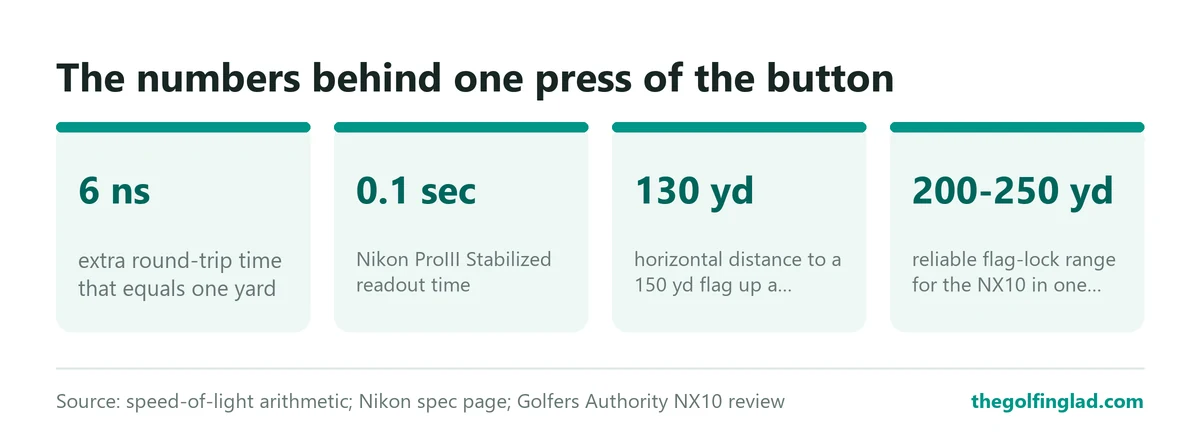
Now the part that should impress you. One yard of distance is about 1.83 metres of extra round trip, or roughly 6 billionths of a second. A unit that claims accuracy to a yard is telling you its clock can split time that finely, every press.
As Pinned Golf’s explainer puts it, the device uses “the speed of light as a constant” and works the rest out from the time of flight. Better units fire several pulses and average them in milliseconds, which is why the number settles rather than flickers.
The rule: every decent rangefinder can measure distance. Stop comparing on that and compare on what it does with the messy returns.
What the spec sheet is really telling you
Three popular rangefinders, three different answers to the same physics. Here is what each maker or tester actually states, and what it means on the course.
| Model | Magnification | Stated accuracy | Range | What helps you lock the flag |
|---|---|---|---|---|
| Nikon Coolshot ProIII Stabilized | 6x, 21 mm lens | ±0.75 yd under 700 yd | 8 to 1,200 yd | Optical stabiliser, 0.1 second readout |
| Bushnell Pro X3+ | 7x, 28 mm lens | 1 yd | 5 to 1,300 yd | PinSeeker with Visual JOLT |
| Precision Pro NX10 Slope | 6x | ±1 yd | 900 yd | Vibration pulse; no advanced flag lock |
Sources: Nikon’s spec page, PlayBetter’s Pro X3+ listing, and Golfers Authority’s NX10 review.
Notice the range column. Every one of them will reach further than you will ever hit a ball, so it is the least useful number on the box. The Golfers Authority test put the NX10’s reliable flag-lock range at 200 to 250 yards, which is the figure that matters when you are aiming at a pin rather than a barn.
The hard part is the flag, not the distance
A flagstick is a thin pole. A tree line or a hillside behind the green is a huge, solid reflector. Fire a beam at that scene and the receiver gets a weak return from the pin and a strong one from the woods 40 yards beyond it.
Pin-seeking (Bushnell calls it PinSeeker, Nikon calls it First Target Priority) is software that favours the nearer return and throws away the background. Pinned Golf describes it as algorithms that “filter out background objects and pinpoint the intended target, like the flagstick.” Then the unit tells you it worked.
On the Pro X3+, PlayBetter’s listing says the feature “confirms when you’ve locked onto the flag, with a visual signal and a gentle vibration”. That buzz is the whole point. It turns is that the pin or the oak? into a yes.
one quick buzz and you know you’ve got your number
Golfers Authority, NX10 review
Cheaper units vibrate too, but the vibration only means “I got a reading”, not “I got the flag”. The same review notes the NX10 has no advanced flag-lock, so with trees or hills behind the green you have to aim deliberately at the stick.
The rule: if your course has tree-lined greens, pay for real flag lock. If it is open parkland, a basic vibrate-on-reading unit will do.
Shaky hands are the error nobody prints
The beam is tiny and the flag is far. At 6x, a small wobble of your hand moves the aim point across the whole green, and the pulse can land on the bank behind it. This is the most common reason a reading is wrong, and no accuracy figure accounts for it.
Nikon’s answer is optical stabilisation that steadies the view and the laser together, and a result in 0.1 second, which it calls the fastest in the Coolshot series. Less time pointing means less time wobbling.
Bushnell takes the other route on the Pro X3+: 7x magnification so the flag looks bigger, and a 28 mm lens that gathers more light. The cost is weight. The Pro X3+ is 12 oz against the Nikon’s 7.2 oz without its battery.
The rule: if your hands are not steady, or you are over 55 and noticing it, stabilisation is worth more than an extra 1x of zoom. Our rangefinder picks for seniors lean that way for this reason.
Slope is a tilt sensor and some trigonometry
The laser always measures the straight line from your eye to the flag. Uphill, that line is longer than the ground the ball covers horizontally, yet the shot plays longer because the ball lands earlier. A slope rangefinder adds an inclinometer, a sensor that reads how far you are tilting the unit up or down.
The geometry is simple. Horizontal distance is the straight-line distance times the cosine of the angle. Aim at a flag 150 yards away up a 30-degree slope and the horizontal distance is about 130 yards.
The “plays like number you see is something else. Each maker adds its own adjustment for how a ball flies up or down a hill, and Bushnell’s version on the Pro X3+ adds Elements” compensation and a home elevation setting. Two brands can show different slope numbers for the same shot.
In the Golfers Authority test, a 142-yard par 3 read 161 with slope on. The tester went from an 8-iron to a 6-iron and found the green. On downhill shots the NX10’s adjustments were typically 5 to 8 yards.
Worth knowing: slope readings are not allowed in competition under the Rules of Golf. One Golf Monthly forum member sums it up: using one with height adjustment turned on “is general penalty first time and DQ the second time – see Rule 4.3.” Buy a unit with a physical slope on/off switch if you play any medals.
The rule: on a flat course, slope is a nice-to-have. On a hilly one, it is the feature that changes which club you pull. Our best slope rangefinders all have the switch.
What throws a reading off
Nikon is unusually honest here. Its spec page says the figures “may not be achieved depending on the target object’s shape, surface texture and nature, and/or weather conditions.” In plain golf: a wet, dark or angled target returns less light, and rain or mist scatters the beam before it gets there.
Weather also matters for the unit itself. Here is how the three compare once the bag gets wet:
- The Bushnell Pro X3+ is rated IPX7, so a downpour or a drop in a puddle is fine.
- The Nikon is waterproof to 1 m for 10 minutes, though its battery chamber is only rated rainproof.
- The NX10 is water-resistant with no IP rating, and its tester says to avoid heavy rain.
The rule: if you play through British-style weather, buy the IPX7 rating. If you are a fair-weather golfer, do not pay extra for it.
Which rangefinder fits how you play
If you play twice a month on a fairly open course and want a number you trust without spending big, the NX10 does the physics well. Its tester found it “consistently within a yard” of course markers, other rangefinders and GPS watches. You just have to aim carefully at tree-backed pins.

- ONE RANGEFINDER, TWENTY WAYS TO SHOW UP: the NX10 is the only rangefinder that looks like yours. Snap on a new design to match your headcovers, your colors, or your mood. Real accuracy underneath, real personality on top. For the golfer who stands out.
- MAKE IT YOURS IN SECONDS: 20+ interchangeable looks, from classic black to USA flag, state pride, and more. The side and face plates snap on and off by hand, no tools, no screws. Change it up every Saturday if you want.
- ACCURATE TO ONE YARD: one press locks the flag from up to 400 yards and gives you a single, confident number. No wondering if you hit the pin or the tree behind it. Just aim, press, and swing.
- SLOPE WHEN YOU WANT IT: turn slope on and the NX10 factors in elevation for a true plays-like distance. Flip it off and you're tournament legal in a flick. One switch, both worlds.
- BUILT FOR THE ROUND: a magnetic cart mount snaps to the bar and stays put, even over the bumps. A display sharp enough to read in full sun. Compact at 12 ounces, and water resistant against morning dew and light rain.
If you play weekly on a tree-lined or hilly course and want the flag lock and slope to do the heavy lifting, the Bushnell Pro X3+ sits in the $500-plus tier for a reason. PinSeeker, 7x, IPX7 and app-linked wind readings cover every weak spot this guide has raised. It is heavy, and it is a lot of money.

- Wind Speed + Direction: The X3+ LINK displays real-time wind speed and direction when connected to the mobile app, to show how wind will affect your shot, helping you choose the right distance and club.
- 600+ Yard Range & 7x Magnification: Delivers accurate readings to 600+ yards to a flag with upgraded 7x magnification, making it easier to spot and lock onto the flag from long distances.
- Elements-Compensated Distances: Temperature and altitude have been added to Bushnell Golf’s patented Slope technology to give you the most precise compensated distances ever.
- Home Elevation Adjustment: With the X3+LINK laser rangefinder, you can now put in your home elevation to reflect the Slope with Elements compensated distances at the elevation where you play your most golf.
- LINK-Enabled Technology: Seamlessly connect your performance data from ANY Foresight Sports or Bushnell Golf launch monitor to your Pro X3 plus laser rangefinder for personalized on course recommendations. Launch Monitor sold separately.
If your hands shake, or you have ever got three different numbers in three presses, the Nikon Coolshot ProIII Stabilized fixes the real-world error rather than the spec-sheet one. It is light at 7.2 oz and quick at 0.1 second. The catch is 6x rather than 7x, and a price in the $300-plus range.

- STABILIZED OPTICS FOR PRECISE TARGETING - The Nikon COOLSHOT PROIII STABILIZED golf rangefinder minimizes hand movement for steady, accurate pin readings; Image stabilization keeps both view and laser stable, ensuring reliable performance even at long distances - perfect for pros and serious golfers
- ULTRA-FAST HYPER READ MEASUREMENT SYSTEM - With improved HYPER READ technology, this laser rangefinder delivers instant distance readings in just 0.1 seconds; Measure targets up to 1,200 yards away with precision, helping golfers plan every shot efficiently on the course without delay or guesswork
- DUAL LOCKED ON QUAKE FLAGSTICK DETECTION - The COOLSHOT PROIII STABILIZED provides both visual and tactile confirmation when the pin is locked; A gentle vibration and clear indicator eliminate confusion with background targets like trees or carts, ensuring confident, accurate flag detection every time
- SLOPE COMPENSATION & COMPETITION-APPROVED MODES - Choose between Golf Mode with ID Technology for incline/decline-adjusted distances or Actual Distance Mode for tournament play; The built-in Actual Distance Indicator (ADI) LED ensures compliance with USGA Local Rule 14-3 during official competitions
- BRIGHT, WEATHERPROOF & PORTABLE DESIGN - Featuring a 6x monocular with multilayer-coated optics, long eye relief, and diopter adjustment, this golf laser rangefinder from Nikon delivers bright, clear views in all light conditions; Compact, rainproof, and only 7.2 oz, it's built for comfort, durability, and performance on any course
New to lasers and not sure you will use one every round? Start with our easy rangefinders for beginners or the picks under $200.
Questions golfers actually ask
Is a golf rangefinder laser safe for my eyes?
Golf units use low-power eye-safe lasers. Nikon’s ProIII Stabilized, for example, is a Class 1M laser under IEC 60825-1 and Class I under the FDA rules. Do not point one into anyone’s eye through binoculars, but normal use is fine.
Why does my rangefinder keep reading the trees?
Because the trees send back far more light than the flagstick. Either your unit has no real flag lock, or your aim drifted off the pin during the press. Brace your elbows against your body and press only once the stick is steady in the reticle.
Is a laser more accurate than GPS?
For the flag, yes, because it measures the actual pin rather than a mapped green. Blue Tees points out that GPS depends on pre-loaded course data, while a laser can target almost anything you can see. GPS wins on blind shots and front and back numbers.
Can I use a rangefinder in competition?
Distance-only, usually yes, if the committee allows them. Slope, no. As one Golf Monthly member put it bluntly:
simple answer – no, you cant use the slope adjusted distance
Bdill93, Golf Monthly forum
Do I need 7x magnification?
No. The NX10’s tester could pick out the flag from 200 yards at 6x without trouble. 7x helps at longer distances and in poor light, but a steady 6x beats a shaky 7x.
The verdict
Every rangefinder on sale measures distance the same way, and every decent one gets it within a yard. What you are really buying is how well it finds the flag against the background, how well it copes with your hands, and whether its slope switch keeps you legal.
Buy flag lock if your greens are backed by trees. Buy stabilisation if your hands shake. Buy slope with a switch if your course has hills. Skip paying for range figures entirely. When you know which of those you need, our ranked list of the best golf rangefinders for 2026 will tell you which one to buy.
By The Golfing Lad
One thought on “How do golf rangefinders work? The laser, the flag and slope”
Comments are closed.