
Best golf rangefinder for seniors: 7 easy picks (2026)
As an Amazon Associate I earn from qualifying purchases.
CERTAIN CONTENT THAT APPEARS ON THIS SITE COMES FROM AMAZON. THIS CONTENT IS PROVIDED ‘AS IS’ AND IS SUBJECT TO CHANGE OR REMOVAL AT ANY TIME.
If you buy through links on this page we may earn a commission, at no extra cost to you.
The Nikon COOLSHOT PROIII STABILIZED is the best golf rangefinder for seniors because it fixes the one thing that ruins a reading: a wobbling picture. It runs 6X magnification and uses a gyroscope-driven stabilizer, so the flag sits still while your hands do not.
If you have ever chased a pin around the eyepiece at 170 yards with a bunker behind it, you know the feeling. This post is about making that stop.
Short answer: the quick picks, by what you actually need.
- Best overall and best for shaky hands: Nikon COOLSHOT PROIII STABILIZED
- Best flag-lock confirmation: Bushnell Tour V6 Shift
- Best large display: Garmin Approach Z82
- Easiest to use: Callaway 300 Pro
- Best lightweight option: Acer Pro Golf Rangefinder with Slope Switch
- Best budget: Shot Scope PRO L2
- Best set-and-forget: Precision Pro NX9 Slope

- STABILIZED OPTICS FOR PRECISE TARGETING - The Nikon COOLSHOT PROIII STABILIZED golf rangefinder minimizes hand movement for steady, accurate pin readings; Image stabilization keeps both view and laser stable, ensuring reliable performance even at long distances - perfect for pros and serious golfers
- ULTRA-FAST HYPER READ MEASUREMENT SYSTEM - With improved HYPER READ technology, this laser rangefinder delivers instant distance readings in just 0.1 seconds; Measure targets up to 1,200 yards away with precision, helping golfers plan every shot efficiently on the course without delay or guesswork
- DUAL LOCKED ON QUAKE FLAGSTICK DETECTION - The COOLSHOT PROIII STABILIZED provides both visual and tactile confirmation when the pin is locked; A gentle vibration and clear indicator eliminate confusion with background targets like trees or carts, ensuring confident, accurate flag detection every time
- SLOPE COMPENSATION & COMPETITION-APPROVED MODES - Choose between Golf Mode with ID Technology for incline/decline-adjusted distances or Actual Distance Mode for tournament play; The built-in Actual Distance Indicator (ADI) LED ensures compliance with USGA Local Rule 14-3 during official competitions
- BRIGHT, WEATHERPROOF & PORTABLE DESIGN - Featuring a 6x monocular with multilayer-coated optics, long eye relief, and diopter adjustment, this golf laser rangefinder from Nikon delivers bright, clear views in all light conditions; Compact, rainproof, and only 7.2 oz, it's built for comfort, durability, and performance on any course
The seven picks side by side
| Award | Pick | Key spec | Our rating |
|---|---|---|---|
| Best overall | Nikon COOLSHOT PROIII STABILIZED | 6X, gyroscope stabilizer | 4.5/5 |
| Best flag-lock feedback | Bushnell Tour V6 Shift | 6x, 8.7 oz, JOLT vibration | 4.5/5 |
| Best large display | Garmin Approach Z82 | Full-colour video screen | 4/5 |
| Easiest to use | Callaway 300 Pro | Simple, few controls | 4/5 |
| Best lightweight | Acer Pro with Slope Switch | 1,200 yards, pin lock vibration | 3.5/5 |
| Best budget | Shot Scope PRO L2 | Slope, built-in magnet | 4/5 |
| Best set-and-forget | Precision Pro NX9 Slope | 6X, 10 oz, about 50 rounds per CR2 battery | 4/5 |
How we chose
Nobody here has handled these units, so this is research: maker specs, named reviews and the advice that keeps showing up in shaky-hands buying guides and seniors-specific roundups. I weighed four things: how steady the picture is, how clearly you know the flag is locked, how easy the screen is to read, and how little the thing weighs. Price decided ties.
Best overall: Nikon COOLSHOT PROIII STABILIZED
The stabilizer is the reason to buy it. Reviewers describe the image as steady regardless of shaky hands or a breeze, and Plugged In Golf’s review of the PROIII is one of several that treat the stabilization as the headline feature, borrowed from Nikon’s camera lenses.
That matters more with age than people admit. Tremor, a cold morning, a long walk up the 14th: any of them can turn a 6X view into a shaky mess. With the picture held still, the crosshair settles on the flag quickly and you press once.
The same reviews say one-handed use stays practical at 200-plus yards. That helps if the other hand is holding a club or steering a cart.
Here is the catch. This is premium-tier money for a rangefinder, and that is the whole case against it. If your hands are steady and your eyes are fine, a cheaper unit with flag-lock vibration gets you most of the way.
Here is what the stabilizer does on a real hole. One buying guide describes an internal gyroscopic mechanism that smooths the live image when you press the button, so the crosshair settles on the flag faster than it would on a standard unit. On a par 3 with a back-left pin and a bunker short, you want one clean press, not five.
There is one thing to watch. A reviewer at Golf Insider UK marked down the earlier Nikon CoolShot Pro II Stabilized for lag:
There is a slightly too long a lag between the jolt and the update on screen
Golf Insider UK, on the Nikon CoolShot Pro II Stabilized, best golf rangefinder for shaky hands
I have not seen that complaint aimed at the PROIII, so treat it as a question to check in owner reports, not a verdict. Stabilization calms the picture. It does not make the reading instant.
It also does not replace technique. The same guide still tells shaky-handed golfers to use two hands and a firm elbow position. The best unit held badly is wasted money.
- STABILIZED OPTICS FOR PRECISE TARGETING - The Nikon COOLSHOT PROIII STABILIZED golf rangefinder minimizes hand movement for steady, accurate pin readings; Image stabilization keeps both view and laser stable, ensuring reliable performance even at long distances - perfect for pros and serious golfers
- ULTRA-FAST HYPER READ MEASUREMENT SYSTEM - With improved HYPER READ technology, this laser rangefinder delivers instant distance readings in just 0.1 seconds; Measure targets up to 1,200 yards away with precision, helping golfers plan every shot efficiently on the course without delay or guesswork
- DUAL LOCKED ON QUAKE FLAGSTICK DETECTION - The COOLSHOT PROIII STABILIZED provides both visual and tactile confirmation when the pin is locked; A gentle vibration and clear indicator eliminate confusion with background targets like trees or carts, ensuring confident, accurate flag detection every time
- SLOPE COMPENSATION & COMPETITION-APPROVED MODES - Choose between Golf Mode with ID Technology for incline/decline-adjusted distances or Actual Distance Mode for tournament play; The built-in Actual Distance Indicator (ADI) LED ensures compliance with USGA Local Rule 14-3 during official competitions
- BRIGHT, WEATHERPROOF & PORTABLE DESIGN - Featuring a 6x monocular with multilayer-coated optics, long eye relief, and diopter adjustment, this golf laser rangefinder from Nikon delivers bright, clear views in all light conditions; Compact, rainproof, and only 7.2 oz, it's built for comfort, durability, and performance on any course
What’s good
- Gyroscope-driven image stabilization at 6X
- Pairs the steady view with Nikon’s target-lock technology
- Reviewers say one-handed use is practical past 200 yards
What’s not
- Premium price
- Overkill if you do not struggle to hold a target
Best for: anyone who has said the words I can’t hold it still. Skip it if: the budget is under $200.
Best flag-lock feedback: Bushnell Tour V6 Shift
Steadier hands are one fix. Knowing the instant you have the flag is another, and that is what Bushnell’s JOLT vibration does: a short buzz when the pin is locked. One seniors’ roundup names the newer Tour V7 Shift as its top pick for exactly that reason, and the V6 Shift keeps the idea.
The Tour V6 Shift lists a range of 5 to 1,300 yards, accuracy of plus or minus 1 yard out to 500 yards, and 6x magnification. It has a 24 mm objective and 16 mm of eye relief, which is friendly if you wear glasses.
The slope is switchable, so the tournament-legal setting is one flick away. It is IPX6 rated, which means a wet bag or a drizzly round will not end its day. A magnetic mount lets it live on the cart.
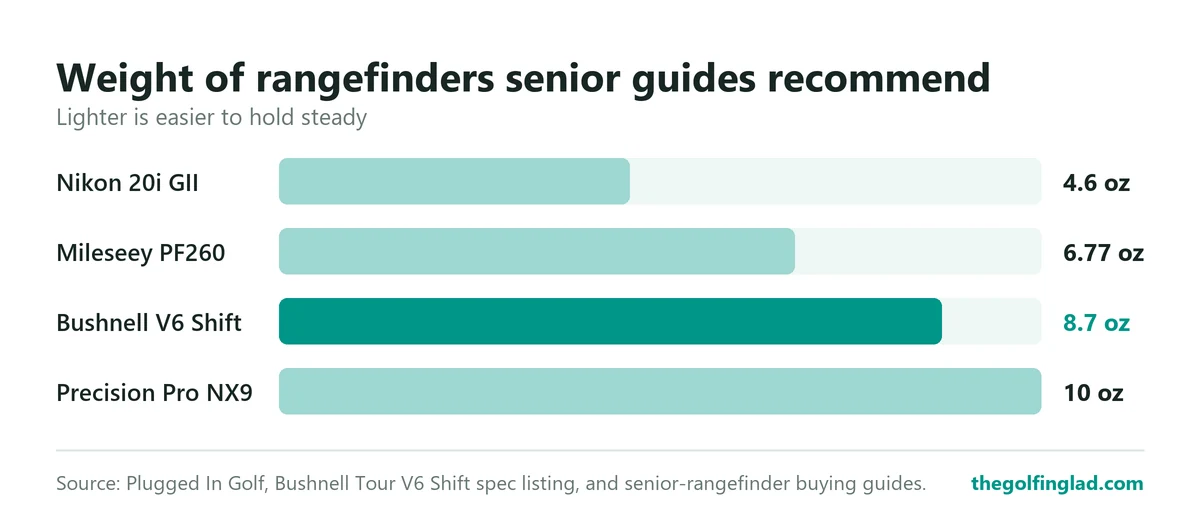
The downsides are plain. It weighs 8.7 oz and it has no image stabilization, so a real tremor still shows in the view.
Golf Insider UK ranks the Tour V6 Shift its best overall pick for shaky hands, and the case is a good one. The buzz tells you when the laser is on the flag, which is the part a tremor makes hard to judge by eye. The guide also says to favour strong pin-seeker technology over stabilization alone.
They give super accurate yardages and are only one of two rangefinders to score 100% on our accuracy test
Golf Insider UK, on the Bushnell Tour V6 Shift, shaky-hands guide
So where does that leave you? If your shake is mild and the real problem is knowing you have the pin, the Bushnell is the smarter spend. If you cannot keep the crosshair on a flag for a second, the Nikon is. The same guide calls the Bushnell expensive, which is fair.

- Slope-Adjusted Distances: This golf rangefinder measures the angle of incline/decline to provide slope-adjusted distances, helping you choose the right club for every shot. An external slope switch allows you to easily toggle slope mode on or off for tournament-legal play.
- Visual Jolt + Pinseeker: A red visual ring flashes and the rangefinder vibrates to confirm when you’ve locked onto the flag, giving you confidence you’re measuring the correct target.
- BITE Magnetic Mount for Easy Access: Stick the V6 Shift securely to your golf cart or any metal surface. Quick, one-handed grabs make this one of the most convenient golf accessories you can own.
- 1300-Yard Range + 6X Magnification: Ultra-clear optics with lightning-fast distance readouts. Locks in on flags from long distances, making it ideal for golfers seeking premium, tour-level golf equipment.
- Patriot Pack: Includes premium case, veteran coin, microfiber cloth, quick-start guide & CR2 battery. Built Bushnell-tough and wrapped in premium style, it's a great golf gift choice.

What’s good
- Vibration confirms the lock, so you stop guessing
- 16 mm eye relief suits glasses wearers
- IPX6 weather resistance and a slope switch
What’s not
- 8.7 oz is not light
- No stabilization for a shaky picture
Best for: golfers who want a clear buzz on lock and a brand with plenty of support. Skip it if: the shake is the real problem.
Best large display: Garmin Approach Z82
Most rangefinders show you a thin red readout. The Garmin Approach Z82 does it differently. It uses a video screen, like a GPS, that reproduces the view through the eyepiece with extra information on top, and reviewers call the full-colour display extremely easy to read.
It also carries about 41,000 courses and picks up where you are on the hole, so you get distances to the front and back of the green without lasering anything. For someone whose eyes struggle with small numbers, that is the point.
It sits in the $500-plus tier. That is a lot to pay for bigger digits, and it is the reason this is not the winner. If you also want a rangefinder-versus-watch answer, our rangefinder vs golf GPS watch comparison covers it.
Read the small print before you commit. Golf Insider UK lists a learning curve, the need to pre-load courses, and a battery you recharge every few weeks. Set that against a CR2 cell that lasts a season, and a laser-only model starts to look restful.
Where the Garmin wins is the screen. If small red digits are what bother you, nothing else in this roundup addresses that, and it does so without asking you to hold a crosshair on the flag for long.
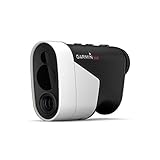
- Most accurate laser range finder on the market within 10” of the flag, up to 450 yards
- Image stabilization makes it easier to find and range the flag for precise distances to the pin; vibrational feedback lets you know when you’ve locked in
- Full-color 2-D CourseView mapping for more than 41,000 courses worldwide overlaid on the viewfinder
- The Laser Range Arc feature draws an arc on the 2-D CourseView map at the distance the laser ranged, so you can see everything in play at that distance
- Hazard view allows you to quickly scroll through each hazard on the map
What’s good
- Full-colour screen that is easy to read
- Course data for roughly 41,000 courses
- Laser plus GPS in one unit
What’s not
- $500-plus price
- No image stabilization, so a trembling hand still shakes the view
Best for: a rangefinder with a large display for older golfers who want maps as well as a laser. Skip it if: you want one number and a quick shot.
Easiest to use: Callaway 300 Pro
The easiest golf rangefinder to use is the one with the fewest decisions in it. Seniors’ guides point to the Callaway 300 Pro for simplicity, and the logic is sound: point, press, read the yardage, put it away.
I have not seen a spec table for this model I would trust enough to quote, so check the listing for weight and range before you buy. What you are buying is the short learning curve. If you have given up on a rangefinder because of menus, this is the type to try.
If you are new to lasers entirely, our guide to easy-to-use rangefinders for beginners covers the same ground.
Simplicity is a spec, even when it is not printed on the box. Each extra mode is another button press between you and a number, and another way to end up in a setting you did not choose. The Callaway’s pitch to older golfers is that there is little to get wrong.
The trade is that I have no source saying it steadies the picture for you, so assume it does not. That makes it a pick for golfers whose hands are steady and whose complaint is complexity, not wobble.

- Precise Slope Measurement: Our highly accurate laser rangefinder accounts for elevation changes and measures the angle of incline/decline, then calculates the slope adjusted distance
- Maximum Magnification: Equipped with 6x magnification, our rangefinders for golfing feature a range of 5-1000 yards with +/- 1 yard accuracy and even measure in both yards and meters
- Pin-Locking Technology: Our precise laser measure with Pin Acquisition Technology (P.A.T.) allows you to lock onto a pin up to 300 yards away
- Pulse Confirmation: Our range finder will emit a short vibrating "burst" when the laser locks onto the pin to confirm you have the correct distance
- External Slope On/Off Switch: Legal for tournament play
What’s good
- Singled out by seniors’ guides for simplicity
- Little to learn before your first round
What’s not
- No stabilization or vibration feedback to rely on
- Check the listing for slope before you buy
Best for: anyone who wants the plainest possible device. Skip it if: your hands shake.
Best lightweight: Acer Pro Golf Rangefinder with Slope Switch
The Acer Pro is named in one roundup as the lightest-weight alternative for older golfers. The listing shows a 1,200-yard range, a slope switch, and pin lock vibration, so the buzz-on-lock idea from Bushnell is here at a lower tier.
Weight matters for a lightweight golf rangefinder for seniors because a unit that is easy to hold steadily is easier to point. It also stays comfortable in a jacket pocket for 18 holes.
The honest limit is that I have no stated weight figure for it from the sources I read. If ounces are your whole reason for buying, compare the listing against the Nikon COOLSHOT 20i GII’s 4.6 oz in the left-out section below.
Here is what pin lock vibration means on the course. You aim at the flag, press, and the unit buzzes when it has the pin rather than the trees behind it. For a golfer who cannot watch a small readout settle, that buzz does the job of a second pair of eyes.
The catch is evidence. It is a newer, lesser-known model with fewer independent tests than the Bushnell or the Nikon, so I cannot point you to an accuracy test. Buy it from a seller with an easy return policy, and check the first few readings against a yardage plate you know.

- [Fast Pin Lock & Precise Reading] No more guessing distances. This golf rangefinder instantly locks onto the flag with pin lock technology and vibrates to confirm, delivering ±0.5-yard accuracy across its full 5 to 1200 yard range. Whether you're a weekend warrior or serious golfer, this golf accessory helps you nail every approach. Trusted by players who demand consistent, tournament-ready precision.
- [7X Clarity with Anti-Shake Tech] Say goodbye to shaky views. 7X magnification combined with Anti-Shake technology delivers steady, crystal-clear images through the built-in transflective LCD screen, so you get precise reading even with unsteady hands. Ideal for men and women golf enthusiasts. A thoughtful golf gift for men and women who value clarity and accuracy on every shot.
- [6-in-1 Rangefinder] Six modes, one compact tool. Toggle between flag lock, slope compensation, horizontal distance, vertical distance, speed measurement, and continuous scan using the M button. Press and hold the M button for 2S to switch between meters (M) and yards (Y). Whether on the fairway or in the field, this golf rangefinder with slope adapts to your needs.
- [Slope Off for Tournament Legal] Compete with confidence. A simple external slope switch lets you turn slope compensation off. Once disabled, no slope info appears on screen, but pin lock and vibration remain active. You'll only see line-of-sight distance, keeping you compliant with tournament rules. Essential for competitive golfers playing sanctioned events.
- [Magnetic & USB-C Tough] Built for convenience. The powerful magnetic stripe keeps your rangefinder securely on your golf cart, keeping it hands-free. Powered by a built-in 750mAh rechargeable battery with USB-C charging, a full charge delivers up to 20,000 measurements. With IP54 waterproofing, this rugged golf accessory for men adapts to multiple environments and is built to last.
What’s good
- Named as the lightest-weight alternative in a seniors’ guide
- Slope switch and pin lock vibration on the listing
What’s not
- Less-known brand, fewer independent tests
- No stabilizer
Best for: golfers who carry everything and count ounces. Skip it if: you want a name with a long track record.
Best budget: Shot Scope PRO L2
The Shot Scope PRO L2 has slope compensation and a built-in magnet, and Breaking Eighty names it the best rangefinder under $150. That is a tidy package for the money.
For a senior golfer on a fixed budget, the magnet is the underrated bit. You stick it on the cart frame and stop fumbling in a bag pocket. For cheaper alternatives see our under $150 rangefinder picks.
It will not steady a tremor and it is not built around big displays. It is a good plain tool at a fair price.
Slope compensation adjusts the distance for uphill and downhill. On a steep approach to an elevated green, the number you play is not the number the laser first reads, and a slope-adjusted yardage saves you from being a club short. Check the listing for whether slope can be switched off before you enter a competition.

- Adaptive slope technology
- Target-lock vibration
- Range 700 yards
- Precision clear lens
- Distances in yards or meters
What’s good
- Slope compensation and a built-in magnet
- Around the $150 mark
What’s not
- No stabilization
- Not marketed on display size
Best for: a first laser on a budget. Skip it if: you need help holding the target steady.
Best set-and-forget: Precision Pro NX9 Slope
Some golfers do not want to charge anything. The Precision Pro NX9 Slope runs on a CR2 battery, and Golfers Authority’s rundown of the NX9 Slope puts that at roughly 50 rounds. For a once-a-week golfer, that is most of a year without a thought.
The rest of the spec sheet is sensible. It has 6X magnification, a range of 5 to 999 yards and a stated accuracy of plus or minus 1 yard out to 400 yards. It can lock a flag from up to 300 yards away, which covers any approach you will face. Pulse vibration confirms the lock, the same idea as Bushnell’s JOLT.
Slope comes off with an external switch, so a tournament does not mean opening a menu. A magnetic grip holds it to the cart. It measures 4.375 inches long, 3 inches high and 1.125 inches deep, and the maker backs it with a 3-year warranty and a 90-day money-back guarantee. That takes some risk out of a purchase you cannot try in a shop.
The catch is weight. At 10 oz it is heavier than the Bushnell Tour V6 Shift at 8.7 oz, and it has no stabilizer. If a heavy pocket annoys you, or your hands shake badly, look higher up the list.

- BUILT FOR THE ESSENTIAL GOLFER: the Honda Civic of rangefinders, everything you need and nothing you don't. Accurate, compact, and simple to use, without the premium-tier price tag. The rangefinder that just gets the job done.
- ACCURATE TO ONE YARD: one press locks the flag from up to 400 yards and gives you a single, confident number. No wondering if you hit the pin or the tree behind it. Just aim, press, and swing.
- SLOPE WHEN YOU WANT IT: turn slope on and the NX9 factors in elevation for a true plays-like distance. Flip it off and you're tournament legal in a flick. One switch, both worlds.
- COMPACT AND READY: at 10 ounces it slips into a pocket and disappears until you need it. The magnetic cart mount snaps to the bar and stays put, even over the bumps. A display sharp enough to read in full sun.
- SIMPLE BY DESIGN: no app, no Bluetooth, no subscriptions to manage. Runs on a replaceable CR2 battery, so there's no charging cable to forget. Water resistant against morning dew and light rain. Pull it out and play.
What’s good
- CR2 battery rated at roughly 50 rounds
- Pulse vibration confirms the lock
- External slope switch and a 3-year warranty
What’s not
- 10 oz is heavy for a pocket
- No image stabilization
Best for: golfers who want a tournament-legal laser that asks nothing of them. Skip it if: ounces or a real tremor are your main concern.
What matters when you buy
Stabilization or flag-lock vibration. One steadies the image, the other tells you when you have the pin. Either beats a plain unit, and Golf Insider UK leans toward the buzz over stabilization alone. Rule: if you can hold the crosshair on a flag for a second, buy the buzz; if you cannot, buy the stabilizer.
Eye relief and glasses. Bushnell lists 16 mm on the Tour V6 Shift, and a Mileseey unit is listed with a 16 mm eyepiece too. Eye relief is how far your eye can sit from the lens and still see the whole view. Rule: if you wear glasses, find the figure before you buy, and walk away from any listing that hides it.
Weight. The numbers I found run from 4.6 oz for the Nikon COOLSHOT 20i GII to 10 oz for the Precision Pro NX9 Slope, with the Bushnell Tour V6 Shift at 8.7 oz. That gap is more than the magnification ever will be. Rule: if it lives in a trouser pocket, stay under about 9 oz; if it lives on the cart, ignore weight.
Display. Every laser here shows a small readout except the Garmin Approach Z82, which uses a colour video screen. Magnification does not fix small digits. Rule: if you already squint at the scorecard, price the Garmin first; if not, any readout will do.
Slope switch. Slope adjusts the distance for uphill and downhill, and the Precision Pro NX9 Slope turns it off with an external switch for tournament play. Rule: buy a unit where the switch is on the outside, not buried in a menu.
Battery. The NX9 Slope runs on a CR2 battery rated at roughly 50 rounds, while the Garmin Approach Z82 recharges every few weeks. Rule: if you forget to charge things, buy a coin-cell laser.
Magnet. A magnet puts the unit on the cart frame, where your hand falls when you step out. Rule: if you ride, make a magnet a requirement; if you walk, it is a bonus.
Worth knowing: if you do not buy a stabilized unit, hold it with two hands, tuck your elbows into your chest and use the flag-lock mode when you have it. It is free, and it helps. More on that in this GolfWRX shaky-hands thread.
On slope, our guide to the best golf rangefinder with slope explains when the switch is worth having. For the whole market, see our ranked list of the best golf rangefinders.
How to hold any rangefinder steadier
Hardware helps, but grip comes first. Golf Insider UK’s advice for shaky hands is two hands with the flag-lock feature engaged, and a firm grip with your elbows bent at about 90 degrees so your arms make a stable base.
- Stand square and tuck both elbows against your chest.
- Bring the unit to your eye rather than leaning toward it.
- Press and hold on the flag until the unit confirms the lock.
- Check the number against the hole before you pull a club.
The same guide suggests a sanity check. Aim deliberately at something behind the flag and note the number. Expect a gap of 10 to 40 yards between that and the flag reading. If the two numbers are close, the laser probably missed the pin.
What we left out and why
- Cobalt Q6. Golf Insider UK calls it the most accurate pick for shaky hands, but also expensive and from a lesser-known brand.
- GolfBuddy Laser Lite. The same guide’s budget pick, with more errors beyond 200 yards and budget build quality.
- Nikon CoolShot Pro II Stabilized. The same guide marks it down for lag between movement and screen update, which is why the PROIII wins instead.
- Nikon COOLSHOT 20i GII. At 4.6 oz it is light and simple to use, but it is a different generation from the stabilized flagship, and I would rather steer shaky-handed readers to the PROIII.
- Bushnell Tour V7 Shift. One seniors’ roundup calls it its top pick, and our Bushnell Tour V7 Shift review covers it in full. The V6 Shift above keeps the same flag-lock buzz.
- Mileseey PF260 Tour. A seniors’ guide lists a 16 mm eyepiece and a 6.77 oz housing with flag-lock vibration. One guide is thin evidence for a recommendation.
Questions older golfers ask
What is the easiest golf rangefinder to use?
A laser with one measurement button, an external slope switch and vibration on lock. The Callaway 300 Pro is the simplest of the seven, and the Bushnell Tour V6 Shift adds the buzz.
Which golf rangefinder is best for shaky hands?
The Nikon COOLSHOT PROIII STABILIZED. Its gyroscope-driven stabilizer holds the image still, and nothing else on this list does that.
Does a bigger magnification help older eyes?
Not much. Both the Nikon and Bushnell are 6x. What helps is a steady view and a clear readout, and the Garmin Approach Z82’s colour screen is the clearest here.
Do I need slope?
If you play hilly courses, yes. Choose a unit with a switch so you can turn it off for competition.
Is vibration on lock enough, or do I need a stabilizer?
If you can hold the crosshair on a flag for about a second, the buzz is enough and it costs less. If the crosshair will not settle, buy the Nikon. For a mild shake, the Bushnell is the better spend.
How do I know the laser hit the flag and not the trees?
Aim at something behind the pin and compare. Golf Insider UK says to expect a gap of 10 to 40 yards between the two readings. If they match, press again.
Which of these needs the least charging?
The Precision Pro NX9 Slope, on a CR2 battery rated at roughly 50 rounds. Golf Insider UK says the Garmin Approach Z82 recharges every few weeks.
The verdict by kind of golfer
- Your hands shake: buy the Nikon COOLSHOT PROIII STABILIZED.
- You want a buzz when the pin locks: the Bushnell Tour V6 Shift.
- You want big, bright numbers and a course map: the Garmin Approach Z82.
- You want the fewest buttons: the Callaway 300 Pro.
- You carry your own bag and count ounces: the Acer Pro.
- You are spending under $200: the Shot Scope PRO L2.
- You never want to think about batteries: the Precision Pro NX9 Slope.
If the picture shakes, pay for the stabilizer. Everything else is a compromise you can live with.
By The Golfing Lad