
Garmin Approach G82 review (2026): GPS first, radar second
As an Amazon Associate I earn from qualifying purchases.
CERTAIN CONTENT THAT APPEARS ON THIS SITE COMES FROM AMAZON. THIS CONTENT IS PROVIDED ‘AS IS’ AND IS SUBJECT TO CHANGE OR REMOVAL AT ANY TIME.
If you buy through links on this page we may earn a commission, at no extra cost to you.
You are standing on the range ten minutes before a round, wondering whether the 7-iron is travelling 150 or 160, and the gadget in your hand is also the thing that will tell you the number to the front of the green on the first hole. That is the whole pitch of the Garmin Approach G82.
Here is the straight answer. Buy it if you want a big-screen course GPS that doubles as a pre-round warmup tool. Skip it if what you want is a proper practice monitor with a deep data set, because the radar side is deliberately basic.
The Garmin G82 is the best handheld GPS Garmin makes for golfers who also want ball speed, club speed, smash factor and tempo before they tee off. It is a better GPS than it is a launch monitor, and it costs like a premium one.
Best for: cart golfers and range-before-round players who want one device for yardages and warmup numbers. Skip it if: you walk with a bag and hate screens, or you want detailed ball-flight data at home.
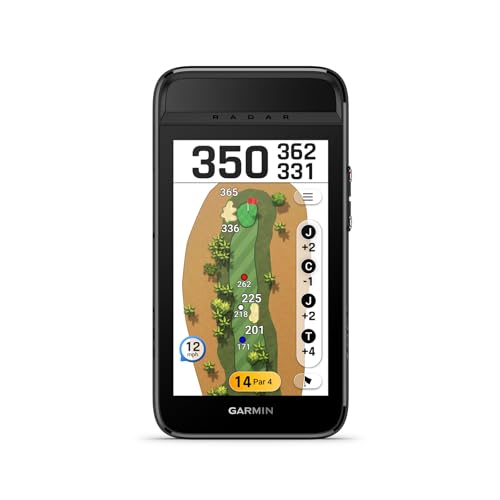

- 5" high-resolution touchscreen display brings 43,000+ preloaded courses to life in the palm of your hand
- Dial in your swing at the range with radar that measures ball speed, club speed, smash factor and swing tempo
- Help improve putting consistency with measured putting stroke length, tempo, and club and ball speed with the integrated launch monitor
- Use bag mapping at the range to evaluate your clubs and know how far you hit with each; data integrates with the virtual caddie feature to help you make informed decisions on the course
- Easily mount the device to your cart with the built-in magnetic mount, or secure it on your bag with the included bag clip accessory

The Garmin Approach G82 is a GPS first
The name says launch monitor, the layout says GPS. Garmin’s own launch announcement calls it the “ultimate pre-round warmup tool that doubles as an intuitive virtual caddie on the course”. Read that twice. Warmup tool first, caddie second.
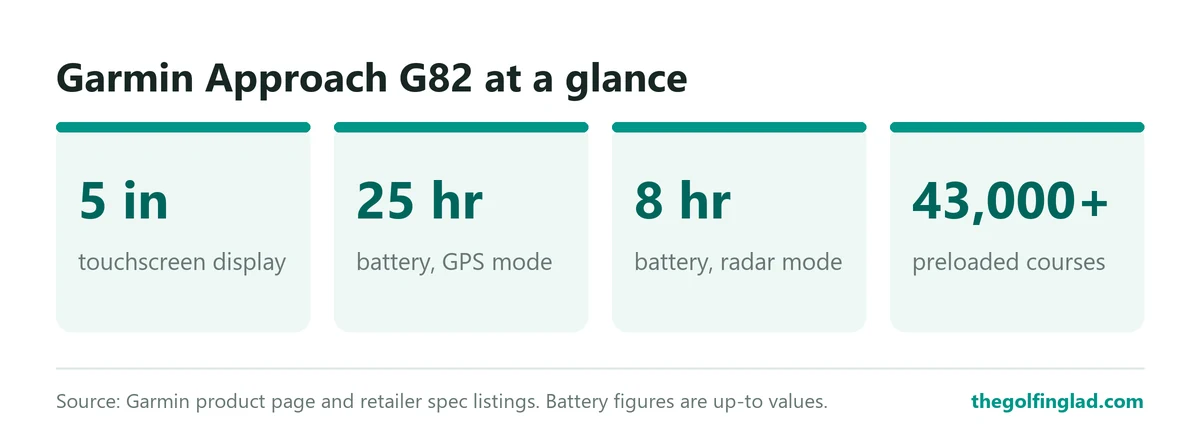
That framing is honest, and it should set your expectations. The G82 is a 5-inch handheld with more than 43,000 preloaded course maps. The radar sits in the same body and switches on when you want it.
If you came looking for a stand-in for a full simulator setup, our guide to simulator versus launch monitor will save you some money. The G82 is not that product.
Garmin Approach G82 vs G80: what actually changed
If you own a G80, the question is whether the upgrade is worth the wait. Reading PlayBetter’s comparison and other reviews, the list is short and useful.
| Feature | Approach G82 | Approach G80 |
|---|---|---|
| Screen | 5-inch touchscreen | 3.5-inch |
| GPS battery | Up to 25 hours | Up to 15 hours |
| Cart mounting | Built-in magnet | Rubber band and clip |
| Putting metrics | Yes | No |
| Bag mapping | Yes | No |
The screen is the headline. A bigger display means a bigger hole map, which on a long par 4 with a dogleg means you can read the layup yardage without squinting at your thumb.
The magnet matters more than it sounds. The G80 relied on a rubber band and clip, and reviewers describe that as cumbersome. The G82 sticks to the cart frame and comes off with one hand.
The core idea has not changed. Both keep the one-button toggle between GPS and launch monitor, and The Golf Shop Online notes the practice and game modes have been expanded since the G80, which makes a solo range session feel more structured.
What the 5-inch screen does for you on the course
Think of a 180-yard approach to a green with a bunker short-right and water behind. On a small screen you get a number. On this one you get the shape of the green, the hazards and the layup options in a single glance, which is what you actually need before choosing a club.
Garmin lists green view, hazard distances and lay-up numbers across the 43,000-plus preloaded courses. The Golf Monthly review was impressed enough by the feature count to say it offers an “Amazing number of features for both on and off-course golf” and rated it highly.
Worth knowing: some of the clever stuff needs extras. Per Garmin, aerial imagery and green contour data need an active Garmin Golf membership, and wind data, PlaysLike distance adjustments and some virtual caddie features need a connected smartphone.
That is the first catch. The device you pay a premium for leans on your phone and a subscription for the smartest course features. The base GPS works without either.
If you already own a laser, the G82 can take its readings. Golf Monthly points out you can link a Garmin rangefinder for precise flag yardages, and Garmin says the Range Relay feature needs a compatible laser rangefinder.
What the radar gives you at the range
The G82’s radar measures ball speed, club speed, smash factor and tempo, and it estimates carry distance. That is the list. There is no spin figure, no launch angle and no dispersion map in what Garmin or the reviewers describe.
For a 10 to 25 handicap that is less of a loss than it sounds. Ball speed and club speed tell you if your good swing is getting good energy into the ball. Smash factor tells you whether you caught it on the face. Carry tells you your real yardage rather than the one you tell your playing partners.
Those four numbers get you most of the way to knowing your gaps. What they do not tell you is why a shot went left.
Garmin quotes accuracy figures for the radar: plus or minus 5 mph on club head speed, plus or minus 2 mph on ball speed, plus or minus 0.3 on swing tempo and plus or minus 5 yards on carry, as listed by retailers such as Abt. The club speed tolerance is the loosest of the lot.
How accurate is the G82 against a proper launch monitor?
Independent comparisons give a consistent picture. In a head-to-head with a Bushnell Launch Pro, Breaking Eighty saw distance differences between 5 and 10 yards, while ball speed was almost identical.
Other write-ups the same week report ball speed typically within 1 mph of dedicated units, short-iron carry within 3 to 5 yards, and longer clubs drifting to 5 to 10 yards off the reference.
Translate that. With a wedge or 8-iron you can trust the carry number to plan a yardage. With a 4-iron or hybrid, treat it as a range of roughly 10 yards, and trust the ball speed more than the carry.
One more thing. It is radar, so the unit needs space behind the ball and a real strike or hit-off-a-mat to give a reading. Do not expect to hit foam balls into a net in your garage and get data you would bet on. If indoor use is the plan, read our list of the best launch monitors under $1000 first.
Putting metrics are the new party trick
This is what the G82 adds that the G80 lacks. Garmin lists stroke length, tempo, club speed, ball speed and consistency tracking for putting, and it pitches the device as a handheld with putting metrics when most rivals have none.
On a practice green this is more useful than it looks. Most amateurs three-putt because their pace is off, and tempo plus stroke length are the two numbers that show it. Put the G82 down behind the ball, roll twenty putts, and see whether your backstroke is the same length on the 30-footer as on the 6-footer.
It will not read the break for you, and it is not a green reader. It is a way to grade your stroke while you practice. For a device in your pocket anyway, that is a fair bonus.
Built for a wet bag and a long day
Garmin’s manual rates the G82 at IPX7, which it defines as withstanding incidental water exposure up to 1 metre for 30 minutes. That means a soaked bag pocket and a drizzly back nine are fine. It does not mean you should drop it in the pond to retrieve a ball.
The operating range runs from -20°C to 60°C (-4°F to 140°F), so a hot car boot in August is not the end of it. The owner’s manual also gives the charging window as 0°C to 45°C, so charge it indoors rather than in a freezing garage.
Battery is where it pulls clear of the G80. You get up to 25 hours in GPS mode, which Garmin says varies with cold, and up to 8 hours with the radar running. In plain terms, five or six rounds of GPS between charges, and a range session with plenty to spare.
Charging is by USB-C, so the cable that charges your phone will do.
The weight problem
This is not a small device. The listed size is 3.3 by 6.3 by 0.9 inches, and it weighs 10.9 oz (308 g). Put that on a clip on a stand bag you carry across hills and you will feel it.
Golf Monthly’s reviewer said bluntly that it is better suited to cart users than walkers, and said “Looking at a screen as I walk during my rounds isn’t my favorite thing to do”. The bag clip is included, and so is the magnet, but the bulk is real.
Quick specs
| Spec | Approach G82 |
|---|---|
| Display | 5-inch color touchscreen, 480 x 800 pixels |
| Size and weight | 3.3 x 6.3 x 0.9 in, 10.9 oz (308 g) |
| Battery | Up to 25 hours GPS, up to 8 hours radar |
| Water rating | IPX7 |
| Preloaded courses | 43,000+ |
| Radar metrics | Ball speed, club speed, smash factor, tempo, estimated carry |
| Stated radar accuracy | Carry +/- 5 yd, ball speed +/- 2 mph, club speed +/- 5 mph |
| Charging | USB-C |
What’s good
- The 5-inch screen makes hole maps and green views easy to read in a glance.
- Up to 25 hours of GPS battery covers several rounds between charges.
- The built-in magnet mounts it on a cart without clips or elastic.
- Putting metrics are a genuine addition that the G80 never had.
- Ball speed readings hold up well against dedicated monitors in independent comparisons.
What’s not
- It sits in the $600 tier, a lot for a device whose launch data is basic.
- At 10.9 oz it is heavy to carry on a stand bag.
- Aerial imagery and green contours need a Garmin Golf membership.
- Wind data, PlaysLike and some caddie features need a phone connection.
- Longer clubs can read 5 to 10 yards off a reference monitor.
What buyers and reviewers keep saying
Looking at a screen as I walk during my rounds isn’t my favorite thing to do
Golf Monthly’s G82 review
That one line captures the split. People who ride, or park a bag on a push cart, love the size. People who walk and carry say the bulk and the screen-staring are not for them.
The praise is just as consistent. Reviewers talk up quick switching between GPS and radar, immediate data and strong battery. The knocks are weight and a limited set of metrics.
Early user comment is gathering on forums, including a GolfWRX thread on the launch, if you want to read the argument yourself.
Who should buy it, and the alternatives
Buy the G82 if you drive a cart or push a trolley, you hit balls for ten minutes before every round, and you want one device to stop carrying a phone and a separate GPS. Buy it if you are on a G80 and the screen and battery already annoy you.
Skip it if you walk with a stand bag, if you want spin and launch angle, or if you mainly practise at home. A few alternatives are worth a look.
- The Garmin Approach R10 is the dedicated launch monitor option, covered in our R10 review, with no on-course GPS role.
- The Rapsodo MLM2PRO, reviewed in our MLM2PRO review, is built for practice data and simulator use.
- Our ranking of the best golf launch monitors for 2026 shows the field if you want to compare more than two options.
Where it loses to the R10
The G82 loses to a dedicated unit on what it is for. The R10 exists to give you practice data and a session you can review. The G82 gives you four radar numbers and an on-course GPS you will use every round.
If you spend more time on the range than on the course, the R10 is the one to look at. If you play more than you practise, the G82 earns its space.

- This Bundle Contains: 1 Garmin Approach R10, Portable Golf Launch Monitor, Take Your Game Home, Indoors or to The Driving Range, Up to 10 Hours Battery Life + 1 Signature Series Microfiber Cloth + 1 Signature Series 5000mAh Portable Power Bank with Wall Charger and Car Plug Adapter
- Work to improve your game at home, indoors or on the driving range with a portable launch monitor. Track key metrics when paired with a compatible smartphone with the Garmin Golf app to help better your shot consistency, including club head speed, ball speed, swing tempo, ball spin, launch angle and more
- Enjoy more time on the range with up to 10 hours of battery life. Understand your golf strengths and areas for improvement by using training mode, which tracks stats for each club and shows a shot dispersion chart based on estimated ball flight using the Garmin Golf app
- You are up to three other golfers can likely play your own home course or even a course you're going to play on your next trip with virtual rounds for more than 42,000 worldwide courses. See and analyze your own swing with automatically recorded video clips that include the metrics of that swing when paired with a compatible smartphone with the Garmin Golf app
- Included phone mount easily attaches to a golf bag for better viewing and easier interaction with the Garmin Golf app. With an active subscription and the Garmin Golf app, play virtual rounds on over 42,000 courses around the world and take part in a weekly tournament with scores posted to our global leaderboard
Is the G80 the smarter buy?
If you find a G80 at a clear discount and you ride a cart, take it. Most of what you get from the G82 is a bigger screen, a magnet and a longer battery. The radar itself is the same idea.
If you walk, the G80 is smaller. But if you want putting metrics, the magnetic mount or 25 hours of GPS, the G82 is the buy. I would go G82 unless the G80 saves you real money, because the larger screen is what you look at on every single hole.
Buyer questions
Is the Garmin G82 a real launch monitor?
It is a radar launch monitor with a short metric list: ball speed, club speed, smash factor, tempo and estimated carry. For range warmups it works. It is not a replacement for a full data unit.
Does the G82 work as a handheld GPS without a subscription?
Yes, the preloaded 43,000-plus courses work on the device. Aerial imagery and green contours need a Garmin Golf membership, and some features need your phone.
Is the G82 waterproof?
It is rated IPX7, per the manual, so rain and a wet bag are fine. Do not go swimming with it.
Does it track my shots automatically?
Only with the optional Approach CT10 club sensors, which Garmin sells separately.
Can I use the G82 handheld GPS with a rangefinder?
Yes. Garmin says the Range Relay feature needs a compatible laser rangefinder, and Golf Monthly notes that you can link a Garmin rangefinder for precise flag yardages.
The verdict
The Garmin Approach G82 is a very good handheld GPS with a useful radar tucked inside. If you ride, warm up before you play and want one screen for both jobs, buy it. If you walk with a bag or want deep practice data, look at a dedicated monitor instead. You can compare it against the field here or see today's price.
Best for: cart golfers who warm up on the range. Skip it if: you carry your bag or want spin and launch angle.
How we rated it
This is a research-based review. The rating draws on Garmin’s published specs and owner’s manual, named third-party tests from Golf Monthly, Breaking Eighty and others, and what reviewers and early users report. No one at The Golfing Lad has used the G82 on a course or range, and none of this is a hands-on claim.
By The Golfing Lad
One thought on “Garmin Approach G82 review (2026): GPS first, radar second”
Comments are closed.