Do it yourself golf hitting net (2026): build it to last
As an Amazon Associate I earn from qualifying purchases.
CERTAIN CONTENT THAT APPEARS ON THIS SITE COMES FROM AMAZON. THIS CONTENT IS PROVIDED ‘AS IS’ AND IS SUBJECT TO CHANGE OR REMOVAL AT ANY TIME.
If you buy through links on this page we may earn a commission, at no extra cost to you.
You have a spare wall in the garage or a strip of lawn, a pile of range balls, and a feeling that a hundred-dollar pop-up net is a rip-off you could beat with a trip to the hardware store.
Often you can. But the money is all in the netting, and that is where most homemade builds go wrong.
Short answer: A DIY golf hitting net is worth building if you have a fixed spot and an afternoon. Use a frame of 1-inch EMT conduit or thick-walled PVC, buy knotted nylon netting sold for golf impact (#18 or #21 twine), hang it loose, and add a baffle panel in front. Skip fishing net, drop cloths and generic sports netting. If you need to pack it away after every session, buy a pop-up instead.
What a homemade golf practice net really costs, and what fails
Forum builders have been doing this for years, so there is a decent record of what held up and what did not. Here are the builds worth learning from, with the figures their owners posted.
| Build | What went in | Cost posted | How it held up |
|---|---|---|---|
| Poolside T-frame | 1-1/2 PVC, 10 x 15 ft impact-grade 3/4 netting, nylon rope, eye bolts | Under $100 for netting, under $60 for hardware | Works; range balls sometimes bounce off the frame |
| Cheap online “golf” net | Turned out to be fishing net | Not given | Fine for about a month, then 3 holes |
| Hardware-store drop cloth | Canvas sheet | Around ten dollars | Ripped after 30 shots, and loud |
| European golf net, 4 x 3 m | 1.8 mm thick netting, 20 mm mesh | About €100 | 2,000 shots with all clubs, no damage reported |
| Garage bed cover | King-size comforter on ceiling hooks | Not given | Later swapped for a proper impact screen |
The pattern is plain. The frame is cheap and forgiving. The thing that stops the ball decides whether your build lasts a season or a weekend. The poolside build comes from a Sand Trap thread on DIY nets; the fishing net, drop cloth and European net come from a Golf Simulator Forum thread on cheap nets.
The rule: spend your money on netting and save it on the frame.
The netting is the whole project
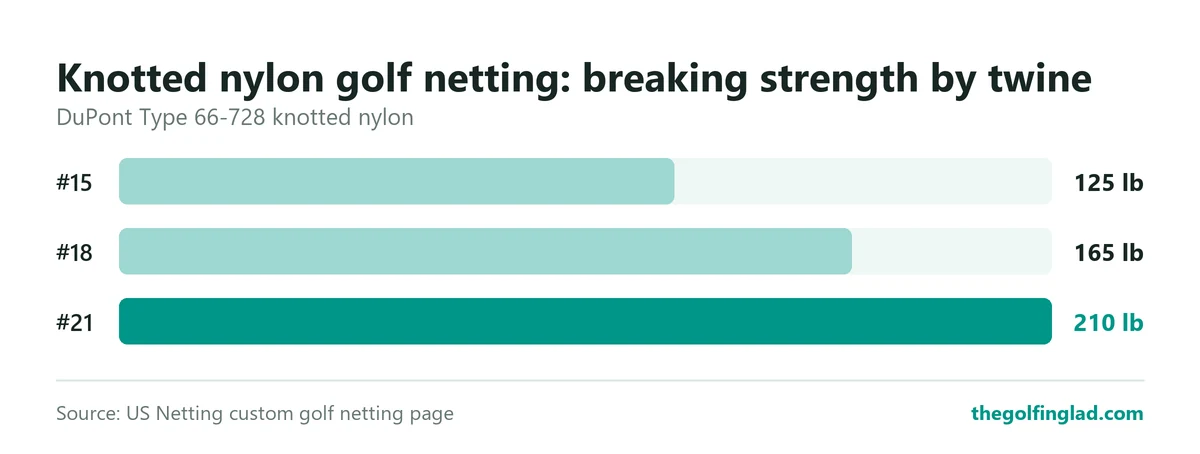
Golf netting is graded by twine number. US Netting’s custom golf netting page lists three weights of DuPont Type 66-728 knotted nylon: #15 at 125 lb breaking strength, #18 at 165 lb, and #21 at 210 lb. The #18 comes in 1-inch mesh; the #15 and #21 in 3/4-inch.
Both mesh sizes stop a golf ball. What separates the grades is how long the knots survive thousands of strikes.
The same page says square mesh “has a more rigid structure and is ideal for impact netting,” while diamond mesh, which has more give, suits perimeter netting. For the panel your ball hits, buy square.
Why does the cheap stuff fail so fast? An owner who has run screens and nets for years put it best.
It’s not the impact as much as it is the spin of the ball tearing the threads of the net.
tlhammond5, Golf Simulator Forum
That is why a fishing net that “looked pretty strong” lasted a month. Fishing net is made to hold a fish, not to take a spinning golf ball in the same spot every session.
The rule: buy knotted nylon sold as golf impact netting, #18 or heavier, square mesh. If the listing does not give a twine number and breaking strength, keep scrolling.
How to build a golf hitting net cage that stands up
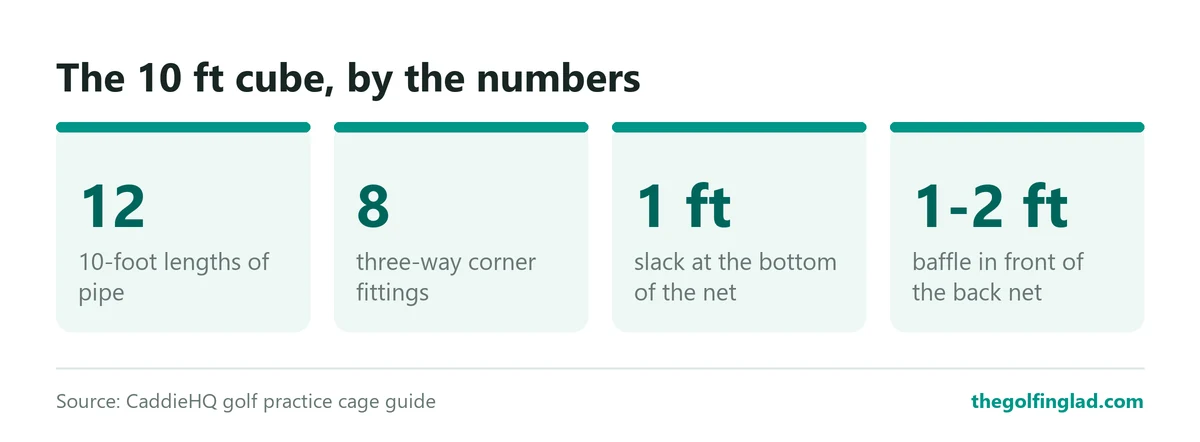
The standard DIY golf net is a 10 x 10 x 10 ft cube. CaddieHQ’s cage guide gives the parts list, and it is short:
- 12 lengths of 10-foot pipe: EMT conduit in 1-inch or 1.5-inch, or Schedule 40 or 80 PVC to cut down on sag
- 8 three-way corner fittings, plus 2 four-way tees if you want a centre roof bar
- A main net of at least 10 x 10 x 10 ft, hung over the top, back and both sides
- A smaller heavy baffle net, around 6 x 8 ft, hung in your line of fire
- Ball bungees or heavy zip ties, a pipe cutter, a step ladder and a helper
Build the floor square first with the fittings loose, stand the four uprights, then lift the roof square on with your helper. Drape the net top panel first and clip it every 12 to 18 inches.
EMT or PVC
Go with 1-inch EMT if the cage lives outside. Corner kits sold for golf cages are mostly made for 1-inch EMT, and the galvanised pipe shrugs off weather. PVC is lighter and easier to cut, but CaddieHQ calls it the least durable option, and a Sand Trap member warned a ball could crack it.
Worth knowing: corner fittings are where pipe builds go wrong. Some kits are sized for 1-inch EMT, others for 1-3/8-inch outside-diameter galvanised pipe. Measure the fitting against the pipe you are buying before you leave the store.
Hang it loose, not tight
This is the mistake almost everyone makes on day one. A drum-tight net sends the ball back at your shins.
Let the bottom edge of the netting pool on the ground with about a foot of slack.
CaddieHQ
Then hang the baffle 1 to 2 feet in front of the back net. It soaks up the strike, protects the main net from the same spot taking every ball, and gives you something to aim at.
The rule: EMT outside, thick PVC in a garage, and always about a foot of slack at the bottom.
Distance, ceilings and the shank you forgot about
Size the cage around your worst swing, not your best one. CaddieHQ says not to go below 8 feet in any direction and to aim for a 10-foot garage ceiling, since 8 feet is usually too low for a driver. Take a slow practice swing with the driver under the roof before you buy anything.
Where you stand matters too. US Netting’s impact netting page puts the net 5 to 10 feet in front of the hitting position. If you are hitting driver from only 8 to 10 feet away, it suggests a second panel 3 to 6 inches behind the first.
The outdoor version comes with its own line from CaddieHQ: “measure the distance and imagine your worst shank – then add another 20 feet.” Keep the open side well away from windows, cars and the neighbour’s fence.
The rule: 10 feet of headroom for the driver, net 5 to 10 feet away, double the panel if you are hitting from close range.
Do not forget what you are standing on
A homemade net does nothing for your wrists and elbows. Hitting off bare concrete in a garage or chewing up the lawn is how winter practice ends early. One Sand Trap builder paired his net with a Real Feel mat, and that is the mat we would put under any DIY cage.
The 3 x 5 ft Country Club Elite is the size that fits a 10 ft wide cage with room to spare. Our golf hitting mat rankings cover the cheaper options if this is more than you want to spend.

- REALISTIC FAIRWAY FEEDBACK: Dense turf fibers let the clubhead move down and through the surface, helping golfers recognize fat contact and develop more consistent ball striking without the unwanted bounce of harder practice mats
- TAKES A REAL TEE: Insert a wooden or plastic tee directly into the turf to practice drives at your preferred height. An adjustable plastic tee is also included for a convenient alternative
- STABLE PRACTICE SURFACE: Commercial-grade base stays secure underfoot and cushions impact during extended practice, creating a comfortable and dependable surface for full swings
- BUILT FOR REPEATED USE: Durable nylon fibers resist wear while maintaining consistent feel and performance through regular practice with drivers, woods, irons, and wedges
- 3 FT X 5 FT SIZE: 5' length enables the user to practice every club in the bag including a full driver swing on a single continuous surface. Ideal for home simulators, teaching studios, driving ranges, and commercial facilities.
When to build, and when to just buy the net
Not every golfer should build one. A buy-or-build thread on Golf Simulator Forum came down firmly on building for a full enclosure, with one member writing that you “will be shocked at how much you can save doing it yourself vs buying the enclosure with screen.” That holds when you have a fixed bay.
It holds less for a backyard net you pull out on Saturday and pack away on Sunday. A 10-foot pipe cube does not fold into a car boot.
If that is you, a pop-up like the GoSports net, listed with a 10 x 7 ft hitting area, is the cheaper way to the same practice. Our roundup of practice nets under $100 covers it alongside its rivals.

- PERSONAL DRIVING RANGE: Improve your swing both indoors or outdoors with this portable at-home golf hitting net (mat not included)
- DESIGNED BY GOLFERS: Beware of other golf equipment made by foreign companies with no real golf experience; The GoSports golf net was designed in the US and is made by golfers for golfers
- CONVENIENT BALL RETURN: Incredibly durable reinforced nylon net with innovative golf ball return feature for added convenience and increased golf swing practice time; No more chasing balls
- QUICK ASSEMBLY: Lightweight yet sturdy build for easy setup/breakdown that gives you the freedom to practice anywhere, anytime
- COMPACT STORAGE: Fits inside the included carrying case for storing neatly when not in use; Great alternative to permanent setups that otherwise require you to sacrifice your garage space, basement, or backyard

Our call, by the kind of golfer you are
Build it if you have a garage bay or a corner of the yard where the cage can stay up, you hit balls three or more times a week, and you plan to add a launch monitor later. Buy 1-inch EMT, #21 square-mesh impact netting, and a baffle panel. For scale, the poolside builder above kept his netting under $100 and his hardware under $60.
Buy a pop-up if you practise twice a month, share the space with a car, or need to pack it away. A hundred-dollar-class net will do more for your game than a half-finished cube in the shed.
Do not build at all if your ceiling is under 9 feet and you want to hit driver indoors. Hit wedges into a chipping net and putt instead; a good putting mat from our best putting mats guide will save you more shots than a cramped cage ever will.
Questions buyers ask
Can I use a tarp or blanket instead of netting?
For a few sessions. One forum builder’s ten-dollar drop cloth ripped after 30 shots and was louder than his club strike. A heavy blanket behind real netting is fine; on its own, it will not last.
Is archery netting good enough?
It is common as a backing layer. CaddieHQ lists golf impact or archery netting rated for ball speeds over 100 mph. Forum owners still debate whether archery netting alone stands up to full driver swings, so use it behind a golf-rated panel, not instead of one.
How should I fix the net to the frame?
Ball bungees, every 12 to 18 inches. They give a little on impact, which is what you want. Zip ties work but hold the net tighter than ideal.
Will balls bounce back at me?
From a tight net, yes. Leave about a foot of slack at the bottom and hang the baffle in front. Range balls can also bounce off a bare frame, so keep your target well clear of the pipes.
The verdict
A DIY golf net is a good project for a golfer with a fixed spot and a few free hours, and a poor one for anyone who needs to pack it up after every session. Build the frame cheap, buy proper knotted impact netting, hang it loose with a baffle in front, and put a real mat under your feet.
If you would rather skip the conduit cutter entirely, start with our best golf practice nets for 2026, and see our guide to building a golf practice area at home for the rest of the setup.
By The Golfing Lad
One thought on “Do it yourself golf hitting net (2026): build it to last”
Comments are closed.