
Callaway Supersoft review (2026): soft, straight, low on spin
As an Amazon Associate I earn from qualifying purchases.
CERTAIN CONTENT THAT APPEARS ON THIS SITE COMES FROM AMAZON. THIS CONTENT IS PROVIDED ‘AS IS’ AND IS SUBJECT TO CHANGE OR REMOVAL AT ANY TIME.
If you buy through links on this page we may earn a commission, at no extra cost to you.
You catch a 7-iron flush, it lands on the green, and it trundles off the back. If that is the shot that annoys you most, the Callaway Supersoft is the wrong ball. If the one that annoys you most is the slice into the trees, keep reading.
The short version of this Callaway Supersoft review: buy it if your driver swing is under about 90 mph and you want a soft, straight, low-cost ball you will not mourn when it finds the pond. Skip it if you swing faster than that, or if you want wedges that bite.
A two-piece ball that does one job well: it keeps slower swings in play and feels soft doing it. It is not the longest ball in its price band and it does not stop quickly on the green. At this money, for this golfer, that trade is fair.
Best for: swings under 90 mph, slicers, seniors, newer golfers who lose a few a round. Skip it if: you swing over 95 mph, play firm greens, or want every ball in the box to feel identical.


- Increased Ball Speed with Soft Feel. The HyperElastic SoftFast Core is engineered for faster driver and iron speed, with soft greenside feel.
- Exceptional Feel, Control and Spin with Long Distance. Supersoft’s Hybrid Cover combines maximized distance with soft feel and durability.
- Greenside Spin and Control. New cover system for enhanced control on approach shots and short game shots.

What changed from the 2023 ball, and what it changes for you
The current Supersoft arrived in January 2025. Callaway’s product page names two parts: a HyperElastic SoftFast Core and what it calls a Hybrid Cover with a “new cover system”.
The core is the real story. Golfbox’s launch write-up says it was adapted from the core in the Chrome Tour range and makes more speed at the same compression, and that the multi-material cover adds grip around the green.
On the course that means the 2025 ball is meant to be a touch quicker off the driver without getting firmer. It does not turn the Supersoft into a spin ball. Callaway also held the launch price where the old one sat, according to California Golf News, so you are not paying for the update.
How soft is it really? The number on the shelf tag is out of date
Retailers still quote 38 compression. That figure dates from the 2014 launch, and Callaway’s own page for the current ball gives no compression number at all.
The gauges say firmer. BallCaddie’s review lists it at 49 in its catalogue and cites a 2026 MyGolfSpy Ball Lab report with an average of 44 and a spread from 40.3 to 53.8.
Still very soft. A Titleist TruFeel measures around 70 and a Srixon Soft Feel about 58, so the Supersoft remains the squashiest of the big-brand cheap balls. You will feel that most on the putter and on chips, where it comes off the face quietly.
Worth knowing: soft does not mean slow-swing magic. A low-compression ball feels nicer at 85 mph, but the same BallCaddie review notes some golfers find it mushy on well-struck irons above 90 mph, with less feedback on long putts.
Off the tee: straight first, long second
This is where the marketing and the data part company. Callaway talks about faster driver speed. In the 2026 robot test BallCaddie reports, the Supersoft was the slowest ball off the driver at both 86 mph and 116 mph, with the shortest carry of 48 balls at 86 mph.
Before you close the tab: the gaps are small. At 86 mph the Supersoft went 227.8 yards against 231.1 for the Srixon Soft Feel. Three yards. That is the difference between a 7-iron and a slightly easier 7-iron.
What you get back is low driver spin and a high launch. Low spin means less sidespin too, which is why a fade that used to finish in the right rough has a better chance of finishing in the right half of the fairway.
Under 90 mph you’re trading a yard for straighter drives.
BallCaddie’s Callaway Supersoft review
A human test tells the same story from the fast end. National Club Golfer’s Jack Backhouse, a PGA member, recorded 154 mph ball speed, 2,500 rpm of spin and 265 yards of carry with driver, 283 yards total. His conclusion was that the ball suits driver swings under 100 mph.
Irons fly high, then roll
Backhouse’s 7-iron averaged 116 mph ball speed with about 5,200 rpm of spin. He flagged that mid-iron spin as a touch low, the kind that costs stopping power if you rely on spin to hold a green.
Translate that to a 150-yard approach over a bunker. The Supersoft gets up easily, which helps you carry the sand. Then it lands and runs a few paces. Aim for the front third and let it release, and it is a perfectly playable ball. Fly it pin-high to a back flag and you are chipping back.
Around the green it releases, so plan for it
The reviews split here. Backhouse measured about 6,700 rpm with a 58-degree wedge at roughly 30 degrees of launch and listed short-game performance as a strength for the price. BallCaddie is blunter and calls greenside spin low, with a cover that lets the ball release on firm greens.
Both can be true. For a two-piece ball in the budget tier, it is decent. Beside a urethane ball such as the one in our Callaway Chrome Soft review, it is a bump-and-run ball. If your short game is already chip-and-roll, you lose nothing.
Quality control is the uncomfortable bit
The Ball Lab report gave the Supersoft a score of 74, a C grade and a “Not Recommended” verdict. Three of the 36 balls checked were flagged as bad, and the compression spread across the sample was 13.5 points.
In plain golf: two balls from the same sleeve can feel a little different off the putter. Will a 20-handicapper see that on the scorecard? I doubt it. A single-figure player chasing consistency should care, and should be looking at a different shelf anyway.
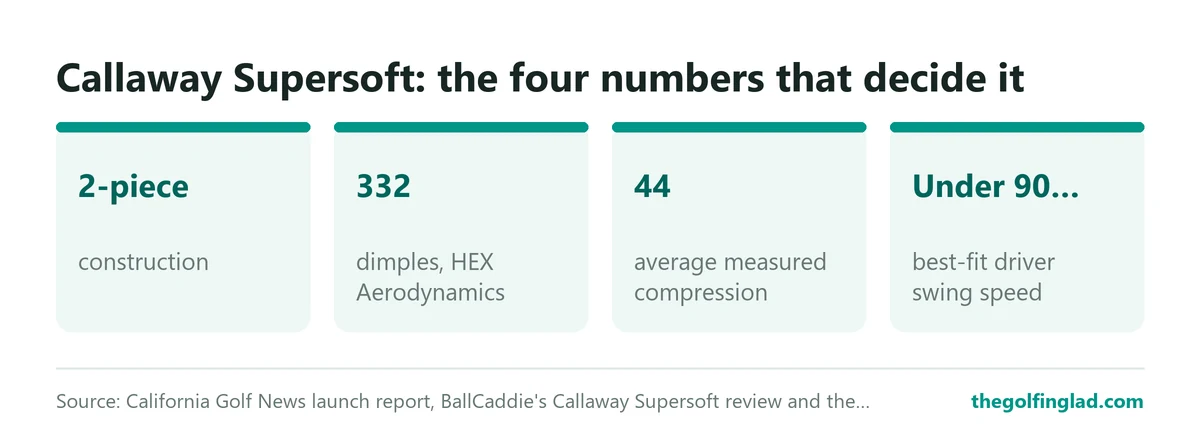
Callaway Supersoft specs at a glance
| Spec | Callaway Supersoft (2025) |
|---|---|
| Construction | 2-piece |
| Core | HyperElastic SoftFast Core |
| Cover | Hybrid Cover |
| Dimples | 332, HEX Aerodynamics pattern |
| Compression | Not published by Callaway; 44 average in Ball Lab, range 40.3 to 53.8 |
| Flight | High launch, low driver spin, low greenside spin |
| Best fit | Driver swings under 90 mph |
| Launched | January 2025 |
| Rules status | On the USGA conforming ball list |
What’s good
- The softest feel among the big-brand budget balls, on the gauge as well as the label
- Low driver spin and a high launch keep a slower swing’s misses closer to the fairway
- Wedge spin that a named tester rated good for the price
- Plenty of colours, including matte and splatter finishes, so you can find it in the rough
What’s not
- Slowest ball off the driver in a 48-ball robot test at both 86 mph and 116 mph
- Approach shots and chips release on firm greens
- Ball Lab found a 13.5-point compression spread and three bad balls in 36
- Can feel mushy on crisp iron strikes once your swing passes 90 mph
What a tester and a rival’s player say about it
Considering the price and the target audience you will do well to find a better golf ball for everyday use.
Jack Backhouse, National Club Golfer
That is the case for the Supersoft in one line, and it comes with a condition attached: Backhouse recommends it to club golfers with a moderate swing speed, as an everyday ball at a budget price.
The complaints come from golfers who have outgrown it. On Titleist’s own player feedback page one golfer describes the Supersoft as marshmallow soft, and he does not mean it kindly. If you already suspect it is too soft for you, it is.
Buy it if, skip it if
- Buy it if your driver swing is under 90 mph and your big miss is a slice.
- Buy it if you lose three or four balls a round and refuse to pay tour-ball money for the privilege.
- Skip it if you swing over 95 mph. You are compressing it too easily and giving away speed.
- Skip it if your home greens are firm and you play high wedge shots that need to stop.
If you are in that second camp and still shopping on a budget, MyGolfSpy’s piece on Supersoft alternatives points to the Kirkland Performance+ for higher ball speed and much more short-game spin. Our list of the best golf balls under $30 covers the rest of the cheap shelf.
Three alternatives worth your money instead
Most people who walk away from the Supersoft do it for one of two reasons: they want a few more yards, or they find it too soft. All three balls below sit in the same under-$30 tier, so this is a choice about feel and flight, not budget.
| Supersoft | TruFeel | Soft Feel | SpeedSoft Ink | |
|---|---|---|---|---|
| Build | 2-piece | 2-piece | 2-piece | 2-layer |
| Dimples | 332 | 376 | 338 | 322 |
| Compression | 44 measured | About 70 | About 58 | Under 50 |
| Suits | Under 90 mph, softest feel | Under 95 mph, wants distance | 80 to 95 mph, middle ground | Soft feel, loud looks |
| The catch | Shortest at slow speed | Flat drives, low wedge spin | Short at faster speeds | Thin independent data |
Titleist TruFeel: the like-for-like rival with more run
The TruFeel is Titleist’s lowest-compression ball: a two-piece design with a TruTouch core, a 3.0 TruFlex ionomer-blend cover and 376 tetrahedral dimples, in white or yellow. BallCaddie’s TruFeel review puts its compression around 70, which is firmer than the Supersoft by a distance, and its fit at driver speeds under about 95 mph.
It costs about the same. Where it wins is total distance: fourth of 48 balls at both 86 mph and 102 mph in the 2026 robot test, while the Supersoft brought up the rear at 86 mph. Where it loses is feel, and it is no better around the green, ranking 41st of 48 for spin on a 35-yard pitch.
Take it over the Supersoft if you want yards and a firmer click. The catch is a flat driver flight, so it will not help you carry a fairway bunker.

- For players who prioritize soft feel and who trust the Titleist brand.
- Long distance and soft feel from a new TruTouch core
- Low penetrating ball flight from unique 376 tetrahedral dimple design
- Increased greenside spin and control from a softer 3.0 TruFlex cover
- Ultra-soft feel
Srixon Soft Feel: the middle ground for 80 to 95 mph swings
The current Soft Feel launched in February 2025 as the 14th generation. It is a two-piece ball with an ionomer cover, 338 dimples and Srixon’s FastLayer core, which is soft in the centre and firmer toward the outside. BallCaddie lists it at about 58 compression and fits it to driver swings of roughly 80 to 95 mph.
Price is about the same, a shade under the Supersoft at list. At 86 mph it went 231.1 yards to the Supersoft’s 227.8, and its greenside spin is rated moderate against the Callaway’s low. That is a small win in both places that matter.
Take it if the Supersoft sounds too squashy but you still want soft. The catch: at 102 mph the Supersoft went farther, 288.1 yards to 283.8, and the Soft Feel had the shortest carry of the 48 balls at that speed.

- Soft Without Compromise: If feel is what matters most to you, play Soft Feel for maximum all-around performance. Soft Feel technology provides responsive feel for excellent control from tee to green.
- Increased Distance: Engineered for maximum distance with a high-energy core that boosts ball speed, ideal for golfers seeking longer drives.
- Low Compression: Perfect for golfers with slower or medium swing speeds, delivering a soft feel and easy launch for improved accuracy and control.
- 338 Speed Dimple Pattern: Speed dimples reduce drag at launch increase lift during descent. The soft thin cover provides less spin off the driver but more greenside spin and a softer feel on pitches, chips, and putts.
- Affordable Performance: Offering premium features at an exceptional value, the Soft Feel golf balls deliver great performance without the premium price tag.
TaylorMade SpeedSoft Ink: the same idea with a paint job
TaylorMade’s answer to the Supersoft is a two-layer ball with a PWRCORE, an ionomer cover and a 322-dimple Extended Flight pattern, according to Academy’s listing. It is described as sub-50 compression, which puts it in the same very soft bracket as the Callaway rather than up with the TruFeel.
The Ink part is the splatter finish. That sounds like a gimmick until you are looking for a white ball in white daisies. It sits in the same price band as the Supersoft, sometimes a little under.
Take it if you want Supersoft-style softness and prefer TaylorMade’s look. The catch is evidence: I found no robot or lab numbers that set it beside the Supersoft, so this is a pick on spec and visibility, not on proven performance. On a tight budget I would take the Srixon first.

- HIGH VISIBILITY INK DESIGN – Features a paint splattering design that’s distinctive and easily stands out from the competition. It’s for the golfers who believe the same old same old, just ain’t cutting it.
- ULTRA-SOFT FEEL – SpeedSoft is engineered with a low-compression core to deliver a soft feel while maintaining responsive performance.
- MAXIMUM DISTANCE – The SpeedSoft construction is designed to generate fast ball speeds for distance off the tee and throughout the bag.
- FORGIVING EVERYDAY PERFORMANCE – A low-compression design helps deliver a comfortable feel on a wide range of shots.
- NEW PWRCORE - A low-compression PWRCORE delivers explosive speed will still delivering a soft feel on iron shots and around the green.
Is the 2023 Supersoft the smarter buy?
No. Buy the 2025.
The 2023 ball was a full redesign and a good one, and MyGolfSpy’s Ball Lab measured it at an average compression of 47, so the feel is close. But the two generations sit in the same price band, and the newer core is claimed to be faster at the same softness. Paying the same for the older one makes no sense.
The only exception is a proper clearance. If a shop is dumping 2023 dozens well below the current ball, fill your boots. You will not notice the difference by the fourth hole.

- HyperElastic SoftFast Core Delivers Increased Ball Speed with Soft Feel
- Optimized for faster speed and soft feel around the green.
- Exceptional Feel, Control and Spin with Long Distance From Our Hybrid Cover
- Allows us to create more wedge control while still maximizing distance, very soft feel, and durability.
Questions buyers ask
What swing speed is the Callaway Supersoft for?
Under 90 mph with the driver is the sweet spot, and it stays sensible up to about 95 mph. Callaway does not publish a figure. National Club Golfer puts the ceiling at 100 mph, which I think is generous.
Is the Supersoft really 38 compression?
Not on a gauge. The 38 figure goes back to the 2014 launch. The 2026 Ball Lab sample averaged 44, with individual balls from 40.3 to 53.8.
Is it legal in competitions?
Yes, it is on the USGA conforming ball list. Check your exact colour version before a tournament, as each one is listed separately.
Is it a good ball for a mid handicapper?
For a mid handicapper with a slower swing, yes. If you are a 12 who swings at 100 mph, look at our guide to the best golf balls for mid handicappers instead, where firmer and spinnier options make more sense.
Does it spin enough to stop on the green?
On soft greens with a full wedge, mostly. On firm greens or from 30 yards, expect it to land and release. Play for the roll.
The verdict
Read enough Callaway Supersoft reviews and you will find two camps: people who call it the best cheap ball going and people pointing at lab grades. Both are right, about different golfers.
If you swing under 90 mph, the Supersoft gives you a soft feel, a high flight and a straighter miss for budget money, and the three yards it gives up will not change your score. If you swing faster, the Titleist TruFeel or Srixon Soft Feel is the better spend, and our roundup of the best golf balls for the average golfer goes further up the ladder.
Our rating: 4/5 (editorial). The right ball for the right swing, with a quality-control mark against it. You can see today's price before you decide.
How we rated it
This is a research-based review. The rating draws on Callaway’s published information, named third-party tests from National Club Golfer, BallCaddie and MyGolfSpy’s Ball Lab, and what golfers report about the ball. Nobody here is claiming rounds played with it, and where the maker publishes no figure, such as compression, we have said so and named whose measurement we used.
By The Golfing Lad
One thought on “Callaway Supersoft review (2026): soft, straight, low on spin”
Comments are closed.