
Maxfli golf ball review (2026): is the Tour a Pro V1 for less?
As an Amazon Associate I earn from qualifying purchases.
CERTAIN CONTENT THAT APPEARS ON THIS SITE COMES FROM AMAZON. THIS CONTENT IS PROVIDED ‘AS IS’ AND IS SUBJECT TO CHANGE OR REMOVAL AT ANY TIME.
If you buy through links on this page we may earn a commission, at no extra cost to you.
You’ve just watched a playing partner peel the plastic off a fresh sleeve of Pro V1s on the first tee, and you’re holding a ball that costs a good deal less. The question you’re really asking is whether anyone but you can tell the difference.
On the numbers, mostly not. The Maxfli Tour is a three-piece urethane ball that independent testers keep finding close to the Pro V1 for spin and carry, at the $40 tier. Buy it if you swing your driver at 95 mph or faster and want tour-ball wedge spin without the tour-ball bill. Skip it if you hit a big slice or simply want the softest feel going.
The best value urethane ball we can point a mid-handicapper to right now. Wedge spin is the real thing, carry is in the mix with the premium names, and the price lets you stop flinching every time one finds the water. The catches: a slightly clickier feel than a Pro V1, an iron flight that doesn’t stop dead, and driver sidespin that punishes a bad swing.
Best for: 10 to 20 handicappers with 95 mph-plus driver speed who chip and pitch a lot. Skip it if: you’re under 90 mph, fight a two-way miss off the tee, or lose six balls a round.
What changed, and why the Tour X isn’t the default pick
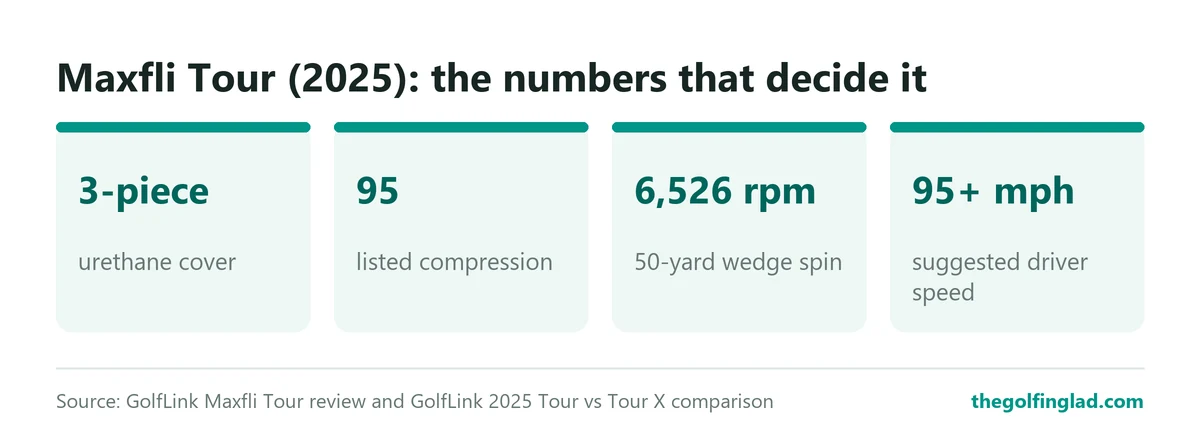
The current Maxfli Tour line has three urethane balls at the same price, which is where most buyers get stuck. GolfLink’s side-by-side of the 2025 Tour, Tour X and Tour S lays them out cleanly: the Tour is a 3-piece ball at 95 compression with a mid trajectory and mid long-game spin. The Tour X is a 4-piece ball at 100 compression with a high flight and high spin. The Tour S is a 3-piece ball at 85 compression that flies low and spins less.
All three are rated high for short-game spin. So the choice is really about what happens with the long clubs.
On the course, the Tour is the middle child that suits most people. In that GolfLink test the Tour X was a couple of yards longer off the tee and launched higher with mid-irons, but the Tour had the edge greenside, launching slightly lower and stopping a bit quicker on chips. If you save more shots around the green than you gain off the tee, that’s your answer.
Golf Monthly’s 2025 Tour review describes the same split from the other side: the Tour is built to feel softer, fly lower and spin less than the Tour X.
As for the older ball, MyGolfSpy’s Ball Lab measured preliminary samples of the 2023 Maxfli Tour at an average compression of 91, which it said basically matched the version before. An even earlier Ball Lab review put its sample at 85 and graded the ball 85 overall, with one gripe: weight consistency could be tighter. The Tour has drifted firmer over the generations, and the 95 figure for the 2025 ball continues that.
Short game is the reason to buy it
This is where the Maxfli Tour earns its place. In GolfLink’s SkyTrak test of the Maxfli Tour, a 50-yard wedge came off at 6,526 rpm with a 32.6-degree launch, enough for an 8.4 out of 10 wedge score.
For comparison, the same site’s test of Maxfli’s own two-piece StraightFli recorded 3,730 rpm on the same shot. That gap is the difference between a pitch that checks on its second bounce and one that releases to the back fringe.
Worth knowing: spin on a wedge only shows up with a clean strike and a dry face. If your pitches skid out regardless of the ball, our guide on how to put backspin on a golf ball covers the strike first.
Golf Monthly’s reviewer ran the 2025 Tour against the 2025 Titleist Pro V1 on a Foresight GC3 with driver, 7-iron and sand wedge, and found ball speed, carry and spin “within a negligible margin” of the Titleist. That covers the sand wedge too.
the only discernible difference I could find was in the feel.
Joe Ferguson, Golf Monthly
Distance: in the mix, which is all you need
GolfLink’s driver numbers for the Tour were 137.9 mph ball speed, 226.5 yards of carry and 246.6 yards total, a 9.1 out of 10 distance score. The tester called it “one of the longest balls in its class” in their testing.
That 137.9 mph ball speed is roughly what a driver swing in the low-to-mid 90s produces, so those yardages are a fair picture of what a typical mid-handicapper could expect. Golf Monthly’s review of an earlier Tour said it wasn’t the longest in its category, so treat distance as competitive rather than a selling point.
The honest summary: you won’t lose yards switching from a Pro V1, and you probably won’t gain any either.
Where it gets awkward: irons and the driver miss
Two weak spots came up in GolfLink’s numbers, and both matter to a 15 handicapper.
First, stopping power with irons scored 7.1 out of 10. The 7-iron peaked at 24.0 yards with a 41.1-degree descent angle, and the reviewer found the ball hard to stop quickly with irons. On a firm green in August, a 7-iron that lands pin-high may finish on the back edge rather than next to the hole. Club down or land it short.
Second, accuracy also scored 7.1. The driver averaged 289.8 rpm of sidespin and 15.3 yards offline. The StraightFli, in the same site’s test, managed 130 rpm and 9.5 yards offline. That’s urethane doing what urethane does: it spins more on everything, including the shots you’d rather it didn’t.
GolfLink’s comparison piece is blunt about it: the Tour line isn’t forgiving for golfers who hook or slice, and the Tour S is the better of the three for players who fight sidespin.
Feel and durability
Golf Monthly’s one real knock on the 2025 Tour was that it felt slightly “clickier” than the Pro V1. If you judge a ball by the sound off the putter face, you’ll notice. If you judge it by where it finishes, you probably won’t care.
Durability reads well in that test: about 30 shots each with three clubs left only minimal marks on the cover. Owners are split. On MyGolfSpy, some members said the 2025 yellow cover scuffed more easily than before, while others reported no problem.
Maxfli Tour specs at a glance
| Spec | Maxfli Tour (2025) |
|---|---|
| Construction | 3-piece |
| Cover | Urethane |
| Compression (listed) | 95 |
| Trajectory | Mid |
| Long-game spin | Mid |
| Short-game spin | High |
| Suggested driver speed | 95 mph and up |
| Driver carry / total (GolfLink) | 226.5 / 246.6 yards |
| 50-yard wedge spin (GolfLink) | 6,526 rpm |
Compression figures vary by source and by year, so don’t read too much into a few points. If the numbers on the box confuse you, we’ve decoded what the numbers on golf balls mean.
What’s good
- Driver, 7-iron and wedge data within a negligible margin of the 2025 Pro V1 in Golf Monthly’s test
- 6,526 rpm on a 50-yard wedge, true premium-ball spin
- Competitive carry, 226.5 yards in GolfLink’s driver test
- Cover held up well in Golf Monthly’s test
- Costs a lot less than the big-name urethane balls, so a lost one stings less
What’s not
- Slightly clickier feel than a Pro V1
- Irons don’t stop quickly; average stopping power in GolfLink’s scoring
- Driver sidespin magnifies a slice or hook: 15.3 yards offline in GolfLink’s test
- Some owners report the 2025 yellow cover scuffs easily
- Too firm a choice for slower swings
What owners keep saying
Agreed, the cover this year scuffs very easily.
Dave, commenting on MyGolfSpy’s Maxfli owner round-up
When MyGolfSpy asked its members why they play Maxfli, value came up again and again: a ball that performs close to the premium names for less money, with promotions that bring it down further. Owners also liked having the Tour, Tour X and Tour S to choose between on feel.
The recurring complaint was the yellow cover’s scuffing, and it was disputed. One member said they’d broken 80 eighteen times in 14 months, all with the Tour, which says more about the golfer than the ball but tells you serious players trust it.
Who should buy it, and who should skip it
Buy it if your driver speed is 95 mph or more, you already play a urethane ball and wince at the price, or you’re moving up from a two-piece ball because your wedges won’t check. It also suits anyone whose game lives inside 100 yards.
Skip it if you’re under 90 mph, slice it off the tee, or lose more than a sleeve a round. In those cases the extra spin is costing you, and the price advantage disappears into the gorse. Our list of the best golf balls for mid handicappers covers softer options that suit slower swings.
Maxfli Tour alternatives worth a look
People walk away from the Maxfli Tour for three reasons: their swing is too slow for a 95-compression ball and they’d rather pay less, they want a different value urethane ball with a softer greenside feel, or they simply want the ball the Tour is measured against.
| Maxfli Tour | TaylorMade Noodle Long & Soft | Vice Pro Plus | Titleist Pro V1 | |
|---|---|---|---|---|
| What you get | 3-piece urethane, mid flight | 2-piece ionomer, very soft core | 4-piece urethane, Vice’s firmest Pro ball | 3-piece urethane, lower long-game spin |
| Who it suits | 95 mph-plus, short-game focused | Slower swings and casual rounds | Value hunters who want greenside feel | Better players who want the benchmark |
| Price | The $40 tier | Well under half per ball | About the same | A step up, $50-plus |
| The catch | Clickier feel, irons release | Little greenside spin | Low long-game spin limits its appeal | Costs the most to lose |
TaylorMade Noodle Long & Soft: the cheap, soft ball for slower swings
The Noodle Long & Soft is a two-piece ball with an ionomer cover and 342 dimples, built around a very soft 34-compression core, per Golfers Authority’s review. It comes in big packs at well under half the Tour’s price per ball.
Where it beats the Tour: cost, and a far softer core for golfers who can’t compress a 95-compression ball. If your driver speed is under 90 mph, the Tour’s firmness is working against you, and a ball this cheap stops a lost one from spoiling the hole.
Where it loses: the short game. Golfers Authority says it doesn’t spin much around the greens, so forget the Tour’s checking pitches and plan for release.
Take it instead if you slice, lose balls in bunches or play mostly for fun. The catch: once your wedge game gets serious, you’ll outgrow it. More budget options sit in our best golf balls under $30 list.
Vice Pro Plus: the like-for-like value urethane rival
The Pro Plus is the closest match to the Tour in spirit: a four-piece urethane ball from a brand built on undercutting the big names. GolfLink describes it as the firmest and highest-spinning model in Vice’s Pro line, and Today’s Golfer lists 336 dimples. It sits at about the same price as the Tour.
Where it beats the Tour: Golf Monthly praised its soft feel around the greens and its durability, which speaks to the Tour’s two soft spots, the clickier feel and the scuffing reports. Where it loses: Golf Monthly found its low long-game spin limits its appeal, which matters if your irons already release on firm greens.
Take it if you want urethane value and the Maxfli feel puts you off. The catch: published compression figures for it vary widely by source, so you’re buying on reviews rather than a clear number.
Titleist Pro V1: the step up the Tour is measured against
The Pro V1 is the benchmark every value urethane ball gets compared to. Golf.com’s rundown of the 2025 model describes a three-piece ball with a gradient rubber core, a mantle layer and a cast urethane cover, with Titleist claiming more speed off the tee, more control with irons and more spin with wedges. Golf Monthly’s Pro V1 review adds a 388 tetrahedral dimple design and a penetrating flight. This yellow version sits in the $50-plus tier, a clear step up.
Where it beats the Tour: feel. Golf Monthly found the Maxfli clickier, and feel was the only difference its reviewer could pick out. Where it loses: price, and not much else on a launch monitor, since that same test found the numbers within a negligible margin.
Take the Pro V1 if feel off the putter decides your ball and money doesn’t. The catch: every one you lose costs noticeably more than a Tour.

- Softer Feel and Performance Characteristics: Pro V1 has a softer feel, less spin and flatter trajectory than Pro V1x, which makes it the preferred model for players who like exceptionally long distance, the ability to flight shots, and score with precision and touch
- Advanced Core Technology: New faster high gradient core delivers more speed and iron and wedge spin for more control
- Low Long Game Spin: Low long game spin from a speed amplifying high-flex casing layer
- Consistent Flight Pattern: Penetrating and consistent flight from a spherically-tiled 388 tetrahedral dimple design
- Superior Greenside Control: Excellent greenside spin from a soft cast urethane elastomer cover

Should you hunt down last year’s Tour or drop to the Tour S?
No to both, for most readers. The Tour, Tour X and Tour S share a price, so there’s no money saved by going softer, and the Tour S makes sense only if sidespin is wrecking your rounds and you’re happy with a lower flight. An older Tour, which MyGolfSpy measured at 91 compression in 2023, is only worth it at a clear discount.
If you want to compare urethane value from elsewhere, our Member’s Mark golf ball review looks at Sam’s Club’s take on the same idea.
Maxfli golf balls: quick answers
Is the Maxfli Tour as good as a Pro V1?
On the launch monitor, nearly. Golf Monthly found ball speed, carry and spin within a negligible margin of the 2025 Pro V1 with driver, 7-iron and sand wedge. Feel is the difference: the Maxfli is slightly clickier.
What compression is the Maxfli Tour?
GolfLink lists the 2025 Tour at 95. MyGolfSpy measured earlier versions at 85 and 91, so treat it as a firmish ball that suits driver speeds of 95 mph and up.
Maxfli Tour or Tour X for a 15 handicapper?
The Tour, if you chip and pitch a lot, since it stopped quicker greenside. The Tour X if your driver speed is around 100 mph and you want a higher flight into greens.
Who makes Maxfli golf balls?
Maxfli is a house brand of DICK’S Sporting Goods, per MyGolfSpy, and the Tour has been sold through DICK’S and Golf Galaxy.
Does the Maxfli Tour scuff easily?
Reports differ. Golf Monthly saw only minimal marking after about 30 shots each with three clubs, while some MyGolfSpy members said the 2025 yellow cover scuffed easily.
The verdict on the Maxfli Tour
Our rating: 4.5/5 (editorial). This is the Maxfli Tour verdict in one line: you get Pro V1-level wedge spin and carry for a lot less, and you pay for it with a clickier feel and an iron flight that runs out a little. For a 95 mph-plus mid-handicapper who plays a urethane ball, it’s the easiest switch in golf. For a slicer under 90 mph, the StraightFli or a softer ball will score better.
How we rated it: this is a research-based review. The rating draws on Maxfli’s published lineup specs as reported by retailers and testers, named third-party tests from Golf Monthly, GolfLink and MyGolfSpy’s Ball Lab, and owner reports from the MyGolfSpy community. Nobody on our staff has played this ball, and nothing here claims otherwise.
By The Golfing Lad
One thought on “Maxfli golf ball review (2026): is the Tour a Pro V1 for less?”
Comments are closed.