
What do the numbers on golf balls mean? (2026) Decoded
As an Amazon Associate I earn from qualifying purchases.
CERTAIN CONTENT THAT APPEARS ON THIS SITE COMES FROM AMAZON. THIS CONTENT IS PROVIDED ‘AS IS’ AND IS SUBJECT TO CHANGE OR REMOVAL AT ANY TIME.
If you buy through links on this page we may earn a commission, at no extra cost to you.
You’re on the first tee, your playing partner pulls out a Pro V1 with a big black 3 on it, and you look down at yours. Same ball, same 3. Somebody is about to mark theirs with a Sharpie.
That moment is most of what the numbers on a golf ball are for. The big digit under the brand name tells you nothing about how the ball flies. A couple of the other numbers can still help you choose a box, though.
Short answer: The large single number (usually 1 to 4) is a play number, there only so you can tell your ball from a friend’s. It has no effect on distance, spin or feel. Two-digit stamps like 90 or 100 on old balls were compression ratings, which mostly ended around 2001. Three-digit numbers are usually a dimple count. Pick the model, not the number.
Every number you’ll find on a ball, decoded
Most guides stop at “it’s for identification”. The table below goes further and tells you whether each number should change what you buy.
| What you see | What it means | Should it change your buy? |
|---|---|---|
| Single digit, 1 to 4 | Play number, purely for telling balls apart | No. A 1 and a 4 are the same ball |
| Single digit, 5 to 9 | Less common play numbers, often sold as “high numbers” | Only if your group all plays 1 to 4 |
| Two digits, 00 to 99 | Custom play number, or a practice or range ball marking | No, it’s still identification |
| 80, 90 or 100 on an old ball | Wound-era compression rating | No. Those balls are decades out of date |
| Three digits in the model name | Usually the dimple count | No. Read the flight claims instead |
| Red vs black number | Once compression; now a model marker or just design | Only on a Titleist, where it tells Pro V1 from Pro V1x |
Sources: Golf Compendium’s breakdown of ball numbers, Vessel Golf’s guide and BallCaddie’s number guide.
The big number is a name tag, nothing more
Golf Compendium puts it flatly: the ID numbers on a ball are “most often a 1, 2, 3 or 4.” A dozen typically comes as four sleeves of three, each sleeve carrying one number, as Vessel’s guide explains. So a fresh box gives you three balls of each.
The number exists because so many people play the same handful of models. The Golf News Net says the point is “making it easier for golfers to identify their golf ball when they play.” That’s the whole job.
Numbers on a ball are a filing system.
BallCaddie, golf ball numbers meaning
Less common numbers run from 5 up to 9, and some makers will print a custom ID anywhere from 1 to 99, per Golf Compendium. Most makers stick to 1 to 4, according to The Golf News Net, so anything from 5 upwards will stand out in a group.
The rule: if your regular four-ball all buys the same model, get the high numbers (5 and up) or a custom two-digit number. If they don’t, the number is irrelevant.
Why the number won’t save you from a penalty
Here’s the catch with relying on a 3. Hit a provisional with the same brand, model and number as your original, find two identical balls in the rough, and you have a problem.
The SCGA Rules Crew covers exactly this. Under Rule 18.3c(2), you pick one, treat it as the provisional and play it.
The other ball is treated as lost in this scenario.
SCGA Rules Crew
In plain golf: the original you probably found in perfect shape counts as lost, and your next stroke is your fourth. The printed number did nothing for you.
Worth knowing: the play number is one identifier, not a personal one. Put your own dot or line on every ball before the round, and use a different mark, or a different number, for any provisional.
The rule: treat the number as a quick way to spot your ball, and a pen mark as the thing that actually proves it’s yours.
The old 90 and 100 stamps were compression, and they were loose
If you’ve fished an ancient ball out of a pond with a 90 or 100 on it, you’ve found a compression rating. Golf Compendium says these two-digit ratings were common from the 1970s to the early 2000s, usually somewhere from 70 to 110, and they told you how soft or firm the ball was.
Older balls printed it straight on the cover, such as the Titleist Professional 90 or 100, The Golf News Net notes. BallCaddie says that system ended around 2001 and calls those stamps unreliable.
Ball makers don’t stamp compression any more, and they don’t agree on how to measure it. Snell is blunt about third-party figures:
Treat any compression figure as internal to the tester, not a universal yardstick.
Snell Golf
Compression still matters to the buyer, though. It just lives in a spec sheet or a test, not on the ball.
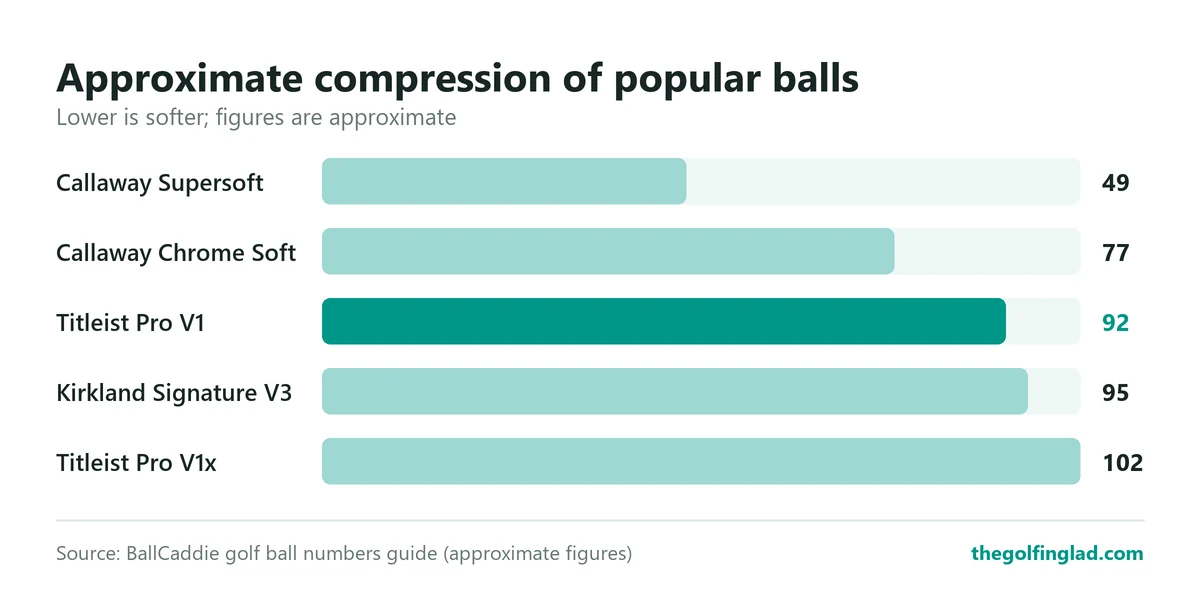
Those approximate figures come from BallCaddie’s guide: Pro V1 about 92, Pro V1x about 102, Kirkland Signature V3 about 95, Callaway Chrome Soft about 77 and Callaway Supersoft about 49. Read them as a ranking from soft to firm, not as gospel.
Vessel’s guide gives the swing-speed rule of thumb: 30 to 60 compression for driver speeds under 85 mph, and 90 or higher for speeds over 100 mph. Lower numbers, it says, mean “the ball’s softer and squishes more when you hit it.”
The rule: if your driver speed is under 85 mph, start your shortlist down at the soft end. Over 100 mph, the firmer tour balls make sense. Our guide to golf balls for mid handicappers sorts the ones in between.
Red or black: only Titleist makes it mean something
Color used to track compression. The Golf News Net quotes the old convention: “Red numbers used to represent 90 compression balls, and black numbers were to represent 100 compression balls.”
Today it’s mostly design. Snell says the color of the number “does not directly impact performance.”
The useful exception is Titleist. Vessel’s guide links black digits to the Pro V1 and red digits to the Pro V1x. That’s handy when you find one in the rough and want to know which model you just picked up, because the two do fly differently. Australian Golf Digest’s 2025 launch story says that “Compared to Pro V1, Pro V1x will fly higher, spin more on full swing shots and have a firmer feel.”
If you want the lower-flying, softer Titleist, it’s the black number.

- Pro V1 has a softer feel, less spin and flatter trajectory than Pro V1x, which makes it the preferred model for players who like exceptionally long distance, the ability to flight shots, and score with precision and touch.
- New faster high gradient core delivers more speed and iron and wedge spin for more control
- Low long game spin from a speed amplifying high-flex casing layer
- Penetrating and consistent flight from a spherically-tiled 388 tetrahedral dimple design
- Excellent greenside spin from a soft cast urethane elastomer cover

If you swing fast and want more height and spin on full shots, the red number is the one. On BallCaddie’s figures it’s also the firmer of the two by about ten points.

- Pro V1x is the optimal premium performance choice for players looking for maximum distance, who need higher flight and more stopping power.
- New faster high gradient dual core produces more speed and iron and wedge spin for more control
- Low long game spin from a speed amplifying high-flex casing layer
- New spherically-tiled 348 tetrahedral dimple design optimized for high and more consistent flight
- Excellent greenside spin from a soft cast urethane elastomer cover
The rule: on a Titleist, black is Pro V1 and red is Pro V1x. On any other brand, ignore the color.
Three-digit numbers are dimples, and they won’t pick your ball
A three-digit figure in a model name is usually the dimple count. Golf Compendium says most balls carry somewhere from the low 300s into the high 400s. BallCaddie lists examples like the Mizuno RB 566, and warns that names can mislead: Srixon’s AD333 actually has 338 dimples.
Dimple counts change between generations too. Australian Golf Digest gives the current Pro V1 388 dimples and the Pro V1x 348, both in a tetrahedral pattern. Some guides still quote older counts, which tells you how little the figure matters to anyone choosing a box.
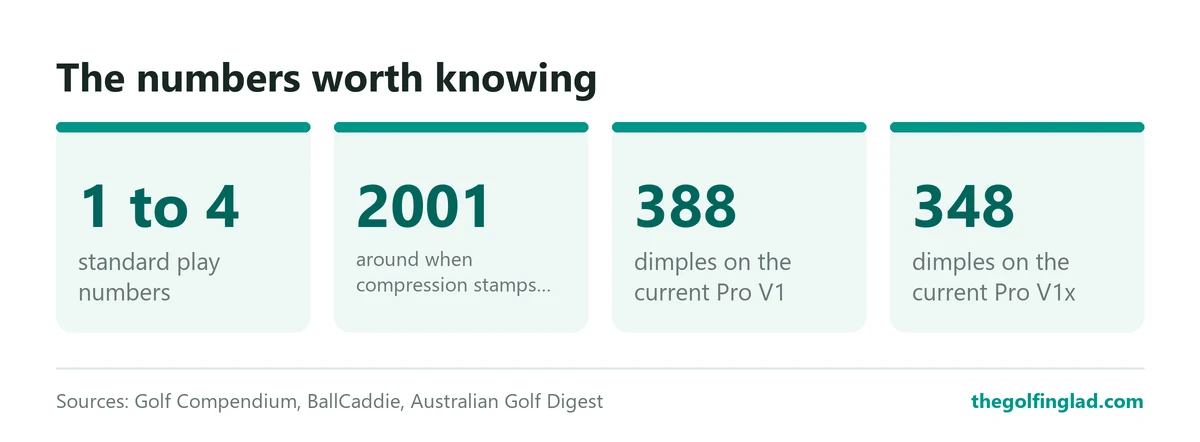
The rule: a dimple count is a design detail. Judge a ball on its flight, spin and feel claims, and on independent tests.
What to buy, by the kind of golfer you are
Since the numbers on the ball won’t choose for you, here’s how I’d choose.
You play twice a month and lose two or three balls a round. Don’t pay tour-ball money. Buy a soft two-piece ball from our best golf balls under $30 list and put a mark on every one.
Your driver speed sits under 85 mph. Go low compression. The Chrome Soft sits around 77 on BallCaddie’s numbers, well below the Pro V1, Kirkland V3 and Pro V1x in the chart above; only the Supersoft, at about 49, is softer. Our Callaway Chrome Soft review covers the catch.

- Outstanding tour performance with soft feel.
- New Hyper Fast Soft Core produces exceptionally fast ball speeds.
- New Seamless Tour Aero delivers a consistently high ball flight with low spin.
- New High-Performance Tour Urethane Soft Cover delivers outstanding greenside control with soft feel.
You swing over 100 mph and care about stopping it on greens. A urethane tour ball. Black-number Pro V1 if you want it lower and softer, red-number Pro V1x if you want it higher with more spin. Our best urethane cover golf balls roundup has the alternatives.
You play in a regular group that all buys the same ball. Order high numbers or a custom two-digit number. That’s the one time the number on the box is the right thing to shop for.
Questions golfers actually ask
Does a number 1 ball go further than a number 4?
No. The play number is identification only. A 1 and a 4 from the same box are the same ball.
Why do some balls have a double-digit number like 23 or 55?
Either it’s a custom play number (Golf Compendium says some makers print 1 to 99) or it’s a practice or range ball. Neither changes how it flies.
Can I switch ball numbers during a round?
The Golf News Net says the rules allow it. Just tell your playing partners what you’re now playing, and mark it.
Is a red-number ball softer?
Historically, red meant 90 compression and black meant 100. Today it only reliably tells you something on a Titleist, where red marks the Pro V1x, the firmer of the two.
Where do I find a ball’s compression now?
Not on the ball. Look at independent tests and guides, and treat any single figure as approximate, as Snell advises.
The verdict: shop the model, mark the ball
The number on your golf ball is a name tag. The old compression stamps are history, dimple counts are trivia, and red versus black only matters on a Titleist.
What does matter is matching compression and cover to your swing speed and how many balls you lose. For most 10 to 25 handicappers, that means a soft ball at a fair price, and our budget golf ball picks are where I’d start. Then grab a pen.
By The Golfing Lad
One thought on “What do the numbers on golf balls mean? (2026) Decoded”
Comments are closed.