
Types of golf clubs (2026): what each one does, what to skip
As an Amazon Associate I earn from qualifying purchases.
CERTAIN CONTENT THAT APPEARS ON THIS SITE COMES FROM AMAZON. THIS CONTENT IS PROVIDED ‘AS IS’ AND IS SUBJECT TO CHANGE OR REMOVAL AT ANY TIME.
If you buy through links on this page we may earn a commission, at no extra cost to you.
You are standing in a golf shop looking at a wall of sticks with numbers on them, and the bloke next to you has just asked for “a 4-hybrid and a 54”. You nod as if that meant something.
Here is the straight version. There are five types of golf clubs, the rules let you carry 14, and a 10 to 25 handicap scores perfectly well with ten. The trick is knowing which ten.
Short answer: The five types of golf clubs are woods (driver and fairway woods), hybrids, irons, wedges and the putter. Each has one job: woods for distance, hybrids for long shots you would otherwise fluff, irons for approaches, wedges for anything inside pitching distance, the putter for the green. Start with a driver, one hybrid, 6-iron to pitching wedge, a sand wedge and a putter.
What each club is called, what it does, and the verdict on each
Most charts stop at loft. This one adds the column you actually want: whether to spend money on it now. Lofts are the standard figures from Golfbit’s loft reference.
| Club | Typical loft | Its job | Buy it first? |
|---|---|---|---|
| Driver | 9° to 12.5° | Tee shots on par 4s and par 5s | Yes |
| 3-wood | 15° | Long second shots, a calmer tee shot | Later |
| 5-wood, 7-wood | 18° to 19°, 21° | High long shots that land soft | Later |
| Hybrid (3 to 5) | 19° to 26° | Stands in for the 3-, 4- and 5-iron | Yes, one |
| 6-iron to 9-iron | 30° to 43° | Approach shots into greens | Yes |
| Pitching wedge | 45° to 47° | Short approaches, chips that run | Yes |
| Gap wedge | 51° to 52° | The yardage between pitching and sand | Later |
| Sand wedge | 56° | Bunkers, pitches, most chips | Yes |
| Lob wedge | 60° | High shots over trouble | Skip for now |
| Putter | 3° to 4° | Rolling it in | Yes |
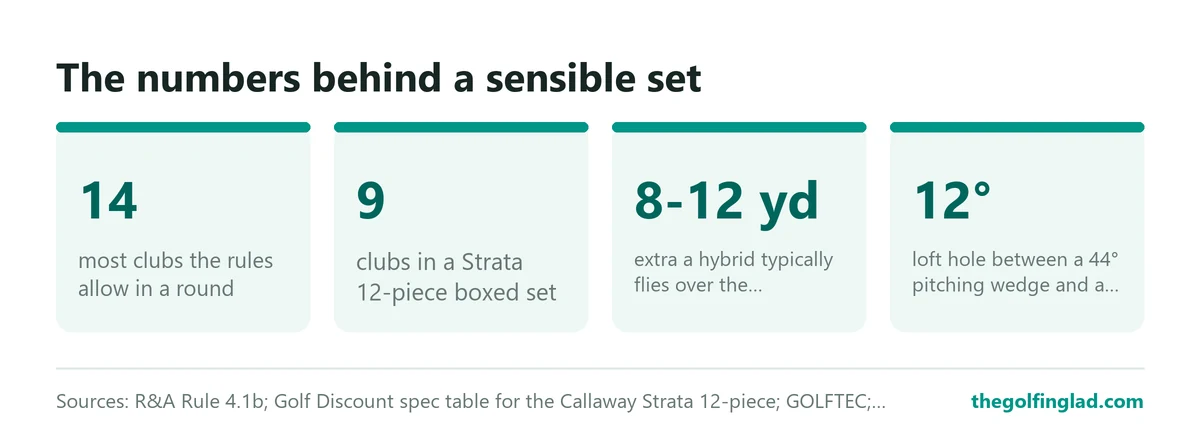
Count the “yes” rows: driver, hybrid, four irons, two wedges, putter. Nine clubs. Add a 3-wood when you are ready and you have ten.
Fourteen is the limit, not the target
Rule 4.1b says a player must not start a round with more than 14 clubs or have more than 14 during it. In stroke play the penalty is two strokes for each hole where you were over, capped at four for the round. In match play the cap is two holes.
Nothing in the rule says you need 14. Every extra club is another one to learn, and a half-learned club is a liability on the course. Our piece on how many clubs belong in a golf bag makes the full case for ten.
The rule: if you cannot say what yardage a club is for, it does not earn a slot yet.
Woods: one you need, two you can wait for
The driver is the longest club with the biggest head, and it is for the tee. Shot Scope’s tracking data, as reported by Golf Monthly, puts a 15-handicap drive at about 236 yards and a 25-handicap drive at about 204. That is with the topped ones taken out.
Fairway woods are smaller drivers you can hit off the turf. A 15° 3-wood is the hardest club in the bag to get airborne from a tight lie, which is why I would not rush it. A 5-wood at 18° to 19° is the friendlier one.
The rule: buy the driver with 10.5° of loft or more. Add a fairway wood only once the driver is behaving.
Hybrids replace the irons you were never going to hit
A hybrid has an iron’s length and a small wood’s head. It exists because the 3-, 4- and 5-iron ask for a strike most of us cannot repeat. GOLFTEC’s comparison says hybrids typically fly 8 to 12 yards farther than the equivalent long iron, and higher.
Hybrids are a no brainer.
GOLFTEC, on beginners and mid-handicappers
Long irons still have a place: low, wind-cheating shots for a low handicap who finds the middle of a small face. That is not the brief here.
The rule: if your longest iron is a 6, carry one hybrid of 24° to 26°. If it is a 5-iron you hit thin twice a round, swap it.
Irons: the number on the sole is not a measurement
Irons are numbered so that loft goes up and distance comes down as the number rises. Simple enough. The catch is that a 7-iron is whatever the maker says it is.
many irons, especially those aimed at beginners, have fewer degrees of loft than irons numbered the same in the past
Golfbit’s guide to club lofts
The same guide gives the example: Cobra’s King RADSPEED 6-iron has 24° of loft, the King Tour 6-iron has 29°. Five degrees apart, same number stamped on the bottom. So when a mate’s 7-iron goes a club farther than yours, check the loft before you check your swing.
For a sanity check, the same Shot Scope figures put a 7-iron at about 154 yards for a 15 handicap, 146 for a 20 and 132 for a 25. Our golf club distance chart has every club.
The rule: compare irons by loft, never by number. And buy the cavity-back, wide-soled kind; here is what makes a golf club forgiving if you want the why.
Wedges: mind the hole after the pitching wedge
Wedges are high-lofted irons for scoring distance. There are four: pitching, gap, sand, lob. You need two of them on day one, and a boxed set usually hands you one.
Take the Callaway Strata 12-piece. A retailer spec table for the set lists nine clubs: a 10.5° driver, 15.5° 3-wood, 26° 5-hybrid, 6-iron to 9-iron, a 44° pitching wedge and a putter. The other three “pieces” are two headcovers and a stand bag.
The irons run 28°, 32°, 36°, 40°, 44°. Four degrees a step, tidy. Then nothing until you buy a sand wedge at 56°, which leaves a 12° hole. That is the 60-yard pitch you keep either flying over the green or leaving in the bunker.
Worth knowing: the Strata’s 5-hybrid (26°) and 6-iron (28°) sit only 2° apart, while the jump up to the 3-wood is 10.5°. Expect those two clubs to go similar distances, and a big gap above them.
The rule: find your pitching wedge loft, then add a sand wedge. If the gap between them is more than about 8°, a gap wedge is the next club you buy. The lob wedge can wait a year.
The putter is the one club you use on every hole
Putters carry 3° to 4° of loft, enough to lift the ball out of its own dent and start it rolling. They come as blades, which are slim, or mallets, which are bigger and have longer alignment lines. The Strata’s is a 35-inch mallet.
The rule: if you struggle to aim, buy a mallet. Do not spend driver money on a putter until you have a putting stroke.
The two purchases that make sense from here
If you own nothing, a boxed set is the cheapest way to get every type of club at once. The Strata 12-piece sits in the $500 tier and covers nine of the ten slots above.

- The Strata 12-Piece Men's is designed to give you maximum performance right out of the box for more confidence from tee-to-green. The lightweight 460cc forged driver, fairway wood, hybrid, irons and putter make up a set that provides a great combination of distance, forgiveness and control, and is very easy to hit.

Then plug the hole. A 56° sand wedge is the missing tenth club, and the Cleveland RTX 6 ZipCore comes in exactly that loft for under $150.
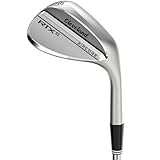
- HydraZip A new, dynamic blast and laser-milled line system creates roughness to enhance friction—maximizing spin in any conditions and from anywhere around the green. Visually, RTX 6 ZipCore Wedge faces are more matte than last generation, reducing glare at address and standing out more from the hosel and toe par.
- ZipCore Our proprietary, low-density core technology has exponentially evolved for RTX 6 ZipCore, with up to 95% more ZipCore material. And by setting the CG right where you strike the ball, plus increasing MOI by up to 20%, this generation offers players increased spin, distance, consistency, feel, and control on every shot.
- UltiZip UltiZip features grooves that are sharper, deeper, and more tightly spaced. They slice through debris and bite harder for enhanced spin and control; channel more debris for better shot consistency; and are set closer together (compared to past TourZip Groove designs) so we can fit two more on the face for greater edge contact and absolute spin performance.
What’s good
- One box gives you a wood, a hybrid, irons, a wedge and a putter
- Even 4° steps through the irons, so the distances stack sensibly
- No long irons to fight with
What’s not
- No sand wedge, so budget for one straight away
- Steel shafts in regular flex only on the listing we read, which will not suit a very slow or very fast swing
- Hybrid and 6-iron lofts nearly overlap
What to buy, by the golf you actually play
- If you play once or twice a month and own nothing, buy the boxed set and a 56° wedge. Ten clubs, done.
- If you have hand-me-down irons with a 3- and 4-iron in them, leave those two in the garage and buy one hybrid.
- If you already break 90 now and then, your next club is a gap wedge, not a new driver.
- If you are choosing between new and second-hand, read box set versus used clubs before you pay for either.
Questions people ask in the shop
What are the five types of golf clubs?
Woods, hybrids, irons, wedges and putters. Some charts fold wedges into irons and call it four. The clubs are the same either way.
Which club should I learn first?
A 7-iron. It is mid-length, mid-loft and it teaches the swing every other iron uses. Our guide to which clubs a beginner should buy first builds out from there.
Do I need a 3-wood?
Not yet. It is a useful club off the tee when the driver is misbehaving, and a difficult one off the fairway. Get a hybrid first.
Why does my friend hit the same iron farther?
Possibly a faster swing. Just as likely a stronger loft: game-improvement 7-irons go as low as 28°, against 34° to 35° on a traditional one. That is the best part of two clubs.
What happens if I carry 15 clubs by accident?
Two strokes per hole played with the extra club, to a maximum of four in stroke play. Count them on the first tee.
Where to go next
In one line: nine clubs cover every shot you have, the tenth is a sand wedge, and the other four slots are for later. For named sets and what to leave on the shelf, go to our best golf clubs for beginners guide.
By The Golfing Lad
One thought on “Types of golf clubs (2026): what each one does, what to skip”
Comments are closed.