Do golf balls go bad? What ruins them, and what doesn’t (2026)
You’re clearing out the garage and find a sleeve of balls from a set of clubs ago. They look perfect. The real question is whether they’ll cost you yards on the first tee, or whether you’re about to spend money on a fresh dozen you don’t need.
Straight answer: a modern ball that has sat somewhere dry and mild is fine. Water, heat and scuffs are what ruin a golf ball. A calendar doesn’t.
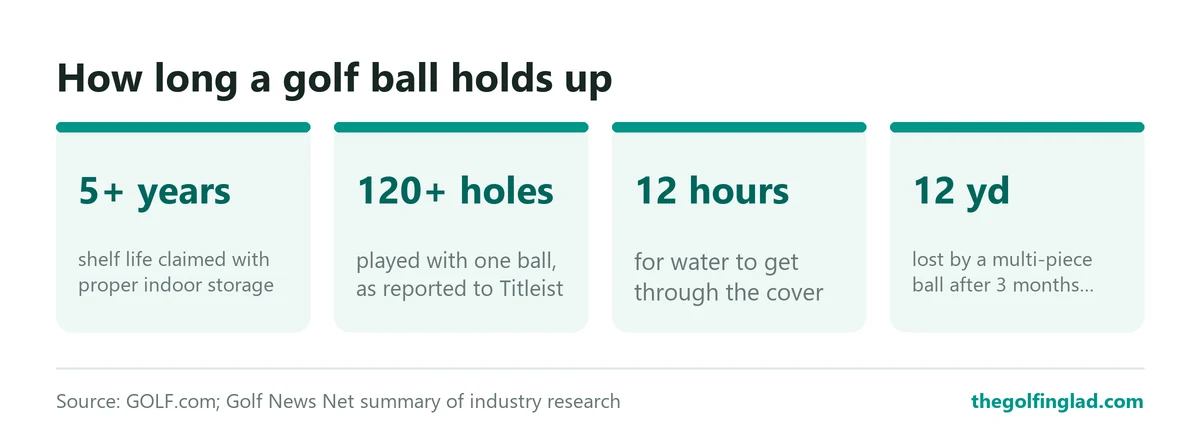
Short answer: Golf balls don’t expire on a date, but they do go bad. A modern solid-core ball kept indoors at room temperature plays close to new for five years or more. A ball that has sat in a lake, a hot car boot or a freezing garage loses distance much sooner, and a cover scuff bigger than a dime means it’s time to swap it out.
What time, water and cold do to a golf ball
Age gets the blame, but it’s the least of your worries. Here is how the threats stack up, using the best figures available.
| What happened to the ball | What the figures say | Play it? |
|---|---|---|
| Stored indoors, 2 years | “Most likely still fine” (GOLF.com) | Yes |
| Stored indoors, 5 years | Makers claim “five years or more” with proper storage | Yes, for casual golf |
| Played, over 120 holes | Owners report it to Titleist without issue | Yes, if the cover is clean |
| Underwater, 8 days | About 6 yards shorter | Practice only |
| Underwater, 3 months | About 10 yards (two-piece) to 12 yards (multi-piece) shorter | No |
| Underwater, 6 months | About 15 yards shorter (multi-piece) | No |
| Played frozen | Over 21 yards of carry lost | Warm it first |
The water figures come from Golf News Net’s roundup of industry research. The storage lines come from GOLF.com’s piece on whether balls have an expiration date, and the 120-hole figure from a Titleist rep quoted by GOLF.com.
Do golf balls expire sitting in a box?
Not in any way you’d notice for years. Today’s balls have solid rubber cores. The old wound balls were the ones that went flat in a cupboard, because the rubber thread inside slowly lost its tension. A solid core doesn’t have that problem.
What does happen is slow firming. MyGolfSpy’s Tony Covey has said a solid-core ball typically gets firmer over time before it levels off, and that ten compression points over three years “isn’t out of the question.” A slightly firmer ball isn’t a broken one. It’s just not quite the ball it was when it left the factory.
MyGolfSpy’s practical rule is a good one: balls two to five years old are fine for practice and casual play. Past five years, or after poor storage, replace them if you care about consistency.
they work just fine when I use them after a couple of years.
srixon 1, on the Golf Monthly forum
That owner keeps dozens of Pro V1s in a cupboard, and the rest of the thread agrees. Another poster said old balls would be fine “unless they were stored in extreme conditions.” That’s the catch, and it covers most garages.
The rule: under five years old and stored indoors, play them. Older than that, use them for practice or scrambles and keep fresh ones for medal rounds.
Where you keep them matters more than how long
GOLF.com recommends keeping balls dry, out of direct sunlight, at around 70 to 80 degrees. Most garages swing well outside that over a year. A hot car boot in July is worse still. Heat and big temperature swings are what age a cover and core faster than time does.
Cold is different. It doesn’t seem to damage a ball for good, but it wrecks the one you’re playing. In MyGolfSpy’s hot-versus-cold test, frozen balls launched lower, spun about 500 rpm more, lost more than 6 mph of ball speed and gave up over 21 yards of carry. Heat-soaked balls were within about a yard of normal on carry.
Picture a 150-yard par 3 with water short. A frozen ball that comes up 20 yards short is wet. That’s a winter morning problem, not a shelf-life one, and the fix costs nothing: bring the sleeve in from the car overnight.
Worth knowing: a coat pocket keeps a spare ball warm between holes in winter. If you play a lot of cold golf, a lower-compression ball helps too. Our guide to the best golf balls for cold weather covers which ones.
The rule: keep your stock in a closet inside the house, not the garage or the car. Take what you need for the round and nothing more.
Lake balls are the ones that really go bad
This is where the question of whether golf balls go bad gets a firm yes. Golf News Net puts the time for water to get through the cover at roughly 12 hours. After that it starts working on the core, and the figures in the table above show where that leads.
Water will penetrate the cover after approximately 12 hours.
Golf News Net
To be fair to lake balls, the evidence isn’t unanimous. A university study that put 96 Pro V1-type balls in campus ponds, with 48 dry controls, found no statistically significant effect on performance even after a full year. Golf Monthly forum members report lake balls at least 10 yards shorter, though one admitted his test was “totally unscientific.”
My read: you can’t know how long a lake ball sat down there or what pond it came from. A 12-yard loss is a full club. You wouldn’t buy a driver that cost you that.
Refinished balls carry the same problem plus a repaint. In a MyGolfSpy lab test, refinished Pro V1s were 13 yards shorter at 115 mph swing speed, 7.5 yards shorter at 100 mph and 6 yards shorter at 85 mph with a driver.
The rule: fished-out balls are for the range, the practice net and the pond holes. If you fish your own back out, play them that day only if they went in that day.
If you have a water hole that eats a ball a round, a retriever pays for itself, provided you get the ball out quickly.
The Callaway retriever is telescopic and comes with a headcover. More choices are in our golf ball retriever guide.
How long do golf balls last in play?
Longer than you’d think, if it doesn’t go in the trees first. A Titleist rep told GOLF.com that golfers have reported playing over 120 consecutive holes with the same ball. Alex Chiarella won the 2019 Lethbridge Paradise Canyon Open on the Mackenzie Tour using one Pro V1x for all 72 holes.
The usual guide you’ll see is about seven rounds, or about 126 holes, for a ball with no visible scuffs or cuts. Treat that as a rough number. Cart paths, trees and desert golf shorten it a lot.
The better test is the one Titleist gives:
as long as paint loss, a scuff or defacement of the golf ball is less than the size of a dime, it should be good to go.
A Titleist rep, via GOLF.com
Why the cover matters: the dimples control how the ball flies. A torn or flattened patch changes the airflow, and you’ll see it as a ball that wobbles or balloons. If you’re curious how many there are, our piece on the dimples on a golf ball has the counts.
Owners on forums say soft urethane covers scuff more easily than firmer ones. That’s the trade for wedge spin.
The rule: run your thumb round the ball after a cart-path bounce or a tree strike. A cut, or a scuff bigger than a dime, goes in the practice bag.
What to buy if your stash has gone off
Since a ball outlasts its time in your bag for most club golfers, you don’t need to buy a lot of expensive ones at once. Buy a dozen at a time and use them up within a season or two.
If you mostly lose balls rather than wear them out, a soft two-piece ball in the under-$30 tier makes sense. The Callaway Supersoft is our pick here: a sensible ball to lose, which is the job a budget ball does.
If you want a tour-style ball but the price stings, graded used balls are the middle road. Mint, top-grade recycled balls sell for less than new. Buy from a seller who grades them, and remember the lake-ball caveat above: you’re trusting their sorting.
Our call by kind of golfer
- If you play twice a month and lose a ball or two a round, don’t worry about age at all. Buy budget balls by the dozen and keep them indoors.
- If you play a cold-weather winter league, keep balls warm before the round and look at a lower-compression model.
- If you’re in single figures and chasing spin around the greens, keep competition balls under about three years old and retire any with a scuffed cover.
- If you’ve got a bucket of lake balls, they’re practice balls. Don’t put a scorecard on them.
- If you found a sleeve of solid-core balls in a cupboard, play them.
Questions golfers actually ask
Can you tell if a golf ball is waterlogged?
Not reliably by eye. The cover can look clean after months underwater. Unless you know its history, treat any found ball as suspect for scoring.
Do old wound balls still work?
They’re the exception. Wound-core balls are the type that really deteriorated with age, so a box of them is a collector’s item, not a playable sleeve.
Is a two-year-old ball worse than a new one?
Barely, if it’s the same model and was stored well. GOLF.com’s view is that a newer model may simply be a better ball, which is a different question from whether the old one has gone off.
Should I store balls in the freezer to keep them fresh?
No. Cold doesn’t preserve anything useful, and a cold ball flies shorter until it warms up. Room temperature is the target.
Is it worth buying balls in bulk?
Yes, if you store them indoors and play often enough to use them within a few years. Avid golfers lose more than a ball a round on average, according to a GOLF Magazine study, so most bulk boxes run out long before they age.
The verdict
Golf balls go bad from water, heat, cold and cover damage, not from age. Keep them in the house, retire scuffed ones, and leave lake balls for the range. If your old stash fails one of those tests, replace it with something sensible rather than expensive. Our best golf balls under $30 guide is where to find a replacement that plays properly without costing much when one ends up in the water.
By The Golfing Lad
One thought on “Do golf balls go bad? What ruins them, and what doesn’t (2026)”
Comments are closed.