
Srixon Q-Star Tour golf ball review (2026): tour spin for less
As an Amazon Associate I earn from qualifying purchases.
CERTAIN CONTENT THAT APPEARS ON THIS SITE COMES FROM AMAZON. THIS CONTENT IS PROVIDED ‘AS IS’ AND IS SUBJECT TO CHANGE OR REMOVAL AT ANY TIME.
If you buy through links on this page we may earn a commission, at no extra cost to you.
You have just thinned a 40-yard pitch over a bunker and watched it skip through the green. The cheap two-piece ball in your bag did exactly what it was built to do: run. The question you are really asking is whether a ball around the $40 mark can make that shot check up without the Pro V1 bill.
For the 2026 Srixon Q-Star Tour, the answer is yes, with one condition. Buy it if your driver swing is moderate and you want real urethane spin around the greens. Skip it if you swing hard, want a high, spinny iron flight, or simply want the best ball money can buy.
A three-piece urethane ball at 74 compression that spins like a tour ball from 50 yards in and flies flatter and straighter off the tee. The 2026 version costs more than the 2024 one did at launch, and stronger players will find the iron spin a touch light.
Best for: mid handicappers with moderate swing speed who want greenside control at a mid price. Skip it if: you swing the driver hard and want a premium ball’s full long-game package.
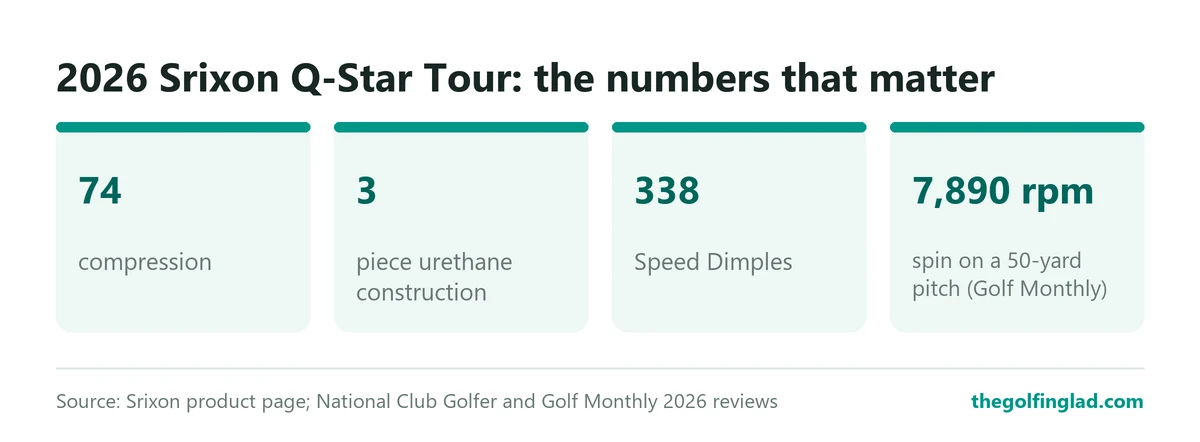
What the 2026 Q-Star Tour changes
Srixon pitches the Q-Star Tour as a tour ball for people who do not swing like tour players. On Srixon’s own product page the line is plain:
Get the spin and distance performance you want in a lower-compression tour ball designed for your moderate swing speed.
Srixon, Q-Star Tour product page
The skeleton has not moved much. The 2024 ball was a three-layer, 74-compression design with a 0.5mm urethane cover and 338 dimples, according to Today’s Golfer’s 2024 review. The 2026 ball keeps the 74 compression and the 338 Speed Dimple pattern.
What changed sits inside and on the skin. Golf Monthly’s 2026 review describes a reworked FastLayer core, and National Club Golfer says the cover now wears Spin Skin+, a coating Srixon says is more durable and digs deeper into the grooves. Retail listings such as Dick’s call it an extra-thin premium urethane cover.
On the course, the FastLayer idea is the bit that matters. Srixon describes a graduated core, soft in the middle and firm at the edge, and claims the lower compression cuts sidespin with the driver and woods. Translation: your slice should curve a little less, not disappear.
The Divide version is the same ball dressed up. National Club Golfer lists it in white/pink, white/lime green, yellow/red and yellow/orange, as a 50/50 gloss design with a 360° seam line you can use to aim putts.
The short game is the reason to buy it
This is where a urethane ball earns its price, and the Q-Star Tour earns it. In Golf Monthly’s Foresight GC3 testing, a 50-yard pitch spun at 7,890 rpm. The TaylorMade Tour Response, the obvious rival, managed 7,645 rpm on the same shot.
What does that look like? A pitch that lands on the front edge, takes one hop and checks, instead of rolling to the back fringe. Golf Monthly’s ball also launched lower on that pitch (28.7° against 31.3° for the Tour Response), which suits the low, biting pitch most club players are trying to learn.
National Club Golfer’s slower-swinging tester got 6,352 rpm with a 58° wedge from 50 yards. He said he would expect about 7,000 rpm from a premium ball and called it a reasonable result. Fair. You are paying mid-tier money and getting most of the premium spin.
Worth knowing: spin comes from clean contact as much as the cover. If your wedges catch the ball thin, no urethane on earth will stop it. Our guide on how to put backspin on a golf ball covers the strike side.
Off the tee it flies flatter, not longer
Do not buy this ball for extra carry. Buy it because the driver flight stays down and fairly straight.
Golf Monthly’s tester, at 114 mph clubhead speed, carried it 289.4 yards with about 2,475 rpm of driver spin and a 123 ft peak height. Against the Tour Response it spun roughly 200 rpm less and peaked lower (123 ft against 128 ft). The reviewer preferred that flatter, more controllable flight.
National Club Golfer’s numbers are closer to most of our readers: 134 mph ball speed, 17° launch, 2,405 rpm and 222 yards of carry. He found the driver spin low to mid rather than the low spin Srixon claims.
What that means for you: a ball that holds its line in a crosswind and does not balloon. If you already hit a low, running drive, it will not add height.
Iron spin is the soft spot
Here is the catch. With a 7-iron, Golf Monthly recorded 183.4 yards carry and 5,890 rpm, and the tester said that spin was “a little lower than I would typically look for”. The Tour Response carried about 1.5 yards farther.
National Club Golfer’s 7-iron: 103 mph ball speed, 22° launch, 5,119 rpm, 144 yards carry.
On a firm green in summer, a 7-iron that spins a little less lands and releases a few extra feet. If you play to back pins with mid irons and want the ball to stop dead, the Q-Star Tour gives a bit of that up. Golf Monthly’s list of reasons to avoid it says the same: it won’t appeal to those wanting more spin and launch.
Feel and durability
National Club Golfer found it reasonably soft off the face and liked it off the putter, though “just a little firm” next to Srixon’s 68-compression AD333. If you are coming from a soft two-piece, expect a little more click.
Durability reads as normal for urethane. Today’s Golfer’s 2026 test saw slightly larger scuffs on some balls after heavy strikes or bad lies, but none that had to be retired mid-round. Expect wedge marks. Do not expect a ball that lasts like a surlyn rock.
Quick specs
| Spec | 2026 Q-Star Tour |
|---|---|
| Construction | Three-piece |
| Core | FastLayer (soft inner, firm outer edge) |
| Cover | Urethane with Spin Skin+ coating |
| Compression | 74 |
| Dimples | 338 Speed Dimples |
| Colours | Pure White, Tour Yellow; Divide in four two-tone options |
| Aimed at | Moderate swing speeds |
| Price band | Around the $40-a-dozen tier |
Not sure what a compression number tells you? Our explainer on what the numbers on golf balls mean sorts it out in a few minutes.
What’s good
- Wedge spin close to premium balls: 7,890 rpm on a 50-yard pitch in Golf Monthly’s test
- Flatter, lower-spin driver flight that holds its line
- Out-spun the Tour Response around the green in a head-to-head
- The Divide gives you a 360° putting line without a separate ball
- Mid-tier price for a urethane cover
What’s not
- 7-iron spin on the low side for players who want balls to stop dead
- Not a distance ball; carry is about level with its rival
- The 2026 ball costs more than the 2024 one did at launch
- A little firmer than Srixon’s softest balls
What owners keep saying
A tour level performing golf ball aimed at the club golfer.
National Club Golfer, 2026 review
Testers like it; the owners on forums are more split. In a GolfWRX thread comparing it with the 2026 Chrome Soft, one player reported little to no wear after 18 holes, while others say the low spin numbers chased them away. One poster who moved from the 2024 ball felt the feel had dropped off after the mantle change.
The pattern is consistent: players who want a straight, controllable ball with a good short game are happy. Players chasing high iron spin, or the old ball’s feel, are not.
Who should buy it, and who should skip it
Buy it if you are somewhere around a 10 to 20 handicap, your driver swing is moderate, you lose shots around the green and you are tired of paying top-tier money for balls you lose in the water.
Skip it if you swing hard enough to compress a tour ball, want the highest-spinning irons, or lose four balls a round. In that last case, our list of the best golf balls under $30 is the honest fix.
Three alternatives worth weighing
People look past the Q-Star Tour for three reasons: they want the rival with the slightly higher iron flight, they want another big brand’s low-compression tour ball, or they want the benchmark and will pay for it. Here is how the options line up.
| Q-Star Tour | Tour Response | Tour B RX | Pro V1 Yellow | |
|---|---|---|---|---|
| What you get | 3-piece urethane, 74 compression | 3-piece urethane, 70 compression | 3-piece urethane, lower compression | 3-piece cast urethane, 388 dimples |
| Who it suits | Moderate swing speeds | Moderate speeds wanting a softer ball | Driver speeds of 105 mph or less | Players wanting the benchmark |
| Price | Around the $40 tier | A little more | A step up | The $50-plus tier |
| The catch | Iron spin a touch low | Spun less on a 50-yard pitch | Less greenside spin than other Tour B balls | Most expensive here |
TaylorMade Tour Response: the like-for-like rival
This is the ball the Q-Star Tour gets measured against. GOLF.com’s rundown of the 2025 Tour Response lists a three-piece build with a Speed Wrapped Core, a Speed Mantle, a soft urethane cover, 70 compression and the dimple pattern TaylorMade has used on the TP5 and TP5x since 2021. It comes in white and yellow.
It sits a little above the Q-Star Tour on price. Where it wins: in Golf Monthly’s head-to-head its 7-iron carried about 1.5 yards farther, and it flew a touch higher, which helps a ball sit down on firm greens. Where it loses: it spun less on the 50-yard pitch (7,645 rpm against 7,890 rpm) and peaked higher with the driver (128 ft against 123 ft), so it is the less wind-proof of the two.
Take it instead if you want a slightly softer ball and a bit more height with the irons. The catch: you pay more for a ball that gives up a little greenside bite.
Bridgestone Tour B RX: the other big brand’s moderate-speed tour ball
The Tour B RX is Bridgestone’s answer to the same buyer: a three-piece, urethane-covered tour ball with lower compression. Golf Digest pegs it for swing speeds of 105 mph or less, and Golf Monthly calls it a superb lower-spinning premium golf ball.
It sits a step up from the Q-Star Tour on price. Where it wins: long-game distance, which Today’s Golfer lists as its big plus, in a low-spin package that should suit the same slice-prone driver swings. Where it loses: Golf Digest notes slightly less greenside spin than the other Tour B balls, and greenside bite is the Q-Star Tour’s strongest card.
Take it if you care more about tee-to-green distance than about checking pitches. The catch: Today’s Golfer says it doesn’t perform too well for faster swing speeds, so this is not a ball to grow into.
Titleist Pro V1 Yellow: the step up to the benchmark
The Pro V1 is the ball everything else in this tier is compared with. Golf Monthly’s 2025 Pro V1 review describes a three-piece ball with a reformulated core that keeps long-game spin low and raises spin on the scoring clubs, a soft cast urethane cover and 388 tetrahedral dimples. Titleist’s launch post promises more speed off the tee, more control with the irons and more spin with the wedges. High Optic Yellow is the colour option.
It sits in the $50-plus tier, a clear step above the Q-Star Tour. Where it wins: overall performance, and Golf Monthly’s tester found it held up well into the wind. Where it loses: price, every time a tee shot finds water.
Take it if you score in the low teens or better and want one ball that does everything. The catch: Golf Monthly found it “Lacked carry distance and short game spin versus Pro V1x”, so even the benchmark has a sharper sibling.

- Softer Feel and Performance Characteristics: Pro V1 has a softer feel, less spin and flatter trajectory than Pro V1x, which makes it the preferred model for players who like exceptionally long distance, the ability to flight shots, and score with precision and touch
- Advanced Core Technology: New faster high gradient core delivers more speed and iron and wedge spin for more control
- Low Long Game Spin: Low long game spin from a speed amplifying high-flex casing layer
- Consistent Flight Pattern: Penetrating and consistent flight from a spherically-tiled 388 tetrahedral dimple design
- Superior Greenside Control: Excellent greenside spin from a soft cast urethane elastomer cover

Is the 2024 Q-Star Tour the smarter buy?
Yes, if you can find it marked down. The 2024 ball shares the 74 compression and 338-dimple layout, and it launched at a lower price than the 2026 one. You give up the Spin Skin+ coating and the reworked core, and one GolfWRX poster preferred the older ball’s feel anyway.
If 2024 dozens are gone or cost the same, buy the 2026. Never pay full 2026 money for old stock.
Questions buyers ask
Is the Q-Star Tour good for a high handicapper?
Only if you already strike your wedges fairly cleanly. If you lose several balls a round, a cheaper ball makes more sense until that number drops.
What swing speed suits the Q-Star Tour?
Srixon only says moderate swing speeds and gives no number. Golf Monthly’s tester at 114 mph clubhead speed still liked it, so faster players are not locked out; they just might get more from a Z-Star.
Does the Q-Star Tour Divide play differently?
No. It is the same ball with a two-tone 50/50 cover. The split colour gives you a 360° line for putting, and makes it easy to see spin on chips.
Is it a soft ball?
Softish. At 74 compression it is in the mid range; National Club Golfer called it a little firm next to Srixon’s 68-compression AD333.
The verdict
The Srixon Q-Star Tour does the one job most mid handicappers need from a better ball: it stops pitches and chips, while flying flat and fairly straight off the tee. The iron spin is a shade light and the 2026 price has crept up, so it is not perfect. For a moderate swing at mid-tier money, it is still the ball I would put in the bag first. If you like the idea of a ball that punches above its price, our Maxfli Tour review is worth a look too.
Our rating: 4/5 (editorial).
How we rated it: this is a research-based review. It draws on Srixon’s published specs, named third-party tests from Golf Monthly, National Club Golfer and Today’s Golfer, and owner reports from golf forums. No one on staff has played the ball, and nothing here claims hands-on use.
By The Golfing Lad
2 thoughts on “Srixon Q-Star Tour golf ball review (2026): tour spin for less”
Comments are closed.