How many indentations on a golf ball? Real counts (2026)
You are standing on the tee, a sleeve of new balls in your hand, and somebody in the four-ball asks how many dents are on one of those things. Nobody knows. Someone guesses a thousand.
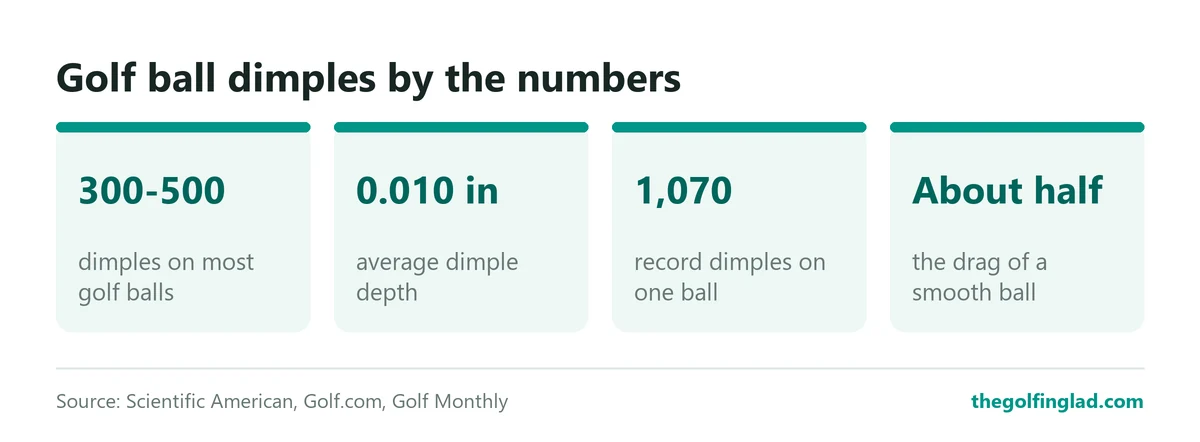
The real answer is smaller, and it is more useful to you than the trivia makes it sound. Most golf balls carry somewhere between 300 and 500 indentations, and the count printed in a spec sheet will not tell you whether a ball suits your swing.
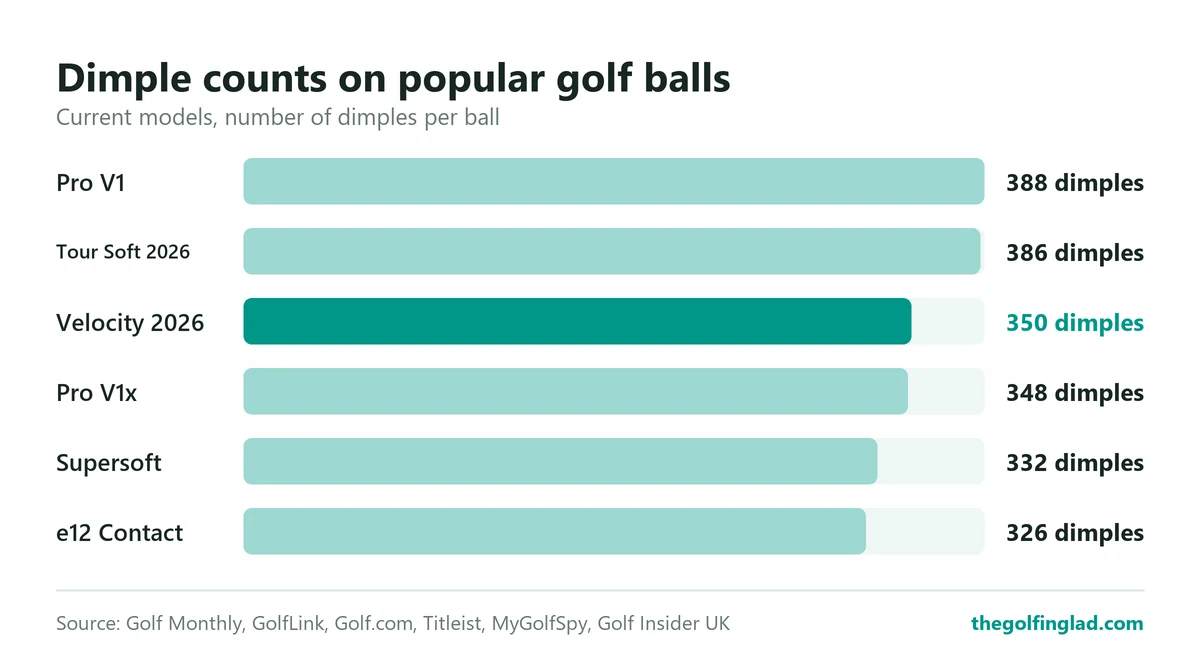
Short answer: A golf ball usually has 300 to 500 dimples, and most popular models sit between about 320 and 390. The Titleist Pro V1 has 388, the Pro V1x 348, the 2026 Velocity 350 and the Bridgestone e12 Contact 326. The rules set no number, only that the pattern must be symmetrical. Count matters far less than depth and pattern design.
The dimple counts on the balls you actually buy
Search for this and you get one number, usually 336, repeated as if every ball were the same. They are not. Here are the counts for balls a mid-handicapper is likely to see in the shop, each from a named source.
| Ball | Dimples | Pattern or note | Source |
|---|---|---|---|
| Titleist Pro V1 | 388 | Tetrahedral | Golf Monthly, GolfLink |
| Titleist Tour Soft (2026) | 386 | Quadrilateral dipyramid | Golf.com |
| Titleist Velocity (2026) | 350 | Octahedral | Titleist |
| Titleist Pro V1x | 348 | Tetrahedral | GolfLink |
| Kirkland Signature | 338 | Costco’s own ball | GolfLink |
| Srixon Soft Feel | 338 | Two-piece value ball | GolfLink |
| Callaway Chrome Soft | 332 | Callaway’s tour line | GolfLink |
| Callaway Supersoft (2023) | 332 | Two-piece, ionomer cover | MyGolfSpy |
| Bridgestone e12 Contact | 326 | Contact Force dimples | Golf Insider UK |
| TaylorMade TP5 | 322 | Five-piece tour ball | GolfLink |
The spread from the TP5 to the Pro V1 is 66 dimples. Both are tour balls that cost about the same, and both are played at the top level. That alone tells you the count is not a quality score.
Counts also change between generations. The Pro V1 went from 352 to 388 dimples and the Pro V1x from 328 to 348 in the 2021 redesign, as Golf Digest reported at launch. An older Velocity carried a 328 tetrahedral design in Golf Monthly’s 2014 review, against 350 now. So a figure you read online may belong to a ball that left the shelves years ago.
The rule: if you want the count for your ball, check the model year. The box will not print it, and older articles go out of date.
Why golf balls have dimples at all
A smooth ball would be a disaster on a par 5. The dimples trip the air around the ball into a thin turbulent layer that hugs the surface, so the air follows the curve further round the back and leaves a smaller wake behind it.
Scientific American’s explainer puts the effect in plain numbers: a dimpled ball has about half the drag of a smooth one, and a smooth ball struck by a professional travels about half as far.
A dimpled ball thus has about half the drag of a smooth ball.
Scientific American
Then there is lift. Backspin pushes the ball up, and the same source says spin supplies about one half of a golf ball’s lift, with the dimples tuning the rest. Golf.com’s dimple guide says dimples contribute as much as 50% of total lift.
Picture a 7-iron that carries 150 yards. Take the dimples off and you would not be choosing between clubs any more. You would be choosing between hitting it and walking it there.
Why the count matters less than you think
Ball designers are blunt about this. Titleist’s golf ball R&D chief Mike Madson told MyGolfSpy that the best patterns tend to land between 300 and 400 dimples, but that designs of 250-plus and some around 450 have worked too.
There’s no magic to the count
Mike Madson, Titleist, via MyGolfSpy
The same piece says Titleist has drawn up nearly 3,000 aerodynamic patterns in 20 years, and only one to two percent of them made it into a ball you can buy. A pattern that flies well on one construction often flies worse on another.
What does move your numbers is depth. The average dimple is about 0.010 inch deep, and a change of 0.001 inch can noticeably alter trajectory and distance, per Scientific American. That is a hair’s difference changing where your drive comes down.
Worth knowing: deeper dimples fly lower and shallower dimples fly higher, as GolfLink puts it. Titleist’s 2026 Velocity tweaks edge angle and depth on its 350 octahedral pattern specifically to bring the flight down a touch, per Titleist’s launch release.
The rule: never pick a ball because it has more dimples. Pick it for the flight it gives you: high or low, spinny or not.
What the rules allow
The governing bodies police a ball’s size and weight closely. Golf.com lists the limits: no smaller than 1.680 inches (42.67 mm) across and no heavier than 1.620 ounces (45.93 grams). Dimples must sit in a symmetrical arrangement.
There is no maximum count. The record stands at 1,070 dimples on a single ball, per both Golf.com and Golf Monthly, which also puts the average across its best-balls list at 343.
Symmetry is the one hard line, and it matters because a lopsided pattern would let a spinning ball wobble off line. So when a ball is sold on a “self-correcting” dimple layout, that is the clue to check its status before you tee it up in a club medal.
The rule: a mainstream tour or distance ball is fine. Anything marketed as straightening your slice through its dimples deserves a look at the packaging before a comp.
How to use this when you buy
Since the count will not decide it, here is what should. Choose by what your misses look like and how hard you swing, then look at the dimple design as the way the maker gets that flight.
Your ball balloons and dies in the wind
You want a lower, more penetrating flight. The 2026 Velocity is built for exactly that: a softer core to cut long-game spin, a firmer ionomer cover and a dimple pattern reworked to bring the trajectory down. Titleist says it is for players who put distance tee to green above everything else, and it sits in the under-$30-a-dozen tier.
The catch is around the green. A firm ionomer cover will not check up on a chip like a urethane ball, so do not expect your wedges to grab.
You slice and want fewer balls in the trees
Bridgestone’s e12 Contact is the one ball here where the dimple itself is the selling point. Each Contact Force dimple has a raised centre meant to put more of the ball on the clubface at impact and cut sidespin. Golf Insider UK lists 326 dimples, a compression around 60, and a reviewer’s figure of 46% more surface contact.
That review is honest about the cost: wedge spin averaged about 7,300 rpm against about 7,900 rpm for a Pro V1, and carry ran 4 to 5 yards shorter.
Around the greens, the ball is a little hard.
Golf Insider UK
You swing gently and want it to feel soft
Callaway’s Supersoft is a two-piece ball with a 332-dimple ionomer cover, per MyGolfSpy’s Ball Lab, which also measured its compression at 47. It is a low-cost ball that feels gentle off the putter. Skip it if you want spin from 40 yards; that is not what it is for.
The rule: match the ball to your miss, then let the dimples be the maker’s problem.
Which ball I would put in your bag
- If you play twice a month, lose a few balls a round and your drives climb too high, buy the Velocity.
- If a slice costs you more shots than anything else, try a dozen e12 Contact before you pay tour-ball prices.
- If you swing slowly and care most about a soft feel off the face and putter, the Supersoft is the cheapest sensible answer.
- If you are under 12 and want your chips to stop, look at urethane balls such as those in our Srixon Z-Star review and Bridgestone Tour B X review. Their dimple counts are beside the point.
Questions golfers actually ask
How many dents are in a golf ball on average?
Figures put the average in the mid-300s. GolfLink’s five-ball sample averages 343.6, and Golf Monthly’s best-balls list averages 343. The range for most balls is 300 to 500.
Does a ball with more dimples go further?
No. The Pro V1 has 388 and the TP5 has 322, and neither is a short ball. Depth and pattern decide the flight far more than the total.
Are all dimples round?
No. Callaway has used hexagonal HEX dimples, and Bridgestone’s Contact Force dimples have a raised centre. The rules care about symmetry, not shape.
Is the number printed on the ball the dimple count?
No. None of the counts above appear on the ball itself. Our guide to what the numbers on golf balls mean breaks down every one you will see.
The verdict
A golf ball has roughly 300 to 500 dimples, the Pro V1 388 of them, and the number is the least interesting thing about it. Buy for flight and feel, not for count. If you want a ball that suits a mid-handicap swing without tour-ball prices, start with our list of the best golf balls under $30, then go to our guide to the best balls for mid handicappers if you want to step up.
By The Golfing Lad
One thought on “How many indentations on a golf ball? Real counts (2026)”
Comments are closed.