What golf balls should I use? A straight answer for 2026
As an Amazon Associate I earn from qualifying purchases.
CERTAIN CONTENT THAT APPEARS ON THIS SITE COMES FROM AMAZON. THIS CONTENT IS PROVIDED ‘AS IS’ AND IS SUBJECT TO CHANGE OR REMOVAL AT ANY TIME.
If you buy through links on this page we may earn a commission, at no extra cost to you.
You’re standing in the shop with a sleeve of tour balls in one hand and a dozen soft ones in the other. One costs twice as much. Both promise more distance. And you lost four balls last Saturday.
Here is the straight answer, then the reasons.
Short answer: If you shoot in the 80s or 90s and lose two or more balls a round, play a soft two-piece ionomer ball such as the Srixon Soft Feel or Titleist TruFeel. Move to a urethane ball once your short game earns it, roughly when you get up and down about three times in ten. Pick by swing speed and short game, never by what the tour plays.
The numbers that should decide it
Most golf ball buying guides sort balls by swing speed and stop there. Swing speed matters, but two other numbers matter more to a mid handicapper: how often you get up and down, and how many balls you lose.
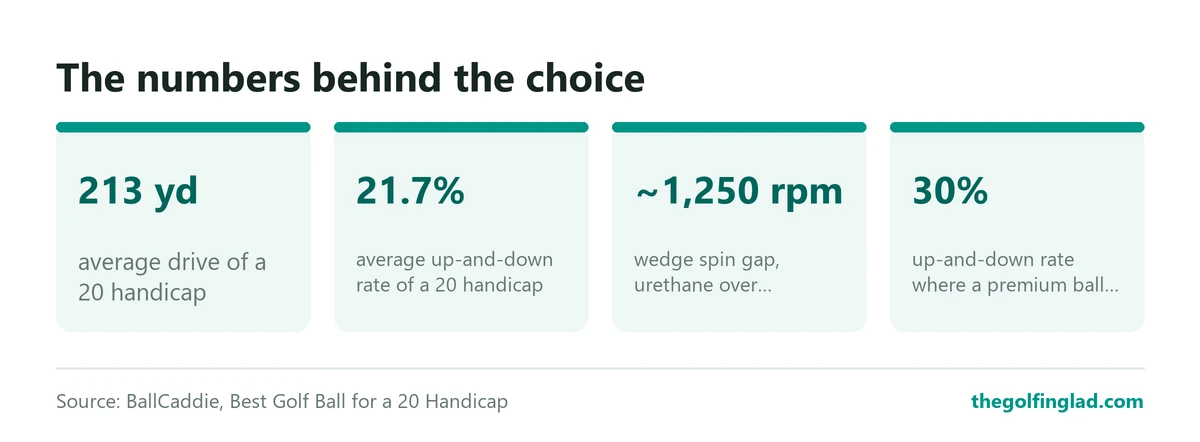
BallCaddie’s guide for 20 handicappers puts the average 20 handicap at 213 yards off the tee and a 21.7% up-and-down rate. On a 35-yard wedge, the urethane balls in its data averaged about 5,400 rpm and the ionomer balls about 4,100 rpm. That gap of roughly 1,250 rpm is the whole case for a premium ball.
The catch is that the extra spin only pays when you convert the chip. Miss the green by 20 yards on the wrong side and no cover saves you.
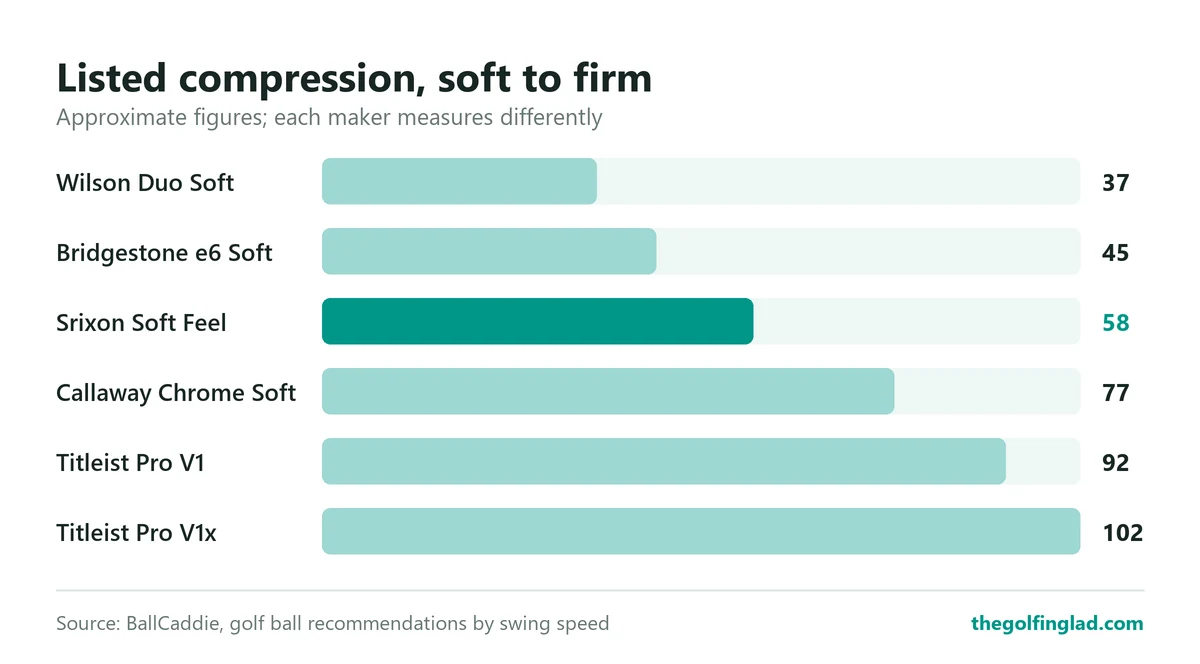
Here is how the speed bands line up with the kind of ball, using the compression figures BallCaddie lists in its recommendations by swing speed.
| Driver speed | Cover | Example balls | Listed compression |
|---|---|---|---|
| Under 75 mph | Ionomer | Wilson Duo Soft, Srixon Soft Feel, Titleist TruFeel | About 37 to 70 |
| 75 to 85 mph | Ionomer or soft urethane | Bridgestone e6 Soft, Srixon Soft Feel, Callaway Chrome Soft | About 45 to 77 |
| 85 to 95 mph | Urethane | Kirkland Performance+, Vice Pro, Bridgestone Tour B RX, Pro V1 | About 89 to 95 |
| 95 to 105 mph | Urethane | Pro V1x, TaylorMade TP5x, Vice Pro Plus | About 97 to 102 |
| Over 105 mph | Urethane | Pro V1x, Bridgestone Tour B X, Callaway Chrome Tour X | About 97 to 102 |
A warning on that last column. Compression is measured differently by each maker, and the sites disagree: Stymie lists the Pro V1 at 88 where BallCaddie has about 92. Treat the numbers as a ranking, not a law. If you want to know what the digits printed on the ball itself mean, our guide to the numbers on golf balls covers it.
Worth knowing: no launch monitor? BallCaddie’s rough rule is driver carry in yards divided by 2.2. A 190-yard carry works out at about 86 mph. A 220-yard carry is about 100 mph.
Golf ball construction explained in one minute
Every ball is a core, a cover and, on better balls, something in between. That’s it. The layers matter because each one does a different job, and you only pay for the jobs you can use.
A two-piece ball is a big core inside a cover. Lynx Golf’s breakdown says the big core keeps driver and long-iron spin down, which means less curve and more durability, at the cost of grab around the green.
A 2-piece golf ball is the simplest construction: one large core and one cover.
Lynx Golf
A three-piece ball adds a mantle between core and cover. The mantle manages how energy moves through the ball, so it stays quick off the driver but spins more on irons and wedges. Lynx calls this the easiest jump in short-game control for most club golfers.
Four and five-piece balls stack a second or third mantle. The idea is low spin off the tee and high spin on scoring shots. Lynx’s own catch: they reward consistent strikes and can feel inconsistent when contact is erratic.
Golf ball layers explained by what you feel
- The core sets most of your ball speed and how hard the ball feels off the face.
- The mantle separates driver spin from wedge spin.
- The cover decides greenside grab. Urethane grips the grooves and scuffs. Ionomer, often sold as Surlyn, lasts longer and spins less.
Layer count is not a perfect guide. Today’s Golfer’s robot data found two-piece balls out-spinning three-piece tour balls with a 7-iron and wedge in its 2024 testing, while four and five-piece models carried over six yards further with driver on average than two-piece balls.
The rule: read the cover first, the layer count second. Urethane means short-game spin. Ionomer means durability and straighter long shots.
How to choose a golf ball: start with what you lose
Before swing speed, count balls. If you lose three or more a round, BallCaddie’s maths shows a premium ball costs well over twice as much per round as a ball in the under-$30 tier. Across a 25-round season that gap comes to a couple of hundred dollars.
That money buys a lesson. A lesson fixes the slice that lost the balls.
Save the premium upgrade for when your up-and-down rate climbs past 30%.
BallCaddie, best ball for a 20 handicap
Soft ionomer balls are not just the cheap option. In BallCaddie’s slow-speed data the Titleist TruFeel ranked 4th of 48 for total distance. Among the ionomer balls, the Srixon Soft Feel spun the most on that 35-yard wedge, at about 4,600 rpm, which closes some of the gap to urethane.
If you are in that camp, this is where I’d start:

- Soft Without Compromise: If feel is what matters most to you, play Soft Feel for maximum all-around performance. Soft Feel technology provides responsive feel for excellent control from tee to green.
- Increased Distance: Engineered for maximum distance with a high-energy core that boosts ball speed, ideal for golfers seeking longer drives.
- Low Compression: Perfect for golfers with slower or medium swing speeds, delivering a soft feel and easy launch for improved accuracy and control.
- 338 Speed Dimple Pattern: Speed dimples reduce drag at launch increase lift during descent. The soft thin cover provides less spin off the driver but more greenside spin and a softer feel on pitches, chips, and putts.
- Affordable Performance: Offering premium features at an exceptional value, the Soft Feel golf balls deliver great performance without the premium price tag.

The Soft Feel is listed at about 58 compression with an ionomer cover, BallCaddie’s value pick for the 75 to 85 mph band. Our list of the best golf balls under $30 ranks it against the e6 Soft, Duo Soft and TruFeel.
The rule: lose two or more balls a round and you play ionomer until that number drops to one or fewer.
Swing speed: why soft is not always longer
The old line says slow swingers need soft balls to compress them. The data is less tidy than that.
A soft ball costs you more ball speed the faster you swing.
BallCaddie, recommendations by swing speed
At a fast driver speed of about 116 mph, BallCaddie’s numbers show ball speed running from 170.7 mph for the fastest ball down to 165.0 mph for the softest. That is real distance. At about 86 mph, the same gap shrinks to roughly 2 mph.
So a slow swinger gives up very little by playing a firmer ball, and a fast swinger gives up a lot by playing a marshmallow. BallCaddie puts it plainly: speed sets no minimum compression. It also notes that Titleist says it doesn’t design balls by swing speed.
The softest ball is not automatically the right slow-speed ball either. The Callaway Supersoft had the slowest ball speed and shortest carry of 48 balls at the slow speed in the same data, and scored 74 in the 2026 Ball Lab report with 3 bad balls in 36.
The rule: fast swingers should avoid very soft balls. Slow swingers should pick by feel and short game, not by the softest number on the box.
The urethane step-up, and where to stop
Once you are chipping well and losing a ball a round or fewer, urethane starts to pay. You do not have to jump straight to the top shelf.
The Srixon Q-Star Tour is the obvious middle step: a urethane cover at about 70 compression, listed as BallCaddie’s step-up for a 20 handicap. It brings the extra greenside spin without the firm feel of a tour ball.

- Thin , Premium Urethane Cover with Biomass- Every Q-STAR TOUR golf ball features an extra thin, premium urethane cover for tour-caliber greenside spin, feel, and control. Our latest covers are also made with Biomass—a durable, plant- derived material requiring fewer carbon emissions to manufacture. It’s our signature, unbeatable performance and feel, plus a step toward reducing environmental impact.
- FastLayer Core- FastLayer uses a contrasting compression effect across the core to generate better ball speeds and distance. Q-STAR TOUR’s unique FastLayer formula also offers a lower compression rating—helping players hit longer, straighter shots on low-lofted clubs and achieve a satisfying, softer feel on Iron and Wedge shots.
- Spin Skin+ Coating- A durable coating, Spin Skin+ digs deep into Wedge and Iron grooves, maximizing spin for better control and stopping power, while also improving the cover’s resistance to dirt and grime.
- 338 Speed Dimple Pattern- The 338 Speed Dimple Pattern on Q-STAR TOUR improves overall aerodynamics for better flight performance. A lower drag coefficient helps the ball cut through the air with less resistance for a more penetrating launch and straighter flight. A higher lift coefficient allows the ball to stay airborne longer for maximum distance.
For mid-speed swingers who want tour-style performance for less, the third-party data is kind to the cheaper urethane balls. The white Kirkland Performance+ finished about 4 yards behind the Pro V1 at the mid driver speed. The Vice Pro Plus finished within 3 yards of the Pro V1x at fast and mid speeds. If you are weighing that Costco ball, our best golf balls for mid handicappers sets it against the others.
Further up the speed range, the Pro V1 and Pro V1x split by flight. BallCaddie lists the Pro V1 as a 3-piece urethane ball and the Pro V1x as 4-piece, and the Pro V1x carried 9 yards farther than the Pro V1 at the fast speed. In the MyGolfSpy 2026 test winners, the TaylorMade TP5 took best tour-standard ball for higher flight and the Titleist Tour Soft took best ionomer for higher flight.

- Pro V1 has a softer feel, less spin and flatter trajectory than Pro V1x, which makes it the preferred model for players who like exceptionally long distance, the ability to flight shots, and score with precision and touch.
- New faster high gradient core delivers more speed and iron and wedge spin for more control
- Low long game spin from a speed amplifying high-flex casing layer
- Penetrating and consistent flight from a spherically-tiled 388 tetrahedral dimple design
- Excellent greenside spin from a soft cast urethane elastomer cover
The Pro V1 is the default for a reason: a 3-piece urethane ball with 388 dimples, listed by Stymie at 88 compression. Buy it if you get up and down often and swing over 85 mph. Skip it if you are still reloading off the tee. If you want to know why a urethane cover checks up and how much of that is the strike, our piece on putting backspin on a golf ball is honest about it.
The rule: step to urethane when your up-and-downs pass 30%, and buy the cheapest urethane ball that fits your speed before the premium one.
What golf balls should I use? Our call by golfer
- If you play twice a month, shoot 95 to 105 and lose three balls a round, buy the Srixon Soft Feel or Bridgestone e6 Soft by the dozen and stop thinking about it.
- If you shoot in the high 80s, carry the driver about 200 yards and chip reasonably, try the Srixon Q-Star Tour for one season.
- If you swing over 85 mph and lose a ball a round or fewer, the Kirkland Performance+ (85 to 95 mph) or Vice Pro Plus (95 mph and up) get you most of the way to tour performance for less.
- If you are single figures and your up-and-down rate is over 30%, play the Pro V1 or Pro V1x and let flight decide between them.
- If you swing under 75 mph and want the ball in the air, the TruFeel is our pick over the softest balls on the shelf.
Whatever you choose, stick with one model. Changing balls every week means you never learn how far your 7-iron goes. For a wider look at middle-of-the-road options, see our best golf ball for the average golfer.
Questions buyers actually ask
Does the ball really matter for a high handicapper?
Less than the swing does, but yes. The real difference at a high handicap is cost per lost ball and how straight the ball flies. A soft ionomer ball spins less off the driver, so your slice curves a bit less.
Is a three-piece ball better than a two-piece?
Better around the green for most players, not better for everyone. The mantle gives more spin on irons and wedges. If your problem is the tee shot, a two-piece ball is the better tool.
What compression should I play?
There is no minimum for any swing speed. Fast swingers lose ball speed with very soft balls; slow swingers lose little with firmer ones. Use compression to rank balls against each other, since each maker measures it differently.
Are Kirkland balls as good as a Pro V1?
Close off the driver. In BallCaddie’s data the white Performance+ was about 4 yards behind the Pro V1 at mid speed. Our Callaway Chrome Soft review covers the softer premium alternative if feel matters more than price.
When should I move up to a tour ball?
When you lose a ball a round or fewer and get up and down about three times in ten. Before that, the extra spin mostly helps balls that end up in the trees.
The verdict
Most golfers reading this should play a soft ionomer ball, one model, all season. The Srixon Soft Feel is my first pick there, with the TruFeel close behind for slower swingers. Earn the urethane step with your short game, start with the Q-Star Tour, and buy a Pro V1 when your chipping and your ball count both say you are ready.
For the full ranking of the balls that make sense for most of us, start with our best budget golf balls for 2026.
By The Golfing Lad