Spikeless vs spiked golf shoes (2026): which grips when it counts
As an Amazon Associate I earn from qualifying purchases.
CERTAIN CONTENT THAT APPEARS ON THIS SITE COMES FROM AMAZON. THIS CONTENT IS PROVIDED ‘AS IS’ AND IS SUBJECT TO CHANGE OR REMOVAL AT ANY TIME.
If you buy through links on this page we may earn a commission, at no extra cost to you.
It is 7:40 on a late October Saturday. The fairways are soaked with dew, you are on a sidehill lie with a 7-iron, and your back foot is wondering whether it will still be there at impact. That is the whole spikeless vs spiked golf shoes argument in a single swing.
Here is the straight answer, then the reasons.
Short answer: Buy spikeless if you play mostly dry, flat courses, swing at a normal club-golfer pace and want one shoe from the car park to the 19th hole. Buy spiked if you play through wet months, on hills, or swing hard enough that your back foot slides. If you can only own one pair and play year-round, get spikes.
The internet is full of pages that say “it depends” and leave you there. The useful bit is that the evidence on grip is thinner than the confident takes suggest, and it points one way once the ground gets wet.
What the numbers actually say
There is no large, independent lab study that pits spiked against spikeless shoes across lots of golfers and lots of turf. What exists is a spike maker’s study, tour counts and some honest tester opinion. Read the table with that in mind.
| Finding | Figure | Who says so | How much to trust it |
|---|---|---|---|
| Players in spiked shoes, 2026 PGA Championship | 87% | Softspikes, via MyGolfWay | Spike maker’s count |
| Spikeless share of that field | 13% (by subtraction) | Same | Same |
| Extra total distance, golfers above 110 mph, wet grass | 5.2 yards | The Golf Lab for Softspikes | Seven swings, sponsor-funded |
| Dispersion, same group | 60% tighter | Same | Same |
| Horizontal impact location, all speeds | 32% better | Same | Same |
| NCG office poll, “only one pair” | 8 spiked, 1 spikeless | National Club Golfer | Small, but golfers who play a lot |
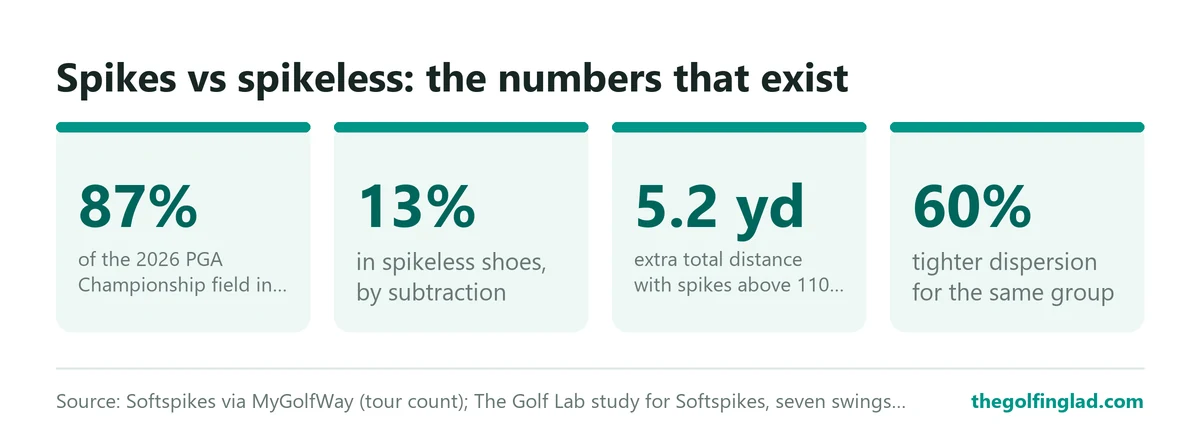
The tour count is the striking one. MyGolfWay’s report from the 2026 PGA Championship put 87% of the field in spiked shoes. Back in 2018, a National Club Golfer writer reckoned at least half of tour players had gone spikeless. The best players in the world have walked back towards spikes, not away from them.
The distance figures come from a Softspikes press release on research by The Golf Lab: seven swings on wet grass, spikes against spikeless. Golfers above 110 mph gained 5.2 yards of total distance and cut dispersion by 60%. Seven swings is a tiny sample and the people paying for it sell spikes. Still, the direction matches what everyone else says about wet turf.
Rule: treat the yardage as a hint, and the wet-grass grip gap as real.
Where spikeless wins, and it wins a lot
Spikeless shoes feel like trainers because they mostly are trainers with a grippier sole. They are usually lighter, you can drive in them, walk into the clubhouse in them and stop at the shop on the way home. Nobody at the bar hears you coming.
That is why spikeless shoes suit a big slice of club golfers. On a dry, firm summer course a modern sole of rubber nubs holds a normal swing fine. MyGolfSpy’s 2025 test of nearly 50 shoes found the top spikeless models now rival spiked ones for traction, which would have been a joke ten years ago.
Spikeless also has an odd winter edge. Tom Irwin at National Club Golfer found a spiked shoe collected so much grass and mud on the outsole in one winter round that it hurt its grip, while spikeless soles pick up less of the course.
Would never go back to spikes.
Bunkermagnet, Golf Monthly forum
Rule: if most of your golf is between May and September on a flat course, spikeless is the better shoe for you, full stop.
The catch with spikeless shoes
Here are the pros and cons of spikeless shoes that matter once the season turns. The cons are short but serious.
What’s good
- Light and comfortable for a walking round
- Wear them on and off the course without changing
- Top models now grip close to spiked ones in the dry
- Less mud and grass packed into the sole in winter
What’s not
- Less grip on dewy or soaked grass, which is when you need it
- Weaker on steep slopes and sidehill lies
- When the nubs wear down the shoe is done; you cannot swap them
- Hard swingers report the back foot sliding
The non-replaceable sole is the con that people forget. With spikes, worn cleats are a cheap swap and the shoe gets a second life. With spikeless, a bald outsole means a new pair, and you may not notice the grip fading until you slip.
Owners split along the weather line. On the same Golf Monthly thread, one member put the two-pair answer better than any brand does:
I wear them in the dry but go to cleats when it is wet.
jim8flog, Golf Monthly forum
Rule: if you would cancel a round rather than play in the wet, spikeless costs you nothing. If you play anyway, it costs you grip.
Where spikes earn their place
The choice between spikes and no spikes comes down to what happens when the turf is soft. A spike pushes into the ground. A rubber nub sits on top of wet grass and hopes. Under Armour’s own guide, from a brand that sells plenty of both, does not hedge:
Spiked shoes are better for traction when course conditions are damp and soggy.
Under Armour golf playbook
Think about what that means in a round. On a 160-yard par 3 off a dewy tee, a back foot that slides an inch moves your low point and you hit it fat. Spikes do not make you a better player. They take one variable away on the shots where you can least afford it.
Hills make it worse. T3’s guide says you get more grip from spikes on wet turf than from rubber nubs, and every source agrees sloping lies are where spikeless gives out first.
The old knock on spikes was comfort. That one is mostly gone. Irwin found the spiked FootJoy Tour-S more comfortable than the spikeless FootJoy Pro SL, and he put it plainly:
So do spiked shoes offer more traction? In my opinion, they do.
Tom Irwin, National Club Golfer
Worth knowing: spiked shoes are for the course only. Walking them across a car park or concrete path wears the cleats and can mark clubhouse floors, so keep a pair of trainers in the boot.
Rule: if your course is hilly, or you play before the dew burns off, buy spikes.
Swing speed is the tiebreaker
The Golf Lab numbers were biggest above 110 mph. That is a fast driver swing, faster than most 10 to 25 handicappers manage. If you are in that group, your feet are working hard, and the 60% dispersion figure, even from a small sample, is the kind of gap you would see on the course as fewer balls in the trees.
If you swing in the 80s or low 90s mph, the force going through your feet is smaller and a good spikeless sole has an easier job. You still want spikes in the wet, but in the dry the difference shrinks.
Rule: the faster you swing, the more spikes are worth. Above 105 mph, I would not play a wet round without them.
Three shoes that fit the decision
If you have landed on spikeless, the Under Armour Drive Fade 2 is a good place to start: a spikeless shoe from a brand that also makes serious spiked models, so the sole is built for golf, not just styled for it.

- Softer, more premium microfiber upper is durable, waterproof & breathable to keep you cool & dry
- Molded sockliner for enhanced fit & comfort
- UA HOVR cushioning in the heel helps eliminate impact
- UA Rotational Resistance outsole provides directional traction where you need it
- Rubber outsole wraps up the sidewall for added support at impact

If you need spikes for wet months and do not want to spend much on a second pair, the FitVille wide spiked shoe is waterproof and aimed at golfers who struggle with narrow fits.

- 【Performance Traction】FitVille Patented Sole Technology feature a state-of-the-art traction outsole with enhanced slip-resistant spikes
- 【Wide Toe Box】The wide toe design of extra wide golf shoes for men relieves pressure points and reduces foot pain including plantar fasciitis, flat feet, hammer toes, and more. It would be easy to walk 18 holes in these shoes without getting a foot ache.
- 【Arch Support】FitVille men's golf shoes are built with arch-support insoles that combine moisture-wicking technology with a supportive heel cup. Experience breathable comfort with every step.
- 【Water-Resistant Upper】FitVille spiked golf shoes are designed with advanced water-resistant technology, keeping your feet dry and comfortable even in wet or damp conditions on the golf course.
- 【All-Day Comfort and Support】FitVille waterproof golf shoes are meticulously crafted to provide unmatched comfort and steadfast support, ensuring a pleasurable experience from the first tee to the final putt.
For the worst of winter, a spiked boot is the honest answer. FootJoy’s Cascade is a spiked golf boot, which means grip and ankle cover for mornings when the fairway is more puddle than grass.

- Cascade Boots Previous Season Shoe Style
- Black/Charcoal
More options on both sides are in our guide to the best spikeless golf shoes for comfort and grip, and if wet feet are your real problem, start with our waterproof golf shoes for rain. On a budget, our best golf shoes under $100 covers both types.
Which one you should buy
- You play twice a month, mostly in summer, on a flat course, and drive straight from work: spikeless.
- You play every week year-round, including frosty and dewy starts: spiked, or one of each.
- Your course is hilly, with sidehill lies on most holes: spiked.
- You swing over 105 mph and your back foot has slipped before: spiked, no debate.
- You walk 18 holes and your feet ache by the 14th: spikeless for dry days, and look hard at comfort-first spiked models for wet ones.
- You can only afford one pair and play in all weather: spiked.
Questions buyers ask
Are spikeless golf shoes good enough for regular golfers?
Yes, in the dry. Top spikeless models now get close to spiked grip on firm turf. They lose ground on wet grass and slopes, which is where most slips happen.
Why do tour players still wear spikes?
They swing fast, play in every condition and cannot afford a slip on 72 holes. At the 2026 PGA Championship 87% of the field wore spikes, per Softspikes.
Can I add spikes to a spikeless shoe?
No. Spikeless soles have no cleat sockets. If you want the option to swap grip, it has to be a spiked shoe from the start.
Do spiked shoes damage greens?
Modern soft plastic spikes are what nearly every course allows. Metal spikes are a different story, so check your club’s rules before you buy anything with metal cleats.
Is it worth owning both?
If you play through autumn and winter, yes. A spikeless pair for dry summer rounds and a spiked pair for the wet is what many regular golfers settle on, and each pair lasts longer for sharing the load.
The verdict
Spikeless is the better everyday shoe. Spiked is the better golf shoe when the ground fights back. If your golf is a summer thing on a flat course, buy spikeless and enjoy the comfort. If you play through the wet months, on hills, or swing hard, buy spikes first and add spikeless later.
Ready to pick a pair? Our best golf shoes of 2026 list ranks the top spiked and spikeless models side by side.
By The Golfing Lad
One thought on “Spikeless vs spiked golf shoes (2026): which grips when it counts”
Comments are closed.