
How to put backspin on a golf ball (2026): strike, face, ball
As an Amazon Associate I earn from qualifying purchases.
CERTAIN CONTENT THAT APPEARS ON THIS SITE COMES FROM AMAZON. THIS CONTENT IS PROVIDED ‘AS IS’ AND IS SUBJECT TO CHANGE OR REMOVAL AT ANY TIME.
If you buy through links on this page we may earn a commission, at no extra cost to you.
You flush a wedge at the pin from 90 yards. It lands two feet past the flag, takes one hop and keeps going, off the back and into the fringe. Your playing partner hits the same shot and it checks up like it hit Velcro.
Here’s the blunt answer: backspin comes from three things, in this order. A strike that takes ball first, then turf. A clean, sharp wedge face. And a ball with a urethane cover. The ball comes last, but it’s the one you can change by Saturday.
Short answer: To put backspin on a golf ball, play it about one ball width back of centre, hit down so you catch the ball before the turf, keep accelerating through impact with your hands ahead, and keep the grooves clean. Then play a urethane-covered ball. In robot testing, urethane averaged 5,415 rpm on a 35-yard pitch against 3,506 rpm for ionomer.
The ball is the part you can buy today
Technique takes months. A sleeve of the right balls takes a trip to the shop. So start with the numbers, because they’re bigger than most golfers expect.
MyGolfSpy’s 2026 ball test put 48 models through a robot in Scottsdale, including a 35-yard wedge shot hit with a Vokey SM10 at 42 mph and full wedges off dry and wet faces. Here’s how the two cover types averaged.
| Shot | Urethane cover | Ionomer cover |
|---|---|---|
| 35-yard pitch | 5,415 rpm | 3,506 rpm |
| Full wedge, dry face | 10,339 rpm | 7,079 rpm |
| Full wedge, wet face | 9,310 rpm | 3,891 rpm |
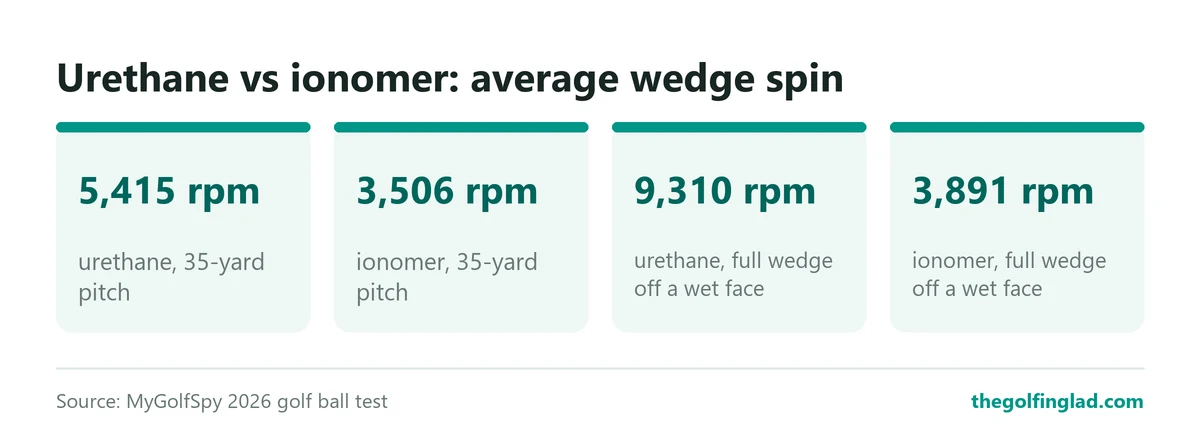
Look at that last row. A wet ionomer ball off a full wedge spun barely more than half what it managed dry. The urethane balls gave up about a tenth.
That’s the morning-dew round, the shot from a damp fairway, the approach after a shower. Exactly when you most need the ball to stop.
The rule: if you want the ball to check, you need a urethane cover. Everything else in this guide makes it check more.
Urethane is the entry ticket, not a guarantee
MyGolfSpy is the first to say that a urethane cover doesn’t guarantee high spin. Among urethane models, the 35-yard numbers spread by more than 1,600 rpm. The Bridgestone Tour B XS hit 5,948 rpm; the Snell PR3 managed 4,274 rpm.
At the far end, the 2025 test found the Titleist Velocity’s firm ionomer cover produced the lowest greenside spin of any ball in the field, barely a third of the top model. If you play a distance ball and wonder why nothing stops, that’s why.
Here’s where the top of the 2026 greenside chart landed, with the median for context.
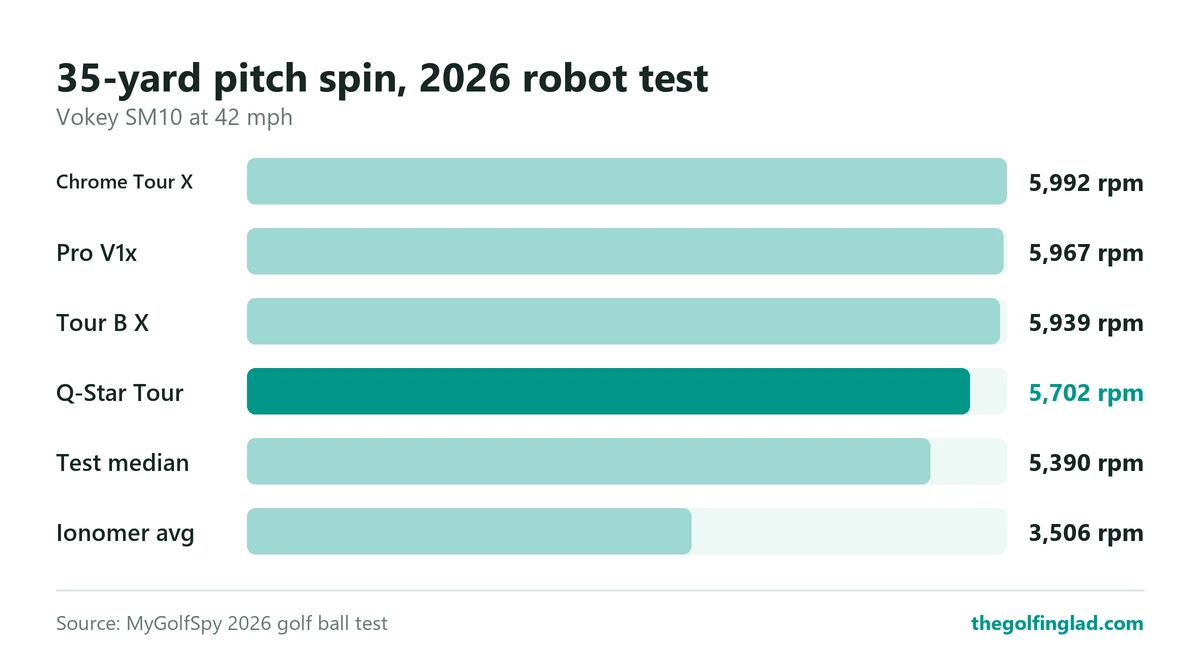
| Ball | 35-yard pitch | Full wedge, dry | Full wedge, wet |
|---|---|---|---|
| Callaway Chrome Tour X | 5,992 rpm | n/a | n/a |
| Titleist Pro V1x | 5,967 rpm | 10,782 rpm | n/a |
| Bridgestone Tour B X | 5,939 rpm | n/a | n/a |
| Srixon Q-Star Tour | 5,702 rpm | 10,169 rpm | 9,647 rpm |
| Titleist Pro V1 | n/a | 10,632 rpm | 10,381 rpm |
| Test median | 5,390 rpm | n/a | n/a |
The Pro V1 figures come via BallCaddie’s Pro V1 review, which reports the ball finished 8th of 48 on the dry full wedge and 3rd of 48 off a wet face. The Q-Star Tour numbers are from MyGolfSpy’s wet-conditions breakdown, which notes it held almost 95 percent of its full wedge spin when wet.
The rule: pick from the top half of the urethane field, not just any ball that says “urethane” on the box.
How to get backspin on a golf ball with your strike
Now the part no ball fixes. The SkyTrak guide to spin numbers puts full-swing spin from 50 to 60 degree wedges at 9,000 to 12,000 rpm, and says wedge spin is more sensitive to strike quality than any other club.
How sensitive? A fat hit can cost over 2,000 rpm on a single shot. That’s more than the whole gap between a urethane and an ionomer ball on a pitch.
When you need backspin on a golf shot, you want to make sure you catch the golf ball first and then the turf.
HackMotion, backspin on wedges
The HackMotion breakdown is the most practical version of the technique. Boiled down:
- Move the ball about one ball width back of centre and watch what happens to the spin.
- Get steeper. Take the club more straight back rather than around you, so you arrive on a descending blow.
- Lead with the hands at impact, but don’t exaggerate the forward press at address. That strips loft off the face.
- Keep the lead wrist flexed rather than cupped through the strike.
- Shorten the backswing and feel the club speed up through the ball. Decelerating kills spin.
Speed matters more than people think. HackMotion’s line is that “higher swing speeds generate more spin and increase the friction between the clubface and the golf ball.” That’s why a 35-yard chip will never check like a full wedge. SkyTrak makes the same point: partial swings spin less because they’re slower.
Worth knowing: the quickest strike fix is the low-point drill. Lay a towel about eight inches behind the ball and hit wedges without touching it. Brush the towel and you were about to hit it fat, and lose that 2,000 rpm.
The rule: if your divot starts behind the ball, no ball on earth will stop for you. Fix the low point first.
Your wedge face is doing half the work
Spin is friction. Anything between the face and the ball cuts it: sand, dirt, grass, water. SkyTrak notes that dirty or worn grooves reduce spin, and HackMotion recommends sharp grooves and a milled face.
This is the cheapest fix in golf. A groove brush and a damp towel clipped to the bag. Clean the face before every wedge, not every few holes.
Worn grooves are the harder conversation. If your sand wedge is the one you’ve had since the last decade and the face has gone shiny in the middle, the ball will slide up it.
The rule: wipe the face before every short shot, and if the grooves feel smooth under a fingernail, budget for a new wedge before a new driver.
How to put spin on a golf ball without paying tour prices
Tour balls sit in the $50-plus tier. You don’t have to go there for real spin.
The Srixon Q-Star Tour is the one I’d point most mid-handicappers at. Urethane cover, 5,702 rpm on the 35-yard pitch against a 5,390 rpm median, and it barely flinched on a wet face. MyGolfSpy also notes it kept driver spin below average, so you aren’t buying wedge spin at the cost of a ballooning drive.

- Thin , Premium Urethane Cover with Biomass- Every Q-STAR TOUR golf ball features an extra thin, premium urethane cover for tour-caliber greenside spin, feel, and control. Our latest covers are also made with Biomass—a durable, plant- derived material requiring fewer carbon emissions to manufacture. It’s our signature, unbeatable performance and feel, plus a step toward reducing environmental impact.
- FastLayer Core- FastLayer uses a contrasting compression effect across the core to generate better ball speeds and distance. Q-STAR TOUR’s unique FastLayer formula also offers a lower compression rating—helping players hit longer, straighter shots on low-lofted clubs and achieve a satisfying, softer feel on Iron and Wedge shots.
- Spin Skin+ Coating- A durable coating, Spin Skin+ digs deep into Wedge and Iron grooves, maximizing spin for better control and stopping power, while also improving the cover’s resistance to dirt and grime.
- 338 Speed Dimple Pattern- The 338 Speed Dimple Pattern on Q-STAR TOUR improves overall aerodynamics for better flight performance. A lower drag coefficient helps the ball cut through the air with less resistance for a more penetrating launch and straighter flight. A higher lift coefficient allows the ball to stay airborne longer for maximum distance.

The Kirkland Signature Performance+ V3 is the bargain. In a robot pitching wedge test by Today’s Golfer, it spun 8,043 rpm, third in the whole test and 352 rpm more than the Pro V1. Different test, different club, so don’t line that number up against MyGolfSpy’s. The point is that a house-brand urethane ball can genuinely spin.

- 3 Piece Golf Balls, USGA Certified
- CORE - Soft, high elastic core provides distance
- Mantle - Soft-cover interaction generates proper spin for irons and wedge shots
- Cover - Durable urethane cover for spin and greenside control
The catch with Kirkland is the naming. Reviews mix up the V3.0 and the newer v3.5, so check which version the listing is before you buy.
If you want the cheaper side covered properly, our best golf balls under $30 guide ranks the budget options, and our best urethane cover golf balls roundup sorts the spinny ones.
When the Pro V1 is worth it
The Pro V1 isn’t the spin king at 35 yards; the Pro V1x and Chrome Tour X sit above it. Where it earns its money is consistency and wet-weather spin. BallCaddie puts it in the top 10 of 106 balls for compression consistency, with no bad balls among the 36 measured, and 3rd of 48 for full wedge spin off a wet face.
high levels of short game feel and control
Golf Monthly, quoted in BallCaddie’s Pro V1 review

- Pro V1 has a softer feel, less spin and flatter trajectory than Pro V1x, which makes it the preferred model for players who like exceptionally long distance, the ability to flight shots, and score with precision and touch.
- New faster high gradient core delivers more speed and iron and wedge spin for more control
- Low long game spin from a speed amplifying high-flex casing layer
- Penetrating and consistent flight from a spherically-tiled 388 tetrahedral dimple design
- Excellent greenside spin from a soft cast urethane elastomer cover
The catches are real. It’s full price by design and rarely discounted, it feels harder in the cold, and BallCaddie fits it to driver speeds of roughly 90 to 105 mph. Below about 90 mph, cheaper urethane balls perform similarly off the tee. And if you lose three a round, you’re paying tour money to feed the pond.
Which ball for which golfer
If you play twice a month, shoot in the 90s and lose a few balls a round, buy the Kirkland Performance+ V3 or the Q-Star Tour. You get a urethane cover and real spin, and losing one doesn’t sting.
If you’re in the 80s, strike your wedges cleanly and play a lot of early or wet rounds, the Q-Star Tour is the value pick and the Pro V1 is the upgrade. Both held their spin off a wet face in testing.
If you swing fast and want the most greenside bite, look at the Pro V1x or the Bridgestone Tour B X, at 5,967 rpm and 5,939 rpm on the pitch. Our Bridgestone Tour B X review covers the trade-offs.
If you’re playing a distance ball like the Velocity, stop expecting it to check. It isn’t built to, and the data says so.
Questions golfers actually ask
Can you get backspin with a cheap ball?
Some, off a full wedge on a dry day. On short pitches and in the wet, ionomer balls fall well behind: 3,506 rpm against 5,415 rpm for urethane on the 35-yard shot. Cheap urethane options like the Kirkland close most of that gap.
Why does my ball check on the range but not on the course?
Mostly it’s lie and moisture. Grass or water between face and ball cuts friction, and the wet-face numbers show how hard that hits ionomer covers. A clean lie on a dry mat flatters everything.
Should I open the face for more spin?
More loft can help, but the bigger wins are a ball-first strike and speed through impact. Opening the face while decelerating gets you a floaty shot that still releases.
Does a higher-lofted wedge always spin more?
Not on its own. SkyTrak’s 9,000 to 12,000 rpm range covers full swings from 50 to 60 degree wedges, and strike quality swings the number by more than loft does. A fat lob wedge spins less than a clean gap wedge.
Backspin is mostly strike, then the face, then the ball. But the ball is the only part you can fix this weekend, and switching from ionomer to urethane is worth close to 2,000 rpm on a pitch. Start with the Srixon Q-Star Tour or the Kirkland Performance+ V3, clean your grooves, and work the towel drill.
Best for: golfers who strike wedges reasonably cleanly and still watch the ball release. Skip it if: your divots start behind the ball. Fix that first, then spend.
If budget is the deciding factor, our budget golf ball picks for 2026 show which cheaper balls give you the most spin for the money.
By The Golfing Lad
One thought on “How to put backspin on a golf ball (2026): strike, face, ball”
Comments are closed.