
Srixon ZXi RKT driver review (2026): straight, fast, one catch
As an Amazon Associate I earn from qualifying purchases.
CERTAIN CONTENT THAT APPEARS ON THIS SITE COMES FROM AMAZON. THIS CONTENT IS PROVIDED ‘AS IS’ AND IS SUBJECT TO CHANGE OR REMOVAL AT ANY TIME.
If you buy through links on this page we may earn a commission, at no extra cost to you.
The first tee, a tight fairway, a group behind you watching. What you want from a driver in that moment is simple: a ball that goes where you aimed it and keeps enough speed to matter. That is what the Srixon ZXi RKT driver is built around.
Straight answer: buy it if you hit a fade or a slice and want a head you can tune heel to toe, and you value straight over curvy. Skip it if you love working the ball both ways, or if a crisp, high-pitched sound puts you off. It also sits in the $600-plus tier, which is real money for a brand the big four still outsell.
The straightest Srixon driver yet, with ball speed that tests near the top of its class and a weight system that actually moves the ball. The feel and the alignment aid are the two things that hold it back.
Best for: mid and higher handicaps with a steady miss to one side who want a forgiving, adjustable 460 cc head. Skip it if: you shape shots for a living, or you want the quietest, most muted impact on the market.

- RKT FACE: RKT Face is not just one thing. It is the perfected sum of our most advanced ball speed, flex, and roll technologies. Each one re-tuned to perform better and enhance the others—with the common goal of creating our fastest and most accurate face ever.
- TOUR DRIVEN CHASSIS: Through rigorous prototyping and on-tour testing, R&D engineers aligned with pro staff to create significant shaping updates on every ZXi RKT clubhead that fit the eyes and performance needs of the best players in the world.
- ACOUSTICORE: Our completely new ACOUSTICORE chassis feature AIoptimized internal rib structures, precisely tuned to refine the acoustic character of every ZXi RKT model. The result is a crisp, controlled sound at impact.
- PLAYER-FOCUSED ADJUSTABILITY: Different weighting designs on each model plus adjustable hosels allow for fine-tuning launch and spin performance for every player.
- GRAPHITE SHAFT: Mitsubishi Kai’li Dark Waves Blue 60

What the RKT changes from last year’s ZXi
The 2025 Srixon ZXi driver had the ball speed. What it lacked was personality. Srixon’s own engineer told Golf.com that across the old line “the sound and the shapes were very similar”, so the three heads did not feel like three different clubs.
The RKT fixes that in three ways.
- A new RKT Face: a multi-thickness VR Titanium face with an updated i-Flex pattern, a variable roll profile in the high toe, and a Rebound Frame that now uses two flex zones to keep speed on off-centre hits.
- A redesigned laser milling pattern meant to hold spin in wet conditions, which matters on the dewy early tee time more than any lab number.
- Sound tuned per head through a new Acousticore system, a rebuilt chassis and a new rib layout.
The standard head also grew. The Hackers Paradise reports it is “longer from front to back while also receiving a deeper face”. Longer front to back pushes mass away from the face, which is where stability on a thin or toe strike comes from.
It’s really just more forgiveness and off-center impacts
Srixon’s Ripp, speaking to Golf.com
Speed: it holds up on the bad swings
The headline number comes from Plugged In Golf, whose tester ran a 9° head with the stock Mitsubishi Kai’li Blue 60S shaft. He saw ball speeds above 160 and a smash factor of 1.50, which is about as efficient as a driver strike gets.
His verdict was blunt: it “is the fastest and straightest driver I have ever used”.
What that means on the course is less about your best drive and more about your average one. The face is built to keep speed up across more of its surface, so the drive you catch a groove low still reaches the spot where you have a mid iron in, not a hybrid.
Spin: why your toe miss stops hooking
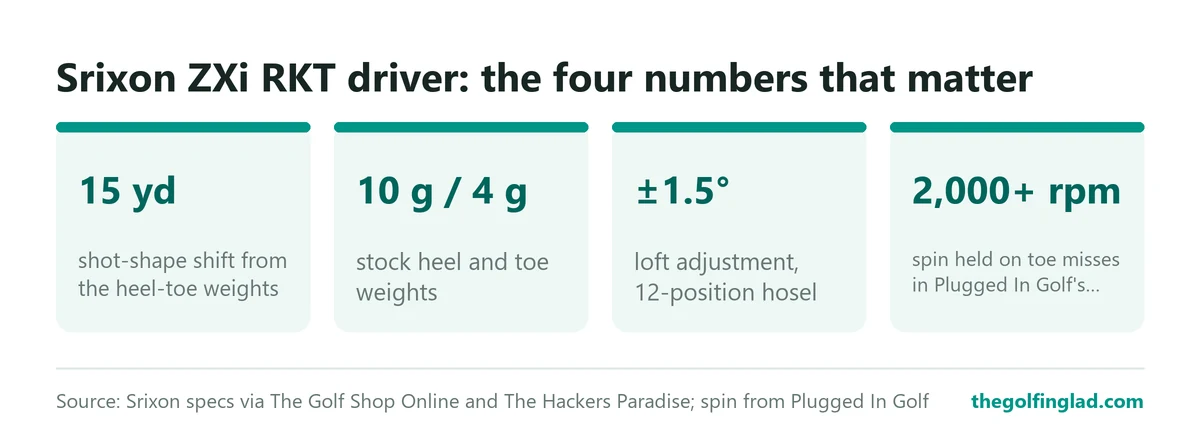
Here is the number that matters for most players. In the same Plugged In test, a centre strike spun around 2,600 rpm, and the toe miss stayed above 2,000 rpm.
That second figure is the quiet win. A toe strike usually loses spin and dives left for a right-hander through gear effect. Holding it above 2,000 rpm keeps the ball in the air and on line instead of ducking into the trees.
Today’s Golfer, which scored it 4.2 out of 5, found it spins more than the low-spin heads, though not excessively. If you swing it in the 90s mph range, that is a feature: carry needs spin. If you already launch it high and spin it too much, look at the LS instead.
Worth knowing: a forum tester quoted by The Hackers Paradise moved from a 9° head to the 10.5° RKT and saw spin of 2,200 to 2,500 rpm. Pick the loft before you pick the shaft. Our guide to which driver loft most golfers should use covers the basics.
The weights are the reason to buy it
The standard RKT has two sole weights, 10 g in the heel and 4 g in the toe as it ships. Srixon calls that neutral to slight draw. Swap them and Srixon says you can shift the shot shape by up to 15 yards.
Fifteen yards is roughly the gap between a fairway and the first cut on a lot of par 4s. If your miss is a fade that keeps finding the right rough, leaving the heavy weight in the heel is the free fix. An eight-piece kit runs from 2 g up to 16 g if a fitter wants to go further.
Golf Monthly notes the heel-to-toe system carries over from the original ZXi but reaches further, so the flight changes are stronger than before.
The hosel is the QTS 1.5, with 12 positions and up to 1.5° of loft either way.
Where it falls short: shaping, feel and that alignment aid
All that straightness has a cost. The Plugged In tester found that a shot he would normally curve 20 yards moved about 5. Players who like to hit a cut on one hole and a draw on the next will find it stubborn. He pointed those players to the LS.
Feel divides people. Plugged In heard a medium-high “shink rather than a lower crack, and wrote that The feel leaves something to be desired”. Today’s Golfer called it loud but not too loud, and on the crisp side.
The bigger annoyance is the S alignment aid on the crown. It sits slightly toward the heel. Today’s Golfer found it looks off-centre at address, and Plugged In warned it can lead you to set up for toe strikes. Ignore the logo and line up off the face.
Srixon ZXi RKT driver specs
| Spec | ZXi RKT (standard) |
|---|---|
| Head volume | 460 cc |
| Lofts | 9°, 10.5° |
| Lie | 59° |
| Standard length | 45.75 in |
| Sole weights | 10 g heel, 4 g toe |
| Hosel | QTS 1.5, 12 positions, up to 1.5° loft up or down |
| Swing weight | D3.5 |
| Stock shaft | Mitsubishi Kai’li Dark Waves Blue 60 (X, S, R) |
| Grip | Golf Pride Tour Velvet 360 |
| Price band | $600-plus |
Specs from The Golf Shop Online’s model guide and Golf.com’s launch report. Srixon put it into shops on October 16, 2026.
What’s good
- Ball speed above 160 with a 1.50 smash factor in Plugged In Golf’s test
- Toe misses held above 2,000 rpm, so they stay up instead of hooking
- Heel-toe weights move the shot shape by up to 15 yards, per Srixon
- 12-position hosel and a weight kit from 2 g to 16 g give a fitter plenty to work with
- The same face tech carried Ryan Fox to the Open in the LS+ version
What’s not
- The alignment aid sits toward the heel and looks off-centre at address
- Hard to curve on purpose: a 20-yard shape shrank to about 5
- Medium-high “shink” sound and a feel testers found lacking
- Priced in the $600-plus tier, level with the big brands
- Only two lofts, 9° and 10.5°; slower swingers wanting 12° need the MAX
What owners keep saying
not unplayably low
A forum commenter on the RKT’s spin, via The Hackers Paradise
Early owners are mostly happy. In the GolfWRX ZXi RKT thread, one poster who put it in play reported 7 of 7 fairways and a match won, and others call the sound loud but not offensive, with a pleasant crunch.
The MyGolfSpy forum leans the same way: the complaint about the old ZXi was sound, and owners say the acoustics are better. Sound still varies by head, and one GolfWRX poster found the LS and MAX far louder than the standard model.
Who should buy it, who should skip it
Buy it if you play off 10 to 20, you have one dominant miss, and you want a driver that lets you lean against it with weight rather than swing changes. It also suits anyone who has found TaylorMade and Callaway heads launch too low for them.
Skip it if you work the ball, if the look at address matters more to you than the numbers, or if your swing is slow enough that you need a 12° head. A beginner on a budget should also look elsewhere: our guide to the best golf clubs for beginners spends that money better.
The alternatives worth weighing
Two things push people away from the RKT: the price, and that crisp sound. If either is a deal-breaker, these are the three drivers to look at, each one you can buy today.
| Srixon ZXi RKT | Srixon ZXi | TaylorMade Qi35 | Callaway Elyte | |
|---|---|---|---|---|
| Price band | $600-plus | A step cheaper | Under $500 | Around $400 |
| Adjustable weight | Heel-toe, 10 g and 4 g | Heel-toe | 13 g and 3 g | 13 g, three settings |
| Who it suits | Straight hitters who tune shape | Value-first, higher flight | Mainstream, lower spin | Lighter shaft, easy launch |
| The catch | Alignment aid, feel | Sound, sits open | Lower ball flight | 12° is right-hand only |
Srixon ZXi: last year’s head for less
The 2025 ZXi shares the heel-toe weighting idea and comes with a Fujikura Ventus TR Blue 6. It sits a step below the RKT on price.
In Golfalot’s test against a Qi35, carry varied by less than 15 yards across strikes from all over the face and spin reached about 3,000 rpm. The flight came out about 5 ft higher than the TaylorMade. The reviewer wrote that “The most impressive aspect for me was the consistency.”
Where it loses to the RKT: no two-zone Rebound Frame, and a sound the same reviewer disliked. He also found it sat slightly open at address. MyGolfSpy’s slow-swing test rated its forgiveness slightly below average.
Take it if you want Srixon’s consistency and higher flight and the price gap matters more than the newer face.

- i-FLEX FACE This completely redesigned face thickness pattern produces more efficient energy transfer at impact. The added strength of the interior i-FLEX face structure allows the center of the face to be thinner than last gen, increasing ball speed.
- STAR FRAME CROWN Complex latticework creates the structural integrity necessary to support an ultralight, remarkably thin titanium crown, ultimately allowing discretionary mass to be set where it best suits each ZXi Driver’s ideal launch and spin characteristics.
- REBOUND FRAME Rebound Frame is an entirely unique system that amplifies energy transfer at impact. By utilizing two flex zones, instead of just one, Rebound Frame maximizes flex across the face to increase power, ball speed, and, ultimately, shot distance.
- LASER FACE MILLING Brand new for ZXi Drivers, visible Laser Face Milling has been added to the surface to help stabilize spin and add forgiveness in wet conditions.
- ADJUSTABILITY Two adjustable sole weights placed in the front and rear allow you to dial in your preferred spin characteristics. And an all-new, 1.5-degree hosel sleeve lets you fine tune Driver loft, lie, and face angle.
TaylorMade Qi35: the like-for-like big-brand rival
The standard Qi35 is TaylorMade’s middle head, with over 9,000 MOI, a 13 g weight in the back and a 3 g weight in the front, in 9°, 10.5° and 12°. It costs less than the RKT today.
In Golfalot’s Qi35 fitting with the 10.5° head, the tester averaged 152 mph ball speed, 2,300 rpm and nearly 264 yards of carry. Moving the 13 g weight forward was reported to add about five yards, at some cost to forgiveness.
It beats the RKT on spin if you already launch it high, and on the third loft. It loses on shot-shape tuning, since its weights move front to back rather than heel to toe. Golfalot’s tester called it very expensive for what it is in the UK, and could not stand the bright silver headcover.
Take it if your problem is too much spin, not a slice.

- QUEST FOR LAUNCH Qi35 has a near zero CG projection with incredible MOI creating efficient launch and spin over a larger area of the face.
- HIGH INERTIA SHAPE paired with Twist Face, Thru-Slot Speed Pocket, 4° loft sleeve and Infinity Carbon Crown provide the ultimate suite of technologies.
- FOURTH GENERATION CARBON TWIST FACE creates maximum energy transfer with enhanced alignment benefits.
- MULTI-MATERIAL CONSTRUCTION chromium carbon, steel, aluminum, tungsten and titanium work together seamlessly creating the perfect blend of form and function.
- TRAJECTORY ADJUSTMENT SYSTEM includes two moveable weights (13g x1 / 3g x1) creating the most mass efficient CG adjustments for spin and shot shape control.
Callaway Elyte: the cheapest way into a current big-brand head
The standard Elyte is a 460 cc head with a Thermoforged Carbon Crown, the Ai 10x Face, a 57.0° lie and a 45.75″ length. Callaway’s spec page lists 9°, 10.5° and 12°, and a stock Project X Denali Charcoal 50 shaft. Callaway claims it is “up to 8 yards longer with even more forgiveness.”
It sits around the $400 mark, well under the RKT. It is the only head in the Elyte range with a perimeter weight system: one 13-gram weight with draw, neutral and fade settings.
It beats the RKT on price and loft range, and the lighter 50 g shaft suits slower swings. It loses on fine-tuning: three settings against Srixon’s eight-weight kit. The catch is that the 12° head is right-handed only.
Take it if you want a 12° driver and a lighter build for less money.

- WD RH ELYTE BLACK OUT DR 9.0 60 GR STF
If you are weighing TaylorMade’s newest head instead, our TaylorMade Qi4D driver review covers it, and the Ping G440 Max review is the one to read if forgiveness is all you care about.
Is last year’s ZXi or the RKT MAX the smarter buy?
For most readers of this review, the RKT is worth the extra over the old ZXi. The two-zone frame and the toe-strike spin numbers are exactly the parts of a driver a 15 handicap uses on every hole. Buy the old ZXi only if the price gap pays for a fitting.
The RKT MAX is a different call. It drops the heel-toe weights for a single 14 g rear weight that only changes swing weight, adds a 12° loft, and ships with the lighter Kai’li Red CB 50. Plugged In Golf found the MAX very good at keeping the ball in play but favouring the left side. If you slice, take the MAX. If you fight both sides, take the standard RKT.
Buyer questions
Is the Srixon ZXi RKT driver good for high handicappers?
Yes, if your miss is to the right and your swing is quick enough for 10.5°. If you need 12° or a lighter shaft, the RKT MAX is the better Srixon.
Does the RKT sound better than the old ZXi?
Owners on the MyGolfSpy and GolfWRX forums say the acoustics are improved. It is still crisp and fairly loud, so if you want a muted thud, it will not be your driver.
Can you fix a slice with the weights?
You can reduce one. Keeping the 10 g weight in the heel is the draw setting, and Srixon says the weights move shot shape by up to 15 yards. It will not undo an out-to-in swing on its own.
Do Srixon irons pair well with it?
Brand matching does nothing for your drives, but if you like the Srixon look, our Srixon ZXi irons review covers the set many RKT buyers pair it with.
Final verdict
The Srixon ZXi RKT is the straightest, best-sorted Srixon driver yet, and its speed holds up against anything in its price tier. If you can live with the heel-leaning alignment aid and a crisp sound, it is a strong buy for a player with one miss to fix. If you shape shots or want to save money, go to the Qi35 or the Elyte.
Our rating: 4/5 (editorial)
How we rated it. This is a research-based review. It is built from Srixon’s published specs, named third-party tests from Plugged In Golf, Today’s Golfer, Golf Monthly, Golfalot and Golf.com, and owner reports from the GolfWRX and MyGolfSpy forums. Nobody on our staff has hit this driver, and the rating reflects that evidence, not hands-on use.
By The Golfing Lad
One thought on “Srixon ZXi RKT driver review (2026): straight, fast, one catch”
Comments are closed.