Takomo golf clubs review: the Ignis D2 and irons (2026)
As an Amazon Associate I earn from qualifying purchases.
CERTAIN CONTENT THAT APPEARS ON THIS SITE COMES FROM AMAZON. THIS CONTENT IS PROVIDED ‘AS IS’ AND IS SUBJECT TO CHANGE OR REMOVAL AT ANY TIME.
If you buy through links on this page we may earn a commission, at no extra cost to you.
You are standing on the tee with a driver that costs half what the big names charge, and the question is whether it will embarrass you. For most 10 to 25 handicappers, the answer on Takomo is no. The catch is that you are buying from a Finnish direct-to-consumer brand, not walking into a shop.
Buy Takomo if you want a forgiving driver or a hollow-body iron set without the $1,000-plus sticker. Skip it if you need to try a club in your hands first, or you swing fast enough that every yard counts.
Takomo gives you modern, forgiving clubs at a fraction of the usual price, and the Ignis D2 driver fixed the problem that sank its predecessor. You give up a fitting bay, a shop to walk back into and some top-end distance.
Best for: mid and high handicappers who want fairways and value. Skip it if: you swing fast, want lots of weight adjustment, or insist on trying before buying.
Here is the maker’s own film on two of its iron models. It is a look at the product, not a test.
One thing to know before you go looking for a buy button. The main place to buy new is the Takomo Golf store, with used sets turning up on eBay.
What the Ignis D2 changed from the driver Takomo had to pull
The first Takomo driver, the Ignis D1, was ruled illegal, and the Takomo Ignis D2 driver is the fix, priced in the $300 tier. That is the cleanest answer to anyone asking whether the brand can be trusted: it had a conforming problem, then shipped a new head.
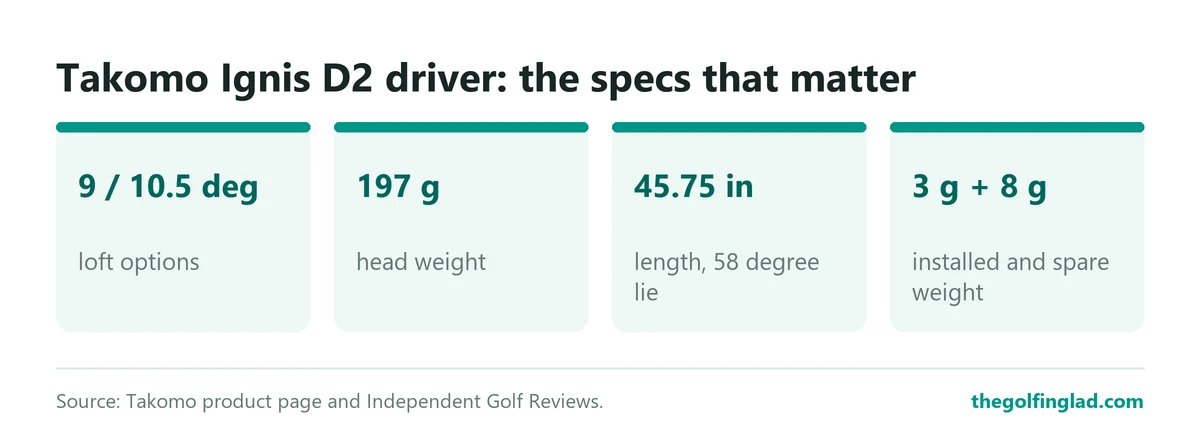
The D2 swaps the D1’s three weight ports for one. Independent Golf Reviews lists a 3g weight installed and an 8g weight in the box. That is a simple, two-position tune: back weight light for a bit more launch and speed feel, heavier for a calmer head.
On the course that means less fiddling and fewer ways to talk yourself out of a good driver. If you are the type who spends the range session swapping weights, the single port will annoy you. If you are not, it is one less variable.
The numbers that decide the purchase
Takomo sells the D2 in 9 degrees and 10.5 degrees with a Fujikura Ventus driver shaft. Independent Golf Reviews gives the rest: a 197g head, 45.75 inches long, a 58 degree lie and a D2 swingweight. The face is variable-thickness titanium under a carbon fibre crown.
| Spec | Ignis D2 driver |
|---|---|
| Lofts | 9 and 10.5 degrees |
| Head weight | 197g |
| Length | 45.75 in, 58 degree lie |
| Swingweight | D2 |
| Weight system | One port, 3g installed, 8g in the box |
| Stock shaft | Fujikura Ventus Blue, 50g or 60g |
A 45.75 inch shaft is a normal modern length, so you are not being handed a long, wild stick. The carbon crown moves weight low and back, which is where a driver gets its stability.
How it flies: fairways first, yards second
The pattern across reviews is consistent. The tester at Independent Golf Reviews, hitting the 9 degree head, saw mid launch and mid-to-low spin with straight, repeatable flights. His summary:
Right off the rack it found more fairways than my custom-fit gamer driver, although it wasn’t as long.
Independent Golf Reviews, Ignis D2 review
That is the trade in one line. Golf Monthly scored the D2 4.45 out of 5 but flagged higher spin and lower ball speeds, which costs distance for a fast swinger.
Now apply that to you. If you carry the driver around 220 yards and your miss is a slice into the trees, a few yards of spin penalty is a bargain for staying in play. If you carry it 270, you are the golfer the reviewers warn off. Check where you sit on our golf club distance chart before you decide.
Feel and sound
One summary of the D2 reviews says the impact feel is much more solid and compressed than the D1, with a tighter tone in place of a loud, clacky echo. At this price a driver that sounds expensive is half the sale.
Worth knowing: Takomo throws in the extra 8g weight with the driver. Start with the 3g installed, and only try the heavier one if the head feels too light or your miss is a hook.
What the irons look like if you are buying a set
The brand is better known for irons. The 101 MKII is the hollow-body game-improvement set. Its listing is for seven clubs, 5-iron through pitching wedge plus a gap wedge, at under $600.
The step up is the 201 line: the 201 is described by Takomo as Golf’s Most Affordable Forged Iron Set, and the 201 MKII and 201T MKII move toward a smaller, more players-style shape. The 101T sits in the $600 tier as a players’ distance iron.
On misses, one review summary reports the 101 MKII losing just 8 to 10 yards on fairly substantial mishits. Plugged In Golf was blunter about who it suits:
Whether you’re a newer player just dipping your toe into golf or simply someone who appreciates value, the Takomo 101 MKII irons are a home run.
Plugged In Golf, 101 MKII review
If you are not sure which side of the forgiveness line you sit on, our guide to what makes a golf club forgiving explains why hollow-body heads help a 20 handicap more than a thin blade.
Where Takomo loses
What’s good
- The D2 driver in the $300 tier is a fraction of what the big brands ask.
- Reviewers report straight, repeatable flights and more fairways found.
- Feel is improved over the D1, with a tighter sound.
- An 8g spare weight comes in the box.
- Hollow-body irons keep mishits close.
What’s not
- No fitting bay and no shop to try clubs.
- Higher spin and lower ball speed than fitted drivers, per Golf Monthly.
- One weight port limits tuning.
- Not on Amazon, so returns and shipping run through Takomo.
- The D1 recall history will make some buyers cautious.
The shipping point matters. Forum chatter comparing Takomo with Sub 70 notes that Sub 70 is US-based, so delivery is quicker and a problem is easier to fix. Takomo is a Finnish brand, as Windtree Golf describes it, so allow for that if you are impatient.
The same threads say Takomo wants you to buy a full iron set rather than singles. That is fine for most players and annoying if you want to replace one club.
What owners keep saying
Owner chatter is steady on two points: the clubs look more expensive than they are, and the value is the main reason to buy. Used listings are described as in good condition with good packaging, which suggests few people are rushing to dump them.
The complaints come from better players, who want more adjustment and more speed from the driver, and from buyers who dislike ordering unseen.
Takomo or the alternatives
Takomo is not the only way to spend less. Sub 70’s 699 Pro is the usual rival for forged-style irons, and buyers lean on it for US-based support and more shaft options. Our Stix golf clubs review covers a cheaper full-set route.
Here is how the Takomo clubs line up against the three I would weigh instead. Price bands are relative to the Takomo you would be replacing.
| Club | Type | Price band | Beats Takomo on | Main catch |
|---|---|---|---|---|
| Takomo Ignis D2 | Driver, 9 or 10.5 degrees | The $300 tier | Price for a modern head | Sold direct, one weight port |
| Takomo 101 MKII | Hollow-body irons | Under $600 | Value for a full set | Sold direct, full set only |
| Cleveland Launcher XL 2 | Driver, 460cc, draw bias | About the same as the D2 | Hosel loft adjustment, 9 to 12 degrees | Draw bias worsens a hook |
| Wilson Dynapower | Game-improvement irons | About the same as the 101 MKII | Easy retail returns | Maker claims only on mishits |
| Callaway Paradym Ai Smoke | Hollow-body irons | A step up, the $700 tier | Reported mishit gains | Strong lofts, higher cost |
Cleveland Launcher XL 2 driver, if you slice and want a draw-bias head
Pick this over the D2 if you slice and want the head to help straighten it out. Cleveland’s Launcher XL 2 is a 460cc driver with a subtle draw bias and a hosel with 12 positions between 9 and 12 degrees, so you set loft where the D2 offers two head lofts and one weight port. The standard build is 45.5 inches with an 8g counterweight in the grip, or 45 inches in the Accuracy Build. Stock shafts are the Tensei AV Blue 55 in regular or stiff, or the Aldila Ascent PL 40 in A flex.
Cleveland claims a 2% heel-to-toe and 12% high-to-low MOI gain, and reviewers such as Plugged In Golf cover it as a stable, forgiving head. Price sits about level with the D2, in the $300 tier, so you choose on features, not money. The catch: the draw bias that helps a slicer makes a hooker’s miss worse.

- MainFrame XL Face MainFrame XL Face Technology uses a variable thickness pattern that maximizes flex at impact to boost distance. It also repositions weight low and deep in the clubhead for added forgiveness and consistency.
- XL Head Design With an improved XL Head Design packing even more MOI than last generation, plus a low-and-deep weighting profile, players can enjoy long, high-launching ball flight with plenty of forgiveness.
- Rebound Frame Instead of giving it one flex zone, we’ve got two. With alternating flex zones acting in-sync, Rebound Frame directs more energy into the ball for speed and distance on every shot.
- Action Mass CB An 8g weight tucked into the end of the shaft counterbalances the club for more control without extra effort. This counterweight helps the club feel lighter on takeaway and stay stable through impact.
- Adjustable Hosel With an adjustable hosel, you can fine-tune your launch angle, distance, and shot shape. Adjust your loft, face angle, and lie angle with 12 different positions. The wrench is sold separately.
Wilson Dynapower irons, if you want a like-for-like iron set
Take the Dynapower over the 101 MKII if you want a big-name game-improvement set you can buy from a retailer and send back. Wilson builds it around Dynapower AI, which varies face thickness to make more of the clubface fast, especially from centre to toe, where Wilson says 85% of shots are struck. The head has a high MOI for off-centre strikes and a low centre of gravity for higher launch and a steeper landing angle, which is what holds a green from 160 yards.
The set is 5-PW plus a gap wedge in steel, here in regular flex. Price is about the same as the Takomo set, in the $600 tier, so you pay for convenience, not savings. The catch is thin evidence: the face claims are Wilson’s own, while the 101 MKII has a reported mishit figure to set beside them.

- Wilson Dynapower Men's Steel Golf Irons - Right Hand, Regular, 5-PW, GW
- DYNAPOWER AI: Dynapower analyzed thousands of combinations of variable face thickness and power holes locations, delivering the optimal combination. Dynapower Irons deliver maximum ball speeds across the entire club face, with a focus on the center and toe, because that is where 65% of shots are struck by 10+ handicap golfers.
- HIGH MOI, LOW CG HEAD DESIGN: Dynapower irons feature a high MOI head design for forgiveness on off-center hits, and a low center gravity that fuels higher launch and steeper descent angles.
- PLAYER-INSPIRED HEAD SHAPE: Dynapower irons feature the perfect balance of pleasing top line, optimal offset and a smooth hosel to deliver a powerful and pleasing look at address
- Set includes 5, 6, 7, 8, 9, Pitching Wedge and Gap Wedge
Callaway Paradym Ai Smoke irons, if you can spend more
Step up to these if you can spend the $700 tier and want a hollow-body iron from a major brand. Today’s Golfer covers a 7-iron at 28 degrees and 37.25 inches, with a forged 455 face cup in a stainless body, tungsten weighting and Ai Smart Face tuning launch and spin. Testers reported about 10 yards over their existing irons on good strikes and 5 yards on mishits.
That is a clear step up from Takomo’s under-$600 set. It beats the Takomo on reported mishit gains and a stock True Temper Elevate MPH 85 steel shaft, and loses on cost. The catch: the lofts are strong, 28 degrees in the 7-iron and 42 in the pitching wedge, so some of that yardage is loft, and you should check the gap to your wedges.

- A Total Revolution In Iron Performance From The Industry-First Ai Smart Face
- Balancing Distance, Control, And Precision Through Ai Advancements
- Contemporary Design Meets Hollow-Body Innovation
- Imported

Brand new to the game and not sure what to buy first? Start with our best golf clubs for beginners guide, or weigh a box set against used clubs.
Is the old D1 or a bigger-name driver the smarter buy?
Skip the D1. It was ruled illegal, and the D2 exists because of that. Used D1 heads show up on eBay, but a driver you cannot take to a competition is a poor bargain at any price.
Against a $500 tier or $600-plus driver from a major brand, the D2 is the smarter buy for anyone swinging under about 100 mph, because you are paying for stability you can use, not speed you cannot.
Questions buyers ask
Are Takomo clubs good?
Yes, for the money. Reviewers praise the irons for forgiveness and the D2 driver for keeping you in the fairway. They are not the longest drivers around.
Is the Takomo driver any good?
It comes down to one thing: the D2 trades a little distance for accuracy. A tester at Independent Golf Reviews scored it 4 out of 5.
Which loft should I pick?
The D2 comes in 9 and 10.5 degrees. If your driver carry is modest or you slice, 10.5 degrees is the safer starting point.
Where do I buy Takomo?
Direct from Takomo’s own store. Used clubs appear on eBay.
The verdict
The Ignis D2 is an easy driver to recommend to the golfer it was built for: someone who wants fairways, a calm head and a price that leaves cash for lessons. The irons are the stronger reason to look at the brand.
Buy the D2 if accuracy beats distance for you. Pass if you need to swing it before you pay.
How we rated it
This is a research-based review. The ratings draw on Takomo’s published specs, named third-party tests from Independent Golf Reviews, Golf Monthly and Plugged In Golf, and what owners and forum threads report. We have not handled these clubs ourselves.
By The Golfing Lad
One thought on “Takomo golf clubs review: the Ignis D2 and irons (2026)”
Comments are closed.