Golf club distance chart: how far you really hit (2026)
As an Amazon Associate I earn from qualifying purchases.
CERTAIN CONTENT THAT APPEARS ON THIS SITE COMES FROM AMAZON. THIS CONTENT IS PROVIDED ‘AS IS’ AND IS SUBJECT TO CHANGE OR REMOVAL AT ANY TIME.
If you buy through links on this page we may earn a commission, at no extra cost to you.
You are 160 yards out, the flag is tucked behind a front bunker, and your mate just hit 7-iron. So you pull 7-iron. The ball comes down in the sand and you spend two minutes explaining that it flew shorter than normal.
It did not. That was your normal. A golf club distance chart only helps if you read it as a mirror, not a target.
Short answer: The average male amateur drives it about 225 yards and carries a 7-iron somewhere between 146 and 154 yards, depending on which dataset you trust. Women average about 178 yards with driver. Use the charts below to find your tier, then measure your own carry numbers. Yours beat any average.
The yardage chart most people copy
This is one widely published average-amateur chart, set beside PGA Tour carry numbers from a 2024 tour averages page. The amateur column does not say carry or total, so treat it as a rough guide. The tour column is carry.
| Club | Average male amateur (yd) | PGA Tour carry (yd) |
|---|---|---|
| Driver | 225 | 275 |
| 3-wood | 195 | 243 |
| 4-iron | 169 | n/a |
| 5-iron | 162 | n/a |
| 6-iron | 151 | n/a |
| 7-iron | 146 | 172 |
| 8-iron | 138 | n/a |
| 9-iron | 129 | n/a |
| Pitching wedge | 108 | 128 |
| Sand wedge | 85 | n/a |
| Lob wedge | 78 | n/a |
Notice the tour gap is about 50 yards with driver and only about 20 with pitching wedge. Distance is a long-club problem. Your wedges are closer to the pros than your driver is.
Charts also disagree. Another TrackMan-based breakdown puts the average 14 to 15 handicap at 236 yards with driver and 75 to 84 yards with sand or lob wedge. Pick a chart, then move on to the part that matters.
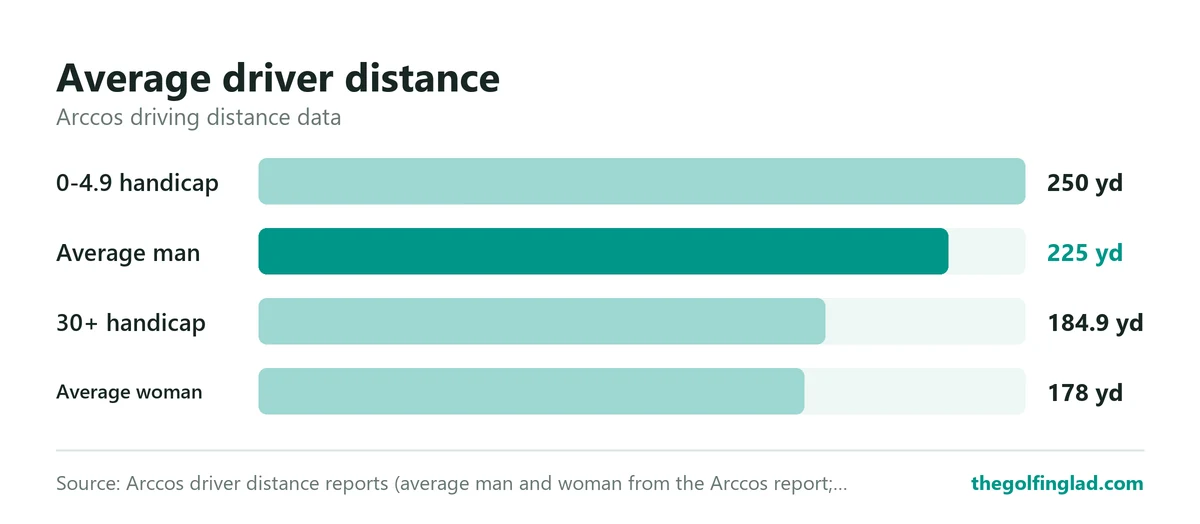
Driver distance follows handicap more than age
Arccos tracked more than a billion shots for its driving report. Its headline for the average golfer was that men average about 225 yards and women about 178 yards.
not much has changed in terms of distance for the average golfer
Arccos, driver distance report
So the new driver in your bag is not worth 15 yards on its own. Skill and strike decide most of your driver distance, and the averages for low and high handicaps sit a long way apart.
Age matters too, just less. Players aged 15 to 19 averaged 240.0 yards and players in their 70s 190.0, about 50 yards. If you are in that bracket, our guide to lightweight clubs for seniors is the place to start.
Worth knowing: Women average about 15 to 25 yards shorter than men across the irons. If you play a women’s set, shift every number in the tables down accordingly, then check it against your own shots.
Your iron distances start with the 7-iron
Every other iron hangs off the 7. Get that number right and the rest is arithmetic. Here is 7-iron carry by handicap from published handicap charts:
| Handicap | 7-iron carry (yd) |
|---|---|
| 5 | 164 |
| 15 | 154 |
| 20 | 146 |
| 25 | 132 |
Look at the slide from 20 to 25. That is 14 yards, a whole club and a bit. A 25 handicap who plays the 150-yard number from a 15-handicap article will be short every time.
Back to the bunker. If the front lip sits at 150 and you are a 20 handicap carrying 146, that 7-iron never clears it. Take the 6-iron, or aim for the middle of the green and accept a longer putt.
The rule: find your handicap row, play that carry number, and when the flag is behind trouble, add a club.
Gaps between clubs matter more than averages
Run the amateur chart above and the gaps jump out. 7-iron to 8-iron is 8 yards. 9-iron to pitching wedge is 21. Driver to 3-wood is 30, and 3-wood to 4-iron is 26.
Gaps of 10 to 15 yards are fine. A gap of 20-plus is where you end up hitting a hard wedge or a soft 9-iron, and those are the shots that go wrong.
If you have a hole like that, the fix is usually one club, not a new set. Our piece on what makes a golf club forgiving explains why the long irons are the first ones to swap for a hybrid.
The rule: write down your carry for every club, circle any gap over 20 yards, and fill that gap before you buy anything else.
How to find your real golf club distances
Swing speed explains most of it. A typical male amateur is around 90 to 95 mph with driver, a scratch player 95 to 105 mph, and a typical woman amateur 75 to 85 mph. You can estimate from that, or you can measure.
The PRGR HS 130-A is the pocket-size route. Its distributor lists swing speed, ball speed, smash factor, carry and total distance, plus club head speed on practice swings without a ball. It runs on four AAA batteries, needs no app or Wi-Fi, and keeps your last 500 shots.

- ACCURATE GOLF LAUNCH MONITOR – The PRGR Launch Monitor accurately tracks club head speed (with or without a ball), ball speed, smash factor, total & carry distance using advanced doppler radar technology.
- MOST AFFORDABLE LAUNCH MONITOR IN GOLF – Get precise golf swing data for a fraction of the price of high-end launch monitors. No Wi-Fi, Bluetooth, or apps required. Runs on AAA batteries.
- COMPARES TO THE HIGH-END UNITS - The PRGR’s golf swing speed monitor delivers accurate data using precise algorithms and keeps 500 past swings in memory.
- PERSONAL LAUNCH MONITOR OF CHOICE FOR PADRAIG HARRINGTON - 3-Time Major Champion and Hall of Famer Padraig Harrington trusts the PRGR to provide accurate feedback for his golf swing speed training sessions.
- PERFECT FOR SPEED TRAINING & MULTI-SPORT USE - One of the only golf launch monitors that measures club head speed without a ball, making it ideal for swing speed training. Also works for Baseball, Tennis, Soccer, and Hockey.

The catch is the range. A retailer spec lists a measuring range of 135 to 270 yards, so check that before you count on it for wedge distances. For irons and driver it covers what most of us hit.
If a launch monitor feels like too much, a yardage book costs far less. Take one to the range, hit ten balls with each club, and write down where most of them landed. Throw out the best and the worst.

- A Must For Every Golfer: This Golf yardage book helps you deliver those winning shots every time
- Made in USA: A must-have golf bag accessory manufactured in the USA with thick premium quality paper
- What's Included: Get 4 blank golf yardage books with 42 pages including a golf club yardage matrix
- Conforming Design: USGA Rule Conforming for tour yardage books (rule 4.3) sized at 4x6.5 inch
- Practical Design: Our golf yardage notebook fits most golf yardage book holders in your back pocket
What to buy, by kind of golfer
- If you play twice a month and have never measured anything, get a yardage book and a range session. That is all you need.
- If you practise weekly and change clubs often, buy the PRGR. It gives you carry numbers you can trust more than a chart.
- If you are building your first bag, skip the distance chasing and read what clubs a beginner should buy first.
Questions golfers ask about club distances
Should I use carry or total distance?
Carry. It is what clears the bunker or the water. Total distance adds roughly 5 to 15 yards depending on how firm the course is, so it changes round to round.
How far should a 15 handicap hit a 7-iron?
About 154 yards of carry on the handicap charts. The single average-amateur chart above says 146. If you land between the two, you are normal.
Why do I hit shorter than the chart?
Most charts blend good and bad strikes from players who also overestimate themselves. Mis-hits cost more distance than slow swings do, so a better strike often beats a faster swing.
Do new clubs add distance?
Rarely enough to count. Arccos found the average golfer’s distance had barely moved, so spend on a fitting before you spend on a headline number.
The verdict
Use the charts to know roughly where you stand, then replace them with your own measured carries. That is the whole job of a golf club distance chart.
If you are still deciding what to put in the bag, start with our guide to the best golf clubs for beginners and match the clubs to the numbers you just wrote down.
By The Golfing Lad
3 thoughts on “Golf club distance chart: how far you really hit (2026)”
Comments are closed.