Golf simulator room dimensions: the ceiling height you need (2026)
As an Amazon Associate I earn from qualifying purchases.
CERTAIN CONTENT THAT APPEARS ON THIS SITE COMES FROM AMAZON. THIS CONTENT IS PROVIDED ‘AS IS’ AND IS SUBJECT TO CHANGE OR REMOVAL AT ANY TIME.
If you buy through links on this page we may earn a commission, at no extra cost to you.
The tape says 9 feet, the joists are right there, and you are standing in the garage doing slow practice swings with a driver and one eye on the ceiling. That is the moment most simulator plans live or die, long before any launch monitor arrives.
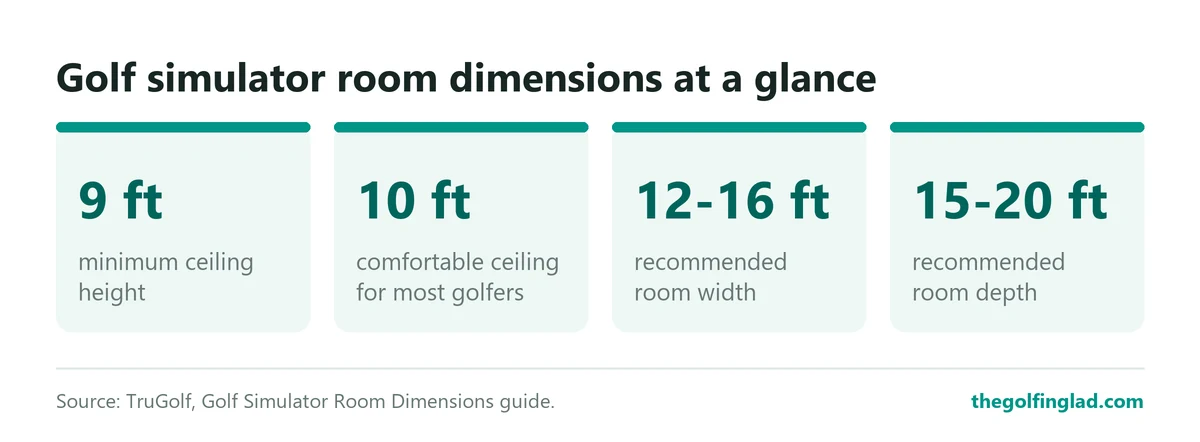
Short answer: Plan for at least 10 ft wide, 12 ft deep and a 9 ft ceiling. Aim for 12 to 16 ft wide, 15 to 20 ft deep and a 10 ft ceiling. Ceiling height is the one number you cannot fix later. A monitor that sits beside the ball needs far less depth than one that sits behind it.
Every guide you will find gives you a different set of dimensions, mostly because they assume different monitors, screens and golfers. So here is how the numbers fit together, what each one is really measuring, and which launch monitor makes the most of a tight room.
The golf simulator room dimensions most guides agree on
The cleanest starting point is TruGolf’s room guide, which splits the answer into three tiers. The two monitor makers I checked land close to it.
| Setup | Width | Depth | Ceiling |
|---|---|---|---|
| Minimum (TruGolf) | 10 ft | 12 ft | 9 ft |
| Recommended (TruGolf) | 12 to 16 ft | 15 to 20 ft | 10 ft |
| Ideal for tall golfers (TruGolf) | 12+ ft | 15+ ft | 10.5 to 12 ft |
| SkyTrak’s planning page | 12 ft at least | 17 ft total | 9 ft minimum |
| Rapsodo MLM2PRO, PlayBetter’s comfortable size | 10 ft | 21.5 ft | 9 ft |
Read the table as a ladder. The minimum row gets you hitting. The recommended row gets you hitting without thinking about the walls.
The Rapsodo row looks greedy on depth because that unit sits behind the ball. More on that below, because depth is where the real choice is.
Ceiling height is the number you cannot fix
TruGolf puts it bluntly: “Ceiling height cannot be easily modified after installation. It is the dimension to prioritize first.” You can move a couch, shrink a net or buy a different monitor. You cannot add a foot of ceiling.
The same guide calls 9 ft the minimum, 10 ft comfortable for most golfers, and 10.5 to 12 ft ideal for taller players. That is the ceiling guidance in one line. Your own swing decides where in that range you sit.
Home Performance Lab’s ceiling breakdown ties it to your build:
- Under 5 ft 6 in with a flat swing: 8.5 ft minimum.
- 5 ft 6 in to 6 ft with a neutral swing: 9.5 ft minimum.
- 6 ft to 6 ft 4 in with an upright swing: 10.5 to 11 ft minimum.
- By club, wedges and short irons need 8 to 8.5 ft, while a driver needs 9 to 10 ft depending on your height.
Then take some of it back. The same page says a premium mat of 1.5 to 2 in, foam tiles and subfloor layers eat 2 to 4 in, so a 9 ft ceiling behaves like 8 ft 8 in to 8 ft 10 in once the floor is down.
Worth knowing: Enclosure frames take height too. The same page lists a 9×12 Carl’s Place frame at 114 in, which needs about 9 ft 10 in of finished room, and a SIG10 at 100 in, which needs a 9 ft room by the maker’s minimum. A ceiling-mounted Uneekor unit wants 9 ft to the bottom of the sensor, with 9.5 ft recommended.
What do 9-footers actually say? Assembled Golf’s ceiling guide quotes a Reddit thread where a 6 ft 3 in golfer wrote that he could “comfortably swing all irons and probably hybrid but initially got too close for comfort with driver.” Another commenter in the same thread, a better swinger, said he could swing a full driver with no fear.
Once you hit the ceiling on a full swing it will always be on your mind.
A commenter quoted in Assembled Golf’s ceiling guide
That last point matters. Home Performance Lab describes “indoor swing syndrome”, where a low ceiling makes you swing shorter even when there is clearance, and it cites community reports of 5 to 10+ mph less clubhead speed indoors. Treat that as owner talk, not lab data. It still tells you to leave a margin.
Rule: take full practice swings with your longest club in the exact spot where the mat will go, ideally with someone filming. If the club head passes within a hand’s width of the ceiling, you need a higher room or a plan to skip the driver.
Golf simulator room size is really two depths added together
How much space do you need for a golf simulator front to back? Add the room behind you to the distance from ball to screen. TruGolf puts the mat-to-screen gap at 8 to 10 ft and the room behind the golfer at 5 to 6 ft minimum, which is how it gets to 15 to 20 ft total.
Where the monitor sits changes that sum. Take a radar-style unit that lives behind the ball. For the Rapsodo MLM2PRO, PlayBetter’s write-up has it sitting 6.5 to 8.5 ft behind the ball, with about 8 ft from ball to net, which is a little over 14 ft of depth at the bare minimum.
Add 1 ft behind the net so it can flex without the ball coming straight back, and the same write-up lands near 15.5 ft. Give the unit the full 8.5 ft and a 13 ft ball-to-screen gap for the best readings, and you reach the 21.5 ft comfortable figure in the table.
Now take a camera unit that sits beside the ball. SkyTrak says that, “Unlike radar based systems that require 15+ feet of ‘ball flight’ distance to track data, SKYTRAK sits directly beside the ball.” That is why its planning page asks for 17 ft total with an enclosure and a safety buffer, not the 21.5 ft of the comfortable radar setup.
Rule: if your room is under 18 ft deep, shop for a monitor that sits beside the ball and check the maker’s own depth figure before you order. If you have 18 ft or more, any monitor works and the choice is about software and budget.
Width decides whether lefties and righties can share
Width is the forgiving dimension until someone left-handed walks in. Golf Simulator Advisor suggests 10 ft for a single player and 12 ft if both right- and left-handed golfers will use the room.
Golfers Authority goes wider, at 14 to 15 ft if you want to accommodate both hands. Check the screen too: SkyTrak says its screens and nets run from 8 to 13 ft wide, and your walls have to clear whichever you choose.
Rule: a solo right-hander can live with 10 ft. If a left-handed friend or kid will ever hit, plan for 14 ft and move the mat to the middle.
Which monitor suits a tight room
If depth is your problem, these are the monitors worth a look. For a head-to-head on what each does with a screen and software, see our best golf launch monitors guide.
SkyTrak ST MAX: the pick at about 17 ft of depth
It belongs here because of the layout, not a spec I can quote for this model. SkyTrak’s own planning page describes its photometric monitors as sitting beside the ball, so you are not spending 6 to 8 ft of room on the unit. The catch is that the page still recommends 17 ft total for an enclosure, so it is not the answer for a room under that.

- Includes 1 year of Core Foresight software at no additional cost
- Speed Training powered by GOLFTEC, exclusive to the ST MAX: guided drills and measurable insights help you build swing speed and unlock more distance
- Measures carry, total distance, ball speed, spin, launch angle, club head speed, smash factor, club path, face angle and face-to-path for a complete picture of every shot
- Built-in game improvement tools include skills assessments, bag mapping, randomized practice and the wedge matrix to help you dial in your distances
- Charge and play with dual USB-C ports for simultaneous charging and data transfer, plus a redesigned modular interior built for long-term calibration stability
Garmin Approach R50: sits beside the ball, but plan on 15 ft
PlayBetter’s R50 space page describes a photometric camera system that sits to the side of the ball rather than behind it. Guides disagree on depth, from a bare 10 x 10 x 9 ft net setup up to a 17 ft minimum depth, so plan on at least 15 ft if you hit drivers into a screen.

- Fine-tune your form with this premium launch monitor and simulator that utilizes a 3-camera system for precision metrics
- Tap into insights, select courses, review impact videos, or play a virtual round (subscription required) straight from the 10” built-in color touchscreen display
- Use advanced measurements to dial in your swing, including ball speed, launch angle, face to path (included tracking sticker required) as well as improved spin rate and axis both indoors and outside
- Understand every part of your game with training mode, which tracks stats for each club and shows a shot dispersion chart based on an advanced ball flight trajectory model
- Play virtual rounds — including putting — with up to four players on more than 43,000 courses through the Home Tee Hero (active Garmin Golf membership required); participate in a weekly tournament with scores posted to our global leaderboard — all viewable from the Approach R50 display

Rapsodo MLM2PRO: the alternative if you have the length
The MLM2PRO suits a long, narrow garage better than a squat one. Budget a little over 14 ft at the bare minimum, closer to 15.5 ft with room behind the net, and 21.5 ft if you want the comfortable setup PlayBetter describes. It is the radar-style example in the sums above. If you have the room, the sums work in its favour.

- TOUR LEVEL SHOT TRACK ACCURACY — Doppler radar & dual camera setup ensure reliable data on every shot to help you improve faster.
- 15 KEY METRICS CAPTURED — measure spin rate, spin axis, carry distance, club speed, club path, launch angle, and more.
- 21 DAY PREMIUM/CORE TRIAL INCLUDED — Unlock simulated courses, 3rd party app integration, target range, impact vision, rapsoo combine, and speed training with your free trial premium membership.
- 30,000+ HOME GOLF SIMULATOR COURSES INCLUDED WITH PREMIUM — play iconic courses or dial in your game with customizable driving range. Multiple tee boxes and game formats for every age or skill level.
- ELITE GOLF SWING TRAINIG AID & LAUNCH MONITOR — capture your swing from any angle to identify patterns, plus view precise club/ball contact in slow motion for deeper insights into your game.
What’s good
- Beside-the-ball monitors save 6 to 8 ft of depth
- Net setups work from about 10 ft of width
- A 9 ft ceiling handles a driver for many golfers
What’s not
- A 9 ft ceiling loses 2 to 4 in to flooring
- Taller golfers may be limited to irons at 9 ft
- Behind-the-ball monitors push depth toward 21.5 ft
What to measure before you buy anything
Measure the finished room, not the framing. Subtract the floor build-up from the ceiling and write down the real height. Then measure the distance from the wall where the screen will hang to the far wall behind the mat.
- Ceiling to the top of the mat, then swing your longest club.
- Screen wall to back wall, minus 1 ft behind the screen.
- Side wall to side wall, centered on the mat.
- Add the enclosure frame height to the ceiling check.
If the numbers fall short, our guide to building a home golf simulator on a budget covers cheaper ways to shape the space, and the golf simulator vs launch monitor comparison helps if you are still deciding whether you need a full screen at all.
What I would buy for your room
- You play twice a month, have a 9 ft garage ceiling and about 15 ft of depth: a beside-the-ball monitor, a net, and irons-first expectations. Do the driver swing test before you order.
- You are 6 ft 2 in or taller with an upright swing and a 9 ft ceiling: do not build there. The guidance for your swing is 10.5 to 11 ft, and that is a different room.
- You have a spare room at 10 ft ceiling, 14 ft wide and 18 ft deep: any monitor works, and you can add a left-handed friend without moving furniture.
- You have a long, narrow space of 20 ft or more with a 10 ft ceiling: the radar-style Rapsodo gets its full 21.5 ft setup there.
Common questions about room size
Can I build a golf simulator with an 8 ft ceiling?
Assembled Golf lists 8 ft as the absolute minimum, for wedges and irons only. Home Performance Lab agrees that wedges and short irons need 8 to 8.5 ft. If you want a driver, look for a different room.
Is a 10 by 10 room enough?
For a net and a beside-the-ball monitor, PlayBetter’s R50 page gives 10 ft wide, 10 ft deep and 9 ft tall. That is a bare minimum, and other guides want 15 ft of depth for drivers, so treat 10 by 10 as an irons-and-wedges room.
Do I need space behind the screen?
Yes. One guide gives 12 to 16 in between the screen and the wall, and the Rapsodo guidance above asks for 1 ft or more so the net can flex.
How far should the ball be from the screen?
TruGolf says 8 to 10 ft from mat to screen. For the best Rapsodo readings, PlayBetter recommends 13 ft.
The verdict on room size
Measure the ceiling first, swing your driver in the spot second, and only then pick a monitor to match the depth you have. If you want the full ranking with the monitors that suit tight rooms, start with our best golf launch monitors for 2026, then see the best home golf simulators for complete packages.
By The Golfing Lad
2 thoughts on “Golf simulator room dimensions: the ceiling height you need (2026)”
Comments are closed.