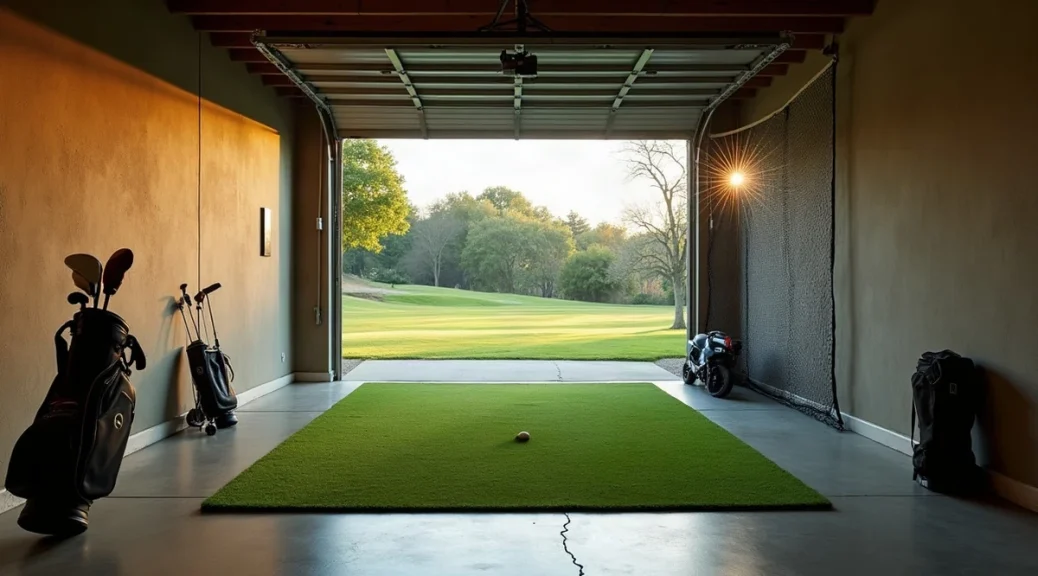
How to build a golf practice area at home (2026 guide)
As an Amazon Associate I earn from qualifying purchases.
CERTAIN CONTENT THAT APPEARS ON THIS SITE COMES FROM AMAZON. THIS CONTENT IS PROVIDED ‘AS IS’ AND IS SUBJECT TO CHANGE OR REMOVAL AT ANY TIME.
If you buy through links on this page we may earn a commission, at no extra cost to you.
Most home golf setups fail the same way. Someone buys a net on a Friday, unpacks it on Saturday, and finds the garage is two feet too short for a driver swing. The net goes back in its bag and stays there.
Measure first. Everything else in a home golf practice setup follows from the space you actually have.
Short answer: Pick the room before the gear. Indoors you need roughly 9 feet of ceiling, 10 feet of width and about 15 feet of length. In the yard you want 20 to 30 feet from mat to net. Then buy a proper net, a mat of at least 4×5 feet, and only add a launch monitor if the room allows it.
The numbers that decide what you can build
Here is the part a quick search tends to bury. The space numbers below come from a mix of the maker’s own manual and retailer setup guides, and they agree more than they differ.
| Setup | Length | Width | Height |
|---|---|---|---|
| Indoor net plus Garmin R10 | 15 ft minimum | 10 ft | 9 ft |
| Indoor, driver swing | n/a | 10 ft for a net | 9 to 10 ft |
| Backyard net, full swing | 20 to 30 ft mat to net, plus 10 to 15 ft behind it | 12 to 15 ft net, 5 to 10 ft each side | 12 to 15 ft overhead |
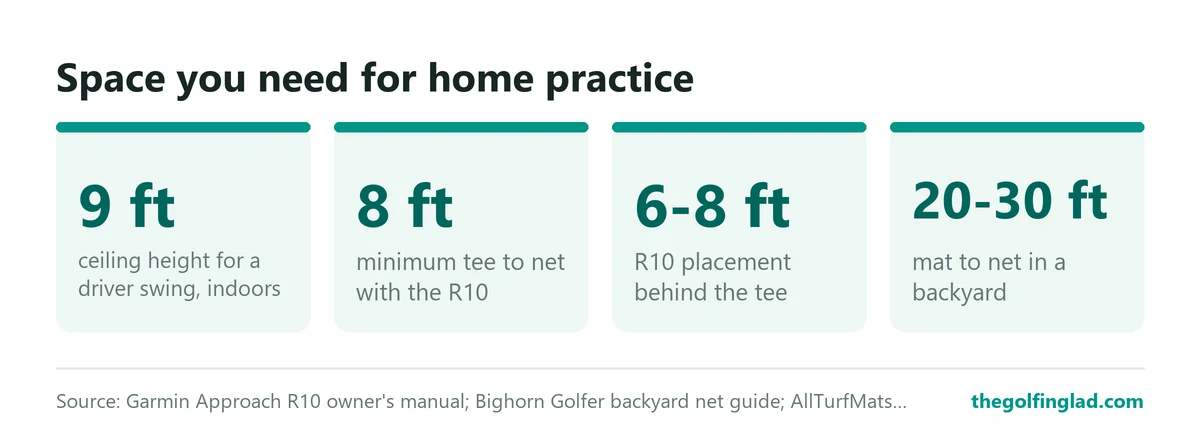
Read that table twice. The indoor and outdoor builds are different projects, not the same one in different sizes.
Indoors: the ceiling is the first veto
Most golfers need around 9 feet of clearance above the hitting spot for a full driver swing, and 10 feet is the usual standard for taller players. At 8 feet you are an iron-and-wedge golfer.
Do not trust a tape measure alone. Stand where you would hit, take a slow full backswing and follow-through with your longest club, mark the highest points on the ceiling, and add 6 to 9 inches.
Worth knowing: a garage with a door track or a light fixture sitting in the swing arc is the classic trap. Check the finish of your swing, not just the top of it.
Rule you can use: if you cannot swing a driver slowly without touching anything, buy a chipping net and a short-game setup, not a full cage.
Outdoors: space is the easy part, anchoring is not
A yard gives you height for free. What it takes away is shelter and a flat floor. One setup guide lists the usual mistakes: putting the net too near a property line, facing it into afternoon sun, setting it in a low spot that floods, parking it under a big tree, or building on a slope.
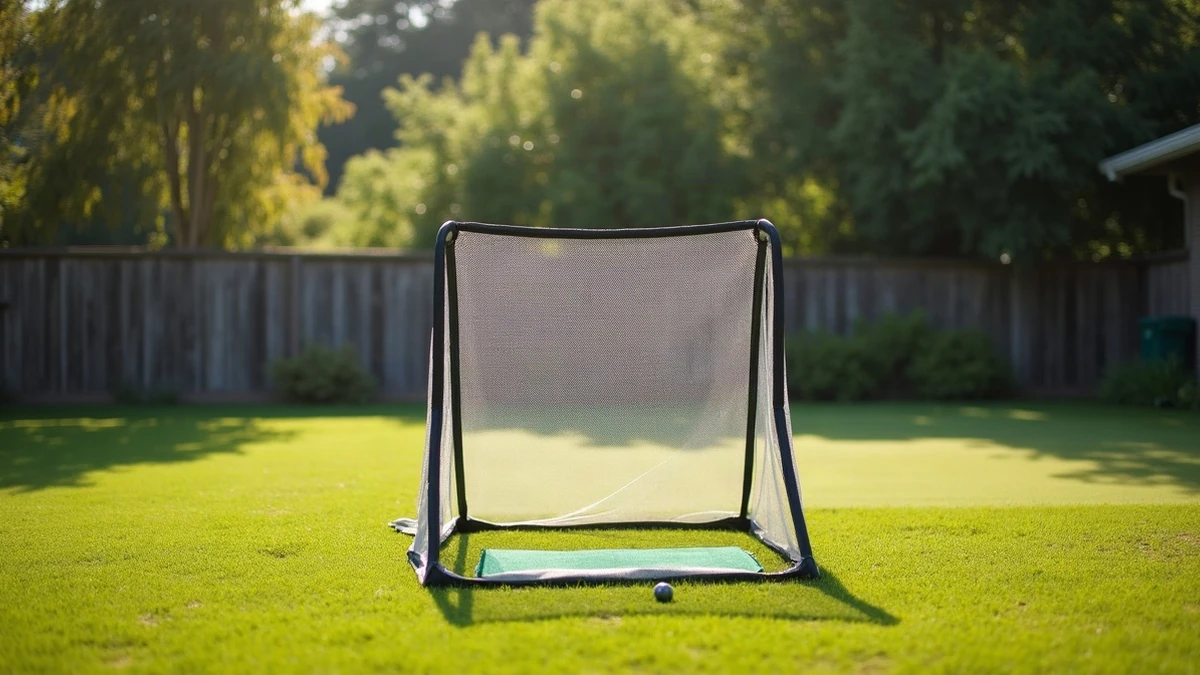
Anchoring matters more than you would think. The same guide suggests 18 to 24 inch ground stakes on grass, with 6 to 8 anchor points for most nets, and 50 to 75 lbs of sandbag per corner on concrete.
Also, never hit off the grass in front of the net. You will chew it up, and the lies will teach you nothing. Put a mat down.
Rule: if the yard is smaller than 20 feet from tee to net, or there is a window within reach of a bad hook, stay with chipping. Our roundups of backyard golf nets and practice nets for indoor and outdoor use cover the sizes in detail.
The net: buy the cage, not the flat sheet
A flat sheet stretched between two poles stops a ball. It does not tolerate a thinned 7-iron that comes back at you. A cage-style net with side walls and a depth to it catches the ball that flies off line.
The Rukket Haack Pro is the sort of cage net I would look at first for a driveway or a large garage. The maker pitches it as a quick fold-up with a carry bag, and it has a following with people who set up and pack away for each session.

The catch is footprint. A cage that size wants the 10 feet of width in the table above and a clear run behind you, so it is a poor fit for a spare bedroom.
The mat: size and cushion beat looks
You want at least 4 by 5 feet. Bigger, around 5 by 6 feet, lets you move the ball around so you are not hitting the same worn spot all night.
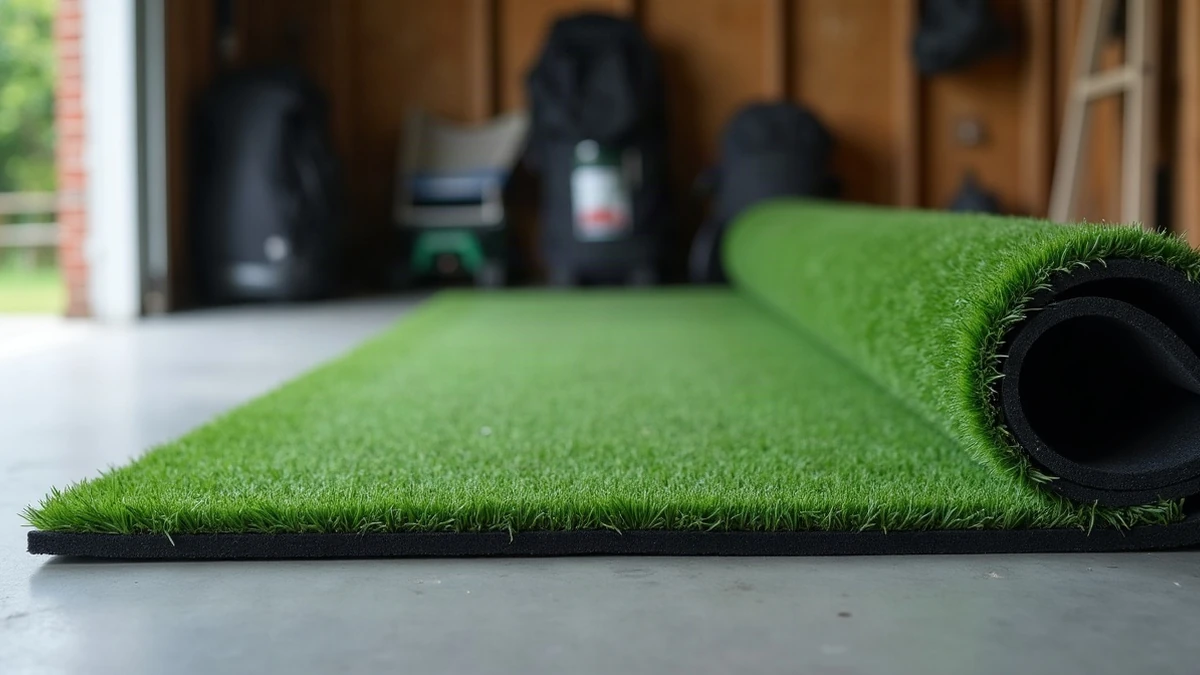
The cushion matters more than the turf. Reviewers who write about this converge on at least half an inch of foam or dense rubber under the turf as the floor for comfortable repeated practice, and more if you are on concrete. A thin mat on a garage floor is how you get a sore elbow in week three.
The Country Club Elite 4×5 is the size to start with, and it matches the minimum above.

- REALISTIC FAIRWAY FEEDBACK: Dense turf fibers let the clubhead move down and through the surface, helping golfers recognize fat contact and develop more consistent ball striking without the unwanted bounce of harder practice mats
- TAKES A REAL TEE: Insert a wooden or plastic tee directly into the turf to practice drives at your preferred height. An adjustable plastic tee is also included for a convenient alternative
- STABLE PRACTICE SURFACE: Commercial-grade base stays secure underfoot and cushions impact during extended practice, creating a comfortable and dependable surface for full swings
- BUILT FOR REPEATED USE: Durable nylon fibers resist wear while maintaining consistent feel and performance through regular practice with drivers, woods, irons, and wedges
- GENEROUS 4 FT X 5 FT PLATFORM: Provides comfortable stance and hitting room in a streamlined footprint that fits easily into home practice spaces, garages, teaching studios, and golf simulator bays.
Skip it if you want a big shock-absorbing mat for daily driver sessions. Our hitting mat rankings and the home practice mat guide show where a thicker mat is worth the money.
A launch monitor is the optional, awkward upgrade
A monitor tells you carry, ball speed and club speed, which a net never will. The Garmin Approach R10 is the obvious entry point.
The room has to fit it, though. Garmin’s own manual puts the monitor on the ground 6 to 8 feet behind the tee, and says the tee must be at least 8 feet from the net when playing indoors. That is 14 to 16 feet before you count the net, which is why the room length matters.
The tee location must be at least 8 ft. (2.4 m) away from the net when playing indoors
Garmin, Approach R10 owner’s manual
Now the real cons. Owners on the Garmin forum report that tight rooms hurt the numbers. One wrote that:
Most of us cannot get the device to be accurate distance-wise even with 10 feet between ball and net
Sdee, Garmin Forums
That is one thread, not a verdict, but it matches a common complaint: indoors the spin and distance numbers need a healthy dose of salt.

- This Bundle Contains: 1 Garmin Approach R10, Portable Golf Launch Monitor, Take Your Game Home, Indoors or to The Driving Range, Up to 10 Hours Battery Life + 1 Signature Series Microfiber Cloth + 1 Signature Series 5000mAh Portable Power Bank with Wall Charger and Car Plug Adapter
- Work to improve your game at home, indoors or on the driving range with a portable launch monitor. Track key metrics when paired with a compatible smartphone with the Garmin Golf app to help better your shot consistency, including club head speed, ball speed, swing tempo, ball spin, launch angle and more
- Enjoy more time on the range with up to 10 hours of battery life. Understand your golf strengths and areas for improvement by using training mode, which tracks stats for each club and shows a shot dispersion chart based on estimated ball flight using the Garmin Golf app
- You are up to three other golfers can likely play your own home course or even a course you're going to play on your next trip with virtual rounds for more than 42,000 worldwide courses. See and analyze your own swing with automatically recorded video clips that include the metrics of that swing when paired with a compatible smartphone with the Garmin Golf app
- Included phone mount easily attaches to a golf bag for better viewing and easier interaction with the Garmin Golf app. With an active subscription and the Garmin Golf app, play virtual rounds on over 42,000 courses around the world and take part in a weekly tournament with scores posted to our global leaderboard
Rule: buy it if you have 20 feet or more of room and want to chase club speed and strike. Skip it if you are squeezed into the 15 foot minimum and expect the carry number to be right.
What to buy, by kind of golfer
- You play twice a month with a spare corner of the garage under 9 feet high: a chipping net and a small mat, plus a putting mat for evenings. Our putting mat roundup is the place to start.
- You have a yard of 20 to 30 feet clear and a shed for storage: a cage net, a 4×5 mat and ground stakes.
- You have a 10 foot ceiling and a room that is 15 feet or longer: net, mat and, if you must, the R10.
Questions people ask
How much space do I need for a backyard golf net?
Plan on 20 to 30 feet from mat to net, a net 12 to 15 feet wide, and 10 to 15 feet clear behind it. If you cannot find that, go to chipping.
Can I practise in a garage with an 8 foot ceiling?
Yes for wedges and short irons. For a driver you want 9 to 10 feet, so test with a slow swing before you buy anything.
Do I need a launch monitor to practise at home?
No. A net and a good mat do most of the work. Add a monitor only when the room gives it the 14 to 16 feet it needs ahead of the net.
The verdict
Start with a tape measure, then a mat, then a net, in that order. A launch monitor comes last, and only if the room is longer than the bare minimum.
If your space is tight, put the money into a good putting surface first. Our best putting mats guide is the cheapest way to turn dead evenings into practice.
By The Golfing Lad
One thought on “How to build a golf practice area at home (2026 guide)”
Comments are closed.