Best Golf Balls Under $30
Why Budget Golf Balls Matter More Than You Think
Look, I get it. When you see Tour pros spinning Pro V1s into every green, it’s tempting to think you need a $55 dozen to play decent golf. But here’s the truth most golfers learn the hard way: losing a Pro V1 in the woods stings a lot more than losing a ball that costs a third of the price. That’s exactly why finding the best golf balls under $30 is one of the smartest things you can do for your game and your wallet.
The budget golf ball market has gotten ridiculously good over the last few years. We’re talking balls with urethane covers, low compression cores, and real spin technology — stuff that used to cost $40+ is now sitting on shelves for under 30 bucks. Manufacturers figured out that most golfers don’t need Tour-level spin rates. They need a ball that feels good off the driver, flies reasonably straight, and doesn’t punish imperfections.
If you’re a high handicapper losing three to five balls a round — and most of us are — playing affordable golf balls isn’t just smart budgeting. It’s actually better for your scorecard. When you’re not worried about losing a $4 ball, you swing freer. You commit to shots. You play more aggressively. That mental freedom matters way more than whatever spin advantage a premium ball gives you.
I’ve tested dozens of cheap golf balls over the past year, and I’ve narrowed it down to seven that genuinely deliver. These aren’t just “acceptable for the price” — they’re good balls, period. Let’s dig into what makes the best golf balls under $30 worth your attention and which ones deserve a spot in your bag.
What to Look for in Golf Balls Under $30
Before we get to the reviews, let’s talk about what actually matters when you’re shopping for budget golf balls. Because not all cheap golf balls are created equal, and knowing what to look for separates a great value from a dud.
Compression
Compression is how much the ball deforms at impact. Lower compression balls (30-50) compress more easily, which means they fly farther and feel softer for golfers with slower swing speeds. If you swing under 90 mph — and that’s most weekend golfers — a low compression ball is your best friend. High compression balls (70-100+) require fast swing speeds to activate the core. Most of the best value golf balls in the under-$30 range lean low compression, which is exactly what the average golfer needs.
Cover Material
You’ve got two main options: Surlyn (ionomer) and urethane. Surlyn covers are more durable and resist scuffs, but they spin less on short shots. Urethane covers spin more around the greens and feel softer, but they scuff easier and cost more. In the budget range, most balls use Surlyn — but there are exceptions (looking at you, Kirkland Performance+) that offer urethane at a crazy price. For most golfers searching for golf balls under 30 dollars, Surlyn is perfectly fine. You’re not generating Tour-level spin anyway.
Construction
Two-piece balls have a core and a cover. Simple, durable, long on distance. Three-piece balls add a mantle layer between core and cover, which can improve feel and spin separation. Most affordable golf balls are two-piece, which is honestly ideal for beginners and high handicappers. Less layers means more consistent performance and fewer things that can go wrong.
Spin and Feel
Here’s the deal: low spin off the driver is good (straighter flights), and higher spin on short shots is good (more control around greens). Budget balls tend to favor low overall spin, which helps with distance and accuracy — two things most weekend golfers need more than Tour-level greenside spin. Feel is subjective. Some golfers love a mushy soft ball. Others want something firmer. I’ll note the feel characteristics of each ball so you can match it to your preference.
The key takeaway? Don’t overthink it. The best golf balls under $30 are designed for the average golfer. Pick the one that matches your swing speed and feel preference, and you’ll be just fine.
Callaway Supersoft (2025) — Best Overall

- Increased Ball Speed with Soft Feel. The HyperElastic SoftFast Core is engineered for faster driver and iron speed, with soft greenside feel.
- Exceptional Feel, Control and Spin with Long Distance. Supersoft’s Hybrid Cover combines maximized distance with soft feel and durability.
- Greenside Spin and Control. New cover system for enhanced control on approach shots and short game shots.

The 2025 Callaway Supersoft is the gold standard for budget golf balls, and it’s not even close. This is the ball I reach for when someone asks me, “What should I play that won’t cost me a fortune?” It’s been the go-to recommendation for best golf balls under $30 for years, and the 2025 version keeps that streak alive.
Let’s start with the feel. The Supersoft has a compression of around 38, making it one of the softest balls on the market. When you catch one flush with a mid-iron, there’s this buttery sensation through your hands that makes you want to hit another one immediately. It’s that good. For golfers with swing speeds under 95 mph — which is most of us — this low compression means the core actually compresses at impact, transferring energy efficiently and generating real distance.
The 2025 model features Callaway’s new Hybrid Cover, which combines a soft inner layer with a durable outer cover. What does that mean in plain English? You get a ball that feels soft off every club but doesn’t shred after two holes with a wedge. The cover technology has steadily improved over the years, and this latest version is the most durable Supersoft yet.
Off the driver, the Supersoft is a launcher. Low spin plus low compression equals high launch angles and carry distances that’ll make you check your GPS twice. It’s not going to run through the fairway like a harder ball, but that higher flight means more carry — which is where most amateur golfers pick up their distance. If you struggle to get the ball in the air off the tee, the Supersoft might be the easiest fix available for under 30 dollars.
Around the greens, it’s solid if not spectacular. You’ll get adequate spin on chips and pitches, and the soft feel makes distance control on putts very intuitive. It’s not going to zip back six feet like a Pro V1, but you’re not hitting those shots anyway. For 90% of your short game situations, the Supersoft gives you everything you need.
The bottom line: if you want one ball that does everything well at a price that doesn’t make you wince when it lands in the water, the Callaway Supersoft is the best golf ball under $30 you can buy. It’s consistent, it’s soft, and it flies far. What else do you want?
Srixon Soft Feel — Best for Beginners

- Soft Without Compromise: If feel is what matters most to you, play Soft Feel for maximum all-around performance. Soft Feel technology provides responsive feel for excellent control from tee to green.
- Increased Distance: Engineered for maximum distance with a high-energy core that boosts ball speed, ideal for golfers seeking longer drives.
- Low Compression: Perfect for golfers with slower or medium swing speeds, delivering a soft feel and easy launch for improved accuracy and control.
- 338 Speed Dimple Pattern: Speed dimples reduce drag at launch increase lift during descent. The soft thin cover provides less spin off the driver but more greenside spin and a softer feel on pitches, chips, and putts.
- Affordable Performance: Offering premium features at an exceptional value, the Soft Feel golf balls deliver great performance without the premium price tag.
If the Supersoft is the king of budget golf balls, the Srixon Soft Feel is the prince waiting in the wings. This ball has quietly been one of the best value golf balls on the market for years, and the latest version continues that tradition of understated excellence.
Srixon designed this ball with one thing in mind: making golf easier for regular golfers. The Soft Feel uses a 60 compression core, which is slightly firmer than the Supersoft but still very much in the “soft” category. That slightly higher compression gives it a touch more stability through impact, which translates to a bit more consistency on mis-hits. For beginners who don’t always catch the ball flush, that’s a real advantage.
The cover is Srixon’s FastLayer Core technology, which gradually transitions from soft in the center to firm around the edges. This is clever engineering. You get the soft feel and high launch from the inner core, plus the distance and durability from the firmer outer layers. It’s a two-piece ball, so it’s simple and reliable — exactly what new golfers need.
Where the Soft Feel really shines is consistency. This ball goes remarkably similar distances shot after shot, even when your contact varies. That predictability is worth its weight in gold for beginners who are still learning their distances. Nothing kills confidence faster than hitting two 7-irons 20 yards apart with no idea why. The Srixon Soft Feel minimizes those wild variations.
Off the putter, it’s got a nice, responsive feel. Not as marshmallow-soft as the Wilson Duo, but a pleasant, cushioned sensation that gives you good feedback. On chips and pitches, the ionomer cover produces moderate spin — enough to stop the ball on your target, not enough to make you look like you’re playing a different sport than your buddies.
For golfers who are just starting out or high handicappers looking for a reliable, affordable golf ball, the Srixon Soft Feel is hard to beat. It’s forgiving, it’s consistent, and at its price point, it’s one of the best golf balls under $30 for building confidence on the course. Pair it with a solid fundamentals routine and you’ll see real improvement.
Wilson Duo Soft (2025) — Softest Feel

- Wilson 2025 Duo Soft Golf Balls - White, 12 Balls
- WORLD'S SOFTEST GOLF BALL: Industry-leading feel that delivers exceptional feedback on all shots.
- HIGH ENERGY CORE: Delivers maximum distance off the tee.
- STRAIGHTER FLIGHT: Two-layer construction reduces spin on longer shots.
If you’re the kind of golfer who loves a ball that feels like you’re hitting a marshmallow through a cloud, the Wilson Duo Soft is your jam. With a compression of roughly 35, this is officially the lowest compression golf ball on the market. It is absurdly soft. And for some golfers, that makes it one of the best golf balls under $30 available.
The Duo Soft has been Wilson’s flagship budget ball for years, and the 2025 version refines the formula without reinventing it. The core is as soft as ever, giving you that signature feel off every club. When you catch a driver flush, the Duo Soft almost feels like the ball compresses around the face for a split second. It’s a unique sensation that softer-swinging golfers absolutely love.
Distance-wise, the Duo Soft holds its own. The ultra-low compression means slower swing speeds can fully activate the core, which translates to efficient energy transfer and solid carry distances. Is it as long as a harder ball for a fast swinger? No. But if your swing speed is in the 70-85 mph range, this ball will fly every bit as far as anything else on this list. Maybe farther, because you’re actually compressing the thing.
Where I think the Duo Soft really wins is on and around the greens. The soft feel makes putting distance control almost instinctive. You can feel the ball come off the face, which gives you confidence on those tricky 4-6 footers that make or break rounds. And on chip shots, the soft cover gives you enough grab to stop the ball without wild spin that sends it racing past the hole.
The one knock? Durability. That ultra-soft cover does scuff more easily than harder ionomer covers. If you’re the type who hits a lot of full wedge shots, you might see some scuff marks after a round. But honestly, at this price point, you can swap to a fresh ball without feeling guilty. That’s the whole point of cheap golf balls that play like they’re not cheap.
Wilson also offers this ball in a bunch of colors — yellow, green, orange, pink — which is great for visibility. If you’ve ever spent five minutes searching for a white ball in the rough, you know how much a bright color can save your sanity (and your pace of play). The yellow version is particularly good if you struggle with tracking the ball in flight.
If feel is your number one priority and you want the softest sensation in golf without spending premium money, the Wilson Duo Soft delivers. It’s one of the most good cheap golf balls you’ll find, and it earned its spot on this list.
Titleist TruFeel — Best Brand Name Budget Ball

- For players who prioritize soft feel and who trust the Titleist brand.
- Long distance and soft feel from a new TruTouch core
- Low penetrating ball flight from unique 376 tetrahedral dimple design
- Increased greenside spin and control from a softer 3.0 TruFlex cover
- Ultra-soft feel
Let’s be real. There’s something about seeing “Titleist” on a golf ball that just feels right. Whether it’s brand loyalty, the Pro V1 halo effect, or just the confidence that comes from knowing the same company that makes the gold standard of golf balls also made this one — the Titleist TruFeel carries weight. And the good news is, it actually backs up that brand name with real performance, making it one of the best golf balls under $30 you can play.
The TruFeel sits right in that sweet spot between soft feel and responsive distance. Its compression lands around 60, similar to the Srixon Soft Feel. But Titleist engineers tuned this ball with a slightly different character: it feels a touch firmer off the driver while still delivering a soft touch on and around the greens. If you find the Supersoft or Duo Soft too mushy, the TruFeel is a great middle-ground option among affordable golf balls.
Off the tee, the TruFeel is impressively long for a soft ball. Titleist’s aerodynamic package — the dimple pattern — is borrowed from their higher-end designs, and it shows. This ball cuts through the air cleanly and maintains a stable flight in mild wind conditions. For golfers who want distance without giving up feel, the TruFeel delivers both in solid measure.
The cover is a proprietary ionomer blend that’s noticeably more durable than the ultra-soft covers on the Duo Soft. After 18 holes, your TruFeel will look better than most budget golf balls in this price range. That matters if you’re the type who likes to play a ball for more than one round before consigning it to the practice bag.
Where the TruFeel really shows its Titleist DNA is in the short game. It’s not going to spin like a Pro V1 — nothing at this price will — but the feel on chips and pitches is clean and consistent. Distance control on putts is reliable, and the ball comes off the face with enough feedback to let you know when you’ve hit a good one. There’s a reason Titleist has been the most played ball in golf for decades: they know what they’re doing, and even their budget offerings reflect that expertise.
If brand confidence matters to you — and there’s no shame in admitting it does — the Titleist TruFeel gives you that Titleist assurance at a price that fits comfortably among the best golf balls under $30. It’s a ball you can trust, round after round.
Kirkland Signature Performance+ (3-Piece) — Best Value 3-Piece

- 3 Piece Golf Balls, USGA Certified
- CORE - Soft, high elastic core provides distance
- Mantle - Soft-cover interaction generates proper spin for irons and wedge shots
- Cover - Durable urethane cover for spin and greenside control
Alright, let’s talk about the elephant in the Costco aisle. The Kirkland Signature Performance+ is the ball that disrupted the entire golf ball market, and it’s still one of the most insane values in the game. A three-piece ball with a urethane cover for this price? That shouldn’t exist. But it does, and it’s earned its place as one of the best golf balls under $30 by sheer audacity of value.
Let me break down why this ball is special. Three-piece construction means it has a core, a mantle layer, and a cover. That mantle layer is what separates it from the two-piece balls on this list. It creates spin separation: low spin off the driver for distance and accuracy, higher spin on iron and wedge shots for control. That’s a design philosophy usually reserved for balls costing twice as much.
And then there’s the cover. Urethane. The same material used on the Pro V1, the TP5, the Tour B X — balls that cost $50+ a dozen. Urethane gives you real greenside spin, the kind that lets you hit a spinning pitch that checks up on the green. On a ball at this price point, it’s almost unfair. This is what makes the Kirkland one of the most compelling inexpensive golf balls you can buy.
Off the driver, the Performance+ is solid if not spectacular. The three-piece construction keeps driver spin low, producing a mid-high launch with decent carry. Golfers with moderate swing speeds will find it plenty long, though faster swingers might notice it doesn’t quite have the pop of a Tour-level ball. But for 90% of golfers looking for golf balls under 30 dollars, this ball delivers more than enough distance.
The real magic happens around the greens. With a urethane cover, you can actually spin this ball on chip shots and short pitches. It bites on the green instead of releasing into the next zip code. If you’re a decent short game player who’s been frustrated by how hard budget balls roll out on pitching and chipping, the Kirkland Performance+ will feel like a revelation.
The catch? Availability. These balls come and go at Costco, sometimes disappearing for months at a time. When they’re in stock, you need to grab them. Also, the cover, while urethane, isn’t quite as durable as the urethane on premium balls. It’ll scuff on full wedge shots more than a Pro V1 would. But again — at this price, who cares? Stock up, play fresh ones, and enjoy the fact that you’re getting Tour-level short game performance for a fraction of what the other guys charge.
The Kirkland Signature Performance+ isn’t just one of the best golf balls under $30. It’s one of the best values in all of golf. Period.
TaylorMade Noodle Long & Soft — Best for Distance
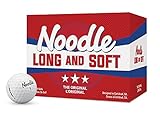
- Durable and soft iothane cover
- Impact propulsion core for longer carry
- Great feel and increased spin around the greens
- Patented dimple design for straighter flight
Say what you want about the name — “Noodle” is iconic, and TaylorMade knows it. The Noodle Long & Soft has been a staple of budget golf balls for over a decade, and it keeps getting refinements that keep it relevant. If pure distance is your top priority and you still want a ball that feels reasonable off the face, this is your pick among the best golf balls under $30.
The Noodle uses TaylorMade’s proprietary ionomer cover over a high-energy core. The design philosophy is simple: maximum distance with a soft feel. And it delivers on both counts. Off the driver, this ball rockets. The low compression core (around 50) combined with the aerodynamic dimple pattern produces a high, penetrating flight that carries forever. If you’ve been leaving drives short of the fairway, the Noodle might be the easiest distance upgrade available for under 30 dollars.
One of the things I like about the Noodle is how forgiving it is on mishits. The soft core absorbs vibrations from off-center contact, which means your toe hits and thin shots don’t punish you as badly. The ball still flies reasonably well even when you don’t catch it perfect. For golfers who don’t find the center of the clubface every time — so, most of us — that forgiveness is worth its weight in saved strokes.
Feel-wise, the Noodle is softer than you’d expect from a distance ball. It’s not quite Duo Soft levels of marshmallow, but there’s a pleasant cushioned sensation on full swings. On the greens, it’s a bit clickier than the Supersoft or Duo, but nothing that’ll throw off your putting. Think of it as “firm soft” — if that makes any sense. It gives you feedback without being harsh.
Around the greens, the Noodle is where you see the trade-off of prioritizing distance. The ionomer cover doesn’t spin as much as urethane, so chips and pitches tend to release more and check less. If you’re a “bump and run” type of short game player, this actually works in your favor. But if you like to hit high, spinning wedge shots that stop on a dime, you’ll need to adjust your technique or look at the Kirkland Performance+ instead.
The Noodle also comes in some fun color options, and the yellow version is one of the most visible balls on the market. If you play early mornings, late evenings, or courses with lots of leaves in the rough, a yellow Noodle can save you serious search time. Not to mention it just looks fun, which is kind of the point of this ball.
For golfers who want maximum distance with acceptable short game performance, the TaylorMade Noodle Long & Soft is one of the best golf balls under $30 and a great value golf ball overall. It’s honest, it’s fun, and it goes far. What’s not to like?
Bridgestone e6 Soft — Best for Straight Flight

- NEW! The soft feel, long distance golf ball
- LONGER DISTANCE - Softer and larger core for faster compression and longer distance
- INCREASED CONTROL - Soft seamless cover for better spin and feel
If there’s one thing that ruins more weekend golf rounds than anything else, it’s the big curve. You know the one — that drive that starts down the middle and then veers 30 yards into the trees. Whether it’s a slice that won’t quit or a hook that comes out of nowhere, side spin is the enemy of the average golfer. That’s exactly the problem the Bridgestone e6 Soft was designed to solve, and it’s why it earns a spot among the best golf balls under $30.
Bridgestone’s Delta Wing Dimple Technology is the star of the show here. The dimple pattern is specifically engineered to produce a more aerodynamically stable flight, which reduces the amount of side spin that causes hooks and slices. The result is a ball that flies straighter, more consistently, and with less penalty for the moderate miss. If you’re tired of losing balls to your own swing flaws, this ball is like having training wheels for your driver — except they’re not embarrassing and they actually work.
The e6 Soft is a two-piece ball with a soft compression core (around 45) that delivers the kind of feel you’d expect from a ball with “Soft” in the name. Off the driver, it launches high and flies straight. Really straight. Like, “wait, that actually went where I aimed” straight. It’s not a magic cure for a terrible swing, but it reduces the severity of your misses enough that you’ll find more fairways and fewer hazards.
Distance is solid for a soft ball. You won’t outdrive your buddy who’s playing a Chrome Tour, but you won’t be giving up much either. The e6 Soft is particularly good off the fairway, where the soft core compresses nicely on iron shots to produce a high, landable trajectory. Mid-iron approaches that stop on the green? Yes please. For more on finding the right ball for your swing, check out our guide to the best golf balls for 90 mph swing speed.
On the greens, the e6 Soft has a pleasant, medium-soft feel. It’s not as pillow-soft as the Duo Soft, but it gives you enough tactile feedback to judge distance well. Putting with this ball feels natural and intuitive. On chips, the ionomer cover provides moderate spin — nothing dramatic, but enough to control your shots around the green. Think of it as the sensible, reliable option in the short game department.
The durability of the e6 Soft is a strength. Bridgestone makes some of the most durable covers in the business, and this ball holds up well over 18 holes. You can play a full round and still have a ball that looks decent enough for another round or two. For cheap golf balls that play like they cost more, the e6 Soft delivers on longevity.
Where this ball really shines is for the golfer who fights a consistent miss. If your miss is a slice (and let’s be honest, that’s most right-handed golfers), the e6 Soft will turn that big bend into a manageable fade. It won’t fix your swing, but it’ll make your swing’s consequences less punishing. And that can be the difference between shooting 95 and breaking 90. For more on this topic, see our article on the best golf balls for straight flight.
If straight is the new far, the Bridgestone e6 Soft is one of the best golf balls under $30 for keeping your ball in play and your scorecard looking respectable.
Quick Comparison Table
| Ball | Compression | Cover | Pieces | Best For | Price/dozen |
|---|---|---|---|---|---|
| Callaway Supersoft | ~38 | Ionomer (Hybrid) | 2 | Best Overall | ~$25 |
| Srixon Soft Feel | ~60 | Ionomer | 2 | Beginners | ~$22 |
| Wilson Duo Soft | ~35 | Ionomer | 2 | Softest Feel | ~$20 |
| Titleist TruFeel | ~60 | Ionomer | 2 | Brand Confidence | ~$25 |
| Kirkland Performance+ | ~50 | Urethane | 3 | Best Value 3-Piece | ~$25 |
| TaylorMade Noodle | ~50 | Ionomer | 2 | Distance | ~$20 |
| Bridgestone e6 Soft | ~45 | Ionomer | 2 | Straight Flight | ~$25 |
This table gives you the quick hits, but remember — numbers only tell part of the story. Feel matters. Confidence matters. The best golf balls under $30 are the ones that match your swing and your preferences. Use this as a starting point, not the final word.
How We Tested
Testing golf balls is more art than science, but we tried to bring some rigor to it. Each ball on this list was hit with a full range of clubs — driver, 7-iron, pitching wedge, and putter — across multiple rounds on different courses. We tracked carry distance, total distance, dispersion patterns, and feel feedback.
We also paid attention to the stuff that doesn’t show up on a launch monitor. How does the ball feel on a cold morning? Does it scuff on the first wedge shot? Can you see it in the rough at dusk? These real-world factors matter more than spin rate numbers for the average golfer looking for golf balls under 30 dollars.
For reference, our primary tester has a swing speed around 88 mph with a driver — right in that sweet spot where low to mid compression balls perform best. We also tested with slower swingers (70-80 mph range) to validate our recommendations for that audience. The best golf balls for swing speeds under 90 mph are well-represented on this list.
We specifically didn’t test with high-speed Tour-level swingers, because if you’re swinging 110+ mph, you’re probably not shopping for budget golf balls. But if you are, check out our guide to the best golf balls for swing speeds over 100 mph.
Finally, we factored in price and availability. A ball that’s technically great but always out of stock or priced at $32 doesn’t make this list. Every ball here is consistently available at under $30 a dozen from major retailers. That’s what makes them genuinely the best golf balls under $30 — not just in theory, but in practice.
Final Verdict — Our Top Picks
After all those rounds, all those range sessions, and all those balls lost in hazards (for science, obviously), here are our final picks.
Best Overall: Callaway Supersoft (2025)
The Supersoft takes the top spot because it does everything well. Soft feel, solid distance, reliable performance, and a price that lets you play without anxiety about losing balls. Whether you’re a beginner or a 15-handicap grinder, the Supersoft is the best golf ball under $30 you can put in play. It’s the total package — no glaring weaknesses, plenty of strengths, and a reputation that’s been earned over years of solid performance. If you just want one ball recommendation and don’t want to think about it any further, this is it.
Best Value: Kirkland Signature Performance+
If you can find it in stock, the Kirkland Performance+ offers the most bang for your buck in golf. A three-piece urethane ball at this price is absurd. It gives you real short game spin, a stable flight, and a performance profile that punches way above its weight class. For affordable golf balls that actually compete with premium options around the greens, nothing touches the Kirkland.
Best for Beginners: Srixon Soft Feel
New golfers need consistency and forgiveness above all else. The Srixon Soft Feel delivers both in spades. Its moderate compression, consistent flight, and forgiving response on mishits make it the ideal ball for golfers still finding their swing. When you’re looking for good golf balls cheap that won’t punish you for being new to the game, the Srixon Soft Feel is your best bet.
Honorable Mention for Straight Flight: Bridgestone e6 Soft
If slicing is killing your scores, the e6 Soft deserves serious consideration. It’s not the flashiest ball on the list, but it does one thing exceptionally well: keeping the ball in play. Sometimes the best strategy isn’t hitting it farther or spinning it more — it’s just keeping it in front of you. The e6 Soft helps you do exactly that, and that’s why it’s one of the best golf balls under $30 for golfers fighting a curve.
Look, at the end of the day, any ball on this list will serve you well. The differences between them are real but not dramatic, and any of these best golf balls under $30 will serve you well. Pick the one that matches your priorities — softest feel, most distance, straightest flight, best value — and commit to it. Golf is hard enough without second-guessing your ball choice. And according to the USGA’s golf ball standards, every ball on this list conforms to the Rules of Golf, so you can play any of them in competition with full confidence.
The best golf balls under $30 aren’t compromises. They’re smart choices that let you play your best golf without paying premium prices. Pick one, trust it, and go play.
You Might Also Enjoy
Looking for more golf ball guides? Here are some of our most popular articles to help you find the perfect ball for your game:
→ Best Golf Balls for Straight Flight — Keep it in the fairway with balls designed to reduce sidespin
→ Best Golf Balls for Cold Weather — When the temperature drops, your ball choice matters even more
→ Best Golf Balls for Chipping and Putting — Maximize your short game performance with the right feel
→ Best Golf Balls for Swing Speeds Under 90 mph — Most weekend golfers fall into this category — here’s what to play
→ Best Golf Balls for 90 mph Swing Speed — The sweet spot for compression and performance
→ Best Golf Balls for Windy Conditions — Low spin, stable flight, and penetration for those breezy rounds