
Golf driver size chart (2026): length, loft and head size
You are on the tee, the fairway looks about nine yards wide, and the club in your hands is longer than any other in the bag by a distance. Most club golfers never ask whether that length, that loft or that head was ever right for them. They just buy whatever is on the rack.
Here is the straight version. Three numbers decide whether a driver fits you: head size, length and loft. Only one of them is easy.
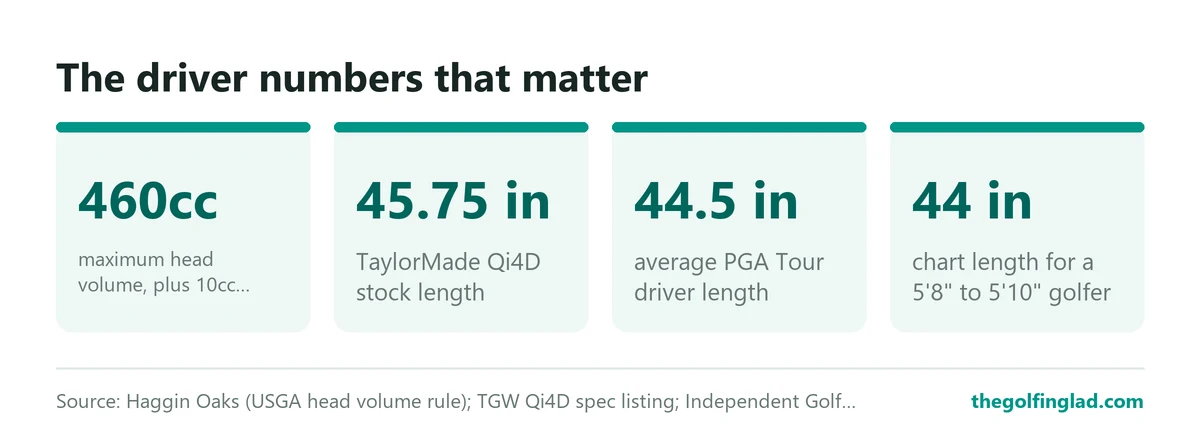
Short answer: Buy a 460cc head, the legal maximum, unless you have a reason not to. Pick length from your height, and expect to land shorter than the 45.5 to 45.75 inches most drivers ship at: a 5’9″ golfer sits around 44 inches on the chart below. Pick loft from swing speed, with 10.5 degrees or more if you swing under 95 mph.
The golf driver size chart: your height against stock length
The chart comes from Independent Golf Reviews’ length-by-height chart. Hold each row up against the 45.75 inches TaylorMade lists for the Qi4D, and you see how far off the rack most of us are.
| Your height | Suggested length |
|---|---|
| 5’0″ to 5’2″ | 41.5″ |
| 5’2″ to 5’4″ | 42″ |
| 5’4″ to 5’6″ | 43″ |
| 5’6″ to 5’8″ | 43.5″ |
| 5’8″ to 5’10” | 44″ |
| 5’10” to 6’0″ | 44.5″ |
| 6’0″ to 6’2″ | 45″ |
| 6’2″ to 6’4″ | 45.5″ |
| 6’4″ to 6’6″ | 46″ |
Read it again. Unless you are 6’2″ or taller, the chart says the driver on the shelf is too long for you. The same page puts the average PGA Tour driver at 44 1/2 inches, while the average stock shaft is 45 1/2 inches. Tour players, with the best swings on earth, play a shorter club than the one sold to you.
Length is where the fairways are
The case for a longer shaft is simple: a bigger arc means more clubhead speed. GOLF’s Fully Equipped column puts it at roughly 10 yards for each extra inch, for the average player. That is the theory the stock lengths are built on.
The catch is that the theory assumes you hit the middle. When MyGolfSpy tested one driver at 44.5″ and 45.5″, the performance numbers barely moved, but the impact pattern on the face was smaller and more consistent with the shorter shaft for most testers. Centre strikes are where ball speed lives.
a straighter drive that lands a few yards shorter in the fairway is almost always better
GOLF, Fully Equipped mailbag
At least one owner reports the same trade. A poster on the Team Titleist forum who went shorter lost a little distance and hit more fairways. That swap is worth it for nearly everyone reading this, because a drive in the rough costs you more than five yards ever gives back.
There is a real downside. GOLF notes that a shorter shaft usually wants a slightly softer flex and a heavier profile to keep the club balanced, and that a heavier shaft can bring the flight down. If you already struggle to get the ball airborne, cut the shaft and add loft together.
Worth knowing: GOLF says that for golfers under 5’5 with a fingertip-to-ground measurement of 29 to 30 inches, a 45.75-inch driver is likely way too long”. Measure yourself in shoes, standing straight with your arms hanging, before you trust height alone.
The rule: find your row in the chart, then go no longer than that unless you are tall or a fitter shows you centred strikes at the longer length.
Head size: buy the full 460cc
This is the easy one. The rules cap a driver head at 460 cubic centimetres, plus a 10cc tolerance, measured by water displacement, as Haggin Oaks explains. Every driver in this guide sits at that figure.
A bigger head puts more face behind the ball and more stability on a mishit. For a 10 to 25 handicap there is no reason to give that away. The smaller-headed clubs that do exist, such as the ones in our guide to the best mini drivers, are a second club for tight holes, not a replacement.
On length, the rulebook is generous. A 48-inch general limit applies to everything but putters, and the 46-inch cap you may have heard about is a model local rule that tours and events choose to adopt. Your club medal almost certainly has not.
The rule: 460cc as your gamer, a mini driver only as an extra.
Driver loft chart: go higher than your ego wants
Loft follows swing speed. Callaway’s guide, reproduced by GolferGeeks, and the Worldwide Golf Shops chart broadly agree.
| Driver swing speed | Callaway | Worldwide Golf Shops |
|---|---|---|
| Under 85 mph | 12 degrees or more | 12 to 14 (under 80 mph); 11 to 13 (80 to 90) |
| 85 to 95 mph | 10.5 to 12 | 11 to 13 (80 to 90); 10 to 12 (90 to 100) |
| 95 to 105 mph | 9 to 10.5 | 10 to 12 (90 to 100); 9 to 11 (100 to 110) |
| Over 105 mph | 8 to 9 | 9 to 11 (100 to 110); 8 to 10 (110-plus) |
slower swings generally need more loft to carry the ball, not less.
Callaway, quoted by GolferGeeks
Look at the TrackMan averages GolferGeeks lists: the PGA Tour launches the driver at 10.4 degrees with 2,545 rpm of spin, the 14.5-handicap average at 12.6 degrees and 3,275 rpm. Copying a tour loft into an amateur swing is how drives end up low, short and in the left rough.
More loft also helps a slice. Less sidespin relative to backspin means the curve is less severe, which is why we lean higher in our guide to the right driver loft for beginners.
The rule: if you do not know your swing speed, you are probably under 95 mph. Buy 10.5 or 12 degrees, never 9.
A worked example
Take a 5’9 golfer, 18 handicap, swinging somewhere in the 85 to 95 mph band. The height chart says 44 inches. The loft chart says 10.5 to 12 degrees. Hand them a stock 45.75 9-degree driver and it is too long for them and short on loft.
The fix costs little. Buy the 10.5 or 12-degree head, ask the shop to cut the shaft to 44 inches and re-check the swingweight, and you have a club that fits for the price of a regrip.
Two drivers that make the numbers easy
If you swing under 95 mph and want help getting the ball up, the Cleveland Launcher XL 2 is the sensible buy. It is a 460cc head offered in 9, 10.5 and 12 degrees, and Golf Discount lists the men’s model at 45.5 inches. That is a quarter inch shorter than many rivals before you cut a thing. Cleveland’s distributor pitches the Draw version as a great option for beginners or high handicappers.
If you swing faster and like to tinker, the TaylorMade Qi4D is the adjustable one. TaylorMade lists a 460cc head at 45.75 inches, lofts of 8, 9, 10.5 and 12 degrees, a 4-degree loft sleeve that also moves lie and face angle, and a 56 to 60-degree lie range. The sleeve lets you add loft later without buying a new head. Our full Qi4D review covers where it fits and where it doesn’t.
The catch with the Qi4D is the length. At 45.75 inches it is the longest stock length in this guide, so anyone under 6’2″ should plan on a shorter shaft or choking down.
Our pick by kind of golfer
- If you play twice a month, shoot in the 90s and slice: Launcher XL 2 in 12 degrees, cut to your chart length.
- If you are a 10 to 15 handicap swinging over 100 mph: Qi4D in 9 or 10.5 degrees, and try it at 45 inches before you take it at stock.
- If you are under 5’6″: do not buy any men’s driver at stock length. The chart tops out at 43 inches for you, against stock lengths of 45.5 to 45.75 inches.
- If you are over 6’2″: stock length is finally yours. Spend the effort on loft instead.
Questions buyers actually ask
Does a shorter driver lose distance?
On paper, yes: GOLF estimates about 10 yards per inch for the average player. In practice, more centred strikes can win much of it back, and the MyGolfSpy test found little difference between 44.5″ and 45.5″.
Can I just choke down instead of cutting the shaft?
Yes, and it is a fine way to test a length before paying for the cut. Cutting is tidier long term because the grip sits where your hands are.
What length are women’s drivers?
About 44 inches on average, according to Independent Golf Reviews, roughly an inch and a half shorter than the men’s average.
Is a 460cc driver legal for club golf?
Yes. 460cc is the limit itself, with a 10cc tolerance on top, so every mainstream driver sold for 2026 is legal for competition.
Should I get fitted instead of using a chart?
If you can, yes. A chart gets you to the right row; a launch monitor confirms it. If a fitting is not happening, the chart above beats buying stock.
The verdict
Buy the full 460cc, buy more loft than you think, and buy a driver that suits your height rather than the rack. For most of you that means 10.5 degrees or higher and a shaft somewhere between 43.5 and 44.5 inches. If you are still putting the rest of the bag together, start with our guide to the best golf clubs for beginners, which shows what is worth buying and what to skip.
By The Golfing Lad
One thought on “Golf driver size chart (2026): length, loft and head size”
Comments are closed.