How does a golf simulator work? Radar vs cameras (2026)
As an Amazon Associate I earn from qualifying purchases.
CERTAIN CONTENT THAT APPEARS ON THIS SITE COMES FROM AMAZON. THIS CONTENT IS PROVIDED ‘AS IS’ AND IS SUBJECT TO CHANGE OR REMOVAL AT ANY TIME.
If you buy through links on this page we may earn a commission, at no extra cost to you.
You have a spare garage bay, a tape measure and a browser full of launch monitors that all claim to put Pebble Beach on your wall. Before you pick one, know what is actually going on when you hit into that net.
Because the box you buy decides how much room you need, which balls you hit and how honest the numbers are.
Short answer: A golf simulator is a launch monitor plus software plus a screen. The launch monitor measures the strike (ball speed, launch angle, spin, club data) with radar, cameras or both. Software feeds those numbers into a physics model that works out the full flight, then draws the shot on a virtual course. The ball only travels a few feet. The rest is maths.
What is a golf launch monitor, and why it is the whole simulator
Everything else in the room is furniture. The net stops the ball, the mat saves your wrists, the projector paints the picture. The launch monitor is the only part that knows what you did.
It reads the first moments after impact, hands the numbers to the software, and the software decides whether that was a 160-yard 7-iron or a slice into the trees. Get the launch monitor wrong and no screen will save it. That is why the golf simulator vs launch monitor question is really one question.
The rule: spend on the sensor first, the screen second.
Types of launch monitors: the three ways a shot gets read
There are three families, and they differ most in where they sit and how much room they eat.
| Type | How it reads the shot | Where it sits | Room depth | Examples |
|---|---|---|---|---|
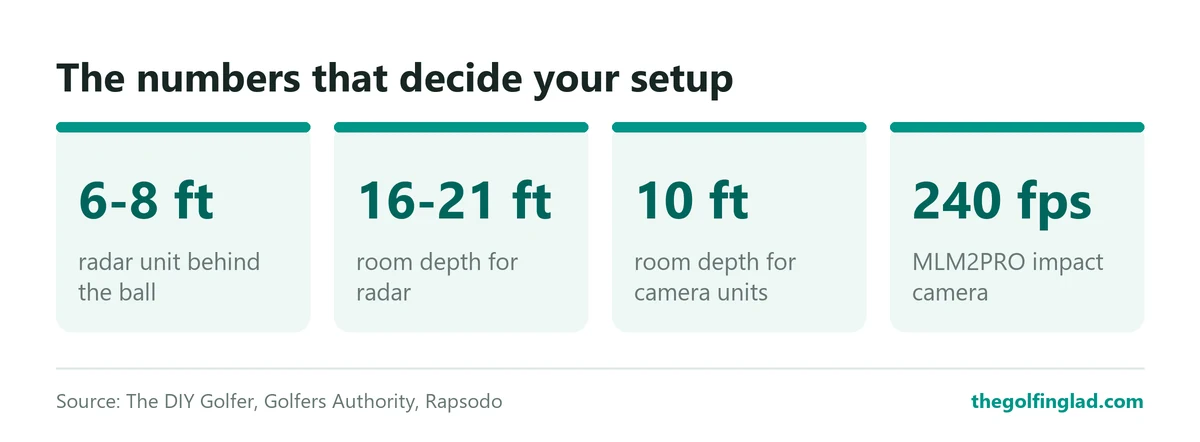
| Doppler radar | Radio waves bounce off ball and club; tracks the flight | 6 to 8 ft behind the ball | 16 to 21 ft | Garmin Approach R10 |
| Camera (photometric) | High-speed images at impact; flight is calculated | Beside the ball | About 10 ft | Garmin Approach R50 |
| Hybrid | Cameras plus radar | Behind or beside, by model | 14 ft-plus (MLM2PRO) | Rapsodo MLM2PRO, SkyTrak ST MAX |
Room figures come from the Golfers Authority photometric vs radar guide, the 6 to 8 feet from The DIY Golfer, and the MLM2PRO number from Rapsodo’s own product page.
Radar follows the ball
A radar unit sends out a microwave signal that bounces off the ball and club, and it tracks the flight as it happens, as the GOLF.com explainer puts it. Outdoors, with the ball free to fly, that is its home ground. Golfers Authority credits radar with 2 to 3% carry accuracy outdoors.
Indoors the ball hits a net 10 feet away and the radar loses its best data.
Radar struggles indoors, even with 15 feet of depth, because it can’t see the ball to its apex in confined spaces.
Golfers Authority
Cameras freeze the strike
A camera unit sits next to you and photographs impact. GOLF.com says these systems “record thousands of images per second” and then calculate the whole flight from a few feet of movement. The trade-off is that the flight is predicted, not watched.
The upside is space. About 10 feet of depth, 10 feet of width for one golfer, and a 9 to 10 foot ceiling covers a photometric setup, per Golfers Authority. That fits a lot of garages a radar unit will not.
Hybrids split the job
Rapsodo’s MLM2PRO runs two cameras with Doppler radar. Its Impact Vision camera shoots at 240 frames per second to read the logo pattern on special RPT balls, which is how it gets spin. Rapsodo lists 15 metrics, 8 of them measured, including spin rate, spin axis, club path and angle of attack.
The rule: measure your room before you shop. Under about 16 feet of depth, buy a camera unit. Outdoors most of the year, buy radar.
Worth knowing: even a hybrid that sits behind you needs room in front as well. For the MLM2PRO, Rapsodo asks for 8 feet from ball to net plus 6.5 to 8.5 feet behind the ball, so 14 feet is its floor, and taller golfers need more. A pure radar unit wants 16 to 21 feet. Our golf simulator room dimensions guide covers ceilings.
Launch monitor features explained: spin is where cheap units cut corners
Ball speed and launch angle are easy. Spin is hard, and spin is what turns a straight number into a hook or a ballooning wedge.
Budget units often calculate it rather than measure it, or need help. Garmin’s own blog says the R10 gives more confident spin readings with Titleist RCT balls. The MLM2PRO needs RPT balls to show spin at all, though Rapsodo puts a 3-ball sleeve in the box. The R50, by contrast, works with any ball but wants stickers on your clubs.
Weather is a quieter catch. GOLF.com notes radar readings can be thrown by wind and rain, while camera systems are “immune to weather but rely on their calculations”.
The rule: if you care about why your 7-iron balloons, pay for measured spin and accept the special balls.
The software is the part you keep paying for
The hardware draws the ball flight. The software decides which course you are standing on, and most of it is rented.
- Garmin’s Home Tee Hero needs a subscription, which opens more than 43,000 courses, according to Garmin’s R50 vs R10 blog.
- The MLM2PRO comes with a 21-day Core membership, and the 4K Rapsodo Studios courses cost extra every year.
- The SkyTrak ST MAX runs on PC, Mac, iOS and Android, and plays with third-party software such as E6 and GSPro.
The rule: add three years of subscription to the sticker price before you compare. Our golf simulator cost breakdown does that maths.
Launch monitor buying guide: which one for which golfer
If you play twice a month and want range practice plus the odd winter round, buy the Garmin Approach R10. It is radar, it lasts up to 10 hours on a charge, and it fits in your golf bag, so it does the range as well as the garage. Skip it if your room is short; it has to sit behind you.

- Work to improve your game at home, indoors or on the driving range with a portable launch monitor .Waterproof : IPX7.Control Method:Application,VoiceWater Resistant: Yes.Club Head speed accuracy : plus/- 3 mph, Ball speed accuracy : plus/- 1 mph, Launch angle accuracy : plus/- 1 degree, Launch direction accuracy : plus/- 1 degree.
- Track key metrics when paired with a compatible smartphone with the Garmin Golf app to help better your shot consistency, including club head speed, ball speed, swing tempo, ball spin, launch angle and more
- Understand your golf strengths and areas for improvement by using training mode, which tracks stats for each club and shows a shot dispersion chart based on estimated ball flight using the Garmin Golf app
- See and analyze your own swing with automatically recorded video clips that include the metrics of that swing when paired with a compatible smartphone with the Garmin Golf app
- With an active subscription and the Garmin Golf app, play virtual rounds on over 42,000 courses around the world and take part in a weekly tournament with scores posted to our global leaderboard

If your garage is tight and you want measured spin in the $500 tier, buy the Rapsodo MLM2PRO. You get the cameras, a swing video with shot tracer, and real spin numbers, as long as you hit RPT balls. Skip it if you hate subscriptions; the good stuff sits behind one.

- DUAL SHOT TRACK ACCURACY — Doppler radar & dual camera setup ensure reliable data on every shot to help you improve faster.
- 15 KEY METRICS CAPTURED — measure spin rate, spin axis, carry distance, club speed, club path, launch angle, and more.
- 21 DAY PREMIUM/CORE TRIAL INCLUDED — Unlock simulated courses, 3rd party app integration, target range, impact vision, rapsodo combine, and speed training with your free trial premium membership.
- 30,000+ HOME GOLF SIMULATOR COURSES INCLUDED WITH PREMIUM — play iconic courses or dial in your game with customizable driving range. Multiple tee boxes and game formats for every age or skill level.
- PROVEN GOLF SWING TRAINING AID & LAUNCH MONITOR — capture your swing from any angle to identify patterns, plus view precise club/ball contact in slow motion for deeper insights into your game.
If the simulator is the point and money is not, look at the Garmin Approach R50 in the $5,000 tier. Three high-speed cameras sit beside the ball, a 10-inch touchscreen means it works as a simulator on its own, and there is an HDMI out for a projector. It reads putts too. The catch is battery: up to 4 hours, against 10 for the R10.

- Fine-tune your form with this premium launch monitor and simulator that utilizes a 3-camera system for precision metrics
- Tap into insights, select courses, review impact videos, or play a virtual round (subscription required) straight from the 10” built-in color touchscreen display
- Use advanced measurements to dial in your swing, including ball speed, launch angle, face to path (included tracking sticker required) as well as improved spin rate and axis both indoors and outside
- Understand every part of your game with training mode, which tracks stats for each club and shows a shot dispersion chart based on an advanced ball flight trajectory model
- Play virtual rounds — including putting — with up to four players on more than 43,000 courses through the Home Tee Hero (active Garmin Golf membership required); participate in a weekly tournament with scores posted to our global leaderboard — all viewable from the Approach R50 display
If you are weighing the SkyTrak ST MAX, read the fine print first. PlayBetter’s review says it adds speed training, a new look, an extra USB-C port and a faster response, but that “The data set and simulation experience remains exactly the same” as the SkyTrak+, the cheaper previous model with the same dual-radar-plus-camera tracking. I would buy the SkyTrak+ and keep the difference.

- Ultimate Golf Simulation Experience: SkyTrak+ delivers advanced club data—Club Head Speed, Smash Factor, Club Path, and Face Angle. New Doppler Radar and improved Photometric Camera ensure precision.
- Play & Improve: Optimize practice with the Play & Improve plan featuring WGT by TopGolf and TruGolf E6 Connect. Play 100,000+ global courses from home. Personalize your improvement journey.
- Award-Winning Launch Monitor: Recognized by Golf Digest, Golf Monthly, and Today’s Golfer, SkyTrak+ is the editor’s choice for the best golf launch monitor. Improve your game with the best—SkyTrak+.
- Learn from the Best: SkyTrak+ offers top-tier tutorials for a deeper understanding and rapid improvement of your game. Offering features like Wedge Matrix, Shot Optimizer, Skill Assessment, and more.
- Experience Cutting-Edge Tech: SkyTrak+'s advanced technology ensures a reliable, efficient, and enhanced golfing experience. Offering a light, portable design, and detailed ball flight & launch data.
Questions buyers actually ask
Does the ball really fly the distance shown on screen?
No. It travels a few feet into a net. The software calculates the rest from launch data, so your 250-yard drive is a prediction built on ball speed, launch and spin.
Are cheap launch monitors accurate enough?
For ball speed and carry, the good budget units are close enough to practise with. Spin and club data are where they slip. Our guide to how accurate golf simulators are has the test numbers.
Can I use a radar unit in a small room?
You can, but it will be guessing. With 6 to 8 feet needed behind the ball and room for flight in front, anything under 16 feet compromises it. A camera unit is the better fit.
Do photometric units need marked balls?
Sometimes. The DIY Golfer warns of “a lengthier calibration process” with some camera units, and some want dots or lines on the balls. Golfers Authority adds that you will be cleaning lenses and replacing club stickers.
The verdict: let the room pick the technology
How a golf simulator works comes down to one choice: does your launch monitor watch the ball fly, or photograph the strike and do the maths? Radar wins outdoors and on price. Cameras win indoors and in small rooms. Hybrids such as the MLM2PRO give you a bit of both at the budget end.
Measure the room, decide whether you want measured spin, then go to our best golf launch monitors of 2026 list to pick the exact unit.
By The Golfing Lad
One thought on “How does a golf simulator work? Radar vs cameras (2026)”
Comments are closed.