How much does a golf simulator cost? Real 2026 budgets
As an Amazon Associate I earn from qualifying purchases.
CERTAIN CONTENT THAT APPEARS ON THIS SITE COMES FROM AMAZON. THIS CONTENT IS PROVIDED ‘AS IS’ AND IS SUBJECT TO CHANGE OR REMOVAL AT ANY TIME.
If you buy through links on this page we may earn a commission, at no extra cost to you.
It is November, the course is frozen or flooded, and you are standing in the garage working out whether a hitting bay fits between the car and the freezer. Then you look up what one costs and the answers run from a few hundred dollars to the price of a small car.
Both ends are true. Here is what each one actually buys.
Short answer: A working home golf simulator costs under $2,000 if you start with a portable launch monitor, a net and a mat. A proper screen-and-projector bay with a mid-range monitor lands around $6,000. A premium build runs about $16,000 in year one, and tour-grade rooms go $25,000-plus. Then add a software bill every year.
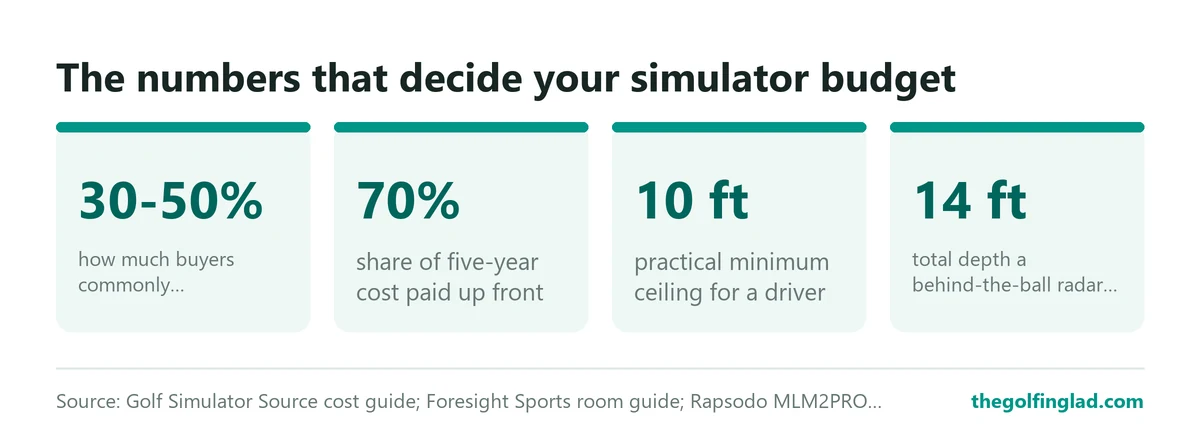
The trap is that the sticker on the launch monitor is only part of the golf simulator cost. Golf Simulator Source’s cost guide reckons buyers commonly underestimate the total by 30 to 50 percent, and the gap is almost always the stuff around the sensor: screen, projector, mat, computer, room prep and subscriptions.
Four real budgets, priced over five years
The table below uses the itemised example builds in that guide, rounded. “Year one is everything you pay to get hitting. Every year after” is software renewals and replacement balls. The last column is how many rounds a year you would need to replace, at around $60 a round, before the bay pays for itself.
| Build | Year one | Every year after | Five-year total | Rounds a year to break even |
|---|---|---|---|---|
| Budget: portable monitor, net, mat | Under $2,000 | Around $150 | Under $2,500 | About 8 |
| Mid: enclosure kit, short-throw projector, PC, GSPro | Around $6,000 | Around $350 | Under $8,000 | About 25 |
| Premium: Bushnell Launch Pro, studio enclosure, pro mat | About $16,000 | Around $1,000 | About $20,000 | About 65 |
| Ultra: Uneekor EYE MINI, 4K projector, room work | About $26,000 | Around $1,350 | $30,000-plus | About 104 |
Read the last column twice. If you play twice a month and would hit the sim instead of a few of those rounds, the budget build pays its way inside a winter. The ultra build only makes money sense if it replaces two rounds a week, every week. Past that point you are buying a hobby room, which is fine, as long as you know it.
Initial purchase is maybe 70% of your 5-year cost. Budget accordingly.
Community consensus quoted in Golf Simulator Source’s cost guide
Measure the room before you price anything
The cheapest way to waste money is to buy a monitor that needs more room than you have. Your ceiling and depth decide which sensors you can use, and that decides most of the bill.
Foresight Sports’ room guide calls 10 feet of ceiling the practical minimum for a comfortable driver swing. It says 9 feet works for many golfers and 8.5 feet is irons only. It recommends 12 to 15 feet of width and 15 to 18 feet of depth.
Smaller rooms are not dead. SkyTrak’s own guide lists its smallest studio at 8 feet deep by 10 feet wide by 9 feet high, because the SkyTrak sits beside the ball rather than behind you. A radar unit that sits behind the hitter, such as the Rapsodo MLM2PRO, needs a little more than 14 feet in total: 8 feet from ball to net, plus 6.5 to 8.5 feet behind the ball for the unit, per Rapsodo’s product page.
Worth knowing: If your garage is deep but your ceiling is low, swing a driver in it slowly before buying anything. A ceiling strike is the one cost no budget table includes. Our guide to golf simulator room dimensions has the full numbers.
The rule: under 9 feet of ceiling, plan around irons and a side-mounted monitor. Under 14 feet of depth, rule out the behind-the-ball radar units.
The launch monitor is the first decision, not the whole bill
Foresight puts it bluntly: “The launch monitor should be your first decision.” It is the part that measures your shot, and every other component has to suit it. It is also where the price spread is widest.
In the budget build, the monitor is a sub-$500 portable unit. In the premium build it is a $3,000-class Bushnell Launch Pro. Golf Simulator Source puts ultra-tier monitors at $8,000-plus. If you are unsure whether you need the full bay at all, our piece on golf simulator vs launch monitor settles it before you spend.
Here is the catch most people find after checkout: many monitors hide course play behind a membership.
- Garmin’s Home Tee Hero course play on the Approach R10 needs a Garmin Golf membership, around $100 a year, per PlayBetter’s listing.
- Rapsodo includes a 21-day Core membership trial with the MLM2PRO. Retailers list the ongoing Premium membership at around $200 a year.
- SkyTrak’s own guide lists a free Basic tier with the driving range only, then Essential at around $100 a year, Core in the $250 to $300 range a year, and Elite at around $500 a year.
- Bushnell’s Launch Pro needs the Foresight+ Gold plan, around $600 a year, to run GSPro, per Golf Simulator Source.
The rule: price the monitor plus five years of the membership tier you will actually use. A cheaper sensor with a pricey plan can cost more by year three.
Three monitors that fit the budget and mid tiers
These are the sensors that turn the table above from theory into a shopping list. All three live in our best golf launch monitors of 2026 ranking.
Garmin Approach R10: the cheapest way in
The R10 is the monitor in the budget build. It is the reason that build lands under $2,000 with a net, a mat and some room prep. Pair it with a phone or tablet you already own and the first-year spend stays small. Budget for the Garmin Golf membership if you want to play courses rather than just hit range balls.

- Work to improve your game at home, indoors or on the driving range with a portable launch monitor .Waterproof : IPX7.Control Method:Application,VoiceWater Resistant: Yes.Club Head speed accuracy : plus/- 3 mph, Ball speed accuracy : plus/- 1 mph, Launch angle accuracy : plus/- 1 degree, Launch direction accuracy : plus/- 1 degree.
- Track key metrics when paired with a compatible smartphone with the Garmin Golf app to help better your shot consistency, including club head speed, ball speed, swing tempo, ball spin, launch angle and more
- Understand your golf strengths and areas for improvement by using training mode, which tracks stats for each club and shows a shot dispersion chart based on estimated ball flight using the Garmin Golf app
- See and analyze your own swing with automatically recorded video clips that include the metrics of that swing when paired with a compatible smartphone with the Garmin Golf app
- With an active subscription and the Garmin Golf app, play virtual rounds on over 42,000 courses around the world and take part in a weekly tournament with scores posted to our global leaderboard

Buy it if you want feedback on your numbers more than a cinema screen. Skip it if a projected course is the whole point, because that is where the other line items start.
Rapsodo MLM2PRO: the forum favourite for a full bay
The MLM2PRO measures eight metrics directly: ball speed, club speed, launch angle, launch direction, spin rate, spin axis, club path and angle of attack. Carry, total distance and apex are calculated from those. One catch: Rapsodo says “Golf balls with RPT are required to show spin numbers”, and a dozen RPT balls is a $60-plus purchase on its own.
It is also the monitor at the centre of one of the more useful build threads out there. A Golf Simulator Forum member built a full bay for about $4,100 including tax and freight: an enclosure, curtains, a 10 x 10 foot screen, a short-throw projector, putting turf, cables and the MLM2PRO. An iPad he already owned saved him roughly $1,000.

- DUAL SHOT TRACK ACCURACY — Doppler radar & dual camera setup ensure reliable data on every shot to help you improve faster.
- 15 KEY METRICS CAPTURED — measure spin rate, spin axis, carry distance, club speed, club path, launch angle, and more.
- 21 DAY PREMIUM/CORE TRIAL INCLUDED — Unlock simulated courses, 3rd party app integration, target range, impact vision, rapsodo combine, and speed training with your free trial premium membership.
- 30,000+ HOME GOLF SIMULATOR COURSES INCLUDED WITH CORE — play iconic courses or dial in your game with customizable driving range. Multiple tee boxes and game formats for every age or skill level.
- PROVEN GOLF SWING TRAINING AID & LAUNCH MONITOR — capture your swing from any angle to identify patterns, plus view precise club/ball contact in slow motion for deeper insights into your game.
The surprise in that list is that the hitting mat cost more than the launch monitor. His verdict on it:
This mat is an absolute joy to hit off of
Builder on Golf Simulator Forum
His one complaint was the screen, which he found “a bit louder than I would like.” Cheap screens are noisy. Nobody puts that in the listing.
SkyTrak ST MAX: for the short room
SkyTrak’s guide lists the ST MAX launch monitor at around $2,200, with retailers quoting higher studio package prices from around $3,000. Its pitch is the shallow room: that 8-foot-deep studio is the smallest footprint in this guide. On SkyTrak’s own five-year sums, the ST MAX with a Core membership comes to around $3,450, and with Elite around $4,700. Those are the maker’s figures, so read them as the best case.

- Includes 1 year of Core Foresight software at no additional cost
- Speed Training powered by GOLFTEC, exclusive to the ST MAX: guided drills and measurable insights help you build swing speed and unlock more distance
- Measures carry, total distance, ball speed, spin, launch angle, club head speed, smash factor, club path, face angle and face-to-path for a complete picture of every shot
- Built-in game improvement tools include skills assessments, bag mapping, randomized practice and the wedge matrix to help you dial in your distances
- Charge and play with dual USB-C ports for simultaneous charging and data transfer, plus a redesigned modular interior built for long-term calibration stability
Buy it if your room is short and you want courses without building a gaming PC around it. Skip it if you would never pay for a membership, because the free tier is the driving range only.
The parts that quietly double the bill
Once the monitor is chosen, the rest of the golf simulator cost comes from five places. Golf Simulator Source’s ranges, rounded:
| Component | Budget | Mid | Premium |
|---|---|---|---|
| Enclosure or net | Net, $200 to $500 | DIY enclosure, $800 to $1,500 | Studio kit, $3,000-plus |
| Projector | None, or under $700 | Around $900 to $2,200 | Around $2,200 to $4,900 |
| Hitting mat | $150 to $250 | $250 to $500 | $500 to $1,350 |
| PC or tablet | One you own | Around $800 to $1,200 | $1,500 to $2,500 |
| Room prep | Nothing | $200 to $500 | $500 to $2,000 |
The computer is the line people forget. In Indoor Golf Kit’s three-year budget, a 4K build around an Uneekor EYE MINI LITE came to around $11,000 in hardware alone, and the gaming PC was its single most expensive item at nearly $3,800. Drop the projector to 1080p and you can drop the PC with it.
The projector should be short-throw. Foresight recommends at least 3,000 lumens and says short-throw models “reduce shadows”, which matters when you are standing between the lens and the screen.
An unquoted installation is not a zero-cost installation.
Indoor Golf Kit
The rule: spend on the mat before the projector. A bright picture is nice. A mat that saves your elbows is the part you feel every swing.
Software: the bill that comes back every year
How much is a golf simulator once it is built? The answer depends mostly on software. Golf Simulator Source lists GSPro at around $250 a year and Windows only. E6 Connect sits in the $300 to $600 range a year, depending on the course library. The Golf Club 2019 is a one-off purchase of roughly $1,000 with no renewal.
Stack them carelessly and it gets silly. The same guide shows a SkyTrak+ membership plus E6 Connect Expanded at around $1,200 a year in software alone.
Worth knowing: Some monitors charge a membership just to talk to outside software like GSPro. Check that before buying, or you pay twice for the same round.
The rule: pick one course platform and one monitor plan. Do not run two subscriptions to play the same course.
What to buy, by the kind of golfer you are
- If you play twice a month and want to keep your swing alive through winter, buy the budget build: an R10, a net and a decent mat. Under $2,000, and it pays back in about eight rounds a year.
- If you want to play courses with mates on Friday nights and have 14 feet of depth, build the mid tier around the MLM2PRO, a short-throw projector and GSPro. Plan on $4,000 to $6,000.
- If your room is under 10 feet deep, start with the ST MAX and a SkyTrak studio rather than forcing a radar unit into a space it does not fit.
- If you are eyeing the premium build around the Bushnell Launch Pro, be honest about the break-even. At around 65 rounds a year, a premium bay is a lifestyle purchase.
Accuracy also climbs with price. Our guide to how accurate golf simulators are gathers published test numbers that show where the cheaper units drift.
Questions buyers actually ask
Can I build a golf simulator for under $1,000?
A practice setup, yes, if you already own the tablet. A course-playing bay with a projector, no. Golf Simulator Source’s budget range starts around $1,500 for a reason. Our step-by-step budget build guide shows where to cut.
Do I need a projector?
No. Every budget build in this guide skips one and uses a phone or tablet. Add a projector when you want to play courses rather than practise.
Is installation worth paying for?
Only for ceiling mounts and electrical work. Foresight puts optional installation anywhere from $1,000 to $10,000-plus, and its package prices exclude tax, freight and installation. Kits are built for owners with a drill and a free weekend.
Does a simulator hold its value?
The launch monitor partly does. Golf Simulator Source estimates resale could take $200 to $1,000 off your net cost. Screens, mats and turf you should treat as spent.
Should I buy a discontinued model on clearance?
Carefully. The same guide notes the FlightScope Mevo+ is on final clearance and new SkyTrak+ units are discontinued. Cheap hardware is fine. Check the membership will still be supported.
Where I would put the money
Start smaller than you think. Buy the monitor that fits your room, a good mat and a net, and hit balls for a month before you buy a screen or a projector. Most of the regret in build threads comes from spending on the picture before the swing.
For most people reading this, the MLM2PRO-based bay around the $4,000 mark is the sweet spot: real courses, sane yearly costs, and a break-even you can hit. If you want the sensors ranked side by side before you spend, our launch monitor rankings are the next stop.
By The Golfing Lad
One thought on “How much does a golf simulator cost? Real 2026 budgets”
Comments are closed.