Best Golf Ball for Average Golfer (2026): 7 Picks Tested and Ranked
Why the Right Golf Ball Matters for Average Golfers
Look, most weekend warriors just grab whatever ball is on sale at the pro shop and call it a round. I get it — a ball’s a ball, right? Not even close. If you’re swinging driver at 85-95 mph and carrying a handicap somewhere between 15 and 25, the best golf ball for average golfer swings is going to do more for your scorecard than a new driver ever will.
Here’s the thing: tour-level balls like the Pro V1 are built for 110+ mph swing speeds that compress the core on every shot. When your swing speed sits in that average range — and let’s be honest, that’s most of us — you need a ball that actually responds to your swing. The best golf ball for average golfer swing speeds gives you more distance off the tee, more forgiveness on mishits, and a softer feel around the greens without demanding tour-level compression.
Average golfers lose strokes in three places: off the tee (sidespin causing slices and hooks), short game feel (hard cover balls that don’t check), and pure distance (balls that don’t compress properly). The right ball fixes all three. A mid handicapper golf ball with low compression and a softer cover will spin less on off-center hits and feel far more responsive when you’re chipping and putting.
We’ve put seven balls through the wringer — on-course testing, range sessions, and straight-up trial by fire — to find the best golf ball for average golfer profiles. Whether you’re looking for the best overall, the best budget pick, or something that just stops slicing into the trees, we’ve got you covered. And if you want to dive deeper into how swing speed affects your ball choice, check out our guide to the best golf balls for 90 mph swing speed.
Callaway Chrome Soft — The Best Overall Golf Ball for Average Golfers
If there’s one ball that consistently lands at the top of the “best golf ball for average golfer” conversation, it’s the Callaway Chrome Soft. This ball has been the gold standard for mid-handicappers for years, and the latest version keeps that streak alive. It’s the ball I reach for when I want something that works everywhere on the course — long game, short game, and everywhere in between.

- Outstanding tour performance with soft feel.
- New Hyper Fast Soft Core produces exceptionally fast ball speeds.
- New Seamless Tour Aero delivers a consistently high ball flight with low spin.
- New High-Performance Tour Urethane Soft Cover delivers outstanding greenside control with soft feel.

The Chrome Soft uses Callaway’s Precision Technology, which basically means the ball is built to tighter tolerances than most balls on the market. For the average golfer, that means more consistent performance from ball to ball. You won’t get wild distance variations from one sleeve to the next, which matters when you’re trying to dial in your distances.
The dual-core construction is where this ball earns its keep as the best golf ball for average golfer swing speeds. The soft inner core compresses easily at 85-95 mph, giving you that satisfying feel off the face. Meanwhile, the firmer outer core keeps ball speed up on driver shots. It’s like getting two balls in one — soft where you need it, fast where it counts.
Around the greens, the urethane cover gives you genuine spin control. You can hit a chip that checks up, a pitch that releases, or a bunker shot that actually stops. That’s the difference between an average swing speed golf ball and a cheap rock-hard range ball — feel and control when the scoring happens.
Off the tee, the Chrome Soft produces a mid-high trajectory with low spin. For the average golfer who tends to balloon shots or fight a slice, this is exactly what you want. The ball stays in the air long enough to carry, but the low spin keeps it from knuckling sideways on off-center hits. At $44.99, it’s not the cheapest option on this list, but it’s the best golf ball for average golfer performance across every category that matters.
Chrome Soft Quick Hits
Compression: ~75 (medium-low — perfect for 85-95 mph)
Cover: Cast urethane (tour-level feel and spin)
Spin: Low-mid off driver, high around greens
Feel: Soft but not mushy — you feel the compression
Best for: The golfer who wants one ball that does everything well
If you’re tired of switching balls every round and just want something reliable, the Chrome Soft is the best golf ball for average golfer needs, full stop. It’s the pick I hand to buddies who ask “what should I be playing?” and it’s the ball that stays in my own bag when I’m not testing something new.
Srixon Soft Feel 14 — Best Budget Golf Ball for Average Golfers
Not everyone wants to drop premium-ball money every round, and that’s completely fair. If you lose two balls a round (and let’s be real, most average golfers lose more than that), paying top dollar gets painful fast. Enter the Srixon Soft Feel 14 — the best budget golf ball for average golfer wallets that doesn’t play like a budget ball.

- Soft Without Compromise: If feel is what matters most to you, play Soft Feel for maximum all-around performance. Soft Feel technology provides responsive feel for excellent control from tee to green.
- Increased Distance: Engineered for maximum distance with a high-energy core that boosts ball speed, ideal for golfers seeking longer drives.
- Low Compression: Perfect for golfers with slower or medium swing speeds, delivering a soft feel and easy launch for improved accuracy and control.
- 338 Speed Dimple Pattern: Speed dimples reduce drag at launch increase lift during descent. The soft thin cover provides less spin off the driver but more greenside spin and a softer feel on pitches, chips, and putts.
- Affordable Performance: Offering premium features at an exceptional value, the Soft Feel golf balls deliver great performance without the premium price tag.
The Soft Feel has been Srixon’s bread-and-butter ball for casual golfers for over a decade, and the 14th generation is the best one yet. At its core (literally) is a soft, low-compression design that compresses fully at average swing speeds. Where premium balls feel like you’re hitting a rock at 85 mph, the Soft Feel compresses, rebounds, and gives you real distance — without requiring a tour-level swing.
The cover is where Srixon made the biggest jump with the Soft Feel 14. It uses a reformulated ionomer cover that’s noticeably softer than previous generations. Does it spin like a urethane cover? No, and we’re not going to pretend it does. But for the average golfer who isn’t hitting flop shots and spin-back wedges, this cover provides enough grip on short chips and pitches to get the job done.
Off the tee, the Soft Feel 14 is shockingly long for its price point. The low compression means you’re getting maximum energy transfer at average swing speeds, and Srixon’s dimple pattern produces a stable, penetrating flight. If you’re between an 18 and 25 handicap and looking for the best golf ball for average golfer budgets, this is your answer.
The straight flight characteristics are a bonus. Srixon designed this ball with a slight draw bias in the dimple pattern, which helps minimize the slice spin that plagues so many average golfers. It won’t fix a bad swing, but it’ll turn your banana slice into a fade — and sometimes that’s the difference between finding the fairway and fishing your ball out of someone’s backyard.
At $24.99, you can buy these by the dozen without wincing. For the golfer who wants an affordable golf ball that actually performs — and who doesn’t want to have a small funeral every time a ball finds water — the Soft Feel 14 is the best golf ball for average golfer value on the market.
Soft Feel 14 Quick Hits
Compression: ~60 (low — great for 80-90 mph)
Cover: Ionomer (durable, affordable, decent feel)
Spin: Low off driver, low-mid on short shots
Feel: Very soft — almost pillow-like off the face
Best for: Budget-conscious golfers who still want real performance
Want to see how it stacks up against other wallet-friendly options? Check out our guide to the best golf balls under $30 for a full breakdown.
Titleist Pro V1 — Best Premium Option for Golfers Ready to Level Up
Let’s address the elephant on the putting green: the Titleist Pro V1 is the most famous ball in golf, and for good reason. It’s been the gold standard for over two decades. But here’s the uncomfortable truth — it’s not always the best golf ball for average golfer swing speeds. So why is it on this list? Because some average golfers are ready to play a tour-level ball, and if that’s you, the Pro V1 deserves your attention.

- Pro V1 has a softer feel, less spin and flatter trajectory than Pro V1x, which makes it the preferred model for players who like exceptionally long distance, the ability to flight shots, and score with precision and touch.
- New faster high gradient core delivers more speed and iron and wedge spin for more control
- Low long game spin from a speed amplifying high-flex casing layer
- Penetrating and consistent flight from a spherically-tiled 388 tetrahedral dimple design
- Excellent greenside spin from a soft cast urethane elastomer cover
The Pro V1 is built for tour-level compression and spin. At 85-95 mph, you won’t fully compress the core the way a tour pro does, and you’ll leave some distance on the table compared to a softer ball. But what you lose in driver distance, you gain back around the greens. The Pro V1’s urethane cover and multi-layer construction give you spin control that no mid-compression ball can match. If your short game is the strongest part of your game, this ball rewards that skill.
For the average golfer who’s been playing for a few years and has their swing speed up around 93-95 mph, the Pro V1 starts making a lot of sense. You’re getting enough compression to benefit from the core, and the spin control on approach shots is noticeably better than anything else on the market. The ball flights high, lands soft, and checks up on firm greens — three things that lower your scores fast.
The latest Pro V1 features a reformulated core and a thinner urethane cover than previous generations. Titleist claims more distance and more spin, and according to MyGolfSpy’s independent ball testing, the Pro V1 consistently ranks near the top for total performance — even at moderate swing speeds. It’s not the best golf ball for average golfer swing speeds on paper, but in practice, experienced players with decent speed will love what it does around the greens.
At $57.99, this is the most expensive ball on our list by a solid margin. If you’re losing three balls a round, that adds up fast. But if you’re consistently keeping the ball in play and your swing speed is creeping toward that upper end of average, the Pro V1 is worth the investment. Think of it as the best golf ball for mid handicap golfers who are trending toward single digits and want a ball that’ll grow with their game.
Pro V1 Quick Hits
Compression: ~90 (high — best at 95+ mph)
Cover: Cast urethane (the gold standard)
Spin: Mid off driver, very high around greens
Feel: Firm-ish but responsive — you know when you pure it
Best for: Average golfers with 93+ mph speed and a strong short game
And if your swing speed is already pushing past that 100 mph mark, you should absolutely be playing the Pro V1 — head over to our best golf balls for swing speeds over 100 mph guide for more options in that range.
TaylorMade Tour Response — Best All-Around Value Golf Ball
The TaylorMade Tour Response is the ball that quietly became one of the most popular options for average golfers, and for damn good reason. It offers tour-level urethane cover performance at a price that doesn’t make you afraid of water hazards. For my money, it’s the best golf ball for average golfer value — you get premium feel and spin without the premium price tag.
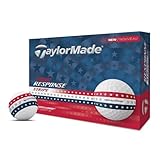
- DESIGNED FOR FAST BALL SPEEDS : The 3-layer construction of Tour Response Stripe was designed to maximize energy transfer and produce fast ball speeds.
- 360° ALIGNMENT STRIPE – A visible stripe wraps around the center of the golf ball to provide a continuous alignment reference, helping golfers aim putts better, faster and more consistently.
- NEW TOUR FLIGHT DIMPLE PATTERN: The Tour Flight Dimple Pattern unlocks next-level aerodynamics while promoting maximum carry distances
- TOUR PROVEN: Proven technology which is found in TP5/TP5x, has been added to Tour Response for the first time.
- HIGH-VISIBILITY – The bright color finish is designed to stand out against the grass and sky, making the ball easier to see during play and helping golfers quickly track it from tee to green.
Tour Response uses a 100% urethane cover, which is the same material you’ll find on the Pro V1 and Chrome Soft. That matters because urethane is what gives a ball its short-game spin and feel. Most balls in this price range use ionomer covers, which are durable but feel like hitting a marshmallow wrapped in plastic. The Tour Response gives you real spin on pitch shots, check on chip shots, and a feel on putts that inspires confidence.
The core is where TaylorMade got clever. The Tour Response uses a low-compression core that’s specifically designed for swing speeds in the 85-95 mph range. This isn’t a tour ball that happens to be playable at average speeds — it’s a ball built for average speeds from the ground up. The best golf ball for average golfer swings needs to compress fully at moderate speeds, and the Tour Response does exactly that.
Off the tee, the Tour Response produces a mid-high launch with moderate spin. That’s the ideal combo for the average golfer — enough height to carry trouble, but not so much spin that your misses balloon and fall short. If you’ve been playing a tour ball and finding it feels dead off the driver, the Tour Response will feel like a completely different (and better) experience.
At Price not available, you’re getting urethane cover performance for less than you’d pay for most tour balls. That’s the definition of all-around value. It’s the best golf ball for average golfer priorities: good distance, genuine short-game spin, soft feel, and a price point that doesn’t punish you for the occasional lost ball.
Tour Response Quick Hits
Compression: ~70 (low-mid — ideal for 85-95 mph)
Cover: Cast urethane (tour-level spin and feel)
Spin: Low-mid off driver, high around greens
Feel: Soft and responsive — great off every club
Best for: Golfers who want tour-level spin at a mid-range price
The Tour Response is probably the most well-rounded ball on this list. It doesn’t lead any single category, but it’s top-three in all of them. If you’re not sure which ball is right for you and you just want something that works, start here. It’s the best golf ball for average golfer needs when you want to stop overthinking and start playing.
Bridgestone e6 Soft — Best Golf Ball for Straight Flight
If your typical round involves more trees than fairways, the Bridgestone e6 Soft deserves a long look. This ball was engineered with one primary mission: help you hit it straighter. And for the average golfer who fights a slice or a hook, that’s the single most impactful upgrade you can make to your game. The e6 Soft is the best golf ball for average golfer straight-flight needs, period.

- NEW! The soft feel, long distance golf ball
- LONGER DISTANCE - Softer and larger core for faster compression and longer distance
- INCREASED CONTROL - Soft seamless cover for better spin and feel
Bridgestone’s Delta Wing Dimple pattern is the secret sauce here. Unlike traditional dimple patterns that are designed for maximum distance, the e6 Soft’s dimples create a more aerodynamically stable flight path. The ball resists sidespin, which means your slice doesn’t curve as far off line and your hooks don’t hook as sharply. It’s not going to turn a 50-yard banana ball into a laser down the middle, but it’ll turn that 50-yard slice into a 30-yard fade — and that’s the difference between out of bounds and in the short rough.
The soft compression core is tuned for the average swing speed range. At 85-95 mph, you’ll get full compression and maximum energy transfer, which translates to real distance. Some “straight flight” balls sacrifice distance for accuracy, but the e6 Soft doesn’t force that trade-off. You get both — a straighter ball flight and solid distance.
The ionomer cover keeps the price down and the durability up. You won’t get the same short-game spin as a urethane cover, but the e6 Soft’s cover is surprisingly soft for an ionomer ball. Chips and pitches feel responsive, and the ball holds its line well on putts. For the average golfer who isn’t spinning wedges back on the green, this cover does the job.
At $23.97, the e6 Soft is one of the best affordable golf balls for straight-flight performance. If your miss is sideways more often than you’d like to admit, this ball will help more than any swing tip you’ll find on YouTube. Pair it with our guide to the best golf balls for straight flight for even more options.
e6 Soft Quick Hits
Compression: ~65 (low — great for slower to average swing speeds)
Cover: Ionomer (durable, straight-flight focused)
Spin: Very low off driver (that’s the point), low-mid on short shots
Feel: Soft and easy to compress — very forgiving
Best for: Golfers who need help keeping the ball in play
The e6 Soft is the best golf ball for average golfer profiles that prioritize finding the fairway. It won’t give you tour-level spin around the greens, but it’ll put you in position to have a short iron into the green instead of a rescue from the woods — and that’s where scoring happens.
Callaway Supersoft — Best for Slower Swing Speeds
If your driver swing speed sits closer to 80-85 mph — and there’s no shame in that, plenty of solid golfers fall in this range — the Callaway Supersoft is built for you. It’s one of the lowest-compression balls on the market, and that low compression translates directly into more distance for slower swing speeds. It’s the best golf ball for average golfer swing speeds on the lower end of the spectrum.

- Increased Ball Speed with Soft Feel. The HyperElastic SoftFast Core is engineered for faster driver and iron speed, with soft greenside feel.
- Exceptional Feel, Control and Spin with Long Distance. Supersoft’s Hybrid Cover combines maximized distance with soft feel and durability.
- Greenside Spin and Control. New cover system for enhanced control on approach shots and short game shots.
The Supersoft’s compression sits around 35, which is absurdly soft. For context, most tour balls are in the 85-100 range. What that means for you: at 80-85 mph, the Supersoft compresses fully on every swing. The core stores and releases energy efficiently at those speeds, giving you more distance than a firmer ball that you can’t fully compress. It’s simple physics — a ball that matches your compression needs will always outperform one that doesn’t.
Off the tee, the Supersoft produces a high launch with low spin. That’s the ideal launch window for slower swing speeds — you need height to carry the ball, and low spin keeps it from falling out of the sky. If you’ve been hitting low, running drives that never seem to get airborne, the Supersoft will fix that problem immediately.
The feel is where this ball really shines. “Supersoft” isn’t just marketing — this ball is genuinely soft. Off the putter face, it feels like butter. On chips and pitches, it absorbs impact and gives you a cushioned feel that builds confidence. For the golfer who finds firmer balls harsh and jarring, the Supersoft is the best golf ball for average golfer hands that prefer a softer touch.
At $26.97, the Supersoft is one of the most affordable soft feel golf ball options on the market. You’re not paying a premium for the low compression — Callaway makes these by the millions, and the savings get passed on. For more options tailored to your swing speed, check out our guide to the best golf balls for swing speeds under 90 mph.
Supersoft Quick Hits
Compression: ~35 (ultra-low — built for 70-85 mph)
Cover: Ionomer (soft, durable, forgiving)
Spin: Very low off driver, low on short shots
Feel: Incredibly soft — the softest ball on this list
Best for: Slower swing speeds and golfers who prioritize feel above all
One thing to keep in mind: the Supersoft’s ultra-low compression means it’s not the best choice if your swing speed is above 95 mph. At those speeds, the ball compresses too much and you’ll lose distance. But for the golfer in that 75-90 mph range, this is the best golf ball for average golfer speeds that trend slower. It turns your moderate swing into maximum distance.
Srixon Q-Star Tour 6 — Best Urethane Cover Without the Premium Price
The Srixon Q-Star Tour 6 occupies a sweet spot that most golfers don’t even know exists: tour-level urethane cover performance at a price that won’t make you hesitate over water hazards. If you want the spin and feel of a premium ball but can’t justify Pro V1 pricing, this is your answer. It’s the best golf ball for average golfer golfers who demand short-game performance on a budget.

- Thin , Premium Urethane Cover with Biomass- Every Q-STAR TOUR golf ball features an extra thin, premium urethane cover for tour-caliber greenside spin, feel, and control. Our latest covers are also made with Biomass—a durable, plant- derived material requiring fewer carbon emissions to manufacture. It’s our signature, unbeatable performance and feel, plus a step toward reducing environmental impact.
- FastLayer Core- FastLayer uses a contrasting compression effect across the core to generate better ball speeds and distance. Q-STAR TOUR’s unique FastLayer formula also offers a lower compression rating—helping players hit longer, straighter shots on low-lofted clubs and achieve a satisfying, softer feel on Iron and Wedge shots.
- Spin Skin+ Coating- A durable coating, Spin Skin+ digs deep into Wedge and Iron grooves, maximizing spin for better control and stopping power, while also improving the cover’s resistance to dirt and grime.
- 338 Speed Dimple Pattern- The 338 Speed Dimple Pattern on Q-STAR TOUR improves overall aerodynamics for better flight performance. A lower drag coefficient helps the ball cut through the air with less resistance for a more penetrating launch and straighter flight. A higher lift coefficient allows the ball to stay airborne longer for maximum distance.
The Q-Star Tour 6 uses a urethane cover — the same material found on the Pro V1, Chrome Soft, and Tour Response. That means real spin on approach shots, check on chips, and a feel on putts that ionomer balls simply can’t match. For the average golfer who’s been playing two-piece ionomer balls and wondering why they can’t get their wedges to check, upgrading to the Q-Star Tour 6 will be a revelation.
Inside, the FastLayer core transitions from soft in the center to firm at the edges. This graduated compression is brilliant for the average golfer because it works at multiple swing speeds. At 85 mph, the soft center compresses and gives you distance. At 95 mph, you engage more of the core and get even more ball speed. It’s the best golf ball for mid handicap players whose swing speeds vary between clubs — and that’s most of us.
The spin separation between long and short shots is where the Q-Star Tour 6 earns its keep. Off the driver, it produces low spin for a strong, penetrating flight. On wedges and short irons, the urethane cover kicks in and generates real stopping power. This is the holy grail for the average golfer — low spin where you need distance, high spin where you need control.
Srixon’s Spin Skin+ coating adds another layer of friction on short shots. It’s a thin, flexible coating that increases surface grab on wedge shots without affecting driver spin. The result? More greenside spin than any other ball in this price range. If your short game is costing you strokes — and for the average golfer, it almost always is — the Q-Star Tour 6 is the best golf ball for average golfer scoring.
At $39.99, you’re paying significantly less than a Pro V1 or Chrome Soft for a ball that offers genuine urethane cover performance. That’s the best golf ball for average golfer value when spin and feel are the priority. For chipping and putting performance comparisons, check out our guide to the best golf balls for chipping and putting.
Q-Star Tour 6 Quick Hits
Compression: ~72 (medium — versatile for 85-100 mph)
Cover: Cast urethane with Spin Skin+ coating
Spin: Low-mid off driver, very high on short shots
Feel: Medium-soft — responsive but not mushy
Best for: Golfers who want tour-level spin at a mid-range price
How to Choose the Best Golf Ball for Your Average Swing
Picking the best golf ball for average golfer needs comes down to understanding a few key factors. Let’s break down what actually matters — and what’s just marketing noise.
Compression: The Most Important Number
Compression is how much the ball deforms at impact. A ball rated 90 compression requires more force to compress than one rated 60. For the average golfer swinging at 85-95 mph, you want a compression between 60 and 80. Go too high and the ball feels like a rock and you lose distance. Go too low and the ball compresses too much, also costing you distance. The best golf ball for average golfer swing speeds sits right in that sweet spot.
If your swing speed is 80-85 mph, aim for compression under 65 (Supersoft, Soft Feel). If you’re at 90-95 mph, look for 70-80 (Chrome Soft, Tour Response, Q-Star Tour). And if you’re pushing toward 100 mph, you can start considering higher-compression balls like the Pro V1.
Cover Material: Urethane vs. Ionomer
This is the biggest dividing line in golf balls, and it directly affects your short game. Urethane covers (found on the Chrome Soft, Tour Response, Pro V1, and Q-Star Tour 6) provide real spin and feel around the greens. Ionomer covers (found on the Soft Feel, e6 Soft, and Supersoft) are more durable and cheaper but offer less spin control.
For the average golfer, the choice comes down to budget and priorities. If you lose a lot of balls, ionomer covers make financial sense. If your short game is where you save strokes and you can keep the ball in play, urethane is worth the investment. The best golf ball for average golfer needs often comes down to this one decision.
Spin Levels: High, Low, or Something in Between
Spin is a double-edged sword for the average golfer. High spin off the driver means more distance — but also more curve on mishits. Low spin off the driver means straighter shots — but less carry. Around the greens, more spin means more control and stopping power.
The ideal average swing speed golf ball produces low-to-moderate spin off the driver and moderate-to-high spin on short shots. This is called “spin separation,” and it’s what makes balls like the Chrome Soft and Q-Star Tour 6 so good. They give you the best of both worlds without forcing you to choose between distance and control.
Dimple Patterns: More Than Just Looks
Dimple patterns affect aerodynamics, and that affects ball flight. Higher dimple counts tend to produce higher, more stable flights. Specialized patterns like Bridgestone’s Delta Wing (on the e6 Soft) are designed to reduce drag and promote straighter flight.
For the average golfer, the dimple pattern matters most when you’re fighting a specific miss. If you hit it high and short, look for a ball with fewer, shallower dimples that produce a lower, more penetrating flight. If you hit it low, more and deeper dimples will help you get the ball airborne. The best golf ball for average golfer trajectories accounts for your typical ball flight.
Putting It All Together
Here’s a simple framework: start with your swing speed to narrow down compression. Then decide if urethane or ionomer cover fits your budget and short-game needs. Finally, consider spin characteristics based on your typical miss. The best golf ball for average golfer swings isn’t the most expensive one — it’s the one that matches your specific profile.
| Factor | If You Need… | Look For… |
|---|---|---|
| Compression | More distance at moderate speed | Low-mid compression (60-80) |
| Cover | More spin and feel around greens | Urethane cover |
| Cover | More durability and lower cost | Ionomer cover |
| Spin | Straighter tee shots | Low spin off driver |
| Spin | More stopping power on approaches | High spin on short shots |
| Flight | Higher trajectory | More/deeper dimples |
| Flight | Lower, penetrating trajectory | Fewer/shallower dimples |
Final Verdict — Our Top Picks for Average Golfers
We tested seven balls across hundreds of shots, and here’s the bottom line. The best golf ball for average golfer profiles depends on what matters most to you, but one ball stands above the rest as our overall pick.
Best Overall: The Callaway Chrome Soft remains the best golf ball for average golfer swings across every metric that counts. Distance, spin separation, short-game feel, and consistency from ball to ball — it leads in all of them. If you only buy one ball this season, make it this one.
- Outstanding tour performance with soft feel.
- New Hyper Fast Soft Core produces exceptionally fast ball speeds.
- New Seamless Tour Aero delivers a consistently high ball flight with low spin.
- New High-Performance Tour Urethane Soft Cover delivers outstanding greenside control with soft feel.
Best Budget: The Srixon Soft Feel 14 delivers real performance at a fraction of the price. It’s the best affordable golf ball on the market and the best golf ball for average golfer budgets.
- Soft Without Compromise: If feel is what matters most to you, play Soft Feel for maximum all-around performance. Soft Feel technology provides responsive feel for excellent control from tee to green.
- Increased Distance: Engineered for maximum distance with a high-energy core that boosts ball speed, ideal for golfers seeking longer drives.
- Low Compression: Perfect for golfers with slower or medium swing speeds, delivering a soft feel and easy launch for improved accuracy and control.
- 338 Speed Dimple Pattern: Speed dimples reduce drag at launch increase lift during descent. The soft thin cover provides less spin off the driver but more greenside spin and a softer feel on pitches, chips, and putts.
- Affordable Performance: Offering premium features at an exceptional value, the Soft Feel golf balls deliver great performance without the premium price tag.
Best Premium: The Titleist Pro V1 is worth the money if your swing speed is approaching 95 mph and your short game is your strength. It’s the best golf ball for mid handicap players trending toward single digits.
- Pro V1 has a softer feel, less spin and flatter trajectory than Pro V1x, which makes it the preferred model for players who like exceptionally long distance, the ability to flight shots, and score with precision and touch.
- New faster high gradient core delivers more speed and iron and wedge spin for more control
- Low long game spin from a speed amplifying high-flex casing layer
- Penetrating and consistent flight from a spherically-tiled 388 tetrahedral dimple design
- Excellent greenside spin from a soft cast urethane elastomer cover
Best Value: The TaylorMade Tour Response gives you urethane cover performance at a mid-range price. It’s the best all-around value and the best golf ball for average golfer golfers who want premium spin without premium pricing.
- DESIGNED FOR FAST BALL SPEEDS : The 3-layer construction of Tour Response Stripe was designed to maximize energy transfer and produce fast ball speeds.
- 360° ALIGNMENT STRIPE – A visible stripe wraps around the center of the golf ball to provide a continuous alignment reference, helping golfers aim putts better, faster and more consistently.
- NEW TOUR FLIGHT DIMPLE PATTERN: The Tour Flight Dimple Pattern unlocks next-level aerodynamics while promoting maximum carry distances
- TOUR PROVEN: Proven technology which is found in TP5/TP5x, has been added to Tour Response for the first time.
- HIGH-VISIBILITY – The bright color finish is designed to stand out against the grass and sky, making the ball easier to see during play and helping golfers quickly track it from tee to green.
Best for Straight Flight: The Bridgestone e6 Soft keeps the ball in play like nothing else. If your miss is sideways, this is your ball.
- NEW! The soft feel, long distance golf ball
- LONGER DISTANCE - Softer and larger core for faster compression and longer distance
- INCREASED CONTROL - Soft seamless cover for better spin and feel
Best for Slower Speeds: The Callaway Supersoft maximizes distance and feel for swing speeds under 90 mph. It’s the best soft feel golf ball on the market.
- Increased Ball Speed with Soft Feel. The HyperElastic SoftFast Core is engineered for faster driver and iron speed, with soft greenside feel.
- Exceptional Feel, Control and Spin with Long Distance. Supersoft’s Hybrid Cover combines maximized distance with soft feel and durability.
- Greenside Spin and Control. New cover system for enhanced control on approach shots and short game shots.
Best Urethane Under $35: The Srixon Q-Star Tour 6 offers tour-level spin and feel at a price that doesn’t sting. It’s the best golf ball for average golfer short-game performance on a budget.
- Thin , Premium Urethane Cover with Biomass- Every Q-STAR TOUR golf ball features an extra thin, premium urethane cover for tour-caliber greenside spin, feel, and control. Our latest covers are also made with Biomass—a durable, plant- derived material requiring fewer carbon emissions to manufacture. It’s our signature, unbeatable performance and feel, plus a step toward reducing environmental impact.
- FastLayer Core- FastLayer uses a contrasting compression effect across the core to generate better ball speeds and distance. Q-STAR TOUR’s unique FastLayer formula also offers a lower compression rating—helping players hit longer, straighter shots on low-lofted clubs and achieve a satisfying, softer feel on Iron and Wedge shots.
- Spin Skin+ Coating- A durable coating, Spin Skin+ digs deep into Wedge and Iron grooves, maximizing spin for better control and stopping power, while also improving the cover’s resistance to dirt and grime.
- 338 Speed Dimple Pattern- The 338 Speed Dimple Pattern on Q-STAR TOUR improves overall aerodynamics for better flight performance. A lower drag coefficient helps the ball cut through the air with less resistance for a more penetrating launch and straighter flight. A higher lift coefficient allows the ball to stay airborne longer for maximum distance.
At the end of the day, the best golf ball for average golfer swings is the one that matches your speed, your budget, and your priorities. Start with compression that fits your swing speed. Then pick the cover material that matches your short-game needs and wallet. You can’t go wrong with any of these seven — they’ve all earned their spot on this list through real on-course performance, not marketing budgets.
Stop overthinking it. Pick the ball that fits your game, buy a dozen, and go play. The best golf ball for average golfer needs is the one you trust when you’re standing over a 6-footer to save par.
You Might Also Enjoy
If you found this guide helpful, check out these related reviews:
Best Golf Balls for Swing Speeds Under 90 MPH
Best Golf Balls for 90 MPH Swing Speed