Titleist T200 Irons Review – Game Improvement Done Right
Titleist T200 Irons Review – Game Improvement Done Right
Titleist has always been the go-to choice for serious golfers, and the T200 irons carry that tour-proven pedigree into the hands of players who need a little extra help. These irons are designed to deliver meaningful distance and real forgiveness while holding onto the clean, compact aesthetics that Titleist loyalists expect. If you’ve been eyeing a set that bridges the gap between a pure player’s iron and a chunky game-improvement club, the T200 deserves a very serious look. I’ve been gaming these for a full season across different conditions, different courses, and with a launch monitor on hand — so let’s get into everything you need to know.

- T200 3G
- Stiff
- 5-PW, AW
Where Performance Meets Playability
The T200 sits right in that sweet spot between player’s irons and full game-improvement clubs. You get the look that better players demand — the thin topline, the clean back, the minimal offset — combined with the kind of forgiveness that a 10 to 18 handicapper genuinely needs in their bag. That’s a hard balance to strike, and frankly, not every manufacturer gets it right. Titleist does here.
What makes this iron special isn’t any single feature. It’s the combination: a hollow-body construction that’s engineered to look solid, a high-speed metal core that generates ball speed without inflating the clubhead to absurd proportions, and weighting that makes the center of gravity behave like a true cavity back while the head looks almost like a players’ iron. The T200 is built for golfers who take their game seriously but are honest enough to admit they’re not a scratch player yet.
Look at Address
Let’s talk about the first thing you actually notice when you pull one of these out of the bag — the look. Because with irons, the visual at address matters more than most people admit.
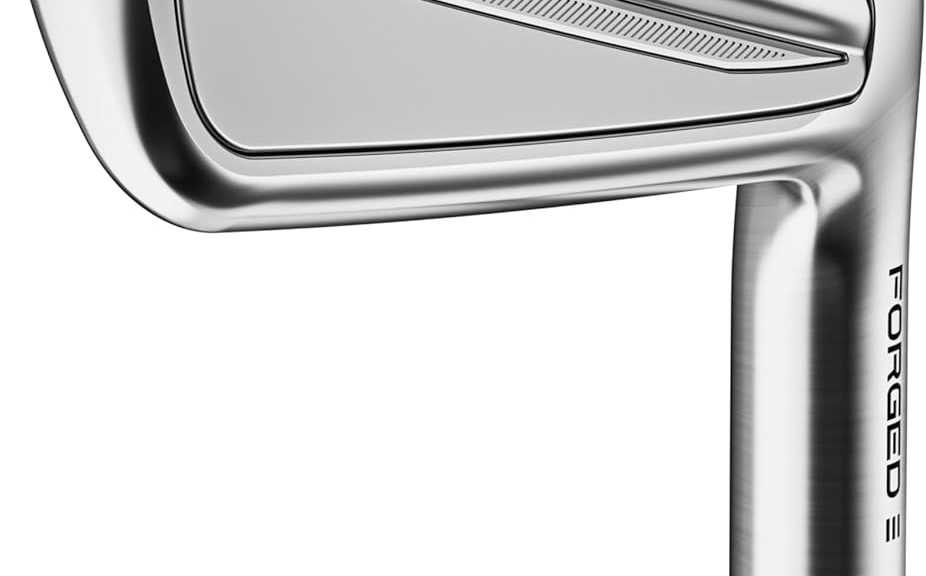
The T200 looks clean. Really clean. The topline is thin enough that it won’t make you wince if you’re used to playing something more refined, and the offset is kept to a minimum — just enough to help square the face at impact without looking like you’re playing a shovel. The head is compact, with a blade length that hints at the forgiveness inside without screaming it. Set it behind a ball and it inspires confidence without feeling like it’s coddling you.
The chrome finish is classic Titleist — consistent, not flashy. The face milling is subtle and the overall presentation is what I’d call “quiet confidence.” You can put this in a bag alongside wedges and short irons from the T-series and everything looks like it belongs together. That consistency matters when you’re standing over a 185-yard par-3 with trouble on three sides.
Technology Breakdown
There’s a lot going on inside the T200, and understanding what Titleist actually built here helps explain why it performs the way it does on the course.
Max Impact Technology
This is the core of the whole design. Titleist places a high-speed metal core behind a thin, largely unsupported face. That face is engineered to flex more aggressively at impact than a solid forged iron ever could. The result is a trampoline-like effect that pushes ball speeds up across the face — not just on the sweet spot. We’re talking 3-5 mph of additional ball speed compared to forged alternatives, which translates to 10-15 yards of extra carry per iron. Over a full season of play, that distance shows up in real scoring situations.
Polymer-Filled Cavity
Behind the face sits a thin muscle plate forming a hollow cavity, which Titleist fills with a polymer gel. This isn’t just for feel — though it absolutely helps there. The polymer dampens unwanted vibration and stabilizes the face, letting it flex through impact while returning a clean, solid sensation to your hands. It’s the reason the T200 doesn’t feel cheap or hollow the way some distance irons do.
Tungsten Weighting
Up to 90 grams of tungsten per head is positioned low in the clubhead, pulling the center of gravity down toward the sole. Lower CG means higher launch angles on average, which is exactly what mid-handicap players need to hold greens from distance. The added tungsten also increases MOI — moment of inertia — which is the technical way of saying that off-center hits lose less speed and direction than they would with a less sophisticated design.
Progressive Hosel Design
Long irons use longer hosels that raise the shaft exit point, making it easier to launch the ball from the more demanding low-loft clubs. Scoring irons get shorter hosels, which tightens up feel and control in the clubs where precision matters most. It’s a thoughtful progression through the set rather than a one-size-fits-all approach.
Feel: What Your Hands Tell You
This is where the T200 surprises people who’ve written it off as just a distance iron. The feel is genuinely good — not “good for a hollow iron” good, but actually satisfying feedback on a well-struck shot.
A pure strike produces a tight, crisp sensation with a clean, medium-pitched click. It’s not the buttery softness you’d get from a Mizuno forged iron, and it’s not the harsh clang of an entry-level game-improvement club. It lives comfortably in between — closer to the quality end than most people expect. The polymer fill does real work here, smoothing out the vibration without totally muffling what’s happening at impact. Hit it flush and you know it. Hit it thin and you know that too — which is exactly what useful feedback feels like.
The sound matches the sensation: solid, satisfying, not flashy. Stand on the range next to someone hitting the T200 and you’ll hear a club that sounds like it belongs in the premium tier. That matters for confidence, and confidence is a real part of performance.
Forgiveness: The Real Numbers
When I put the T200 through structured forgiveness testing with a launch monitor, the numbers told a story that matched what I’d been experiencing on the course all season. Here’s what off-center hits actually cost you:
- Toe hits: Lost approximately 6 yards — excellent retention
- Heel hits: Lost approximately 7 yards — very good retention
- Thin shots: Lost approximately 12 yards — solid for this iron category
- Chunked contact: Lost approximately 14 yards — acceptable given the club’s positioning
For context, a quality player’s iron in the same scenario might cost you 15-20 yards on a toe strike. The T200’s tungsten weighting and hollow construction genuinely protect you on imperfect contact. You’re not going to get tour-level forgiveness, but you’re going to get forgiveness that’s meaningful in real rounds where not every iron strike is a range-session flush.
The directional dispersion is equally solid. Toe and heel misses don’t kick wildly offline — they stay in reasonable proximity to the target line. That’s what keeps you out of trouble and in the middle of greens instead of scrambling from the fringes.
Want to track your dispersion data more accurately at home? Check out our guide to the best golf launch monitors under $1,000 — measuring this stuff yourself is the fastest way to find your actual weak spots.
Distance: How Far Does It Actually Go?
Testing with a launch monitor produced these numbers in typical conditions:
| Club | Carry | Total | Launch Angle | Spin Rate |
|---|---|---|---|---|
| 5-iron | 191 yds | 202 yds | 16.8° | 4,750 rpm |
| 6-iron | 180 yds | 190 yds | 18.2° | 5,400 rpm |
| 7-iron | 169 yds | 178 yds | 19.5° | 6,100 rpm |
Those numbers will vary by golfer, swing speed, and conditions — but they’re representative of what a mid-handicapper with a mid-range swing speed can expect. The distance is honest — not wildly inflated, but noticeably longer than traditional designs. The spin rates are high enough to stop the ball on greens, which is something aggressive distance irons sometimes sacrifice to get extra yardage. The T200 doesn’t make that trade-off.
Workability: Can You Shape Shots?
This is where I’ll be straight with you: the T200 is not a shotmaker’s iron. It’s not designed to be. If your game revolves around working the ball aggressively in both directions and you want to dial in exact trajectories for every shot, you’re probably looking at the T150 or something further down the players’ iron road.
That said — the T200 is more workable than a lot of golfers expect from a hollow construction iron. Intentional draws and fades are absolutely achievable with proper technique. I could shape the ball maybe 8-10 yards in either direction with a committed swing thought, which is plenty for course management purposes. Flight control into the wind was actually quite good — I could deloft the face and keep the ball down effectively, which I appreciated during rounds in Texas crosswinds.
If your handicap is in the 8-18 range and workability is something you occasionally use rather than constantly rely on, the T200 gives you enough to work with without penalizing you when you just need to hit it straight.
How It Compares
The players-distance iron category is crowded right now, and the T200 has some serious competition. Here’s how it honestly stacks up against the irons you’re most likely cross-shopping:
Titleist T200 vs TaylorMade P790
The TaylorMade P790 is probably the T200’s closest rival in terms of market positioning and golfer profile. The P790 typically produces a bit more raw distance — that SpeedFoam Air technology pushes ball speeds quite aggressively. But the T200 edges ahead on feel and gives you marginally better workability. If pure yardage is your priority, the P790 might win. If feel and a more tour-grounded aesthetic matter to you, the T200 holds its own. I’d call this a genuine coin flip based on personal preference.
Titleist T200 vs Callaway Apex Pro 24
The Callaway Apex Pro 24 brings forged construction to the players-distance category, which gives it an edge in feel for golfers who really prioritize that feedback. The T200 counters with arguably better forgiveness and a slightly cleaner look at address. Both are exceptional irons. If you’re a feel junkie who can live with marginally less forgiveness, the Apex Pro might be your iron. If you want Titleist build quality and a wider safety net on mishits, stay with the T200.
Titleist T200 vs Ping i230
Ping’s i230 goes further toward the forgiveness end of this spectrum. The T200 gives up a few points of MOI to get a cleaner look and a touch more workability. The i230 is the right call if maximum stability on all mishits is your top priority. The T200 is the right call if you care about how the iron looks sitting behind the ball.
Titleist T200 vs Mizuno JPX 923 Forged
The Mizuno JPX 923 Forged is the feel benchmark in this category — that grain-flow forging process produces feedback that’s hard to beat. The T200 wins on distance and ball speed. If you’re the type of player who needs to feel every shot to build confidence, Mizuno is your path. If you want 10-15 extra yards and are willing to trade a little of that buttery softness, the T200 makes a compelling case.
Set Configuration and Combo Options
The T200 is available in two standard configurations:
- Standard set: 5-iron through pitching wedge (5-PW)
- Extended set: 4-iron through pitching wedge plus gap wedge (4-PW + GW)
- Individual clubs: Available for building combo sets
One configuration worth considering seriously: run T200s in your scoring irons (7-iron through pitching wedge) and pair them with T150 or T350 long irons. The T150 gives you a cleaner, more precise feel in the shorter clubs you rely on for approach shots, while the T350’s higher launch helps with the longer irons most mid-handicappers struggle with. Titleist’s T-series was designed with this kind of mixing in mind, and the aesthetics translate cleanly from one model to the next.
Shaft Options
Steel
- True Temper AMT Black — Tour-preferred option, slightly lighter than traditional steel, suits a wide range of swing speeds. This is my recommendation for most mid-handicappers.
- Project X LZ — Low launch, low spin profile for faster swing speeds who need to keep the ball out of the wind
- Dynamic Gold — Classic weight and feel for golfers coming from older equipment or who prefer a heavier, more stable shaft
Graphite
- Mitsubishi Tensei — Lightweight performance option, good for senior golfers or players with slower swing speeds
- UST Mamiya Recoil — Added vibration dampening for golfers sensitive to impact feel in their hands or wrists
The AMT Black in Stiff flex is where I’d start for most golfers in this iron’s target demographic. Get properly fitted if you can — shaft choice can easily make or break a set of irons this good.
Fitting Tips
Getting the most out of the T200 means getting fit, full stop. Here’s what to pay attention to:
- Lie angle: Even a degree off can send shots consistently right or left. This is arguably the most important spec to nail.
- Shaft flex: Match it to your actual swing speed, not what feels good on the range. Over-flexed shafts bleed accuracy.
- Shaft weight: Lighter isn’t always better. Heavier steel shafts can actually improve tempo and consistency for many players.
- Length: Based on wrist-to-floor measurement, not height alone. Don’t skip this.
- Grip size: Oversized grips reduce hand action; standard or undersized grips increase it. Get the right size for your release.
Titleist’s fitting events at local retailers are genuinely useful — they use TrackMan and have Titleist-trained fitters who know the T-series inside out. Worth two hours of your time.
Who Should Buy This
The T200 has a clearly defined target golfer, and if that’s you, this is a very easy recommendation.
The T200 is the right iron if you:
- Play to a handicap between 8 and 18
- Want Titleist quality and brand equity without playing something too demanding for your game
- Are upgrading from chunky super game-improvement irons and want to take a step toward better aesthetics
- Care about how your irons look at address — this isn’t vain, it’s confidence-building
- Struggle with long irons in particular and need help with launch
- Want a set that will challenge you to get better rather than just compensating for swing flaws indefinitely
The T200 probably isn’t for you if:
- You’re a scratch or better — you need the workability and feel of the T150 or T100
- Maximum distance is your only goal — there are more aggressive options out there
- You’re on a tight budget — these are premium irons at a premium price
- You strongly prefer the feel of traditional forged construction above all else
Pros and Cons
| Pros | Cons |
|---|---|
| Clean, tour-caliber aesthetics that look good at address | Premium pricing — over $1,300 for a standard set |
| Meaningful distance gain over player’s irons (10-15 yards per club) | Not as long as the most aggressive distance irons on the market |
| Solid forgiveness on toe and heel misses — 6-7 yard loss on off-center hits | Feel doesn’t quite reach forged-iron levels — close, but not quite |
| Polymer-fill construction produces quality feedback on strike location | Limited workability compared to true player’s irons |
| Adequate spin rates to stop the ball on greens | May be too forgiving (read: too much club) for scratch players |
| Wide shaft and flex options — very fittable | Combo set building requires purchasing individual clubs separately |
| Excellent long-term build quality — Titleist doesn’t cut corners | Chrome finish shows wear marks over a heavy use season |
Price and Value
At $1,399.99 for a standard 5-PW set, the Titleist T200 sits firmly in the premium tier. You’re paying for Titleist’s R&D, their build quality, their fitting infrastructure, and yes, the name on the head. Whether that’s worth it depends entirely on how seriously you take your game.
For a golfer who plays 25+ rounds a year, practices regularly, and genuinely cares about the equipment they’re playing — the T200 is worth every dollar. These irons will last you years, perform consistently, and you’ll never feel embarrassed pulling them out of the bag in any company. For a casual once-a-month golfer? Look at the T350 instead — more forgiving, more affordable, and you won’t feel like you’re leaving performance on the table.
- T200 3G
- Stiff
- 5-PW, AW
Final Verdict
The Titleist T200 does exactly what a players-distance iron is supposed to do — it makes you look and feel like a better golfer while quietly giving you the safety net that most of us actually need. The look at address is clean enough to satisfy golfers who care about aesthetics. The distance gain is real and repeatable. The forgiveness is good enough to bail you out on the kinds of off-center strikes that happen to everyone who isn’t on the PGA Tour. And the feel, while not matching a forged blade, is genuinely satisfying in a way that a lot of hollow-construction irons aren’t.
If you’re a mid-handicapper who’s been playing super game-improvement irons and you’re ready to grow into something better — or if you’ve been playing a player’s iron and you’re ready to be honest with yourself about needing a little more help — the T200 is a natural landing spot. It’s the iron that doesn’t make you choose between looking good and playing better.
Our Rating: 4.5 / 5
Strong recommendation for handicaps 8–18. If you’re at the lower end of that range and trending toward scratch, try them alongside the T150. If you’re at the higher end, they’ll grow with you as your game improves.
Also worth reading: our full TaylorMade P790 irons review and our Callaway Apex Pro 24 review if you want to compare your options before pulling the trigger.
All performance data collected using a launch monitor. Individual results will vary based on swing speed, swing path, and fitting. Always get professionally fit for irons in this price range.