McLaren Golf: Everything We Know About the F1 Giant’s New Golf Brand
An F1 Giant Just Entered the Golf Equipment Game
McLaren Golf is officially here, and honestly, the golf equipment world may never be the same. When a brand with 23 Formula 1 World Championships and over 200 Grand Prix victories decides to turn its engineering obsession toward your bag, you pay attention.
McLaren Golf launched April 29, 2026, and it’s not some half-hearted licensing deal with a badge slapped on discount clubs. This is a full-throttle, engineering-led assault on the premium golf equipment space — and they’ve got the player signatures to prove it.
Justin Rose was announced as the first global ambassador and investor on April 27. Ian Poulter followed on April 28. Two Ryder Cup legends, both putting McLaren irons in their bags from day one. That’s not a soft launch. That’s a statement.
So let’s break down everything we know about McLaren Golf — the players, the irons, the engineering philosophy, and whether this F1 golf brand has real staying power or is just a flashy pit stop.
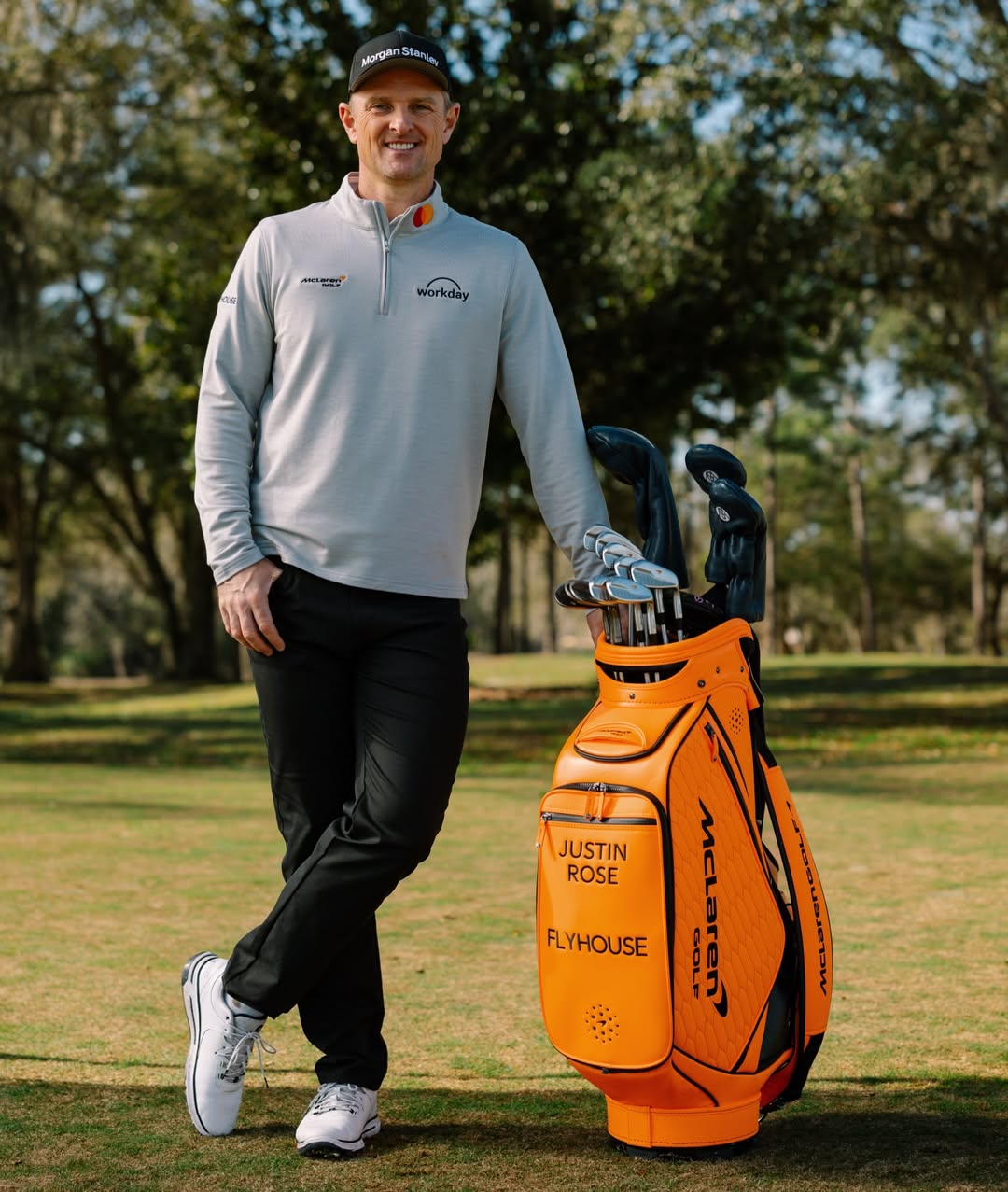
Justin Rose was the first face of the launch, and the papaya bag makes the F1 connection impossible to miss.
Who Is McLaren and Why Should Golfers Care?
If you only know McLaren from the automotive world, here’s the quick version: they’re one of the most successful racing teams in the history of motorsport. Founded in 1963 by Bruce McLaren, the team has racked up 23 F1 World Championships and over 200 Grand Prix wins.
That’s not heritage — that’s dominance. And that engineering DNA is exactly what McLaren Golf is betting on to differentiate itself in a crowded market.
The racing world and the golf world have crossed paths before. Titleist has its aviation roots. Callaway’s founder had a background in textiles and manufacturing innovation. But McLaren Golf is the first time a brand with active, world-class F1 engineering has built a golf equipment division from the ground up.
The parallel isn’t cosmetic. Formula 1 teams obsess over aerodynamics, materials science, precision manufacturing, and marginal gains — the same things that separate a good iron from a great one. Automotive golf engineering isn’t new, but this level of commitment from an active F1 powerhouse is unprecedented.
CEO Neil Howie leads the McLaren Golf division, and the team has reportedly hired designers with deep experience from leading golf brands. This isn’t McLaren figuring out golf as a hobby — they brought in people who know what a good iron feels like at impact.
Justin Rose: The Face of McLaren Golf
The Announcement That Shook the Equipment World
When Justin Rose was announced as McLaren Golf’s first global ambassador and investor on April 27, the golf internet lost its mind. Rose isn’t just a major champion and Olympic gold medalist — he’s been one of the most consistent ball-strikers on the PGA Tour for two decades.
But here’s what makes the Justin Rose McLaren partnership genuinely different from a standard endorsement: Rose has been part of the engineering process for over a year. He didn’t sign a contract and show up for a photo shoot. He was in the room, hitting prototypes, giving feedback, shaping the product.
That’s the kind of involvement you usually only see from player-designed blades at companies like Miura or Honma — not from a brand-new division of an F1 team.
The Honma Parallel — And Why Rose Says This Time Is Different
Let’s address the elephant in the room. In 2019, Justin Rose was the world number one when he switched to Honma. That move was heavily scrutinized, and when it didn’t work out, Rose moved on. It’s the kind of equipment switch that sticks in people’s memories.
Rose has acknowledged the parallel directly. But he’s also made it clear that this situation is fundamentally different. He’s not just an endorser — he’s an investor with genuine engineering input. He’s been testing these clubs for over a year, not weeks. And he lives 20 minutes from McLaren’s headquarters in Woking.
That proximity matters. Rose isn’t shipping clubs across an ocean and hoping for the best. He can drive to McLaren HQ, hit balls on their testing facility, talk to the engineers face to face, and drive home. That’s a level of access and iteration that most Tour players never get with their equipment sponsor.
Rose’s Inner Circle: Zak Brown and Lando Norris
Here’s a detail that tells you everything about how this deal came together: Rose is friends with McLaren Racing CEO Zak Brown and F1 driver Lando Norris. This wasn’t a cold call from a management company. This was a relationship that brewed over dinners, rounds of golf, and shared obsession with performance.
Zak Brown golf involvement makes perfect sense. He’s a golf nut who plays regularly and understands the equipment space. Having the Racing CEO personally invested in the golf division gives the brand credibility that money can’t buy.
And Lando Norris? He’s one of the most popular young drivers in F1, with a massive social following. If the brand wants to bridge the gap between Formula 1 golf fans and traditional golf consumers, Norris is the perfect bridge.
The McLaren CB Prototype Irons: What We Know
A Combo Set Built for a Pure Ball-Striker
The McLaren CB Prototype irons are the first product, and they’re telling. Rose will debut them at the Cadillac Championship at Doral — the same week as the F1 Miami Grand Prix. That’s not a coincidence; that’s a marketing masterclass.
The set makeup is a combo configuration: cavity-back 4-iron, blade 5-iron through pitching wedge. If you know iron design, you know this setup screams “I’m a serious player who wants forgiveness in the long iron and feel in the scoring clubs.”
It’s the same philosophy you see in many of the best golf irons for mid handicappers — blend forgiveness where you need it, workability where you want it. But make no mistake: McLaren CB Prototype irons are not game-improvement clubs. These are player’s irons designed for someone who finds the center of the face.
Design Details That Matter
Here’s where the engineering pedigree shows. The McLaren CB Prototype features a short heel-to-toe length and a flat leading edge. What does that mean in plain English?
Short heel-to-toe length concentrates mass behind the sweet spot. It makes the iron feel more responsive on center strikes but less forgiving on mishits. It’s a design choice that prioritizes feel and workability — exactly what a Tour player wants.
The flat leading edge? That’s about turf interaction. A flatter leading edge lets the club sit flush behind the ball at address and promotes a clean entry into the turf. It’s a detail that matters enormously to players who shape shots and control trajectory.
These aren’t design choices you make if you’re building clubs for the mass market. These are design choices you make when your first customer is a major champion who has been grinding prototypes for a year.
The Papaya Bag and the Speedmark
Rose’s custom golf bag is McLaren papaya — that iconic orange that’s been the team’s signature color since the 1960s. The McLaren Speedmark logo, which draws from the team’s racing heritage, is prominent on the bag and the iron heads.
Look, branding matters. When Rose walks onto the first tee at Doral carrying that papaya bag, every camera in golf is going to point at it. McLaren Golf knows exactly what they’re doing from a visual identity standpoint.
The Speedmark isn’t just decoration — it’s a symbol that says “this comes from the same minds that design F1 cars.” Whether that translates to actual performance superiority remains to be seen, but as a branding play, it’s sharp.
Ian Poulter Joins the McLaren Golf Roster
The day after Rose was announced, McLaren Golf dropped another bomb: Ian Poulter signed on April 28 and is putting McLaren irons in his bag immediately.
Poulter is a fascinating addition for a few reasons. First, he’s one of the most recognizable figures in European golf — his Ryder Cup persona alone makes him marketing gold. Second, he’s an equipment junkie who has never been shy about switching brands when he finds something better. If Poulter is putting McLaren irons in play, it’s because he genuinely believes in them.
Third — and this is speculation, but informed speculation — Poulter’s style-forward personality fits perfectly with a premium, design-conscious brand. McLaren Golf isn’t trying to be the value option. They’re aiming at the top of the market, and Poulter’s personal brand aligns with that positioning.
Having two Ryder Cup legends on board before the brand even officially launched gives them instant credibility. You can’t buy the kind of validation that comes from Tour players putting your clubs in competition — not just in a studio, but under the lights at the Cadillac Championship.
The McLaren Golf Engineering Philosophy
From Wind Tunnels to Iron Heads
The brand positions itself as a “high-end, engineering-led venture.” That phrase tells you everything about their target market and self-image. They’re not competing with Wilson or Top Flite. They’re going after the same buyer who considers Miura, PXG, or the premium end of Titleist.
What does automotive golf engineering actually mean in practice? McLaren’s F1 operation uses computational fluid dynamics, finite element analysis, and advanced materials testing to squeeze performance out of every component. The promise is that this same rigorous approach is being applied to club design.
Now, let’s be real for a second. A golf iron and an F1 car share very little in terms of actual engineering. The CFD that shapes a front wing and the FEA that optimizes an iron’s CG are related disciplines, but they’re not the same thing. What they can credibly transfer from racing is the culture of engineering — the obsession with precision, the willingness to iterate endlessly, and the resources to pursue marginal gains.
That culture, combined with the experienced golf designers they’ve hired, is what makes McLaren Golf genuinely interesting rather than just a branding exercise.
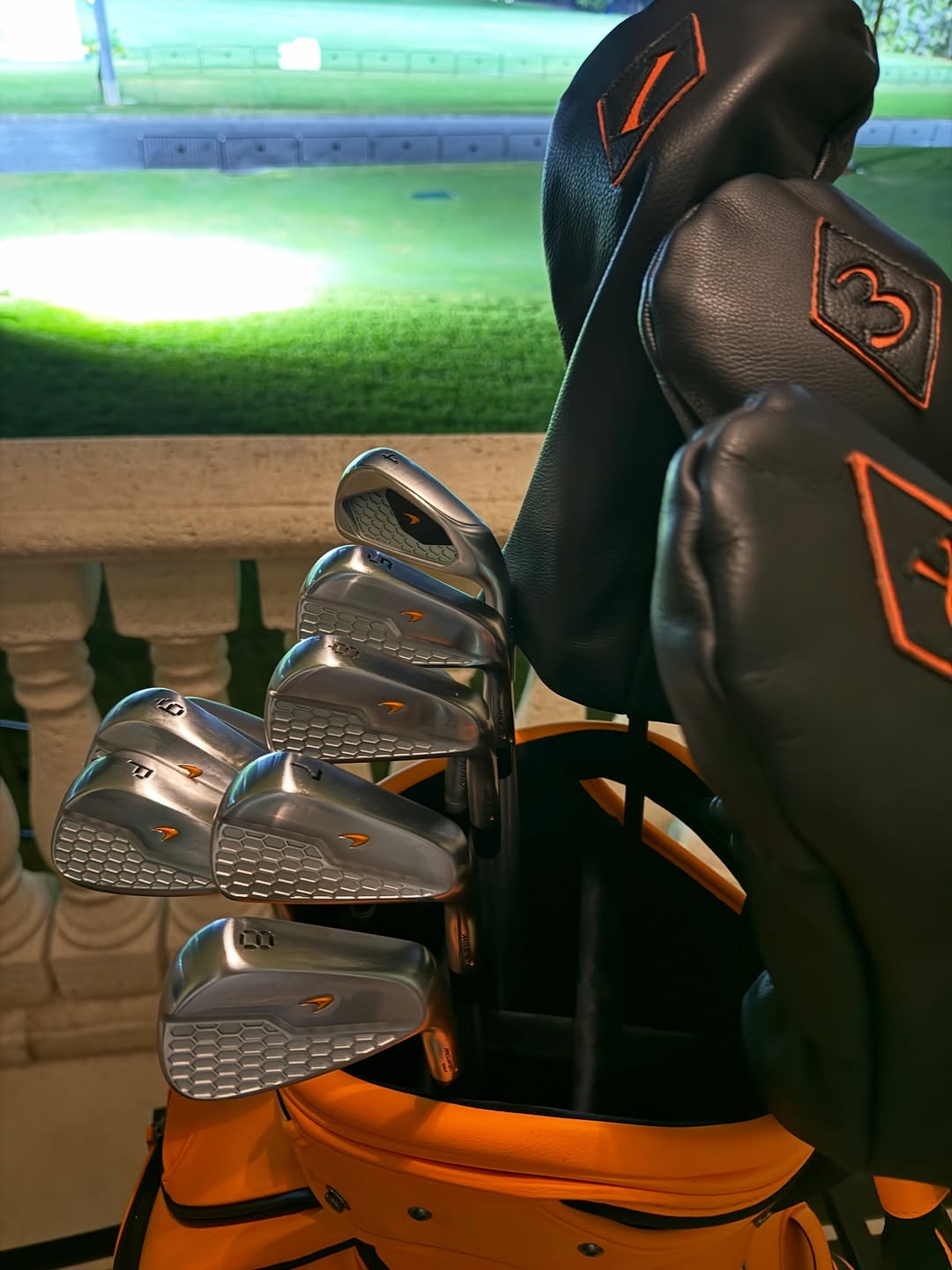
This close-up of Rose’s bag gives us the clearest verified look at the McLaren iron design so far.
The Ultra-Premium Market Play
McLaren Golf is targeting the ultra-premium segment. Expect pricing that competes with PXG Gen5 and Miura — not with Callaway Paradym or TaylorMade Qi. This is a brand that wants you to feel like you’re buying something special, not something accessible.
Is there room for another ultra-premium golf equipment brand? That depends on execution. PXG proved that a new brand could enter the premium space and survive, even thrive. But PXG also had Bob Parsons’ checkbook and an aggressive marketing machine behind it.
They have the F1 halo, which is arguably more valuable than any marketing budget. The question is whether that halo translates to “I need these irons” or just “that’s a cool story.” You can check out what they’re building at mclarengolf.com.
One thing’s certain: if you’re already shopping for a launch monitor to dial in your distances and you’re considering McLaren irons, you’re clearly the type of golfer who takes equipment seriously. McLaren Golf is betting there are enough of you to sustain a premium brand.
What McLaren Golf Means for the Equipment Industry
The F1 Golf Crossover Is Real
The idea of an F1 golf brand has been floating around for years. Remember when Mercedes-Benz had that licensing deal with golf equipment? It was fine, but it never felt authentic. This feels different because the engineering infrastructure is actually there.
McLaren has an applied technologies division that works across industries — healthcare, data systems, even cycling. Golf is the latest vertical, and it’s one where the consumer can actually touch and use the product every weekend. That’s a powerful feedback loop for a brand.
The Formula 1 golf crossover isn’t just a marketing angle anymore. With McLaren Golf launching with Tour players and real products, it’s a viable segment. Don’t be surprised if other racing brands explore the same space — though few have McLaren’s combined racing pedigree and applied engineering capabilities.
What This Means for Established Brands
Does McLaren Golf threaten Titleist, Callaway, or TaylorMade? Not immediately. Those brands have massive Tour presence, enormous R&D budgets, and decades of trust. But McLaren Golf doesn’t need to threaten them directly to matter.
What they do is validate the ultra-premium segment. Every golfer who considers a McLaren iron and ends up buying a set of Titleist 620 MBs or Miura CB-301s is still evidence that the premium space is growing. Their presence expands the pie, even if they take a small slice.
For established brands, the bigger concern is talent. The brand hired designers from leading golf companies. That’s poaching the exact people who know how to build great clubs. If they succeed, expect more talent to flow toward new entrants, which accelerates competition and innovation across the board.
And if you’re a gear junkie who already debates the best putters and best drivers under $300, having another premium brand in the mix just means more options — and more interesting debates.
The Road Ahead: What to Watch from McLaren Golf
Beyond the CB Prototype
The McLaren CB Prototype irons are just the beginning. If the brand is serious about building a full equipment line — and every signal says they are — expect wedges, a driver, fairway woods, and possibly a putter in the pipeline.
Each new product will tell us more about the brand’s engineering philosophy. Irons are a statement of intent. But a driver? That’s where F1 aerodynamics and materials science could actually make a measurable difference. Carbon fiber, titanium alloys, adjustable weighting — these are areas where McLaren Golf’s racing DNA could produce something genuinely innovative.
The timeline matters too. If they can get a driver into Rose’s hands within a year, they’re serious. If the irons are still the only product 18 months from now, questions will start.
Who’s Next on the Roster?
Rose and Poulter give McLaren Golf two elite European players. But to really establish credibility, they need a presence on the PGA Tour — not just at designated events, but week in and week out.
Who would make sense? A young, rising player who values style and engineering could be a perfect fit. Someone who grew up watching F1 and sees the brand as an authentic extension of something they already admire. That player exists, and McLaren Golf has the resources to make a competitive offer.
The other possibility: they sign a LIV Golf player. Poulter already has LIV ties, and that circuit’s emphasis on individual branding aligns with the premium positioning. It’s a controversial path, but it’s a path.
Can McLaren Golf Actually Succeed?
Let’s be honest about the challenges. The golf equipment industry has a brutal failure rate. Nike Golf had unlimited resources and couldn’t make it work. Dunlop, MacGregor, Maxfli — brands that once dominated are either gone or shadows of themselves.
But this brand has something none of those failed entries had: a thriving, high-profile parent company with genuine engineering expertise and no need for the golf division to be profitable immediately. That changes the math.
They also benefit from timing. The premium equipment segment is stronger than ever. Golfers are willing to spend $2,000+ on irons. Custom fitting is mainstream. Launch monitors like the ones we cover in our best golf launch monitors guide have made golfers more informed about equipment than ever before.
The biggest risk for McLaren Golf isn’t engineering — it’s distribution and awareness. Getting clubs into fitters’ hands and onto demo days is where the real work begins. You can have the best iron in the world, but if nobody can hit it before buying, you’re just selling a logo.
They’ll need a fitting network, retail partnerships, and a demo program. That infrastructure takes years to build and millions to fund. But with the backing of an F1 operation, the resources are there if the commitment is real.
The Verdict on McLaren Golf
McLaren Golf has done nearly everything right in its opening move. Two Tour legends. A legit combo-set iron designed with real player input. An F1 halo that no other golf brand can replicate. A launch timed perfectly alongside the Miami Grand Prix. This is a serious entry, not a vanity project.
The McLaren CB Prototype irons will tell us a lot. If Rose contends at Doral with them in the bag — and given his ball-striking pedigree, that’s very possible — the narrative writes itself. If Poulter’s iron play sharpens, even better. Results still matter more than branding.
The broader question is whether they can build a sustainable business, not just a launch moment. Premium golf equipment is a crowded space, and the margin between “legitimate new entrant” and “expensive novelty” is thinner than most people think.
But here’s what I keep coming back to: McLaren didn’t win 23 F1 World Championships by being cautious. They won by being obsessive about performance, willing to take risks, and relentless in pursuit of marginal gains. If that culture truly transfers, the established brands should be nervous.
This brand is real. The irons are real. The players are real. Now we wait to see if the results are real too. One thing’s for sure — the golf equipment world just got a lot more interesting, and you’ll want to keep your eye on what comes out of Woking.
You Might Also Enjoy
If this McLaren Golf deep dive got your gear brain buzzing, check out these:
• Best Golf Irons for Mid Handicappers (2026) — How the new entries stack up against the classics
• Best Golf Cart Bags (2026) — Because that papaya bag isn’t the only option worth considering
• Best Golf Launch Monitors (2026) — Dial in your numbers before you drop premium-iron money
• Best Golf Putters for Mid Handicappers (2026) — The scoring club still matters most
• Best Golf Drivers Under $300 (2026) — Not every premium brand costs premium money