
Golf Simulator vs Launch Monitor: Which Should You Buy?
Here’s a question I get asked constantly: should I build a full golf simulator or just grab a launch monitor? I’ve been on both sides of this. I’ve got a Garmin R10 that I’ve been beating up for two years, and last spring I finally pulled the trigger on a full simulator setup in my garage. I’ve spent real money, dealt with real headaches, and had real fun with both — so I feel pretty qualified to break this down for you.
The short answer? They’re not really competing products. A golf simulator and a launch monitor solve different problems, and which one you need depends entirely on what you’re trying to accomplish. But since you’re here, let’s dig into the full golf simulator vs launch monitor debate — costs, accuracy, space, use cases, all of it — so you can make a decision you won’t regret six months from now.

What Is a Golf Launch Monitor?
A launch monitor is a device — usually radar-based or camera-based — that measures what happens to the golf ball (and sometimes the club) at the moment of impact. That’s really it. The device tracks data points like ball speed, launch angle, spin rate, carry distance, and clubhead speed. Some of the higher-end models also capture smash factor, attack angle, face angle, and spin axis.
What you’re buying with a launch monitor is data. Raw, unfiltered numbers that tell you exactly what your ball is doing when it leaves the face. That information is gold for fitting, for practice, for understanding why your 7-iron keeps going left. But a launch monitor by itself doesn’t put you on a virtual golf course. It doesn’t have a screen with Pebble Beach rendered in front of you. It just gives you numbers.
Popular Launch Monitor Options
The market has exploded in the last few years. Here are three solid options across the price range:
- Garmin Approach R10 (~$599) — The entry-level radar unit that punched way above its weight class when it launched. Tracks 12 data parameters, connects to your phone via the Garmin Golf app, and can pair with E6 Connect for basic simulator play. Accuracy is solid for the price, especially for carry distance and ball speed. If you’re just starting out and want to dip your toe in, this is the one.
- Rapsodo MLM2PRO (~$699–$799) — Camera plus radar hybrid that captures actual video of your shot alongside the data. The video overlay feature is genuinely useful for seeing your swing alongside the numbers. Integrates with GSPro and E6 for simulator functionality. A serious step up from basic radar monitors in terms of versatility.
- FlightScope Mevo+ (~$2,000–$2,500 with FS Golf subscription) — This is where you start approaching professional-grade accuracy in a portable package. Tracks 16 parameters, has a 3D Doppler radar system, and integrates cleanly with E6, WGT, and other simulation software. If you want near-TrackMan accuracy without the TrackMan price tag, Mevo+ is the serious player’s choice.
For a deeper look at options that won’t destroy your wallet, check out our guide to the best golf launch monitors under $1,000.
What Is a Full Golf Simulator?
A full golf simulator is a complete setup that lets you actually play virtual golf indoors. We’re talking hitting bay, impact screen, projector, mat, and a launch monitor or camera system feeding data into simulation software. The launch monitor is actually a component of a full simulator — which is why it’s a bit of an apples-to-oranges comparison. But the distinction people usually mean is this: a portable launch monitor setup you can use anywhere, versus a dedicated indoor hitting bay with a screen and software that lets you play full courses.
A real simulator turns your garage, basement, or spare room into a virtual golf course. You stand on a mat, swing at a ball, it hits the impact screen, and software projects the ball flight on a virtual version of Augusta, St. Andrews, or your local muni. It’s immersive in a way that looking at numbers on your phone simply isn’t.
What Goes Into a Full Simulator Build?
There are several components you’re pricing out when you go full simulator:
- Enclosure/frame: The metal frame structure that holds everything together. Budget $300–$1,500 depending on build quality.
- Impact screen: The screen your ball actually hits. Go cheap here and you’ll regret it — good screens run $400–$1,200.
- Projector: Needs to be short-throw for most home setups. Budget $500–$2,000+ for something that actually looks good in a lit garage.
- Hitting mat: A good turf mat with a proper tee insert. $200–$800.
- Launch monitor/tracking system: This is the heart of it. Ranges from a Garmin R10 ($599) all the way to a SkyTrak+ ($2,995) or Uneekor EYE XO2 ($10,000+).
- Simulation software: E6 Connect and GSPro are the two most popular options. E6 is polished and easy to use, with hundreds of courses. GSPro is the community-driven option with a massive course library and a passionate user base that’s constantly adding content. Both run $200–$800/year depending on the plan.
- Lighting, padding, side netting: Safety items you don’t want to skip. Add $200–$500.
For a step-by-step breakdown of putting a home setup together, our home golf simulator build guide walks through the entire process.
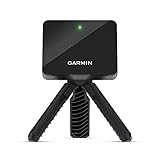
- Work to improve your game at home, indoors or on the driving range with a portable launch monitor .Waterproof : IPX7.Control Method:Application,VoiceWater Resistant: Yes.Club Head speed accuracy : plus/- 3 mph, Ball speed accuracy : plus/- 1 mph, Launch angle accuracy : plus/- 1 degree, Launch direction accuracy : plus/- 1 degree.
- Track key metrics when paired with a compatible smartphone with the Garmin Golf app to help better your shot consistency, including club head speed, ball speed, swing tempo, ball spin, launch angle and more
- Understand your golf strengths and areas for improvement by using training mode, which tracks stats for each club and shows a shot dispersion chart based on estimated ball flight using the Garmin Golf app
- See and analyze your own swing with automatically recorded video clips that include the metrics of that swing when paired with a compatible smartphone with the Garmin Golf app
- With an active subscription and the Garmin Golf app, play virtual rounds on over 42,000 courses around the world and take part in a weekly tournament with scores posted to our global leaderboard


- Advanced Golf Launch Monitor – The Rapsodo MLM2PRO golf launch monitor delivers pro-level accuracy, measuring 13 core golf metrics, including spin rate, spin axis, and swing speed, making it a golf training aid
- Golf Simulators for Home & Practice – Pair this mobile launch monitor with your smartphone or tablet to transform any space into a golf simulator, offering virtual courses and precise golf swing analysis
- Ultimate Golf Tracker & Swing Analyzer – Get real-time data on ball speed, club speed, and launch angle with this cutting-edge golf tracker and swing analyzer, designed to improve accuracy on the course.
- Indoor & Outdoor Golf Training Aid – Whether you're at the driving range or setting up a golf simulator at home, the Rapsodo MLM2PRO provides reliable data, helping golfers perfect their game anywhere.
- MLM2PRO Smart Golf Simulator – Experience realistic golf simulation with the MLM2PRO launch monitor, which integrates with leading golf apps for a full-swing golf simulator exper
Golf Simulator vs Launch Monitor: The Real Cost Breakdown
Let’s talk money, because this is usually where people’s plans meet reality.
Launch Monitor Cost
A portable launch monitor is a single purchase. You’re looking at $300 on the absolute budget end (basic devices with limited accuracy) up to $3,000 for something like the Mevo+ with a full software subscription. The ongoing cost is usually just the app subscription — often $100–$300/year depending on the platform.
You can use it literally anywhere: range, backyard, living room with foam balls, indoors with a net. The portability is a massive advantage. Pack it in your bag and take it to the range, use it during a lesson, bring it to your buddy’s place. It’s genuinely flexible.
Full Simulator Cost
Here’s where things get real. A budget simulator build (and I mean genuinely budget — we’re talking entry-level everything) will run you $3,000–$5,000 when all is said and done. A mid-range setup with a solid launch monitor, decent screen, and a good projector lands in the $8,000–$15,000 range. A premium setup with a high-end tracking system, dual projectors, and a finished room? You’re at $20,000–$30,000+ without breaking a sweat.
And then there’s the room itself. Garage conversion or basement finishing can add thousands to the project cost if you’re starting from scratch.
| Category | Launch Monitor | Full Golf Simulator |
|---|---|---|
| Entry-level cost | $300–$600 | $3,000–$5,000 |
| Mid-range cost | $700–$1,500 | $8,000–$15,000 |
| Premium cost | $2,000–$3,000 | $20,000–$30,000+ |
| Annual software cost | $100–$300/yr | $200–$800/yr |
| Space required | Minimal (range or backyard) | 10’H × 12’W × 18’D minimum |
| Portability | ✅ Highly portable | ❌ Fixed installation |
| Course simulation | Limited (some integration) | ✅ Full immersive play |
| Data accuracy | Good to excellent (device-dependent) | Excellent (premium sensors) |
| Entertainment value | Moderate | ✅ High |
| Best for | Practice, fitting, improvement | Entertainment + improvement |
Space Requirements: This Is the Make-or-Break Factor
Let me save you from a painful mistake: before you fall in love with a simulator setup, measure your space. And then measure it again.
The bare minimum for a functional golf simulator is roughly 10 feet of ceiling height, 12 feet of width, and 18 feet of depth. That gives you enough room for a driver swing without clipping the ceiling, space for the screen and projector throw, and a few feet of safety net behind the hitting position. Shorter ceilings (9 feet is common in basements) will limit your iron play and make driver swings feel cramped and genuinely dangerous.
A launch monitor? No space requirements beyond wherever you’re hitting. You can set up a Garmin R10 behind your mat in your garage in about 90 seconds. Take it to the range and let it sit on its tripod mount. Use it in your living room with foam practice balls. The flexibility is genuinely hard to overstate.
If you’re tight on space, a launch monitor wins by default. It’s not even a close call.
Accuracy: How Close Are These Things to Real Life?
This is a nuanced conversation, and anyone who tells you a $500 radar unit is “basically as accurate as TrackMan” is either lying to you or lying to themselves.
Here’s the honest breakdown:
Launch Monitor Accuracy
Entry-level radar units like the Garmin R10 are actually pretty solid for ball speed, carry distance, and launch angle. Where they struggle is spin data — specifically spin rate and spin axis. Radar has a harder time capturing spin precisely, especially with partial shots and shorter irons. For fitting work or understanding your driver numbers, they’re genuinely useful. For precise wedge fitting? You’re going to see more variance.
Camera-based systems like the Rapsodo MLM2PRO capture better spin data because they’re literally photographing the ball and reading the dimple pattern. That’s why camera-hybrid systems tend to be more reliable for short game work.
The Mevo+ sits in a sweet spot — Doppler radar with solid spin tracking and strong distance accuracy across the bag. It’s been benchmarked extensively against TrackMan by the golf community and holds up well on the metrics that matter most for practice and fitting.
Full Simulator Accuracy
A full simulator’s accuracy is only as good as the tracking system inside it. If your sim is built around a Garmin R10, the data quality is the same as just using the R10 on the range. The screen and projector don’t make the data more accurate.
Where premium simulator systems shine is in club tracking — high-end systems like Uneekor and Foresight Sports use overhead cameras that capture clubface data (face angle, attack angle, path) with exceptional precision. That level of detail costs money. Lots of it.
Bottom line: for the average golfer working on their game, mid-range launch monitor accuracy is more than enough to give you meaningful, actionable data. You don’t need TrackMan precision to know you’re flipping at impact.
Entertainment Value: Playing Pebble Beach in Your Garage
Okay, let’s talk about the fun factor — because honestly, this might be the deciding factor for a lot of people.
There is something deeply satisfying about standing in your garage in January, hitting a driver, watching the ball cannon off the screen, and seeing it fly down the 18th fairway at Pebble Beach on a 100-inch projected display. The simulation software has gotten genuinely good. E6 Connect has polished visuals and a solid course library that includes licensed versions of real tour venues. GSPro has a passionate community that’s built over 200,000 course renditions — including your local muni, probably — and the competitive multiplayer functionality means you can play with friends across the country in real time.
Playing in groups is where a simulator really earns its keep. Invite three buddies over, crack some beers, and play a round at Augusta National. It’s a genuinely great experience that a launch monitor on a net simply can’t replicate.
A launch monitor gives you data. That’s useful. But it’s not fun the way a simulator is fun. Standing at a range mat, hitting shots, looking at numbers on your phone — it takes some level of self-discipline and purpose to keep doing that. The entertainment factor of a full simulator adds built-in motivation to actually practice.
What Each Setup Is Actually Good For
Launch Monitor Is the Right Choice When…
- You want to improve, not just play. If your goal is to fix your swing, dial in your gapping, or get properly fitted for clubs, a launch monitor gives you exactly what you need. The data is the point.
- You’re on a budget. A $700 Rapsodo or $599 Garmin R10 gets you into meaningful practice data for a fraction of simulator cost.
- You don’t have the space. Ceiling too low? Room too narrow? No dedicated space? A launch monitor and a basic net is infinitely better than nothing.
- You want portability. Take it to the course, use it at the range, bring it to lessons. A fixed simulator doesn’t leave your garage.
- You’re club shopping. Nothing beats real numbers when you’re trying to decide between two drivers or validate a shaft swap. Check out our best golf drivers for 2026 to see what we’ve been testing.
Full Golf Simulator Is the Right Choice When…
- You have the space and the budget. If the 20×12 garage is sitting there and you’ve got $8K–$15K to spend, building a simulator is one of the better investments a golfer can make.
- Winter is brutal where you live. If you lose four months of outdoor golf to weather, a simulator pays for itself in rounds you’d otherwise skip.
- You want to entertain. The social use case is huge. Golf buddies, family nights, tournament watching — a simulator turns your house into the spot.
- You’re committed to year-round improvement. The immersive environment makes it easier to stay engaged with practice. Playing 9 holes of Bethpage Black feels less like homework than grinding range balls into a net.
- You want both data AND play. A good simulator gives you the swing data of a launch monitor plus the full-course simulation experience. You just pay (a lot) more for it.
The Middle Ground: Launch Monitor + Net + Software
Here’s an option a lot of people overlook: a launch monitor with a hitting net and software integration, without a full screen/projector setup. You’re spending $600–$2,500 on the launch monitor, $200–$500 on a good net, and $200–$400/year on software like GSPro or E6. Total investment: $1,000–$3,500.
You can use the software on a TV, laptop, or tablet mounted nearby. You won’t have the immersive screen experience of a full sim — the ball hits the net instead of an impact screen — but you can still play virtual courses, track your data, and practice with purpose. The Rapsodo MLM2PRO and Mevo+ both integrate cleanly with GSPro, making this middle-ground setup genuinely capable.
It’s worth seriously considering before you commit to a full build. A lot of people start here, realize they use it constantly, and then upgrade to a full enclosure setup a year or two later — with the launch monitor carrying over as the tracking component.
Pairing With Your Practice Routine
Whether you go launch monitor, full sim, or somewhere in between, these tools work best when you pair them with intentional practice. Data without a plan is just noise. Know what you’re working on — is it carry distance consistency with your irons? Stopping the snap hook with driver? Dialing in your 50-yard wedge? — and use the numbers to track meaningful progress.
Pairing a launch monitor with good training aids is a particularly strong combination. The device tells you what the ball is doing; the training aids help you change what your body is doing. For training aid recommendations that actually hold up, see our roundup of the best golf training aids for 2026.
And if you’re ever using your launch monitor data to evaluate a shaft change — understanding whether you need a stiffer or softer profile based on your actual swing numbers — our golf shaft flex guide breaks down how to read what the data is telling you.
Honest Recommendations Based on Your Situation
You’re a serious player who practices 3+ times a week and has a suitable space: Build the simulator.
If you’re going to use it constantly and you have the room, a full build is the right call. Mid-range setups with a SkyTrak+, solid impact screen, and GSPro are where most dedicated amateur golfers land happily. It becomes part of your weekly routine in a way that a range mat and a phone never quite does.
You play once or twice a week and want to improve without a major commitment: Get a Mevo+ or Rapsodo MLM2PRO.
This tier of launch monitor gives you genuinely useful data that will help you improve. You can pair it with a net and have a capable practice setup for under $3,000 all-in. Test it for a year, see how much you use it, and then decide if you want to go deeper.
You’re just getting started and want to see if this stuff is for you: Start with a Garmin R10.
Six hundred dollars to learn whether launch monitor data actually motivates you to practice more is a reasonable experiment. If you find yourself checking your ball speed and spin rate obsessively, you’ll know you’re the kind of golfer who benefits from this tech. If it collects dust after three months, you haven’t lost your shirt.
You want the full experience and can’t afford a simulator: Middle-ground setup.
Launch monitor + hitting net + software on a tablet. It’s not the same as a 100-inch immersive screen setup, but you can play virtual courses, track your stats, and practice with real data for $1,500–$3,000. For a lot of people, this is the sweet spot.
One More Thing Worth Knowing: The Depreciation Story
Launch monitors hold their value reasonably well. A two-year-old Mevo+ in good condition still sells for 70–80% of retail on the used market. The Garmin R10 floods the secondary market a bit (lots of impulse buyers who didn’t stick with it), but it’s still in demand. Good news if you want to start used, or upgrade down the road.
Full simulator setups are trickier. The technology components — projector lamps, tracking systems, software licenses — depreciate and require maintenance. A $15,000 simulator you built four years ago isn’t worth $12,000 today. That said, you’ve also played hundreds of rounds on it, so the math still works out if you actually use it.
According to data from the National Golf Foundation, indoor golf simulator usage has grown over 50% in the last five years, and the secondary market for simulator components has grown alongside it. Meaning: if you buy quality and want to sell later, there’s a market for it.
The Bottom Line on Golf Simulator vs Launch Monitor
If you’re trying to improve your golf game and want data to help you do it — start with a launch monitor. Full stop. It’s a lower-risk entry into golf tech, it’s portable, it’s genuinely useful, and you can build on it later if your obsession grows.
If you want to play golf indoors, entertain, and have a year-round practice environment that feels more like golf and less like homework — build the simulator. Just measure your ceiling first, budget 20% more than you think you’ll need, and know what you’re getting into before you start cutting drywall.
The two aren’t mutually exclusive. Most serious sim owners started with a launch monitor. Think of it as a path, not a single choice. Start where your budget and space allow, and level up when the time is right.