Golf Rangefinder With Slope vs Without Slope: Which Do You Need?
If you’ve been shopping for a golf rangefinder, you’ve probably run into the big question: golf rangefinder with slope vs without slope — which one do I actually need?
I remember staring at two nearly identical rangefinders on Amazon, one $50 more than the other, wondering if “slope” was worth the extra cash or just a marketing gimmick. Spoiler: it’s not a gimmick — but it’s also not for everyone.
In this guide, I’ll break down exactly what slope does, how it works, when you can and can’t use it, and help you figure out which type of rangefinder makes sense for your game. I’ll also share my top picks for each category so you can stop overthinking and start playing better golf.
What Is Slope on a Golf Rangefinder?
No products found.
No products found.
No products found.

- ADVANCED FEATURES & ADAPTIVE SLOPE: The rangefinder's magnetic grip ensures secure cart attachment, while the pulse vibration system provides instant target confirmation; Combined with its adaptive slope technology, experience unwavering accuracy on every terrain, from the simplest to the most challenging courses
- PERSONALIZE WITH STYLE: Choose from an abundance of designs, including a variety of colors, prints, and John Daly exclusives, ensuring your golf rangefinder reflects your style on the course
- UNPARALLELED HIGH-DEFINITION CLARITY: With its impressive 6X magnification paired with crisp HD optics, the rangefinder delivers precise visuals, stretching up to 999 yards
- SPRINKLE SAFE & YARD METER SWITCH: The rangefinder will keep you playing, even if you encounter a little rain; Additionally, its ability to switch seamlessly between yards and meters caters to golf enthusiasts worldwide
- ENDORSED BY PRO GOLFER JOHN DALY: Our golf products stand in a league of their own; They are not only preferred but also actively used by renowned professional golfer, John Daly, amplifying every swing with unmatched precision
Let’s keep this simple. A standard golf rangefinder shoots a laser beam at a target (like the flagstick) and tells you the straight-line distance. That’s it — raw yardage from point A to point B.
A rangefinder with slope does the same thing, but then goes one step further. It factors in the elevation change between you and your target and gives you an adjusted playing distance — the yardage your shot will actually play like.
Think of it this way: if you’re standing at the bottom of a big uphill par 3, the pin might be 150 yards away in a straight line, but because you’re hitting uphill, the ball has to fight gravity longer. That 150-yard shot might actually play like 160 or 165 yards. Without slope, you’d pull the wrong club. With it, you know to club up.
How Slope Technology Actually Works
Rangefinders with slope use an internal inclinometer — basically a tiny tilt sensor — that measures the angle between you and the target. The device then runs a quick calculation combining the straight-line distance with the angle to produce a “plays like” distance.
Here are some real-world examples to show you why this matters:
- 150 yards, 10° uphill → Plays like ~163 yards (club up!)
- 150 yards, 10° downhill → Plays like ~138 yards (club down)
- 200 yards, 5° uphill → Plays like ~212 yards
- 120 yards, flat lie → Plays like… 120 yards (slope doesn’t change anything on flat ground)
That uphill/downhill difference can easily be a full club or more. On a hilly course, slope compensation is an absolute difference-maker. On a flat links-style course? It barely matters at all.
The beauty of slope is that it removes the guesswork. Instead of eyeballing whether a shot is “maybe 10 yards uphill,” the rangefinder does the math for you with precision. Over 18 holes, getting those yardages dialed in can easily save you 3-5 strokes.
Tournament Rules: When Is Slope Legal?
Here’s where it gets a little tricky — and it’s the main reason “without slope” rangefinders still exist.
Under USGA and R&A rules, slope-compensated distances are NOT allowed during tournament play. Rule 4.3 permits distance-measuring devices (so basic rangefinders are fine), but using any device that measures slope, wind, or other conditions that might affect play is a penalty.
However — and this is important — tournaments can adopt a Local Rule that allows distance-measuring devices. The key distinction is:
- ✅ Legal in tournaments: A rangefinder that measures distance only (no slope active)
- ❌ NOT legal in tournaments: A rangefinder actively providing slope-adjusted yardages
- ✅ Also legal: A rangefinder with slope that has a slope disable/toggle feature turned OFF
So if you play in tournaments, leagues, or club competitions, you either need a rangefinder without slope, or one that has a slope toggle you can switch off.
Slope Toggle Explained
Most modern slope rangefinders come with a slope toggle (sometimes called “slope switch” or “tournament mode”). This is a physical switch or button that completely disables the slope function, turning your rangefinder into a basic distance-only device.
When the slope is toggled off, most rangefinders give you a visual indicator — like a different LED color, a faceplate change, or an icon on the display — so other players (and rules officials) can clearly see you’re in tournament-legal mode.
For example, Bushnell’s “Slope-Switch Technology” on their Tour V6 Shift uses a physical switch on the side of the unit. When slope is off, you’ll see a visual confirmation in the display. Precision Pro uses a similar approach on the NX10.
This is honestly the best of both worlds. You get slope data during casual rounds and practice, and you can flip it off for competitions. That’s why I generally recommend getting a rangefinder with slope and a toggle unless you’re on a tight budget.
Who Needs Slope?
Slope is worth it if:
- You play hilly courses. If your home course has significant elevation changes, slope will help you on nearly every approach shot.
- You struggle with club selection. If you’re frequently coming up short on uphill shots or flying greens on downhill holes, slope removes that guesswork.
- You want to improve faster. Understanding how elevation affects distance is a huge part of course management. Slope teaches you to think about this on every shot.
- You play casually (mostly). If you rarely enter tournaments, slope is pure benefit with no downside.
- You practice with purpose. Using slope during practice rounds helps you learn your course’s elevation changes, which you can apply even when slope is turned off in competition.
Who Can Skip Slope?
You might not need slope if:
- You play mostly flat courses. If your home course is pancake-flat, slope won’t change much for you.
- You’re on a tight budget. Rangefinders without slope are generally $30-80 cheaper. If every dollar counts, a solid non-slope rangefinder is perfectly fine. Check out our guide to the best budget golf rangefinders for more affordable options.
- You only play in tournaments. If you compete every weekend and don’t want to bother with toggling, a dedicated non-slope model keeps things simple.
- You already know your course. If you’ve played the same course 500 times and know every elevation change by heart, raw yardage might be all you need.
Best Golf Rangefinders With Slope
Here are my top picks if you decide slope is the way to go. These all include a slope toggle for tournament legality.
1. Bushnell Tour V6 Shift — Best Overall
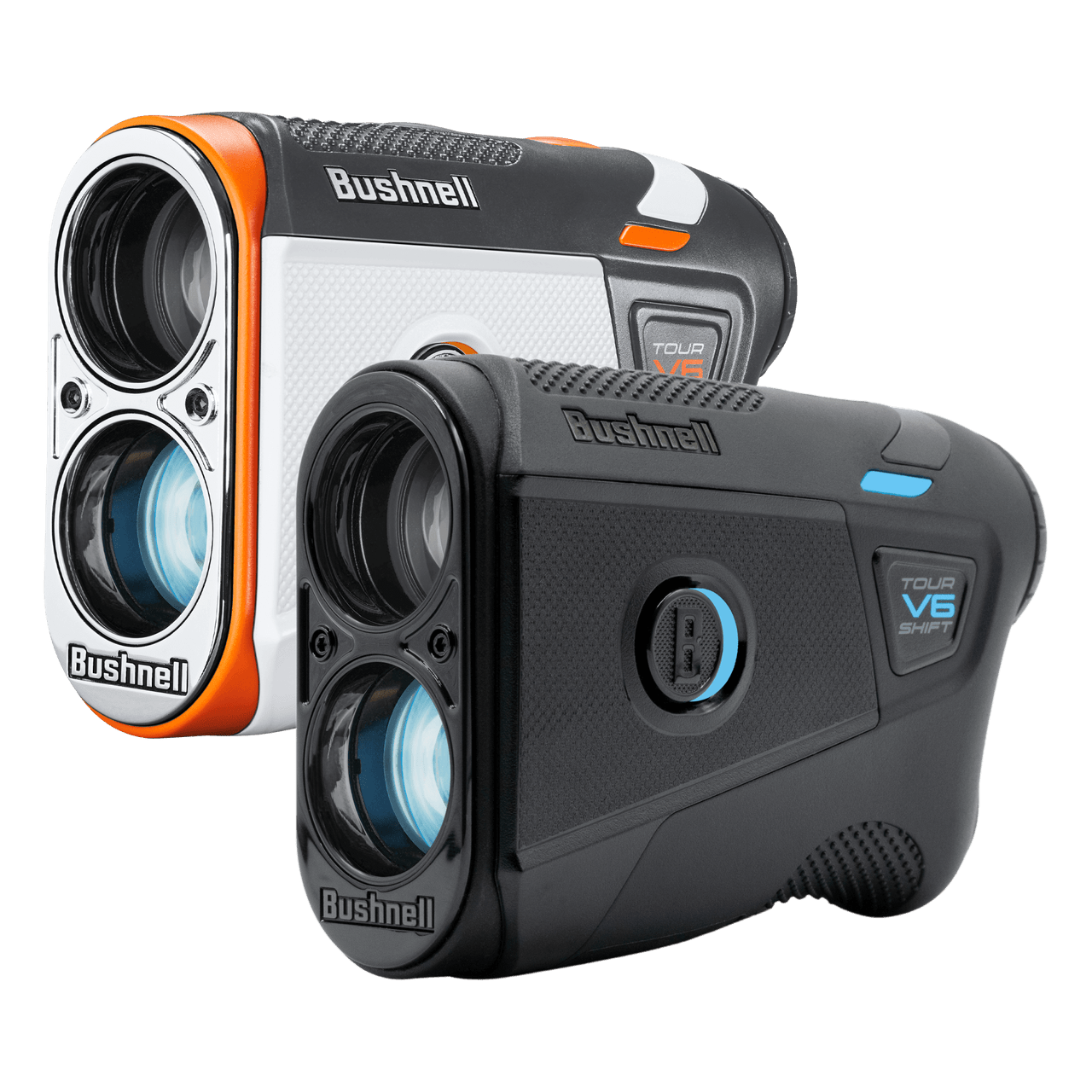
There’s a reason 98% of PGA Tour pros carry a Bushnell. The Tour V6 Shift is the latest in their lineup and it’s genuinely impressive. The Slope-Switch Technology makes it dead simple to toggle between slope and tournament modes, and the improved PinSeeker with Visual JOLT gives you both a vibration and a red ring flash when you lock the flag.
At 8.7 oz with 6x magnification and a 1,300-yard range, it’s compact, accurate to within 1 yard, and IPX6 weather resistant. The integrated BITE magnetic mount is also clutch — just stick it to your cart bar between shots.
It’s not cheap, but if you want the best and trust what the pros use, this is it.
2. Precision Pro NX10 — Best Mid-Range
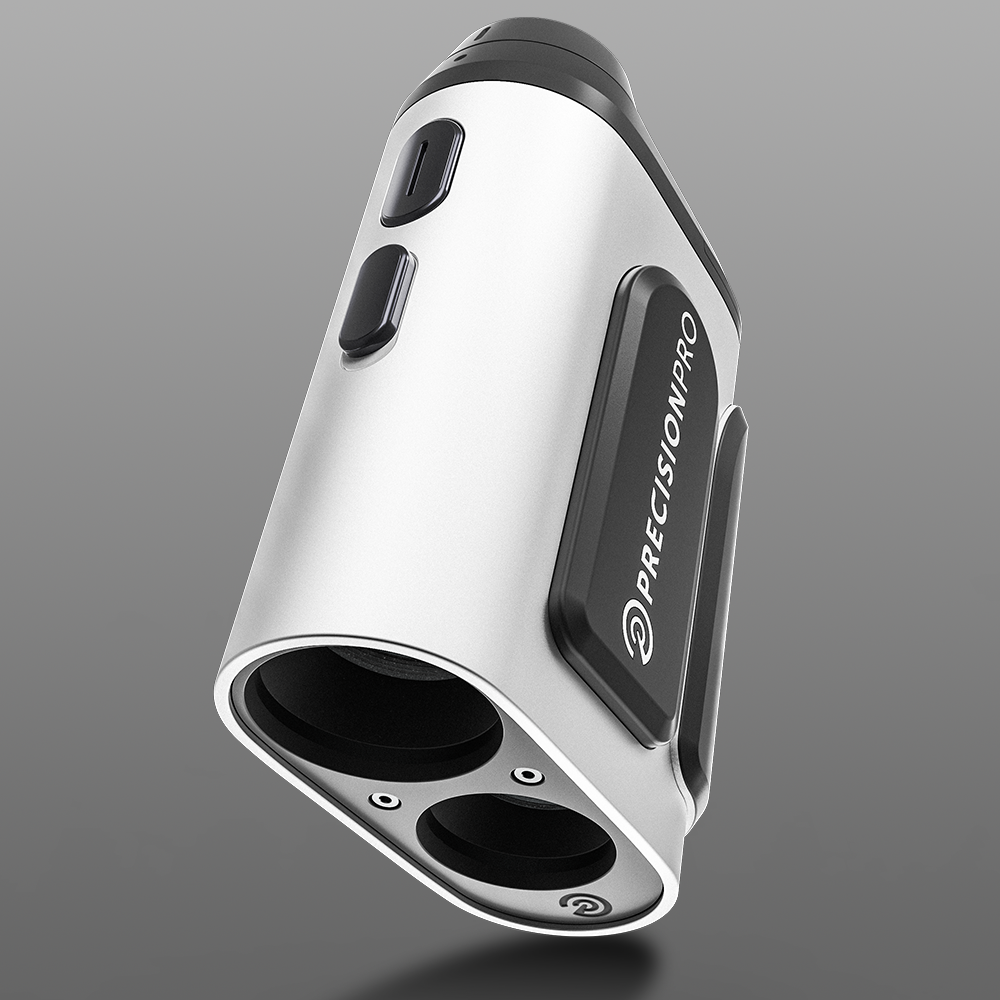
The Precision Pro NX10 is one of my favorite mid-range slope rangefinders. It features 6x zoom, flag lock with pulse vibration confirmation, and slope technology that gives you compensated distances quickly and accurately.
What sets the NX10 apart is that it’s golf’s first customizable rangefinder — you can personalize it with different faceplates. Beyond the novelty, though, the performance is legit. It’s fast, accurate, and the slope readings are reliable. It also has a 999+ yard range and an adaptive slope feature you can toggle off for tournaments.
At a lower price point than the Bushnell, this is an excellent pick for golfers who want slope without breaking the bank.
3. Gogogo Sport Vpro GS24 — Best Budget Slope Rangefinder
If you want slope on a budget, the Gogogo Sport Vpro GS24 is the way to go. At typically under $100, it punches way above its weight class. You get 7x magnification, 1,200-yard range, flag-lock with vibration, continuous scan mode, and yes — slope with a physical switch to toggle it off.
Is it as fast or refined as the Bushnell or Precision Pro? No. But for recreational golfers who want slope compensation without spending $250+, it’s genuinely hard to beat. I’ve recommended this to several buddies who are newer to the game, and they all love it.
For more options in this price range, check out our best budget golf rangefinder roundup.
Best Golf Rangefinders Without Slope
If you’ve decided slope isn’t worth it for your game, here are solid non-slope options.
1. Bushnell Tour V6 — Best Non-Slope Rangefinder
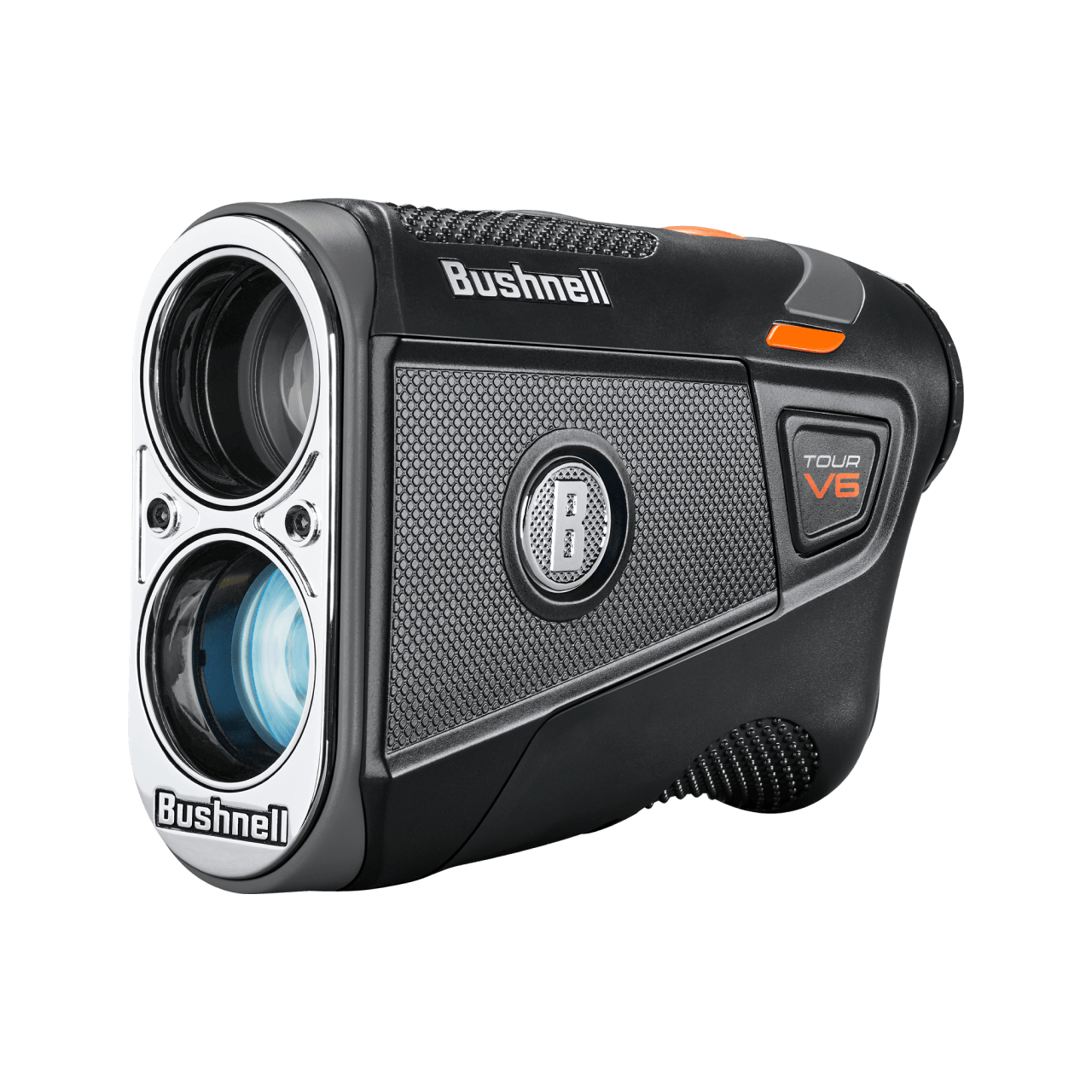
The Tour V6 is the non-slope sibling of the V6 Shift. You get all the same build quality, accuracy, PinSeeker with Visual JOLT, BITE magnetic mount, 6x magnification, and 1,300-yard range — just without slope compensation.
The advantage? It’s always tournament legal right out of the box with no toggles to worry about, and it costs less than the Shift version. If you know you don’t want slope, this is the cleanest, most premium non-slope option available.
2. Gogogo Sport Vpro GS24 (Slope Off) — Budget Tournament Option
Here’s a tip: the Gogogo Sport Vpro GS24 I mentioned above has a physical slope toggle. If you buy it and just leave slope turned off, you essentially have a high-quality tournament-legal rangefinder for under $100. It’s the best of both worlds at the lowest price — you’ve got slope if you ever want it, and a clean non-slope mode when you don’t.
FAQ
Is a golf rangefinder with slope worth it?
For most golfers, yes. If you play courses with any elevation change, slope compensation will help you pick the right club more often. The adjusted “plays like” distances remove guesswork, especially on approach shots. The only reason to skip slope is if you’re on a very tight budget or exclusively play flat courses.
Can I use a rangefinder with slope in a tournament?
Not with slope turned on. Under USGA and R&A rules, slope-compensated distances are not allowed during competition. However, if your rangefinder has a slope toggle and you switch slope OFF, the device becomes tournament legal. Most modern slope rangefinders include this feature.
What’s the difference between slope and non-slope rangefinders?
A non-slope rangefinder gives you the straight-line distance to your target. A slope rangefinder also measures the elevation angle and calculates an adjusted “plays like” distance that accounts for uphill or downhill terrain. Both give accurate raw distances — slope just adds the elevation compensation layer.
How much does slope affect distance?
It depends on the severity of the elevation change. On a moderate uphill shot (around 5-10°), a 150-yard shot might play like 155-165 yards. On a steep downhill, 150 yards might play like 135-140 yards. On flat ground, there’s zero difference.
Do PGA Tour pros use rangefinders with slope?
Pros are allowed to use rangefinders during practice rounds but NOT during official tournament rounds (as of USGA rules). During practice, many pros use slope rangefinders to learn the course. Bushnell is by far the most popular brand among touring professionals.
Final Verdict: Slope vs Without Slope
Here’s my honest take: if your budget allows it, get a rangefinder with slope and a toggle. You get the best of both worlds — slope-adjusted distances for casual rounds and practice, and a tournament-legal device when you need it.
The Bushnell Tour V6 Shift is the gold standard if you can swing the price. The Precision Pro NX10 is a fantastic mid-range option. And the Gogogo Sport Vpro GS24 proves you don’t need to spend a fortune to get slope technology.
If you truly don’t want slope — maybe you play flat courses and compete every weekend — the Bushnell Tour V6 (non-Shift) is the best dedicated non-slope rangefinder you can buy.
Whatever you choose, the most important thing is having a rangefinder at all. Knowing your actual distance to the pin is one of the easiest ways to shoot lower scores. Stop guessing, start lasering.
Affiliate Disclaimer: This article contains affiliate links, which means I may earn a small commission if you make a purchase through these links — at no extra cost to you. This helps support The Golfing Lad and allows me to keep creating helpful content. I only recommend products I genuinely believe in. Thanks for your support!