Best Golf Balls for Beginners 2026: 7 Soft, Forgiving Picks Tested
Finally — Golf Balls That Won’t Make You Cringe When You Lose One
Here’s the truth nobody tells new golfers: the wrong golf ball can make learning this game genuinely harder. Spin off an iron that sends it sideways. Compression that punishes a slow swing. A price tag that makes you wince every time one disappears into the trees. If you’re hunting for the best golf balls for beginners, you’re asking exactly the right question — and it’s one worth taking seriously.
The best golf balls for beginners share a few key traits — low compression, forgiving off-centre hits, decent distance even at moderate swing speeds, and a price that doesn’t sting when you leave three in the pond on the 7th. We’ve ranked seven beginner golf balls that tick all those boxes. Whether you’re brand new to the game or coming back after years away, these are the golf balls for beginners that make sense in 2026.
Quick heads-up: this list covers balls available right now on Amazon with fast shipping. No discontinued models, no clearance stock. Just solid picks that work.
| Ball | Best For | Our Verdict |
|---|---|---|
| Callaway Supersoft 2025 | Overall best for beginners | ⭐ Top Pick |
| TaylorMade Distance+ 2025 | Maximum distance | Great all-rounder |
| Titleist TruFeel | Feel-focused beginners | Best feel at the price |
| Srixon Soft Feel (24 pack) | Best value | Smart buy for starters |
| Bridgestone e6 | Straight ball flight | Cuts out side spin |
| Vice Drive 2025 | Budget pick | Excellent for the money |
| TaylorMade Noodle Long & Soft | Ultra-soft feel | Senior & beginner friendly |
What Makes a Good Beginner Golf Ball?
Before we get into the picks, let’s talk about what you’re actually looking for when you’re shopping for golf balls for beginners. Four things matter most when choosing beginner golf balls — and understanding them makes picking from this list much easier:
Compression
Compression is the measure of how much a golf ball deforms when struck. Lower compression means the ball squishes more at impact — and that’s exactly what you want as a new golfer with a moderate swing speed. Most beginners swing between 70-90mph with a driver. High-compression tour balls are engineered for 110mph+ swings. Hit one with a slower speed and you lose distance, feel everything off-centre even harder, and get less feedback. Low-compression golf balls — think 50 to 70 compression rating — give you energy transfer, decent distance, and a softer feel on mishits. When you’re still building your swing, that forgiveness matters.
Two-Piece Construction
Most beginner-friendly golf balls are two-piece: a large rubber core wrapped in a durable ionomer cover. That’s it. No soft urethane tour cover that scuffs on every chip shot. Two-piece balls — the backbone of every good golf ball for beginners list — are tough, they last longer, and they’re cheaper to produce, which means cheaper to buy. Three- and four-piece balls have their place, but that place is not in a beginner’s bag.
Distance Over Spin
As a new golfer, you want the ball going forward, not curling into the trees. Low-spin golf balls reduce side spin, which is the enemy — the thing that turns a slightly pushed drive into a penalty drop. The best golf balls for beginners are designed to fly straighter by reducing the spin that causes hooks and slices to balloon. Good beginner golf balls are engineered around this principle above everything else. You’ll sacrifice some shot-shaping ability, but that’s not what you need right now. You need it in the fairway.
Durability and Price
Let’s be honest — beginners lose golf balls. Lots of them. Losing a £4 tour ball on every hole adds up to a miserable round. The best golf balls for beginners are priced around £20-30 per dozen, and many brands offer 15-ball or 24-ball value packs. All the golf balls for beginners on this list hit that sweet spot. Buy in bulk, play without anxiety, focus on your game instead of fretting about your ball landing near water.
The 7 Best Golf Balls for Beginners 2026
1. Callaway Supersoft 2025 — Best Overall Golf Ball for Beginners

- Increased Ball Speed with Soft Feel. The HyperElastic SoftFast Core is engineered for faster driver and iron speed, with soft greenside feel.
- Exceptional Feel, Control and Spin with Long Distance. Supersoft’s Hybrid Cover combines maximized distance with soft feel and durability.
- Greenside Spin and Control. New cover system for enhanced control on approach shots and short game shots.

The Callaway Supersoft has been the go-to recommendation among golf balls for beginners for years, and the 2025 version earns that reputation all over again. It’s a two-piece ball with a 35 compression rating — one of the lowest you’ll find in a mainstream golf ball. That translates directly into a soft, forgiving feel off every club in the bag, and meaningful distance gains at slower swing speeds.
What sets the Supersoft apart from cheaper options is Callaway’s HEX Aerodynamics dimple pattern on the cover. It reduces drag and promotes a consistent, penetrating ball flight — the kind that holds its line even when your contact isn’t perfect. For beginners trying to keep the ball in play, that matters more than tour-level spin control.
The cover is tough enough to survive multiple rounds, which is important when you’re still learning to avoid cart paths and tree roots. You won’t get the premium short-game feel of a Pro V1, but you don’t need it. You need distance, straightness, and durability — and the Supersoft delivers all three.
Best for: New golfers who want a well-rounded beginner ball from a trusted brand.
Compression: 35
Construction: Two-piece
2. TaylorMade Distance+ 2025 — Best for Maximum Distance

- React Speed Core
- New Extended Flight Dimple Pattern.
- 2 Layer Construction, Ionomer Cover, Mid-Launch, Max Distance, Mid/High Spin, And Softer Feel
- NEW Plus Alignment Aid
- 1 box with four sleeves of 3 balls each, 12 golf balls in total
TaylorMade calls this one the Distance+, and the name is not marketing fluff. The 2025 update features a React Speed Core — TaylorMade’s proprietary low-compression core that stores and releases energy efficiently, even at moderate clubhead speeds. The result is genuinely impressive distance for a ball in this price range.
The Extended Flight Dimple Pattern on the cover is engineered to stay in the air longer. It’s not magic, but it does produce a higher, more penetrating trajectory that can pick up extra yards on flat courses. For beginners who are still trying to add distance while fixing their swing, every extra yard counts.
The Distance+ sits around 70 compression — slightly firmer than the Supersoft, so the feel is a touch harder around the greens. But off the tee and through the fairway, it’s fast and long. If you’re a beginner who hits it reasonably solidly but wants to add carry distance, this is your ball.
Best for: Beginners focused on distance gains.
Compression: ~70
Construction: Two-piece
3. Titleist TruFeel — Best Feel for Beginners

- For players who prioritize soft feel and who trust the Titleist brand.
- Long distance and soft feel from a new TruTouch core
- Low penetrating ball flight from unique 376 tetrahedral dimple design
- Increased greenside spin and control from a softer 3.0 TruFlex cover
- Ultra-soft feel
Titleist makes the Pro V1 — the most iconic tour ball in golf. The TruFeel is their entry point for the rest of us, and it brings a lot of Titleist’s design philosophy to a beginner-friendly price. The core is soft and large, promoting low driver spin and good distance at moderate speeds. The TruFlex cover is thinner than most two-piece covers, which gives the TruFeel a noticeably softer, more responsive feel than anything else on this list.
That feel matters most around the greens. When you chip and putt, the TruFeel gives you tactile feedback that cheaper balls can’t match. You start to feel what a good strike feels like versus a thin contact. That feedback loop accelerates learning — it’s one of the underrated reasons why golf ball choice actually affects improvement speed for beginners.
The TruFeel is a step up in price compared to the Vice Drive or Noodle, but it’s still firmly in beginner budget territory. If you’re serious about improving and want a ball that will teach you good habits, this is worth the extra spend. Many beginner golfers who start on the TruFeel stick with it through their whole golfing life.
Best for: Feel-focused beginners who want premium feedback without tour ball prices.
Compression: ~60
Construction: Two-piece
4. Srixon Soft Feel (24 Pack) — Best Value Golf Balls for Beginners

- Soft Without Compromise: If feel is what matters most to you, play Soft Feel for maximum all-around performance. Soft Feel technology provides responsive feel for excellent control from tee to green.
- Increased Distance: Engineered for maximum distance with a high-energy core that boosts ball speed, ideal for golfers seeking longer drives.
- Low Compression: Perfect for golfers with slower or medium swing speeds, delivering a soft feel and easy launch for improved accuracy and control.
- 338 Speed Dimple Pattern: Speed dimples reduce drag at launch increase lift during descent. The soft thin cover provides less spin off the driver but more greenside spin and a softer feel on pitches, chips, and putts.
- Pack of 24 Golf Balls
If your main concern is value — and honestly, that’s a smart concern when shopping for golf balls for beginners — the Srixon Soft Feel 24-pack is the right call. You get two full dozen for roughly the price of one dozen of premium balls. And these aren’t terrible balls. Not by a long shot.
The Srixon Soft Feel lives up to its name with a low-compression core and a durable Ionomer cover. The 338 Speed Dimple pattern is Srixon’s aerodynamic design that promotes a high launch angle and good carry distance. Off the tee, it performs well. Around the greens, the soft core gives decent feedback. It’s not the most technically advanced ball on this list, but at 24-pack pricing, it’s the most economical way to get quality beginner golf balls in your bag.
The 24-ball quantity also means you can stop worrying about losing balls mid-round. Play freely, experiment with your swing, and let the budget stretch. For beginners who want to play frequently without spending a fortune, this is smart golf economics.
Best for: Budget-conscious beginners who play often and lose balls regularly.
Compression: ~60
Construction: Two-piece
5. Bridgestone e6 — Best for Straighter Ball Flight

- Engineered for power and feel
- Soft feel, long distance golf ball
- Hyper Elastic SoftFast Core delivers more distance, forgiveness, and incredible feel through the bag
- Soft seamless cover for better spin and feel
- Balls are availble in White and Yellow
The Bridgestone e6 has one specific superpower: it reduces side spin. If your miss is a slice — and statistically, most beginners’ misses are slices — the e6 is designed specifically to soften that tendency. Bridgestone’s Gradational Core technology creates a softer outer core that reduces the spin imparted on off-centre hits. Less side spin means less curve. Less curve means more fairways hit.
It’s not going to turn a wild slice into a dead-straight drive overnight. Your swing still matters. But on those 70% of shots where you’re almost there, the e6 gives you a bit more margin. The ball flight is lower and more penetrating than the Supersoft, which some beginners prefer — it feels more controlled, less balloony.
The 330 dimple cover is durable and performs well in wind. Bridgestone is a serious golf brand — they supply tour staff, they manufacture their own cores, and the e6 benefits from that engineering expertise at a fraction of tour ball pricing. If you’re genuinely plagued by a slice and looking for golf balls for beginners that help mitigate it, start here.
Best for: Beginners who slice and want help keeping the ball straighter.
Compression: ~50
Construction: Two-piece
6. Vice Drive 2025 — Best Budget Pick for Beginners

- PLAYER PROFILE: Designed for players at any swing speed who are looking for a maximum distance.
- BALL CONSTRUCTION: Engineered with a 2-layer design, featuring a Surlyn cover for an optimal balance between performance and durability.
- OPTIMAL ALIGNMENT: Take strokes off your game with our alignment aid. Designed with crisp edges that taper towards the target, use it to visualize your aim on the tee or as a guide when lining up a putt after reading the green.
- PERFORMANCE: 312 dimple pattern structure to increase the flight trajectory with a lower spin rate to maximize distance.
Vice Golf built their brand on direct-to-consumer pricing, and the Drive is their entry-level offering. For the price point, it punches significantly above its weight. The 2025 update features an improved outer mantle layer that increases rebound efficiency — translation: it goes further than the previous generation for the same swing speed.
The cast Surlyn cover is tough and scuff-resistant, which matters when you’re learning and making imperfect contact with cart paths and buried lies. The compression sits around 75, which is slightly firmer than the softest options on this list, but still well within beginner-friendly territory for anyone swinging 80mph or faster with a driver.
Where the Vice Drive shines is consistency. Ball to ball, the quality control is tight for a budget product. You’re not going to find a dead one in the sleeve. For golfers who want to play reliable beginner golf balls without paying premium prices, the Vice Drive 2025 is one of the best deals on the market right now — and one of the most consistent golf balls for beginners at this price point.
Best for: Budget-conscious beginners who don’t want to sacrifice consistency.
Compression: ~75
Construction: Two-piece
7. TaylorMade Noodle Long & Soft — Softest Feel on the List
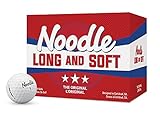
- Durable and soft iothane cover
- Impact propulsion core for longer carry
- Great feel and increased spin around the greens
- Patented dimple design for straighter flight
The TaylorMade Noodle is a bit of a legend in golf circles. It’s been around for decades, it’s been the preferred ball of millions of recreational golfers, and the Long & Soft remains one of the softest-feeling beginner golf balls you can buy. The iothane cover is softer than standard ionomer, giving the Noodle a pillowy, buttery feel at impact that’s unlike anything else in this price range.
For golfers with genuinely slow swing speeds — seniors, beginners, players returning after years away — the low compression and ultra-soft feel of the Noodle is hard to beat. It won’t spin beautifully out of bunkers, and it’s not going to give you workable shot shape, but it will fly straight, feel good, and give you a pleasant experience at the start of your time in the game.
The Noodle comes in large pack quantities too, which makes it another smart value buy. If you’re buying golf balls for beginners as a gift — or for a junior just starting out — a pack of Noodles is a genuinely useful and appreciated choice. Among all the beginner golf balls on this list, the Noodle is the most forgiving for very slow swing speeds.
Best for: Very slow swing speeds, seniors, juniors, or anyone who prioritises feel above all else.
Compression: ~35
Construction: Two-piece
How to Choose the Right Golf Ball as a Beginner
With all these options in front of you, here’s how to narrow it down fast:
Match Compression to Your Swing Speed
This is the single most important factor. If you don’t know your driver swing speed, a general guide: if you hit a driver between 150-180 yards carry, you’re probably in the 65-80mph range. Stick to balls with compression ratings below 70. If you carry it 180-220 yards, you’re in the 80-95mph zone and any ball on this list will work. Above 220 yards carry, you might be ready to look at mid-compression options.
Don’t Overspend Early
The Callaway Chrome Soft and Titleist Pro V1 are excellent golf balls. They’re also wasted on most beginners because you haven’t yet developed the consistent, high-speed contact that makes those balls’ properties come alive. Spend that money on lessons instead. Use golf balls for beginners until your handicap is consistently under 18. There’s no shame in playing beginner golf balls well beyond your first season — they suit a wide range of golfers and there’s no rule that says you have to graduate.
Buy in Bulk
You’re going to lose balls. Accept this and plan for it. A 24-pack of Srixon Soft Feels works out cheaper per ball than a 12-pack of premium balls, and you’ll likely lose fewer balls psychologically when each one costs less. Play without anxiety.
Stick With One Ball
Don’t mix balls in a round. Pick one model from this list, buy a decent supply, and play that ball exclusively for a few months. Consistency helps you calibrate distances, feel, and shot shape. Switching between a Pro V1 found in the rough and your beginner ball on the same hole actively prevents you from building feel.
Colour Matters (Seriously)
High-visibility yellow or orange golf balls are genuinely easier to track in the air and find in rough. If you’re playing on a course with thick rough or tree-lined fairways, a coloured ball saves you time and strokes lost to unplayable lies. Many of the balls on this list come in high-vis options — it’s worth checking.
FAQs About Beginner Golf Balls
Do golf balls actually make a difference for beginners?
Yes — but probably less than equipment marketing suggests. The biggest difference is compression and price. Playing a low-compression golf ball at slow swing speeds gives you more distance and better feel. Playing an expensive tour ball as a beginner mostly means spending more money per ball lost. The best golf balls for beginners are specifically engineered to help lower-speed swings perform — that’s the whole point. Focus on low compression, reasonable durability, and a price you can live with.
How many golf balls should a beginner bring per round?
At minimum, six. Realistically, a dozen for your first season of golf. Carrying twelve golf balls means you’ll never have to declare a lost ball and walk back to the tee. As your game improves and you lose fewer, you can scale back. Until then, play with confidence and keep the bag stocked.
Are recycled golf balls worth it for beginners?
For practice? Absolutely. For competitive rounds where you want consistent performance? Stick to new balls. Recycled balls — especially anything below Grade A — can have micro-cracks in the core that affect distance and trajectory unpredictably. They’re fine for the range or casual rounds, but if you’re trying to track your game’s progress, variable equipment adds noise to the data.
When should a beginner upgrade from a beginner golf ball?
When you’re consistently shooting in the high 80s or low 90s, it’s worth experimenting with mid-range options like the Callaway Chrome Soft or Srixon Q-Star Tour. These offer more spin control around the greens while remaining forgiving enough for improving players. The move from beginner golf balls to mid-tier is a milestone worth marking — it means your swing has developed enough to use the ball’s properties properly.
Can I use tour balls as a beginner?
You can, but there’s no benefit at typical beginner swing speeds. Tour balls like the Pro V1 require high clubhead speeds (100mph+) to compress properly. Hit one with a 75mph swing and you’ll get less distance than a soft beginner ball, harder feel on mishits, and a much higher price per ball. Save tour balls for when you’ve genuinely earned them.
Our Final Recommendation
For most beginners, the Callaway Supersoft 2025 is the best starting point. It’s low compression, forgiving, durable, competitively priced, and comes from a brand with serious engineering behind it. You can’t go wrong.
If budget is the priority, go with the Srixon Soft Feel 24-pack. Two dozen quality beginner golf balls for the price of a premium dozen. Play without worrying about every water hazard.
If you slice and want help, the Bridgestone e6 is worth trying. It won’t fix your swing, but it’ll help keep more drives in play while you do fix it.
Whatever you choose, the important thing is to pick one and stick with it. Consistency in equipment — especially golf balls — makes your game easier to measure and improve. Now go play.