
Best Golf Balls for Beginners 2026: Forgiveness Meets Value
Choosing the best golf balls for beginners can feel overwhelming when you’re staring at a wall of options at your local golf shop. The good news? As a new golfer, you don’t need to spend $50 on a dozen premium balls—and doing so might actually hurt your game.
In this guide, we’ll break down what makes a golf ball beginner-friendly, explore 7 excellent options for 2026, and help you understand why the right ball can shave strokes off your score without emptying your wallet.

Why Golf Ball Selection Matters for Beginners
Here’s a secret most golf shops won’t tell you: the ball you play matters far less than your swing mechanics when you’re starting out. However, choosing the wrong ball can make the game harder than it needs to be.
Premium tour balls like the Titleist Pro V1 are designed for players who generate significant clubhead speed and can control spin. For beginners with slower swing speeds (typically under 90 mph), these balls can actually fly shorter and spin unpredictably.
The best golf balls for beginners share three key characteristics:
- Low compression – Compresses easily at slower swing speeds for maximum distance
- Reduced spin – Minimizes hooks and slices, keeping balls in play
- Affordable pricing – Because you’ll lose a few (or more) while learning
Understanding Golf Ball Compression
Compression is the single most important spec for beginners to understand. It measures how much the ball deforms when struck—think of it as the ball’s “softness.”
Compression ratings typically range from 30 to 100+:
- Low compression (30-60): Ideal for beginners and slower swing speeds
- Mid compression (60-90): Good for intermediate players
- High compression (90+): Designed for fast swing speeds and tour players
When you swing at 80 mph and hit a 100-compression ball, you won’t fully compress it. The result? Lost distance and an inconsistent ball flight. Low-compression balls transfer energy more efficiently at slower speeds, giving you more distance with less effort.
The 7 Best Golf Balls for Beginners in 2026
1. Callaway Supersoft – Best Overall for Beginners

- Increased Ball Speed with Soft Feel. The HyperElastic SoftFast Core is engineered for faster driver and iron speed, with soft greenside feel.
- Exceptional Feel, Control and Spin with Long Distance. Supersoft’s Hybrid Cover combines maximized distance with soft feel and durability.
- Greenside Spin and Control. New cover system for enhanced control on approach shots and short game shots.

The Callaway Supersoft lives up to its name with an incredibly low 35 compression rating. This makes it one of the easiest balls to compress, regardless of your swing speed.
Key features:
- 35 compression – Among the lowest available
- HEX Aerodynamics for reduced drag
- 2-piece construction for durability
- Available in multiple colors including matte options
The Supersoft delivers surprising greenside control despite being a distance-focused ball. If you’re only going to try one ball from this list, make it this one.
2. Srixon Soft Feel – Best Value Pick

- Soft Without Compromise: If feel is what matters most to you, play Soft Feel for maximum all-around performance. Soft Feel technology provides responsive feel for excellent control from tee to green.
- Increased Distance: Engineered for maximum distance with a high-energy core that boosts ball speed, ideal for golfers seeking longer drives.
- Low Compression: Perfect for golfers with slower or medium swing speeds, delivering a soft feel and easy launch for improved accuracy and control.
- 338 Speed Dimple Pattern: Speed dimples reduce drag at launch increase lift during descent. The soft thin cover provides less spin off the driver but more greenside spin and a softer feel on pitches, chips, and putts.
- Affordable Performance: Offering premium features at an exceptional value, the Soft Feel golf balls deliver great performance without the premium price tag.
The Srixon Soft Feel offers tour-level quality at a beginner-friendly price. With 60 compression, it’s slightly firmer than the Supersoft but still well within the beginner range.
Key features:
- 60 compression – Soft yet responsive
- FastLayer Core for gradual compression
- 338 Speed Dimple Pattern for stable flight
- Excellent durability for the price
Srixon has refined this ball over 13 generations, and it shows. The Soft Feel offers perhaps the best balance of performance and price on this list.
3. Wilson Staff Fifty Elite – Best Budget Option

- Wilson Fifty Elite Golf Balls - 12 Pack, White
- UNIQUE DIMPLE PATTERN: The 302 PhD aerodynamics dimple pattern features unique flat-bottomed, shallow dimples that rip through the air to create a stable, penetrating flight.
- BALANCE ACHIEVED: An advanced rubber core delivers big distance with high greenside spin. Likewise, a responsive cover combines a low driver spin for powerful acceleration with effective softness around the green.
Don’t let the low price fool you—the Wilson Staff Fifty Elite is a legitimate performer. At 50 compression, it sits in the sweet spot for beginners.
Key features:
- 50 compression – True to its name
- Rubber core chemistry for consistent performance
- 302 smooth dimple pattern
- Often under $20 per dozen
Wilson has been making golf equipment since 1914, and their expertise shows in this affordable ball that punches above its price class.
4. Titleist TruFeel – Premium Brand, Beginner-Friendly

- For players who prioritize soft feel and who trust the Titleist brand.
- Long distance and soft feel from a new TruTouch core
- Low penetrating ball flight from unique 376 tetrahedral dimple design
- Increased greenside spin and control from a softer 3.0 TruFlex cover
- Ultra-soft feel
If you want the Titleist name without the Pro V1 price tag, the Titleist TruFeel delivers. This is Titleist’s softest ball ever at approximately 40 compression.
Key features:
- ~40 compression – Ultra-soft feel
- TruTouch core for improved feel
- TruFlex cover for short game control
- 376 tetrahedral dimple design
The TruFeel proves you don’t need to sacrifice quality to play a beginner-appropriate ball. It’s particularly good around the greens.
5. Pinnacle Rush – Maximum Distance Focus
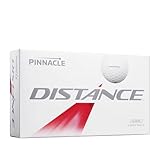
- Long Distance
- Proprietary high energy core for maximum distance
- Consistent and penetrating ball flight
- Responsive feel
- Dependable high-quality manufacturing
The Pinnacle Rush is engineered for one thing: distance. If you’re struggling to get the ball airborne or reach fairways, this might be your answer.
Key features:
- High-energy core for explosive distance
- Icosahedral dimple design for penetrating flight
- Cut-proof cover for durability
- Excellent value per dozen
The Rush won’t offer much greenside spin, but for beginners focused on getting off the tee, it’s hard to beat.
6. Vice Drive – Direct-to-Consumer Value

- PLAYER PROFILE: Designed for players at any swing speed who are looking for a maximum distance.
- BALL CONSTRUCTION: Engineered with a 2-layer design, featuring a Surlyn cover for an optimal balance between performance and durability.
- OPTIMAL ALIGNMENT: Take strokes off your game with our alignment aid. Designed with crisp edges that taper towards the target, use it to visualize your aim on the tee or as a guide when lining up a putt after reading the green.
- PERFORMANCE: 312 dimple pattern structure to increase the flight trajectory with a lower spin rate to maximize distance.
German brand Vice disrupted the golf ball market with their direct-to-consumer model, and the Vice Drive is their beginner offering.
Key features:
- Low compression surlyn cover
- 2-piece construction
- Energy Speed Core (ESC)
- Modern, eye-catching design options
Vice balls look premium and perform well. The Drive is specifically engineered for players seeking distance and forgiveness.
7. Bridgestone e6 – Straightest Ball for Slicers

- Engineered for power and feel
- Soft feel, long distance golf ball
- Hyper Elastic SoftFast Core delivers more distance, forgiveness, and incredible feel through the bag
- Soft seamless cover for better spin and feel
- Balls are availble in White and Yellow
If your shots curve more than a mountain road, the Bridgestone e6 was designed with you in mind. Its anti-side-spin technology helps keep balls straighter.
Key features:
- Delta Dimple design reduces drag
- Surlyn cover for durability
- Gradational Compression core
- Specifically designed to reduce slices and hooks
Bridgestone’s expertise in ball fitting shines through in the e6. If accuracy is your biggest struggle, this ball deserves serious consideration.
How to Choose the Right Golf Ball
With seven solid options, how do you pick? Consider these factors:
Your Swing Speed
If you don’t know your swing speed, here’s a rough guide:
- Under 75 mph: Choose the lowest compression available (Callaway Supersoft)
- 75-85 mph: Low-to-mid compression works well (Srixon Soft Feel, Wilson Fifty)
- 85-95 mph: You have more options; consider mid-compression balls
Your Primary Miss
Do you slice? Hook? Top the ball? Different balls address different issues:
- Slice/Hook: Bridgestone e6 or low-spin options
- Short distance: Pinnacle Rush or Callaway Supersoft
- General inconsistency: Srixon Soft Feel or Wilson Fifty Elite
Your Budget
Be realistic about how many balls you’ll lose per round. If you’re going through 6+ balls, stock up on budget options like Wilson Staff Fifty Elite. As you improve and lose fewer balls, you can experiment with premium options.
What About Used or Lake Balls?
Recycled golf balls can be a smart choice for beginners with one caveat: water damage affects performance. Balls submerged for extended periods lose distance. If buying used, look for “mint” or “near mint” grades and avoid anything labeled “practice” or “hit away.”
Final Thoughts
The best golf ball for beginners is one that helps you enjoy the game while you develop your skills. You don’t need expensive equipment to play well—you need equipment that matches your current ability.
Start with the Callaway Supersoft if you want the safest all-around choice, the Wilson Staff Fifty Elite if budget is a priority, or the Bridgestone e6 if you can’t stop slicing. As your game improves, your ball preferences will naturally evolve.
Remember: the ball in your pocket matters less than the confidence in your swing. Pick one from this list, buy a few dozen, and focus on having fun while you learn this incredible game.
]]>