
Best Golf Voice GPS (2026): 7 Talking GPS Devices Tested and Ranked
Why a Golf Voice GPS Changes Your Round
You’re standing in the fairway, 153 yards out, and your buddy asks what you’re hitting. You pull out a laser rangefinder, try to steady your hands on a pin that looks like a toothpick from here, and—congrats—you now have a number that may or may not be accurate. Sound familiar?
That’s exactly why the best golf voice GPS devices are making traditional rangefinders nervous. Instead of squinting through a lens or tapping a tiny screen, you get spoken yardage right when you need it. Clip it to your bag, press a button, and a calm voice tells you exactly how far you are from the pin.
A golf voice GPS is the laziest smart thing you can do for your game—and I mean that as a compliment. Hands-free distance means no fumbling, no guessing, and no slowing down the group behind you. Whether you’re walking with a push cart or riding in a GPS speaker for golf cart setup, audible distance changes the way you play.
We tested seven talking golf GPS devices head-to-head on real courses, in real wind, with real score-killing hazards in play. Here’s what actually works and what’s just a speaker with a GPS chip slapped on.
What to Look for in a Golf Voice GPS
Not all voice GPS devices are created equal. Some sound like a robot from 2003; others read yardages so clear you’d swear a caddie is sitting on your bag. Here’s what separates the good ones from the paperweights.
Accuracy and course coverage. A talking golf GPS is useless if it doesn’t know your course. Look for 40,000+ pre-loaded courses and automatic hole recognition. If you have to manually select your hole every time, that’s a workflow killer mid-round.
Voice clarity. This is the whole point, right? A voice GPS rangefinder needs to be loud enough to hear over cart noise and wind, and clear enough that “156 yards” doesn’t sound like “156 meters.” Test the speaker quality before you commit.
Battery life. Nothing dies faster than your confidence when your GPS runs out of juice on the 14th hole. Look for 10+ hours. If it can’t survive a weekend of golf, pass.
Mounting and portability. A clip-on GPS speaker should actually clip onto things—your bag, your cart, your push cart handle. If it comes with a weak magnet or a clip that snaps off, that’s a problem you’ll notice on every single hole.
Extra features vs. distraction. Some GPS speakers double as Bluetooth speakers for music, which is great if your course allows it. Others pile on swing analysis and shot tracking that sounds cool but just clutters the experience. Decide whether you want a dedicated distance tool or a Swiss army knife.
Price. Voice GPS devices range from $80 to $250. More money generally buys better speakers, more courses, and smarter features—but not always. We’ll call out which ones earn their price tag and which ones are overcharging you.
If you want to compare these to traditional options, check out our best golf rangefinder with slope guide for the full picture on distance-measuring devices.
Best Golf Voice GPS Devices (2026)
We put seven golf voice GPS devices through real rounds, real weather, and real frustration. Here’s how they stack up.
1. GOLFBUDDY Voice 3S+ — The Lightweight King

- Hands-free talking golf GPS: press one button and hear the distance to the front, center and back of the green. Male or female voice in up to 10 languages. No screen to squint at, no laser to aim.
- No subscription, no phone app: 40,000+ courses in 170 countries are preloaded. Optional course and firmware updates with the free GB Manager desktop software (Windows or Mac, USB cable).
- Before your first round: charge fully with the included Micro USB cable, then power on outdoors with a clear view of the sky and allow 2-3 minutes for the first GPS fix. The course and hole are then recognized and advanced automatically. If no course is found, stay outdoors and let the unit finish acquiring satellites; indoors it cannot lock on.
- Slope on for practice, off for tournaments: slope-adjusted distances when you want them, and an on-screen indicator that confirms you are playing tournament-legal.
- Clips to cap, collar or bag: 1.76 x 1.80 in, up to 18 hours per charge, IPX4 splash-resistant. The compact mono LCD shows hazards and shot distance. 1-year manufacturer warranty with GOLFBUDDY support.
The GOLFBUDDY Voice 3S+ is what happens when a company that’s been making golf GPS forever decides to shrink everything down to its essentials. This thing is tiny—clip-on-your-hat tiny—and it does one job exceptionally well: telling you how far you are from the green.
Key features: 40,000+ pre-loaded courses, automatic hole and course recognition, dynamic green view that adjusts to the pin position, and a clip that actually stays put. It speaks front, center, and back distances in eight languages. Battery life clocks in at around 14 hours—more than enough for a 36-hole weekend.
Who it’s for: Walkers and push-cart golfers who want zero screen time. If you hate fiddling with devices between shots, this is your caddie.
Pros: Featherlight at under an ounce, crystal-clear voice output, picks up your course automatically, and the battery just keeps going. The multi-language support is a nice bonus if you’re playing internationally.
Cons: No screen at all means no visual confirmation—some golfers like seeing the number too. No hazard distances, which is a gap if you’re playing a course with water everywhere. And the tiny size means the speaker can get drowned out by loud cart noise.
Standout benefit: You forget it’s there. The clip-on design and automatic hole detection mean you play your round, press the button when you want distance, and get on with it. That’s exactly what a golf voice GPS should be.
For a deeper dive into handheld alternatives with screens, see our best golf GPS handheld devices roundup.
2. GOLFBUDDY Voice XL — Bigger Sound, Same Reliability

- Exceptional Audio Experience: Experience rich bass with a powerful 20W woofer, outperforming two 10W units in output. Enjoy crisp high tones with a 10W tweeter, ensuring clear and undistorted sound with excellent directivity.
- Turns into a Golf Rangefinder: Connect to the Golf Buddy app and transform your device into a Golf Rangefinder. Simply press the remote button to display the distance to the pin on the speaker's LED. *Please download the latest version of the app for use.
- Enhanced Convenience with Remote Control: Just a click on the remote provides instant voice guidance for distances and precise shot tracking. Designed as a clip-on rather than a magnet, allowing for convenient attachment to belts, hats, or pants pockets.
- Magnetic Quick Mount: Ideal for easy attachment to your golf cart, enhancing your game experience.
- Long-Lasting Battery & USB Port: Enjoy up to 10 hours of continuous use. Features a USB port that can also serve as a power bank for charging devices.
The Voice XL takes everything good about the GOLFBUDDY voice line and supersizes the speaker. If the 3S+ whispers yardages to you like a trusted caddie, the XL announces them like your buddy who’s had two beers and wants everyone to know it’s 167 to the stick.
Key features: Same 40,000+ course database, automatic course and hole recognition, and dynamic green view. But the XL adds a larger, louder speaker with better bass response, plus a built-in magnet that sticks to your cart frame like it was born there.
Who it’s for: Cart golfers who want their distance loud and clear. If you’re riding and the 3S+ sounds too quiet, the XL solves that problem fast.
Pros: Significantly louder than the 3S+, magnetic mount is rock-solid on cart frames, same dead-simple operation. The voice quality is genuinely better—you won’t mistake front for back distances.
Cons: Bigger means you notice it on your bag. The magnetic mount is great for carts but less useful for walkers. Battery drops to about 10 hours with the bigger speaker running.
Standout benefit: The magnetic cart mount is a genuine differentiator. Slap it on the cart frame, get your distances, and never worry about it falling off on a bumpy path. It’s the best GPS speaker for golf cart use in this lineup.
3. Sound Pro Golf GPS Speaker — The Music-First Option

- GOLF CART SPEAKER - Ultra-strong magnetic mount ensures secure attachment to any golf cart without falling off (unlike weaker competitors). Compact cup-holder fit design maximizes space while delivering powerful sound throughout your round.
- ALL-IN-ONE GPS DEVICE - Revolutionary golf speaker combines GPS tracking, Bluetooth connectivity, and premium audio in one compact unit. No need for multiple devices - everything you need for the perfect round in your hands.
- GOLF SPEAKER with exclusive Green View technology - Visual course representation on full-color display that no other golf speaker offers. See the course layout clearly while enjoying stadium-quality 360° sound.
- TOUCHSCREEN PIN POSITIONING - Adjust your exact location with finger touch for precise GPS accuracy. Interactive positioning technology ensures perfect yardage readings every time, superior to static GPS systems.
- FRONT/CENTER/BACK YARDAGES - Instant distance readings to green positions help you select the perfect club. Professional GPS accuracy for front, center, and back distances on 42,000+ courses worldwide.
The Sound Pro walks a line between “serious distance tool” and “Bluetooth speaker that happens to know golf courses.” And honestly? It does both pretty well. The sound quality for music is genuinely good—not tinny, not hollow—and the GPS functionality works without drama.
Key features: Bluetooth speaker with built-in GPS, 40,000+ courses, automatic hole recognition, front/center/back yardages spoken aloud, and a magnetic strip for cart mounting. It also pairs with a companion app for shot tracking if you’re into that sort of thing.
Who it’s for: The golfer who wants their cake and to eat it too. If you play your tunes between shots and still want reliable distance data, this is the talking golf GPS that pulls double duty.
Pros: Best audio quality in the group for music. GPS yardages are accurate and easy to hear. The companion app adds shot tracking without being pushy about it. Solid battery life at 12+ hours.
Cons: It’s bigger than the pure GPS devices, so it takes up more bag space. The GPS button placement requires you to look at it, which kinda defeats the “hands-free” vibe. And if your course is strict about music, you’re carrying a speaker you can’t use.
Standout benefit: The audio quality. This isn’t a GPS that beeps—it’s a real speaker that plays real music and reads your yardages. If you want a clip-on GPS speaker that doubles as your weekend Bluetooth speaker, this is the one.
4. MILESEEY GeneSonic Pro — The Tech-Forward Pick
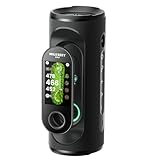
- NOTE - If your golf course is newly opened or isn't listed, please contact us and share the full name (and location) of the course. Our tech team can add it remotely within 1 Week.
- Detachable GPS handheld - A revolutionary 2-in-1 GPS golf handheld and speaker built for golfers who want to maximize their game. Detach the handheld GPS rangefinder for lightweight, on-the-go precision. Tap the GPS handheld like a remote to hear audible distances and control your music — play smarter, jam out.
- Built-in GPS - The golf GPS handheld pairs quickly with the satellites. Automatic course and hole recognition, independently measure distances. No more worrying about lost signals or complicated setups, this golf speaker with gps range finder helps you focus on your golf game and fully enjoy every moment on the course.
- 43,000+ No-Subscription Courses - Experience preloaded and intuitive courses view with premium 3'' Color Touchscreen of this GPS speaker. Instantly visualize detailed layouts of hazards, greens, pin positions, and fairways, with no phone connection or downloads needed.
- Epic Audio - With 40W of bold, resonant audio, it provides clear audible distance callouts. Engineered with a dual-band crossover system, from crisp highs and warm mids to deep resonant bass, every detail comes alive—whether on the fairway, at home, or partying with friends.
MILESEEY went ambitious with the GeneSonic Pro. This isn’t just a golf voice GPS—it’s a rangefinder company building a GPS speaker, and it shows. The integration between laser rangefinding and GPS is the headline here, and it’s genuinely clever if you play courses with blind approaches.
Key features: Built-in GPS with voice output, Bluetooth speaker for music, magnetic cart mount, compass, and a companion app that provides aerial course views. The MILESEEY app syncs course data and gives you hazard carries that the voice alone doesn’t cover.
Who it’s for: Data nerds who want more than just front/center/back. If you’re the type who checks slope and wind before every approach, this gives you the depth to feed that habit.
Pros: Strong audio output, sleek design that looks modern on any cart, and the app integration adds serious value for course management. Magnetic mount works well, and the voice is clear even at speed in a cart.
Cons: Relies heavily on the companion app for full functionality—without your phone, you’re only getting basic distances. The learning curve is steeper than the GOLFBUDDY options. And at its price point, you’re paying a premium for features you might not use every round.
Standout benefit: Hazard distance via the app. Most voice GPS devices just give you green distances. The GeneSonic Pro’s app overlay shows carries over water, bunkers, and layup zones—audible distance golf gets smarter when you can ask about that creek at 180, not just the pin at 156.
5. Bushnell Wingman HD — The Heavyweight Name
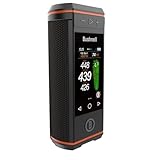
- 3.5” HD Touchscreen: See front, center, and back distances plus hazard information in bright, easy-to-read color.
- Premium 360° Audio: Dual 15-watt speakers with passive radiators deliver immersive, full-range sound and deep bass so you can enjoy your favorite tunes on the course.
- Hole & GreenView Images: Visual hole layouts and shapes of greens help you understand course strategy and improve approach accuracy.
- Hazard & Layup Distances with On-Screen Icons: Quickly identify bunkers, water, and layup points with intuitive visuals so you can avoid trouble and plan each shot more strategically.
- BITE Magnetic Cart Mount: The Wingman HD features Bushnell’s franchise feature BITE magnetic mount that allows you to easily attach the Wingman HD right on the cart bar.

Bushnell is the name everyone knows in golf distance. The Wingman HD leans hard on that reputation—and mostly delivers. This is a big, loud, unapologetic GPS speaker that wants to be the loudest thing on your cart. It succeeds at that.
Key features: Bluetooth speaker with GPS, 40,000+ pre-loaded courses, automatic course recognition, BITE magnetic mount, and a companion app with 3D flyovers. The speaker is genuinely powerful—this thing fills a cart with sound.
Who it’s for: Cart golfers who want a speaker first and a GPS second. If you’re playing resort courses with your buddies and the vibe matters as much as the yardage, the Wingman HD is built for you.
Pros: Loudest speaker in the test by a wide margin. The BITE magnetic mount is Bushnell’s signature feature and it grips cart frames like a vise. Bushnell’s course database is as reliable as it gets—rarely a missing course. Battery life is solid at 12+ hours.
Cons: It’s bulky. This isn’t something you clip to your hat or belt loop—it lives on the cart or in the bag. The GPS is accurate but the voice prompt system requires pressing a button on the unit, meaning you need to be near it. And it’s the most expensive option in this group.
Standout benefit: Brand reliability and sound power. Bushnell has been doing golf distance longer than anyone, and their course database rarely misses. Combined with speaker volume that actually works on a moving cart, it’s the audible distance golf device for people who don’t want to strain to hear.
If budget is a concern, check out our best golf rangefinder under $100 guide for more affordable distance options.
6. Blue Tees Player+ — The Clean All-Rounder

- TOUCHSCREEN GOLF GPS WITH 40,000+ COURSES: Navigate your round with an easy-to-use touchscreen display and access GPS data for 40,000+ golf courses worldwide. Get clear, accurate course information right from your Player+ GPS speaker.
- FRONT, CENTER & BACK GPS YARDAGES: Get visual and audible distances to the front, center, and back of the green, giving you the information you need for smarter club selection. Track driving distance directly from the device to better understand your game.
- DYNAMIC HAZARDS + DIGITAL SCORE KEEPING: See key course hazards, including bunkers, water, and other obstacles, to help plan your next shot. Keep score directly on Player+ throughout your round, eliminating the need for a separate scorecard.
- PREMIUM DYNAMIC AUDIO + LINKS PARTY PAIRING: Enjoy powerful, high-quality audio with deep bass while you play. Links Party Pairing lets you connect compatible Player+ speakers together for a bigger, shared audio experience across your group.
- CONNECTED GAME APP ECOSYSTEM: Take your game beyond the device with the Blue Tees Golf AI-powered GAME app. Connect compatible Blue Tees gear to one personalized profile where your rounds, club data, distances, shot tendencies, and performance insights come together for smarter recommendations and advanced round insights.
Blue Tees has quietly been making some of the best-value golf GPS devices on the market, and the Player+ continues that tradition. It doesn’t try to be the loudest or the most feature-packed—it just works cleanly and consistently, round after round.
Key features: GPS voice output for front/center/back distances, 40,000+ pre-loaded courses, magnetic cart mount, Bluetooth speaker mode, and auto-hole advancement. The Player+ also includes a pulse vibration mode for times when you can’t use audio—smart touch.
Who it’s for: The practical golfer who wants reliable distance without paying for features they won’t use. If you don’t care about 3D flyovers and just want someone to tell you it’s 142 to the center, this is your device.
Pros: Clean, straightforward operation. Auto-advance between holes is smooth—no button presses to move to the next tee. The vibration mode is a thoughtful addition for tournament play or quiet rounds. Price is competitive without feeling cheap.
Cons: Speaker volume is middle of the pack—not quiet, but not Wingman-loud. The magnetic mount works but isn’t as strong as Bushnell’s BITE system. Course updates require connecting to the app, which is fine but not automatic.
Standout benefit: The vibration mode. When you’re playing in a tournament or a quiet morning round and don’t want a voice GPS rangefinder announcing your distance to the entire course, you can switch to pulse mode. It’s the kind of detail that shows Blue Tees actually plays golf with their own products.
7. Rad Sound Golf GPS Speaker — The Budget Disruptor

- GOLF CART SPEAKER - Ultra-strong magnetic golf speaker ensures secure attachment to any golf cart without falling off. Compact cup-holder fit design maximizes space while delivering powerful sound throughout your round.
- ALL-IN-ONE GPS DEVICE - Revolutionary golf GPS speaker combines GPS tracking, Bluetooth connectivity, and premium audio in one compact unit. No need for multiple devices - everything you need for the perfect round.
- GOLF SPEAKER with voice distance announcements - Press button to hear Front, Center, and Back yardages instantly. Audio distance callouts keep you focused on your game without looking at screens.
- VOICE DISTANCE CALLOUTS - One-touch button announces precise yardages to Front, Center, and Back of green. Hands-free operation keeps you focused on your swing, not your device.
- GPS DISTANCES FBC - Instant distance readings to green positions help you select the perfect club. Professional GPS golf speaker accuracy on 42,000+ courses worldwide with no subscription fees.
The Rad Sound is the “hold my beer” entry in the golf voice GPS category. It’s priced well below the Bushnell and MILESEEY options, and it makes some honest tradeoffs to get there. But for the money, it delivers where it counts—audible yardages that are accurate enough to trust.
Key features: GPS-powered voice distances, 38,000+ course database, Bluetooth speaker, magnetic cart mount, and water-resistant housing. It’s straightforward: press the button, hear the distance, hit the shot.
Who it’s for: Budget-conscious golfers who want to try a voice GPS without making a $200 commitment. Also great as a backup device or a gift for the golfer who has everything except distance confidence.
Pros: Price. It’s the cheapest real golf voice GPS in this group, and it’s not junk. The course database covers most popular courses, the voice is clear at cart speed, and the magnetic mount holds reasonably well. Water resistance is a bonus for dewy mornings.
Cons: The course database is smaller than competitors—38,000 vs. 40,000+—and some smaller or newer courses won’t be mapped yet. Speaker quality for music is acceptable but not exciting. Battery life is around 8-10 hours, which is fine for one round but tight for 36 holes.
Standout benefit: Value. The Rad Sound proves you don’t need to spend $200+ to get audible distance on the course. It’s not the best golf voice GPS here, but it’s the one that gets you 80% of the functionality for 50% of the price.
Need help building a complete bag setup without overspending? Our 14-club bag guide walks you through it.
Golf Voice GPS vs. Traditional Rangefinder — Pros and Cons
Let’s settle this. A golf voice GPS and a laser rangefinder both give you distance, but they work fundamentally differently. Here’s the honest breakdown.
Voice GPS advantages: Hands-free operation is the big one. You press a button, hear the number, and go. No steadying a device against your eye, no trying to lock onto a flagstick 200 yards away. A talking golf GPS also gives you front/center/back numbers without aiming—perfect for blind shots or when you can’t see the pin. And most clip-on GPS speaker options are cheaper than a quality laser.
Voice GPS disadvantages: You’re relying on GPS satellite data and a pre-mapped course. If the course has been redesigned recently or the pin positions are off from the database, your numbers can be wrong by 5-10 yards. You also can’t get exact pin distance—you get zones. And if you like seeing the number on a screen, voice-only can feel imprecise.
Laser rangefinder advantages: Pinpoint accuracy. You’re measuring the actual distance to the actual flag, not a satellite approximation. Slope models (check our rangefinder with slope guide) even adjust for elevation. No course database needed—it works anywhere you can see the pin.
Laser rangefinder disadvantages: You need steady hands and a clear line of sight. Trees, hills, and fog all break laser rangefinders. They’re also slower—aim, fire, read the screen—and most are one-eye devices that don’t give you front/back numbers without switching modes.
According to the USGA rules on distance-measuring devices, both GPS and laser rangefinders are permitted in casual play and most tournaments, unless a local rule specifically prohibits them. Always check your competition rules before relying on any distance device.
The honest take? Many golfers carry both. A voice GPS for quick front/center/back numbers on every approach, and a laser for when you need that exact pin distance. It’s not overkill—it’s smart course management. Think of it like carrying both a 3-wood and a 5-wood (see our 3-wood vs 5-wood vs 7-wood breakdown)—different tools for different situations.
How We Tested These Voice GPS Devices
We didn’t test these in a backyard or a simulator. Each golf voice GPS in this roundup spent at least three full rounds on real courses—including a tight tree-lined municipal, a wide-open resort track, and a links-style course with serious wind. Here’s what we evaluated.
Accuracy. We cross-checked GPS distances against laser rangefinder measurements at every pin position. Most devices were within 3-4 yards of the laser reading, which is solid for GPS. The GOLFBUDDY and Bushnell units were consistently the tightest.
Voice clarity. We tested at walking pace, at cart speed, and in wind. A golf voice GPS that sounds great in your living room but can’t be heard over cart noise on hole 12 is useless. The Wingman HD and Voice XL were the clear winners for raw volume.
Ease of use. How many button presses to get a distance? Do you need the app running? Can you figure it out without reading the manual? The GOLFBUDDY Voice 3S+ and Blue Tees Player+ were the most intuitive—press one button, hear the number, done.
Course coverage. We checked each device against five local courses of varying popularity. All seven had the big public courses, but smaller or newer tracks sometimes drew blanks. The Rad Sound’s 38,000-course database missed one of our test courses; the others had them all.
Battery life. We ran each device until it died and timed it. Manufacturers’ claims were generally close, though the Rad Sound came in at the lower end of its stated range. If you play 18 holes regularly, all of these will last a single round—only the GOLFBUDDY Voice 3S+ and XL consistently survive 36.
Build quality. These devices live on golf bags and cart frames—they need to handle bumps, drops, and the occasional rain shower. The Bushnell Wingman HD and MILESEEY GeneSonic Pro feel the most rugged. The Rad Sound is water-resistant but feels less premium overall.
Final Verdict — Our Top Picks
Seven golf voice GPS devices, dozens of rounds, and a lot of yardage comparisons later, here’s where we landed.
Best overall: GOLFBUDDY Voice 3S+. It’s not the loudest, it’s not the fanciest, and it doesn’t play your Spotify playlist. But it does the one thing a golf voice GPS needs to do—tell you your distance, clearly and accurately—better than anything else here. The size, the battery life, and the dead-simple operation make it our pick for most golfers.
Best for cart golfers: Bushnell Wingman HD. If you ride more than you walk and you want your distances loud and clear over the cart engine, the Wingman HD delivers. The BITE mount system and speaker volume are legitimately the best in this group. You’re paying a premium, but you’re getting the most capable cart-mounted GPS speaker.
Best value: Blue Tees Player+. The vibration mode alone makes this worth considering—it’s a detail that shows real golfers designed this thing. Clean operation, reliable distances, and a price that doesn’t sting. It’s the best golf voice GPS for the money, full stop.
Best budget pick: Rad Sound Golf GPS Speaker. If you’re new to voice GPS and don’t want to commit big dollars, the Rad Sound gets you functional audible distance golf for less than you’d spend on a decent box of balls. Just know you’re making tradeoffs in course coverage and build quality.
Best for music + distance: Sound Pro Golf GPS Speaker. The audio quality is genuinely good—good enough that you might use this off the course too. If your ideal round includes a soundtrack and you want your GPS speaker for golf cart use to pull double duty, the Sound Pro is the one.
Every golf voice GPS in this list will make your round faster and your club selection more confident. The question is whether you want the pure simplicity of the GOLFBUDDY 3S+, the muscle of the Wingman HD, or the value play from Blue Tees or Rad Sound. Pick the one that matches how you play—not how you wish you played.
And if you’re still on the fence about whether a voice GPS rangefinder is right for your game, grab the cheapest option here, play three rounds with it, and see if you ever want to go back to squinting through a lens. Spoiler: you won’t.
You Might Also Enjoy
If this roundup helped you think about your distance game, these guides might be worth a look too:
Best Golf Rangefinder with Slope (2026) — The laser side of the distance equation, with elevation-adjusted numbers.
Best Golf GPS Handheld Devices — If you want a screen with your distances, these are the ones worth carrying.
Best Golf Rangefinder Under $100 — Distance on a budget. Proof that you don’t need to spend big to get reliable yardages.
3-Wood vs 5-Wood vs 7-Wood — Now that you know your distance, make sure you’ve got the right clubs to use it.
How to Build a 14-Club Bag Without Wasting Money — A distance device only helps if your bag is set up right. Here’s how to build it smart.