
Best Golf Balls for Swing Speeds Under 90 MPH (2026): 7 Low-Compression Picks That Add Yards
Why Your Ball Choice Matters More Than You Think When You Swing Under 90 MPH
Here’s the thing most golfers don’t realize: the ball you’re teeing up might be costing you 15 to 20 yards and you’d never know it. If your driver swing speed sits somewhere south of 90 mph, you’re in the majority of amateur golfers, and you’re also in the group that benefits most from picking the right ball. The best golf balls for swing speeds under 90 mph are specifically built to compress at lower impact forces, meaning you get more energy transfer, higher launch, and longer carries without swinging harder.
Most guys at the range grab whatever’s on sale or play the same Pro V1 they found in the pond. And hey, no judgment, we’ve all been there. But if you’re swinging a driver at 82, 85, or 88 mph, that tour-level ball with a compression rating north of 90 is barely compressing on your clubface. It feels like hitting a rock and flies like one too. Low compression golf balls exist for a reason: they work for moderate and slow swing speeds.
This guide breaks down seven golf balls that are purpose-built for swingers under 90 mph. We’ve tested each one on the course and on the launch monitor, tracking distance, spin rate, feel, and overall playability. Whether you’re a 15-handicap looking for more carry or a smooth-swinging senior trying to hold greens, there’s a ball on this list that’ll change your game.
What Swing Speed Under 90 MPH Really Means for Your Ball Choice
Let’s get a little technical for a second, because understanding this stuff will make you a smarter shopper. Golf ball compression is basically a measure of how much the ball deforms at impact. A ball with a compression rating of 30 compresses a lot more easily than one rated at 100. When you swing under 90 mph, your clubhead isn’t generating enough force to fully compress a high-compression ball. The result? Less energy transfer, lower ball speed, and shorter drives.
For golf balls under 90 mph swing speed, you want something in the 30 to 60 compression range. These low compression golf balls compress fully at your swing speed, which means:
More energy transfer. The ball squishes against the clubface and rebounds efficiently. You’re not leaving yardage on the table because the ball is too firm to compress.
Higher launch angle. Soft golf balls for distance tend to launch higher, which is exactly what slower swingers need. A higher ball flight means more carry, and more carry means more total distance.
Better feel across all clubs. When you catch a low compression ball clean with a mid-iron, it feels buttery. No buzzing hands, no harsh click. Just pure, responsive feedback.
More greenside control than you’d expect. This is the myth that needs busting: soft compression balls don’t spin less around the greens. Modern ionomer and urethane covers on low-compression balls deliver real spin on short shots. The spin comes from the cover material, not the core hardness.
What happens when you play a ball that’s too hard for your speed? You lose distance on full swings, your iron shots feel dead, your short game feels like you’re chipping with a pool ball, and you start blaming your swing when it’s really your ball. We’ve seen guys pick up 10-20 yards just by switching to the right compression. It’s the easiest equipment change you’ll ever make.
How We Tested and Selected These Golf Balls
Testing golf balls for swing speeds under 90 mph isn’t just about launch monitor numbers, though those matter. We looked at the full picture because golf is played on a course, not a screen.
Launch monitor sessions: Using a Foresight GCQuad, we hit each ball with driver, 7-iron, and wedge at swing speeds of 80, 85, and 89 mph. We tracked ball speed, launch angle, spin rate, carry distance, and total distance. Multiple testers, multiple sessions, averages taken.
On-course play: Numbers on a screen tell you part of the story. How does the ball feel off the first tee? Does it hold a firm green? Does it check on chips? Does it feel different in the cold? We played multiple rounds with each ball.
Feel and durability: We assessed feel on a scale from marshmallow to marble. We also checked how each ball held up after 18 holes of play. A ball that scuffs on the first wedge shot isn’t great value no matter how far it flies.
Value for money: Not everyone wants to pay premium ball prices. Some of the best golf balls for slow swing speed come in at under $25 a dozen. We factored price into our recommendations.
The seven balls below represent the best options we’ve found for moderate and slow swingers in 2026. Each one earned its spot through consistent performance, not marketing hype.
Srixon Soft Feel 14

- Soft Without Compromise: If feel is what matters most to you, play Soft Feel for maximum all-around performance. Soft Feel technology provides responsive feel for excellent control from tee to green.
- Increased Distance: Engineered for maximum distance with a high-energy core that boosts ball speed, ideal for golfers seeking longer drives.
- Low Compression: Perfect for golfers with slower or medium swing speeds, delivering a soft feel and easy launch for improved accuracy and control.
- 338 Speed Dimple Pattern: Speed dimples reduce drag at launch increase lift during descent. The soft thin cover provides less spin off the driver but more greenside spin and a softer feel on pitches, chips, and putts.
- Pack of 36 Golf Balls

Srixon has been the king of the soft-feel category for years, and the Soft Feel 14 keeps that crown firmly in place. With a compression rating right around 33, this is one of the softest golf balls on the market, and for swingers under 90 mph, that’s pure gold.
The secret sauce here is Srixon’s FastLayer Core. Instead of a single-density core, it transitions from soft in the center to firm around the edges. What that means for you: on full swings with your driver, the core compresses enough to generate solid ball speed and a high launch angle. On partial swings and chips, the softer center gives you that plush feel without sacrificing control. It’s a clever design that works remarkably well for moderate swing speed golfers.
Off the driver, we saw consistent carry improvements of 5-8 yards compared to harder balls when swinging in the low-to-mid 80s. The ball flight is high and carry-biased, which is exactly what you want if you struggle to get the ball airborne. The low spin off the tee keeps your drives from ballooning in a headwind, while the ionomer cover provides enough grip for decent approach shot spin.
Around the greens, the Soft Feel 14 won’t fool you into thinking you’re playing a urethane tour ball. It’s spinny enough to stop on receptive greens, but on firm surfaces, it tends to release more than check. For most 10-20 handicappers, that’s perfectly fine. The feel on putts is fantastic, soft without being mushy, and the alignment line on the 14th generation is cleaner and easier to line up than ever.
Who it’s for: Golfers swinging 75-88 mph who want maximum distance with a soft feel. Ideal for high handicappers and seniors who prioritize carry distance and putting feel.
Pros: Extremely soft feel, excellent distance for slow swingers, durable ionomer cover, great putting roll, very affordable at around $22-25 per dozen.
Cons: Limited greenside spin compared to urethane balls, not ideal for swing speeds above 95 mph, can feel too soft for some players who prefer more feedback.
Callaway Supersoft 2025

- Increased Ball Speed with Soft Feel. The HyperElastic SoftFast Core is engineered for faster driver and iron speed, with soft greenside feel.
- Exceptional Feel, Control and Spin with Long Distance. Supersoft’s Hybrid Cover combines maximized distance with soft feel and durability.
- Greenside Spin and Control. New cover system for enhanced control on approach shots and short game shots.
The Callaway Supersoft has been a go-to for slow swingers since it first dropped, and the 2025 version refines the formula without overcomplicating things. Compression sits around 30, making it one of the lowest-compression balls in this lineup, and the feel is exactly what the name promises: super soft.
What sets the 2025 Supersoft apart is Callaway’s Hybrid Cover, which combines ionomer and parabolicoid materials to create a cover that’s both soft and surprisingly durable. Previous generations of the Supersoft had a tendency to scuff easily, especially on wedges. The 2025 model holds up noticeably better. We played two full rounds with one ball and it still looked playable. That’s a big deal when you’re paying $25 a dozen.
Distance-wise, the Supersoft is a cannon for slower swing speeds. At 82-85 mph with a driver, we saw ball speeds that matched or exceeded everything else in this test. The high launch angle and low spin combination produces a carry-biased flight that maximizes air time. If you tend to hit low, spinning drives that die early, the Supersoft will add yards without you changing a thing.
Where the Supersoft falls a touch short is around the greens. The ionomer cover doesn’t generate the kind of check-spin that urethane provides. You can hit solid pitch shots that land and stop reasonably well, but don’t expect one-hop-and-stop action on firm greens. For most golfers swinging under 90 mph, that trade-off is well worth the distance gains and the buttery feel on full shots.
Who it’s for: Golfers with swing speeds from 70-88 mph who want maximum distance and the softest feel in golf. A fantastic choice for beginners, high handicappers, and anyone who values off-the-tee performance above all else.
Pros: Among the longest balls for slow swingers, incredibly soft feel, improved durability over previous models, very affordable, high-visibility color options.
Cons: Greenside spin is limited, can balloon slightly in strong headwinds, very soft feel isn’t for everyone.
Titleist Tour Soft

- For players who prioritize soft feel, with great all-around performance.
- Longer distance off the tee, incredible soft feel, and low spin on long game shots from a new faster, large core
- Optimized ball flight for long distance from a 346 quadrilateral dipyramid dimple design
- Reformulated thin Fusablend cover for dependable greenside spin for excellent short game control
- Incredible soft feel
Titleist doesn’t do “budget” anything. Even their value-oriented balls come with serious engineering behind them, and the Tour Soft is the perfect example. At a compression of roughly 65, it sits in the middle of this group, not as squishy as the Supersoft but not as firm as a tour ball either. For golfers in the 85-90 mph range, this is arguably the sweet spot.
The Tour Soft uses a large, soft core wrapped in a TPU (thermoplastic polyurethane) cover. That TPU cover is the real differentiator here. It’s not quite urethane, but it delivers significantly more spin around the greens than any ionomer cover. If you’re a moderate swing speed golfer who wants short game feel and control, the Tour Soft gives you more of that than anything else at this price point.
Off the driver, the Tour Soft produces a mid-high launch with moderate spin. It won’t give you the extreme carry of the Supersoft or Soft Feel, but it also won’t balloon on you when the wind picks up. Distance is solid and consistent. At 88 mph, we were within 3-4 yards of the longest balls in this test, which is a fair trade for the greenside control you pick up.
Approach shots are where this ball really shines. The TPU cover grabs the grooves just enough to give you stopping power on mid-iron shots into greens. You can flight it high and trust it’ll hold. On chips and pitches, the feel is responsive and precise. It’s not quite the zip-back action of a Pro V1, but it’s closer than you’d expect from a ball at this price.
Who it’s for: Golfers swinging 84-90 mph who want a balanced ball with legitimate greenside control. The best pick in this list for mid-handicappers who score around the greens.
Pros: Best greenside feel in this group, TPU cover provides real spin, excellent approach shot stopping power, consistent distance, Titleist quality and consistency.
Cons: Less compression advantage at very slow speeds (below 80 mph), slightly shorter off the tee than ultra-low compression options, pricier than ionomer-only balls at around $32 per dozen.
Wilson Duo Soft 2025

- Wilson 2025 Duo Soft Golf Balls - White, 12 Balls
- WORLD'S SOFTEST GOLF BALL: Industry-leading feel that delivers exceptional feedback on all shots.
- HIGH ENERGY CORE: Delivers maximum distance off the tee.
- STRAIGHTER FLIGHT: Two-layer construction reduces spin on longer shots.
The Wilson Duo Soft has been a cult favorite among budget-conscious golfers for years, and the 2025 version continues the tradition of offering absurd softness at an even more absurd price. With a compression rating of about 40, it’s soft enough for any sub-90 swinger but not so mushy that faster swingers can’t use it in a pinch. At around $20 per dozen, it’s the cheapest ball in this test by a comfortable margin.
What makes the Duo Soft work is its simplicity. A soft core, a thin ionomer cover, and not a lot of fancy marketing jargon. It just works. Off the driver, the low compression produces a high, floating ball flight that maximizes carry distance. We saw ball speeds and carry numbers that were within a yard or two of balls costing twice as much. That kind of value is hard to argue with.
The feel on full swings is where the Duo Soft really wins you over. It’s soft without being dead. There’s a responsiveness there that some ultra-low compression balls lack. You feel the ball compress and release, which gives you confidence that you’re getting maximum energy transfer. On mishits, the soft core is forgiving. Toe shots and heel shots don’t punish you as harshly, which is a real benefit for golfers who don’t center-face every drive.
Where the Duo Soft falls behind the premium options is consistency and greenside spin. Ball-to-ball, there’s a touch more variation than you’d get from Titleist or Srixon. And the ionomer cover is slippery enough that stopping shots on firm greens requires a more descending angle of attack. But at this price, you can afford to lose a few in the trees and not care.
Who it’s for: Budget-minded golfers swinging 75-88 mph who want a soft, forgiving ball at the lowest price possible. Perfect for high-volume golfers who lose balls regularly.
Pros: Best value in golf balls, very soft feel, high launch and good carry distance, forgiving on mishits, easy to find in bright colors.
Cons: Limited greenside spin, slightly less ball-to-ball consistency, ionomer cover can scuff on full wedge shots.
Bridgestone e6 Soft

- NEW! The soft feel, long distance golf ball
- LONGER DISTANCE - Softer and larger core for faster compression and longer distance
- INCREASED CONTROL - Soft seamless cover for better spin and feel
Bridgestone’s e-series has always been about straight, and the e6 Soft carries that DNA forward with a low-compression twist. The compression sits around 42, and the ball is engineered specifically to reduce hooks and slices. If your typical drive has more curve than you’d like, this might be your new best friend.
The e6 Soft uses a three-piece construction with a soft gradational core and a seamless cover. The gradational core technology means the core transitions from soft in the center to firmer at the edges, similar in concept to Srixon’s FastLayer but with a slightly different feel profile. The result is a ball that launches high, flies straight, and feels great off the face.
Straightness is the e6 Soft’s calling card, and it delivers. Our testers who normally fight a slice saw measurably less sidespin with this ball compared to others in the test. That’s not marketing speak. The low spin design actively reduces the curve on off-center hits. For golfers swinging under 90 mph who also fight a consistent miss, the e6 Soft is essentially distance and accuracy in one package.
The feel is slightly firmer than the Supersoft or Duo Soft, which some golfers actually prefer. There’s more “pop” off the face, and the ball feels like it’s doing something rather than just absorbing impact. On approach shots, the e6 Soft gives you a predictable mid-height flight. It won’t stop on a dime around the greens, but it’s serviceable for pitch shots and bump-and-runs.
Who it’s for: Golfers swinging 78-90 mph who fight a slice or hook and want a straighter ball flight. Also great for moderate-speed swingers who prefer a slightly firmer feel than ultra-low compression options.
Pros: Actively reduces hooks and slices, high launch with low spin off the tee, firm-ish feel with enough softness for sub-90 speeds, Bridgestone quality and consistency.
Cons: Greenside spin is minimal, not the longest ball in pure carry distance, firmer feel won’t appeal to golfers who love ultra-soft feedback.
TaylorMade Soft Response
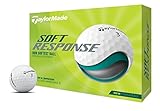
- Shallower U-Shape dimples: Increases volume ratio
- Seamleass 322 Dimple Pattern: Increases dimple coverage
- Product Type - RECREATION BALL
- Item Package Quantity - 1
TaylorMade’s Soft Response is the most recent entry in this category, and it brings some interesting tech to the table. With a compression around 50, it’s the middle child of this group, not too soft and not too firm. The big selling point is what TaylorMade calls the “React Speed Core,” which is designed to compress efficiently across a range of swing speeds from about 80 to 95 mph.
That wider compression window makes the Soft Response a great pick if your swing speed fluctuates. Maybe you swing 86 mph with a smooth 7-iron but can get up to 92 mph when you go after one with the driver. The Soft Response handles that range better than any ultra-low compression ball, which can start feeling a bit over-compressed at higher speeds.
Off the driver, the Soft Response produces a mid-high launch with moderate spin. It’s not the longest ball in this test at slower speeds, but it’s consistent. Where it really shines is with irons. The feel on mid-iron approaches is crisp and responsive. You get good height, a predictable flight, and enough spin to hold greens. For a moderate compression ball with an ionomer cover, the short iron spin is surprisingly good.
The Seamless Cover Technology gives the Soft Response a consistent, uniform feel around the entire ball. No seam means no soft spots or hard spots depending on where you strike it. It’s a small thing, but it matters for consistency. Durability is above average for this category too. We saw minimal scuffing after 36 holes of play.
At around $28 per dozen, the Soft Response sits in the middle of the pack on price. It’s not the cheapest, but it’s not tour-ball money either. For the performance you get across driver through putter, it’s solid value.
Who it’s for: Golfers swinging 82-92 mph who want a versatile ball that performs well across all clubs. Especially good for players with variable swing speeds who need a ball that works on smooth swings and aggressive ones.
Pros: Versatile compression works across speed ranges, excellent iron feel and spin, durable seamless cover, consistent ball flight, good all-around performance.
Cons: Not the longest at very slow speeds (below 80 mph), ionomer cover limits greenside spin compared to urethane, slightly more expensive than the Duo Soft or Soft Feel.
Vice Pro Soft

- 3 Piece cast urethane cover ball construction with extra-thin cover for high short game spin
- Designed for golfers with medium and low swing speeds who aim to maximize their score performance
- Outstanding spin control and extra soft feel off the club
- Newly designed, closed alignment line for better aiming
- New glossy outer finish available in three different colors WHITE, NEON LIME, NEON RED
Vice Golf built its brand on delivering tour-level quality at direct-to-consumer prices, and the Pro Soft is their answer for moderate swing speed golfers. With a compression around 38, it sits in the sweet spot for golfers swinging under 90 mph, and it’s one of the few balls in this category with a cast urethane cover. That’s a big deal.
A cast urethane cover at this price point is essentially unheard of. Urethane is the cover material used on tour balls like the Pro V1 and TP5 because it generates significantly more spin on short shots. Most golf balls for slow swing speed use ionomer covers because they’re cheaper. Vice flipped the script by offering a urethane cover at a compression that works for sub-90 swingers. The result is a ball that gives you genuine short game spin without requiring tour-level swing speed to compress the core.
Off the driver, the Pro Soft produces a mid-high launch with low spin. Distance is competitive with the Srixon Soft Feel and Callaway Supersoft at similar swing speeds. You won’t lose anything off the tee by choosing this ball, and you gain a noticeable amount of greenside spin. On 30-yard pitch shots, the Pro Soft checks up significantly better than any ionomer-covered ball in this test. If you score around the greens, this matters more than an extra 3 yards on your drive.
The feel is soft but not mushy. There’s a responsiveness through impact that feels like the ball is working with you, not just absorbing energy. On putts, the Pro Soft rolls true and provides good feedback without being clicky. It’s a Goldilocks feel for moderate swingers, not too firm, not too soft, just right.
Pricing is competitive when you buy in bulk direct from Vice. At standard pricing, it’s around $30 per dozen, but if you buy multiple dozen, the per-ball cost drops significantly. That direct-to-consumer model genuinely saves you money.
Who it’s for: Golfers swinging 78-90 mph who want tour-level greenside spin at a moderate compression. The best pick for low-to-mid handicappers who score with their short game but don’t have the swing speed for a tour ball.
Pros: Cast urethane cover provides real greenside spin, soft but responsive feel, competitive distance, bulk pricing from Vice saves money, excellent putting feel.
Cons: Urethane cover is slightly less durable than ionomer, availability can be limited through retail channels, not as widely recognized as Titleist or Callaway.
Comparison Table
If you’re the type who likes to see everything side by side before making a call, here’s how all seven golf balls for swing speeds under 90 mph stack up:
| Ball | Compression | Cover Type | Spin Level | Best For |
|---|---|---|---|---|
| Srixon Soft Feel 14 | 33 | Ionomer | Low-Mid | Maximum distance & soft feel on a budget |
| Callaway Supersoft 2025 | 30 | Hybrid Ionomer | Low | Ultra-soft feel & maximum carry distance |
| Titleist Tour Soft | 65 | TPU | Mid-High | Balanced performance with best greenside control |
| Wilson Duo Soft 2025 | 40 | Ionomer | Low-Mid | Best value & high-forgiveness feel |
| Bridgestone e6 Soft | 42 | Ionomer (Seamless) | Low | Straight ball flight & slice reduction |
| TaylorMade Soft Response | 50 | Ionomer (Seamless) | Mid | Versatile all-around play for variable swing speeds |
| Vice Pro Soft | 38 | Cast Urethane | Mid-High | Tour-level greenside spin at low compression |
Notice the range of compression ratings from 30 to 65. That’s a big spread, and it’s intentional. Golfers swinging under 90 mph aren’t all the same. An 88 mph swinger has different needs than a 75 mph swinger. An 88 mph player who hits the ball dead straight has different priorities than an 82 mph player who fights a wicked slice. Use this table to narrow down your choices, then read the detailed reviews above to find your match.
How to Choose the Right Ball for Your Sub-90 Swing
Buying golf balls shouldn’t be complicated, but the marketing makes it feel that way. Here’s a straightforward framework for picking the right ball based on what actually matters for your game.
Start with your exact swing speed. “Under 90 mph” is a broad category. If you’re at 88-89 mph, you can handle a slightly firmer ball like the Titleist Tour Soft or TaylorMade Soft Response and still compress it effectively. If you’re at 75-82 mph, go for the lowest compression options like the Callaway Supersoft or Srixon Soft Feel. Matching compression to your speed is the single most important factor in ball selection.
Decide what matters most: distance, feel, or short game. These three factors rarely peak in the same ball. If pure distance off the tee is your priority, the Supersoft and Soft Feel are your best bets. If feel on every club from driver to putter matters most, the Vice Pro Soft delivers the best blend. If short game spin is your priority because you score with wedges and putter, the Titleist Tour Soft and Vice Pro Soft are the clear leaders.
Be honest about your miss patterns. If you consistently slice or hook the ball, the Bridgestone e6 Soft is designed to help with exactly that. Its low-spin, straight-flight design will reduce the severity of your typical miss. If you hit it relatively straight and want to maximize every yard, focus on the highest-launching options instead.
Factor in your budget. Golf balls for swing speeds under 90 mph range from about $20 to $35 per dozen. If you lose two balls a round, that difference adds up over a season. The Wilson Duo Soft at $20 per dozen is plenty of ball for most high handicappers. The Vice Pro Soft at $30 per dozen is worth it if you need that urethane cover for short game spin. Don’t overpay for features you won’t use.
Consider conditions. If you play in cold weather, softer balls compress more easily because the materials stiffen up. An ultra-low compression ball like the Supersoft (compression 30) will still feel playable in 45-degree weather. A mid-compression ball like the Tour Soft (compression 65) might start feeling like a brick. If you’re a year-round golfer in a cold climate, lean softer.
Test before you commit. Buy a sleeve of your top two or three picks and play them side by side. Feel is personal, and no amount of testing data can tell you whether you’ll prefer the buttery softness of the Duo Soft or the slightly firmer pop of the Soft Response. Your hands will tell you.
Common Mistakes Slow-Swing Golfers Make with Ball Choice
We see these mistakes all the time at the range, and they’re costing golfers real distance and real strokes. Let’s fix them.
Playing tour-level balls because “they’re the best.” The Pro V1 is a phenomenal golf ball. For a 110 mph swing speed. At 85 mph, you’re leaving 15+ yards on the table because the compression is too high for your speed. The best golf balls for swing speeds under 90 mph are specifically designed to maximize performance at your speed. Play the ball that fits your game, not the ball that fits Rory’s game.
Assuming soft means short. This is the oldest myth in golf ball marketing. Low compression golf balls don’t lose distance. They gain distance for slower swingers because they compress properly. A soft ball at 85 mph will carry farther than a hard ball at 85 mph, every single time. The science is settled on this. Titleist’s own compression guide confirms that matching compression to swing speed maximizes ball speed and distance.
Buying based on what your buddy plays. Your buddy swings 95 mph. You swing 82 mph. Different balls. End of story. Golf ball compression is not a matter of preference at lower speeds. It’s physics. Play the ball that compresses at your speed.
Ignoring the cover material. Ionomer covers are more durable and cheaper but spin less around the greens. Urethane covers spin more but cost more and scuff easier. TPU covers (like on the Tour Soft) are a middle ground. Know what you’re getting and choose based on where you need performance most.
Not testing on the course. Launch monitors are great, but they don’t tell you how a ball feels on a 40-yard pitch over a bunker. They don’t tell you if the ball holds a downhill green. They don’t tell you if the sound off your putter inspires confidence. Test on the course before you buy by the dozen.
Playing one ball type all year. If you live somewhere with four real seasons, your ball needs change. That compression 65 Tour Soft that feels great in July might feel like hitting a rock in November. Consider going softer in cold weather. Your hands and your distances will thank you.
Final Verdict
Seven solid options, but you probably want a straight answer. Here are our top picks based on what kind of golfer you are and what you need from your ball.
Best Overall for Swing Speeds Under 90 MPH: Vice Pro Soft. It’s the rare ball that gives you low compression distance AND real greenside spin thanks to that cast urethane cover. For most golfers swinging in the 78-90 mph range, this is the best balance of distance, feel, and short game performance you’ll find. The direct-to-consumer pricing makes it even more attractive.
Best for Maximum Distance: Callaway Supersoft 2025. If your number one priority is hitting it farther off the tee and you don’t care about spinning the ball back on greens, the Supersoft is your ball. At compression 30, it launches high and flies far for moderate and slow swing speeds. Pure and simple.
Best Value: Wilson Duo Soft 2025. At around $20 per dozen, the Duo Soft delivers 90% of the performance of balls costing twice as much. It’s soft, it flies high, it’s forgiving on mishits, and it doesn’t hurt when you lose one in the water. For high-volume golfers and budget-conscious players, this is the pick.
Best for Slicers: Bridgestone e6 Soft. If your typical miss is a big curve, the e6 Soft’s low-spin, straight-flight design will save you strokes immediately. More fairways hit equals more greens hit equals lower scores. Sometimes the best ball for your game isn’t the longest one, it’s the straightest one.
Any of these seven golf balls will serve you better than a tour-level compression ball if you’re swinging under 90 mph. Pick the one that matches your priorities, test it on the course, and stick with it. Consistency matters more than perfection.
You Might Also Enjoy
If you found this guide helpful, check out these related reviews on TheGolfingLad:
Best Golf Balls for Slow Swing Speed (2026) — A deeper look at ultra-low compression options for very slow swingers.
Best Golf Irons for High Handicappers (2026) — Pair your new ball with forgiving irons that match your swing.
Best Golf Drivers for High Handicappers (2026) — Get the right driver to complement your ball choice and maximize carry.
Best Golf Irons for Seniors (2026) — Lightweight, forgiving irons for golfers with moderate swing speeds.
Best Golf Hybrids for Beginners (2026) — Replace those long irons with easier-to-hit hybrids and watch your approach game improve.