
Best GPS Watches for Golf 2026 – Distance at a Glance
Slapping a GPS watch on your wrist before a round is one of those small changes that makes a surprisingly big difference. You stop hunting for sprinkler heads, you stop second-guessing yourself between clubs, and you actually walk up to the ball with a plan. That said, not every golf GPS watch is worth your money — some are overpriced fitness trackers with a course database bolted on, and some are genuinely purpose-built tools that’ll change how you think about course management.
I’ve spent time with all five watches on this list across a range of courses and conditions. Here’s the honest breakdown of what each one does well, where each one falls short, and which one belongs on your wrist.
What to Look for in a Golf GPS Watch
Before you get sucked in by spec sheets and marketing, here’s what actually matters when you’re standing 165 yards out with a crosswind and a bunker between you and the pin.
Yardage Accuracy and Course Coverage
Every watch on the market claims GPS accuracy. Most are close enough for practical use — within a yard or two of center. What separates the good ones is how well they map the whole hole: not just front/center/back, but layup points, hazard carries, and dogleg distances. If a watch only gives you three numbers, it’s doing about 30% of the job.
Course coverage matters too. The top brands cover 40,000+ courses worldwide. If you travel or play unusual layouts, check whether your specific course (and the courses you visit) are actually in the database. Most let you verify before you buy.
Display Readability in Sunlight
This is the one spec reviewers almost always gloss over, and it’s arguably the most important. AMOLED displays look gorgeous in a dim room. In direct afternoon sun on a shadeless fairway? Some of them wash out badly. Garmin’s transflective MIP displays — the ones used on budget models — actually get easier to read in bright sunlight. Know what you’re getting before you buy.
Battery Life
A round of golf runs 4–5 hours in GPS mode. That’s the floor you need to clear. But if you’re playing back-to-back days on a golf trip or you want to wear the watch daily, you need more headroom. Watches that need charging every night get annoying fast. Look for at least 15–20 hours in GPS mode if you plan to use it regularly.
Shot Tracking
Automatic shot tracking has gotten genuinely good on the better watches. It detects your swing via accelerometer, logs the distance, and builds a club-by-club yardage profile over time. Manual tracking — where you tap a button after every shot — works fine but requires discipline. If you’re the kind of golfer who’d actually use that data, automatic tracking pays for itself in club selection improvements within a season.
Smartwatch Features
If you want one device that does golf and daily life, you need notifications, app support, and ideally decent fitness tracking. If you just want a golf tool you strap on at the first tee and forget about otherwise, don’t pay extra for smartwatch features you’ll never use.
Subscriptions and Ongoing Costs
Garmin and Shot Scope both include course updates for free. Some competitors charge annual fees for premium features. Factor that into the real cost of ownership — a cheaper watch with a $50/year subscription closes the gap quickly.
How We Tested
Each watch on this list got real on-course time — not just a quick walk around the practice facility. I wore them across multiple rounds on courses with varied layouts: tight tree-lined parkland tracks, open links-style courses, and a couple of hilly layouts that really stress-tested elevation data and GPS positioning.
Testing focused on: yardage accuracy (cross-referenced with known sprinkler heads and laser rangefinder readings), display readability in varying light conditions, how quickly the watch acquires GPS lock, button responsiveness during a round, and how the companion apps handle post-round data. Battery drain was tracked across full rounds with typical smartwatch notifications enabled.
Where I had personal preferences or found a feature genuinely useful (or genuinely useless), I say so. This isn’t a spec regurgitation — it’s what I’d tell a friend who asked me which one to buy.
The Best Golf GPS Watches in 2026
| Watch | Display | Courses | GPS Battery | Best For | Price (approx.) |
|---|---|---|---|---|---|
| Garmin Approach S70 | AMOLED | 43,000+ | 20 hrs | Serious golfers wanting everything | $500–$600 |
| Garmin Approach S42 | Color LCD | 42,000+ | 15 hrs | Mid-handicap golfers wanting more features | ~$250 |
| Garmin Approach S12 | Sunlight-readable LCD | 42,000+ | 30 hrs | Budget-conscious, keep-it-simple golfers | ~$170 |
| Bushnell Ion Edge | Color touchscreen | 38,000+ | ~10 hrs | Golfers who prefer a touchscreen interface | ~$200 |
| Shot Scope V5 | Color LCD | 36,000+ | ~10 hrs | Stats-obsessed golfers on a budget | ~$200 |
1. Garmin Approach S70 — Best Overall
No products found.
The Garmin Approach S70 is the best golf GPS watch you can buy right now. That’s not a controversial opinion — it’s the one watch that doesn’t make you compromise on anything that actually matters on the course. The AMOLED display is genuinely beautiful, the GPS data is rich and accurate, and the Virtual Caddie feature has gotten smart enough that I catch myself actually agreeing with its club recommendations more often than not.
That 47mm AMOLED display is the first thing you notice. Colors pop, text is crisp, and the green mapping — which shows the full shape of the putting surface with contour shading — is genuinely easy to read at arm’s length. Yes, AMOLED can wash out in extreme sunlight, but Garmin’s auto-brightness does a solid job managing it, and in practical use it wasn’t a problem across any of the rounds I tested it.
The Virtual Caddie pulls in wind, your historical club distances, and the hole layout to suggest which club to hit and where to aim. I was skeptical at first. After using it across a dozen rounds, I’d say it’s right about 75% of the time — and the other 25%, it at least makes you think about the shot differently. That’s genuinely useful.
Green contour mapping is available on S70, and it’s the real deal. You get a bird’s-eye view of the green with shading that shows ridge lines and slope directions. It’s not a substitute for actually reading a putt, but it gives you a starting point that most caddies at mid-range courses couldn’t give you.
Battery runs to about 20 hours in GPS mode — more than enough for back-to-back days on a golf trip without charging. In smartwatch mode, expect around 10 days. It handles notifications, music control, and fitness tracking like a proper smartwatch, which means you can wear it every day and not look like you’ve got a training aid strapped to your wrist.
The price is real — this is a $500+ watch. But if you play 30+ rounds a year and you want the best data available, the S70 earns it. For a deeper look, read our full Garmin Approach S70 review.

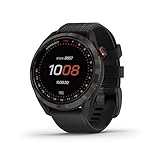
- Stunning Courseview Maps on Your Wrist: Immerse yourself in this Garmin golf watch's 43,000 full-color CourseView maps. The Approach S70 Garmin golf watches for men and women also feature a brilliant 1.4" AMOLED display, making navigation on the course a breeze.
- Style Meets Performance: Stand out both on and off the course with the Garmin Approach S70 GPS golf watch's lightweight and stylish design, featuring a sleek ceramic bezel that adds a touch of elegance to your golf game.
- Unmatched Battery Life: Enjoy up to 16 days of battery life in smartwatch mode and up to 20 hours in GPS mode, ensuring the Garmin Approach S70 golf GPS watch for men and women keeps up with your longest golf outings without needing a recharge.
- Unleash Your Golf Potential: Take your game to the next level with features you won't find in other golf watches with GPS for men and women such as enhanced golf course maps for precise targeting, virtual caddie suggestions based on advanced data analysis, and PlaysLike Distance for accurate shot planning, all in the palm of your hand.
- Ultimate Golfers Bundle: Garmin Approach S70 Premium Golf Smartwatch, PlayBetter #Z05 5000mAh Powerbank, HD Screen Protectors, and USB-C Charging Cable
The case against it: If you play 10 rounds a year, this is overkill. The price is hard to justify unless you’ll actually use the advanced features.
Price: ~$500–$600
Best For: Dedicated golfers who want premium data and daily wearability in one device
2. Garmin Approach S42 — Best Mid-Range Pick
The Garmin Approach S42 is what I’d recommend to most golfers asking for advice. It’s not the flashiest watch on this list and it’s not the cheapest, but it hits a genuinely sweet spot — real golf features, a comfortable price, and enough smartwatch functionality that you won’t feel like you’re wearing a one-trick pony.
You get distances to the front, center, and back of the green as the baseline, plus hazard distances and layup yardages. The S42 covers 42,000+ courses preloaded, so you’re not going to roll up somewhere and find it missing. The color display isn’t AMOLED — it’s a standard transflective LCD — which means it’s actually very readable in bright sunlight. When you’re standing in the middle of a sun-baked fairway, that’s a plus.
Automatic shot detection is here and it works reliably. The watch logs your shots, builds your average distances per club over time, and syncs everything to the Garmin Golf app after the round. If you’ve never had a caddie telling you “you’ve hit this club 172 yards three times today,” that post-round data tends to change how you think about your distances — especially your carry distances versus total distances.
Battery in GPS mode runs about 15 hours, which covers most back-to-back day scenarios without mid-trip charging anxiety. Smartwatch battery is around 7 days, so weekly charging is the rhythm you’ll settle into.
The S42 also handles phone notifications and has basic fitness tracking — step count, heart rate, sleep. It’s not a Fenix-level fitness watch, but it’s enough to make it something you’ll wear every day.
At around $250, the S42 is the watch I’d point a mid-handicap golfer toward if they asked me where to start. It’s not going to wow you with a feature you’ve never seen before, but everything it does, it does well.
- 1.2” easy-to-read color touchscreen display with interchangeable quick release bands
- Battery life: up to 15 hours in GPS mode, and up to 10 days in smartwatch mode
- Green View feature allows manual pin positioning; quickly reference distances to the front, middle and back of the green as well as hazards and doglegs
- The AutoShot round analyzer measures and auto-records detected shot distances distances (lie and ball contact may affect shot tracking) and pairs with optional Approach CT10 club tracking sensors (sold separately) for more automatic game tracking capabilities
- Offers smart notifications (when paired with a compatible smartphone) and estimated activity-tracking features such as steps, sleep and built-in sports profiles
The case against it: If you’re drawn to green contour mapping or the AI caddie features, you’ll want to stretch to the S70. The S42 is capable but not cutting-edge.
Price: ~$250
Best For: Regular golfers who want solid GPS features and smart notifications without flagship pricing
3. Garmin Approach S12 — Best Budget Pick
The Garmin Approach S12 exists to answer one question: “Can I get a reliable golf GPS watch for under $200?” The answer is yes, and the S12 is the proof.
This is a no-frills watch. There’s no color mapping, no shot tracking, no AI caddie. What you get is front/center/back yardages, hazard distances, and a sunlight-readable display that genuinely does its job well. The interface is simple — you scroll through yardages with the buttons, and it auto-advances to the next hole when it detects you’ve moved on. For a lot of golfers, that’s all they actually need.
The battery life is the S12’s hidden strength: 30 hours in GPS mode. That is a genuinely impressive number and blows away most watches at twice the price. You can play every day for a week without charging. That kind of reliability matters, especially on trips where you’re playing three or four days in a row and outlet access is limited.
42,000+ courses are preloaded, which is a number that rivals the premium models. Course data accuracy was solid in testing — front/center/back numbers matched my laser within two yards on the vast majority of shots. For a $170 watch, that’s hard to argue with.
There’s very little smartwatch functionality here. You’ll get basic step counting, but don’t expect notifications or fitness features. This is a golf tool, and it knows it. Wear a different watch during the week if you want daily smartwatch features, or just lean into wearing this one and enjoy the simplicity.
If you’re new to GPS watches, playing more casually, or just want to try GPS without spending serious money, the S12 is the right starting point. It’s also a solid gift for a golfer who’s never used one before.

- New round watch design with a high-resolution sunlight-readable display
- Battery life: up to 30 hours in GPS Mode
- More than 42,000 courses preloaded from around the world
- Keep score right on the watch and upload directly to the Garmin Golf app (when paired with a compatible smartphone) to participate in weekly leaderboards
- Automatically keep track of your score and how far you hit with each club with compatible Approach CT10 club tracking sensors (sold separately)

The case against it: If you want shot tracking or any form of post-round stats analysis, you’ll outgrow the S12 quickly. There’s no color display and no mapping beyond basic yardages.
Price: ~$170
Best For: New GPS watch users, casual golfers, or anyone who wants simple yardages without complexity
4. Bushnell Ion Edge — Best for Touchscreen Fans
Bushnell makes excellent rangefinders — they’re arguably the gold standard in the laser rangefinder space (if you’re shopping that category, check out our guide to the best golf rangefinders under $300). The Ion Edge is their GPS watch entry, and it brings some of that rangefinder DNA with it: clean, fast, no-nonsense distance readouts.
The big differentiator is the touchscreen interface. Among dedicated golf GPS watches in this price range, touch navigation is rare — most use physical buttons. The Ion Edge’s touchscreen is responsive and intuitive, and if you’re used to a smartphone, the learning curve is essentially zero. Swipe to switch holes, tap to get hazard info, pinch on the hole map. It just works the way you’d expect.
The full-color display shows a top-down hole map with your position, hazard markers, and yardage callouts. It’s a clean layout and easy to read without fumbling with buttons mid-stride. Yardage accuracy was good across testing — not quite at Garmin’s level of precision, but within the margin that matters practically.
The Ion Edge covers 38,000+ courses, which is fewer than the Garmin options but still covers the vast majority of courses most golfers will ever play. It also integrates with the Bushnell Golf app, where you can review hole-by-hole distances and basic round stats.
Battery life runs around 10 hours in GPS mode — enough for a round with headroom, but you’ll want to charge between rounds if you’re playing multiple days. That’s the main limitation compared to the Garmins.
Where the Ion Edge earns its place is in user experience. If you find button-based navigation clunky on other GPS watches, this one will feel much more natural. It’s also well-built and sits comfortably on the wrist during a full round.

- Touchscreen and GreenView with Movable Pin Placement
- Front/Center/Back Distances
- Dynamic Green Mapping
- 6 Hazards Per Hole
- 15+ Hours of Battery Life
The case against it: Shorter battery life than most competitors, and the course library is a bit smaller. If you play remote or international courses, double-check coverage before committing.
Price: ~$200
Best For: Golfers who prefer a touchscreen interface and want a clean, intuitive course display
5. Shot Scope V5 — Best for Stats Junkies on a Budget
Shot Scope is a Scottish company that’s been laser-focused on the golf GPS watch market for years, and the V5 reflects that focus. This isn’t a fitness watch that happens to know about golf courses — it’s built from the ground up for golfers who want performance data, and it shows.
The V5’s headline feature is automatic shot tracking that actually works. The watch detects your swings using the built-in accelerometer and logs them with GPS coordinates — no tagging, no button pressing. After the round, you sync to the Shot Scope app and get a full breakdown: where every shot landed, carry distances per club, fairways hit, greens in regulation, putts per hole, and a shot-by-shot map of the round. For a $200 watch, that’s a striking amount of data.
The accuracy of the shot detection is good. I’d say it captures about 90–95% of shots reliably, occasionally missing a chip from a tight lie or a partial swing on a tight approach. The miss rate is low enough that the data is genuinely useful across a round.
GPS yardages cover front/center/back plus hazard distances. The color LCD display is easy to read and navigation is simple. Course coverage sits at 36,000+ courses, which is on the lower end of this list but still covers the vast majority of what most golfers encounter.
Critically: no subscription fees. Ever. Garmin is also free in this regard, but some GPS watch brands tuck premium features behind annual payments. Shot Scope doesn’t play that game — you pay for the watch and that’s it. Over five years, that’s real money back in your pocket.
The V5 is also a capable smartwatch in a basic sense — phone notifications come through, step counting works, and it’s comfortable enough to wear daily. It’s not going to replace a proper smartwatch, but it’ll do the job.
Battery runs around 10 hours in GPS mode. Same limitation as the Ion Edge — plan to charge between rounds on a multi-day trip.

- GPS Distances to greens, hazards, layup points + doglegs
- Full hole maps
- Automatic performance tracking
- 100+ statistics, Strokes Gained + Handicap Benchmarking
- No subscription fees
The case against it: Battery life could be better, and the course library is the smallest on this list. If course mapping depth and GPS battery are top priorities, Garmin is the better call.
Price: ~$200
Best For: Data-focused golfers who want automatic shot tracking and detailed statistics without a premium price tag
GPS Watch vs. Rangefinder: Which Should You Use?
This comes up constantly, and the honest answer is: it depends on what you value, and the best setup is often both.
A GPS watch wins on speed and convenience. You glance at your wrist and you have your yardage — no fumbling for a device, no aiming at a flag. You also get hazard distances and layup yardages passively, without doing anything. For pace of play and ease of use, the watch is unbeatable.
A laser rangefinder wins on precision to the pin. A GPS watch gives you center-of-green distances (and some models give green depth), but if you need to know exactly how far it is to the flag tucked in the back-left, a laser is going to give you a more precise answer. Pin position matters, especially on short irons into greens with a lot of depth variation.
Most serious golfers end up using both: the watch for situational awareness and hazard info, the rangefinder for a final pin distance before pulling a club. If you’re shopping laser rangefinders to pair with your GPS watch, we’ve put together a full guide to the best golf rangefinders under $300 that’s worth a look.
If you only want one device, a GPS watch is the more versatile choice. You can’t wear a rangefinder on your wrist between holes.
Do You Need Launch Monitor Data Too?
A GPS watch tells you where you need to hit it. A launch monitor tells you what your swing is actually doing — ball speed, spin rate, launch angle, carry distance in real time. They’re different tools for different jobs, and they stack well if you’re serious about improving.
If you’re curious about adding launch monitor data to your practice sessions, our roundup of the best golf launch monitors under $1,000 covers the options that actually make sense for club golfers rather than touring professionals.
Common Questions About Golf GPS Watches
How accurate are golf GPS watches?
Most modern golf GPS watches are accurate to within 1–3 yards for center-of-green distances under normal conditions. Accuracy can vary near tall trees, in steep terrain, or under cloudy skies that affect satellite signal. In practical terms, that level of accuracy is plenty precise enough for club selection — you’re not making decisions based on single-yard differences anyway.
Do golf GPS watches work on all courses?
The major brands cover most courses in North America, Europe, and Australia. Garmin and Shot Scope both let you verify course availability before purchasing. If you play a lot of international golf or municipal courses that have never been mapped, it’s worth checking your specific courses against the watch’s database.
Are there ongoing subscription fees?
Garmin and Shot Scope offer free course updates. Some brands charge for premium features or course access. Check before you buy — the total cost of ownership can look very different depending on subscription model.
Can I wear a golf GPS watch every day?
The premium models — like the Garmin Approach S70 and S42 — are genuinely comfortable everyday watches. The budget models work fine too, though they have fewer smartwatch features to make daily wear worthwhile. It comes down to whether you want one wrist device for everything or a dedicated tool you only strap on for golf.
What’s the difference between GPS watches and GPS rangefinders?
GPS rangefinders are handheld devices that sit in your pocket or bag — more like a dedicated GPS unit with a larger display. GPS watches live on your wrist. Watches are more convenient for continuous awareness of yardages throughout a round. GPS rangefinders typically have larger, easier-to-read displays and may offer more detailed course mapping. Most golfers find the watch wins on day-to-day usability.
Final Verdict
Here’s how I’d break it down if a friend asked me straight up:
Buy the Garmin Approach S70 if you play regularly, want the richest possible data experience, and the price doesn’t make you wince. Green contour mapping, Virtual Caddie, AMOLED display — it’s genuinely the complete package. Read our full S70 review before pulling the trigger.
Buy the Garmin Approach S42 if you want real GPS features and automatic shot tracking at a price that doesn’t require a special occasion to justify. This is the watch most golfers should buy.
Buy the Garmin Approach S12 if you want simple, reliable GPS yardages and an absurd battery life without spending more than $200. It does less, but what it does, it does well.
Buy the Bushnell Ion Edge if touchscreen navigation is important to you and you’re already in the Bushnell ecosystem. It’s a solid, intuitive watch from a brand that knows golf technology.
Buy the Shot Scope V5 if your primary goal is automatic shot tracking and detailed statistics, and you don’t want to pay subscription fees ever. The data this watch gives you at $200 is remarkable.
Any of these five will make you a more informed golfer. The differences are about how much data you want and how much you’re willing to spend to get it. Start with what fits your budget and your game — you can always upgrade later once you know what you actually use.