
How to Putt Better: Distance Control Drills That Work
Here’s a putting truth that took me years to fully accept: distance control matters far more than line. You can read every break perfectly, but if you’re consistently leaving putts 6 feet short or blasting them 4 feet past, you’re going to three-putt more than you’d like to admit.
Think about your last round. How many putts did you miss because of direction versus how many you missed because of speed? If you’re honest with yourself, poor distance control is likely costing you 3-5 strokes per round. The good news? Distance control is a skill you can dramatically improve with the right drills and consistent practice.
In this guide, I’ll share five proven distance control drills that have transformed my putting and helped countless golfers eliminate three-putts from their game. These aren’t gimmicks—they’re time-tested practice methods used by tour professionals and weekend warriors alike.
Why Distance Control Matters More Than You Think
Let’s talk numbers. According to PGA Tour statistics, the average make percentage from 3 feet is around 96%. From 6 feet? It drops to roughly 50%. This simple fact reveals why distance control is the foundation of good putting.

The three-putt equation is straightforward: If your first putt finishes outside 3 feet, your chances of making the second putt drop significantly. The goal isn’t necessarily to hole every long putt—it’s to ensure your first putt gives you a tap-in or a stress-free second putt.
Consider this scenario: You’re 30 feet from the hole with a 2-foot break. If you play the perfect line but hit it 5 feet short, you’re left with a tricky 5-footer. But if you misread the break slightly and finish 2 feet past the hole? You’re tapping in for par. Distance trumps direction every time.
Amateur golfers average around 36 putts per round. Scratch golfers average closer to 29-30. The difference isn’t hole-out percentage—it’s three-putt avoidance. Master distance control, and you’ll see your putting stats improve dramatically.
The Pendulum Putting Stroke
Before diving into drills, let’s establish the foundation: the pendulum putting stroke. Consistent distance control requires a consistent stroke, and the pendulum method provides exactly that.
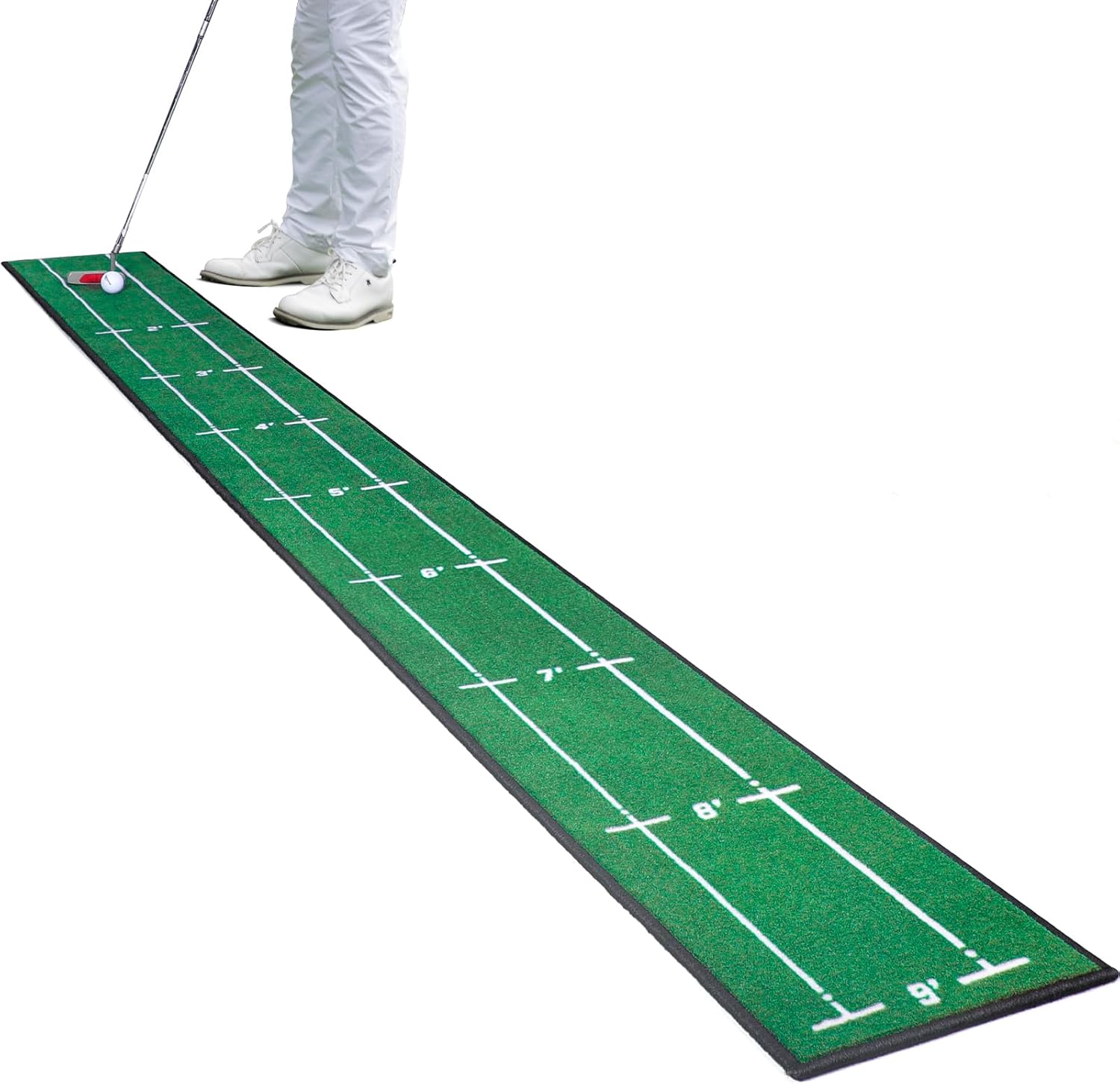
Key elements of the pendulum stroke:
- Shoulders drive the motion – Your arms, hands, and putter move as a single unit, powered by your shoulders rocking like a seesaw
- Quiet hands and wrists – Any wrist breakdown creates inconsistency; keep them firm but not tense
- Equal backswing and follow-through – The putter should travel roughly the same distance back and through
- Smooth tempo – Avoid jabbing or decelerating; maintain consistent speed throughout the stroke
Practice this stroke without a ball first. Set up in your putting stance and make 20 strokes, focusing solely on the pendulum motion. Your shoulders should feel like they’re on a teeter-totter, with everything else simply along for the ride.
Pro tip: Place a tee in the grip end of your putter and ensure it points at your belt buckle throughout the stroke. If the tee moves off-center, your wrists are breaking down.
Reading Green Speed
Distance control isn’t just about your stroke—it’s about understanding the surface you’re putting on. Green speed varies dramatically between courses, seasons, and even morning versus afternoon rounds.
How to assess green speed before your round:
- Use the practice green intentionally – Don’t just roll random putts; hit specific distances (10 feet, 20 feet, 30 feet) and note the stroke size required
- Feel the grass with your feet – Soft, lush greens play slower; firm, tight-cut greens play faster
- Observe ball behavior – Watch how quickly balls stop after landing on the green during approach shots
- Check the stimpmeter rating – Many courses post this; 8-9 is moderate, 10-11 is fast, 12+ is tour-level fast
Adapting to different speeds:
On fast greens, shorten your stroke length rather than slowing your tempo. On slow greens, lengthen your stroke while maintaining the same rhythm. This approach keeps your timing consistent while adjusting power output.
One technique that works well: before each putt, make two practice strokes at the distance you want the ball to travel. Don’t think about mechanics—feel the distance. Your subconscious mind is remarkably good at calibrating stroke length to distance once you give it clear input.
Drill 1: The Ladder Drill
The ladder drill is the gold standard for developing distance control. It trains your brain to make precise adjustments in stroke length and builds confidence across multiple distances.

Setup:
- Find a straight, relatively flat section of the practice green
- Place tees or ball markers at 10, 20, 30, and 40 feet from your starting position
- Use 5-6 golf balls
Execution:
- Putt your first ball to stop as close to the 10-foot marker as possible
- Your second ball must travel past the first ball but stop short of the 20-foot marker
- Your third ball must pass the second ball but stop before the 30-foot marker
- Continue this pattern, creating a “ladder” of balls
- If any ball fails to pass the previous ball (or goes too far), start over
Sets and reps: Complete 3 successful ladders per practice session. A “successful” ladder means all balls are properly sequenced without going past their target zone.
Variations:
- Reverse ladder – Start at 40 feet and work backward
- Tighter spacing – Place markers every 5 feet for more precision work
- Random ladder – Have a partner call out distances in random order
This drill works because it forces you to make small, precise adjustments rather than hitting the same distance repeatedly. It mimics the real-world challenge of judging various putt lengths throughout a round.
Drill 2: The Gate Drill
While primarily a stroke-path drill, the gate drill also reinforces distance control by demanding precision at a specific target distance.
Setup:
- Set two tees or alignment sticks just wider than your putter head (about 1 inch gap on each side)
- Position the “gate” 6 inches in front of your ball position
- Place a target (tee or coin) at 10 feet
Execution:
- Make your putting stroke, ensuring the putter passes through the gate without touching either side
- The ball must stop within 12 inches of your target
- Both conditions must be met for a successful rep
Sets and reps: 3 sets of 10 putts. Track your success rate and aim to improve each session. A good target is 7/10 successful reps per set.
Why it works: The gate forces you to maintain a square, consistent stroke path. When your path is consistent, your distance control becomes more predictable. Many golfers with poor distance control are actually suffering from path issues that cause inconsistent contact.
Progress the drill: Once you’re consistently hitting 7+/10 at 10 feet, move your target to 15 feet, then 20 feet. The gate stays in the same position—only the target distance increases.
Drill 3: The Clock Drill
The clock drill combines distance control with break reading, making it one of the most game-realistic practice exercises you can do.

Setup:
- Choose a hole on the practice green with some slope around it
- Place 8-12 balls in a circle around the hole at 6-foot distance (like clock positions)
Execution:
- Start at the 12 o’clock position and putt
- Move clockwise to each ball and putt
- Track how many you make out of the circle
- Repeat the circle, this time from 10 feet
Sets and reps: Complete 2 full circles at 6 feet and 2 full circles at 10 feet per session. Record your scores to track improvement over time.
Scoring benchmarks:
- 6 feet: Beginner = 4-6/12, Intermediate = 7-9/12, Advanced = 10-12/12
- 10 feet: Beginner = 2-4/12, Intermediate = 5-7/12, Advanced = 8+/12
The distance control connection: Each clock position presents a different break and speed requirement. The uphill putts need more pace; the downhillers need a softer touch. By practicing all angles, you develop the feel for adjusting speed based on slope—exactly what you need on the course.
Challenge variation: You must make all 12 putts consecutively before moving to the next circle. If you miss, start the circle over. This adds pressure that simulates on-course conditions.
Drill 4: Eyes Closed Putting
This might feel strange at first, but eyes-closed putting is one of the most effective ways to develop true feel for distance. When you remove visual feedback, your body learns to sense distance through the stroke itself.
Setup:
- Find a flat section of the practice green
- Place a target at 15 feet
- Use 5-6 balls
Execution:
- Set up to the ball normally, looking at your target
- Make two practice strokes while looking at the target, feeling the distance
- Look down at the ball, then close your eyes
- Make your putting stroke with eyes closed
- Before opening your eyes, guess where the ball stopped (short, long, or on target)
- Open your eyes and check your accuracy
Sets and reps: 3 sets of 10 putts with eyes closed. After each putt, note whether your guess was accurate.
What to focus on:
- The length of your backswing
- The speed of your stroke
- The solidness of contact
- The overall “weight” of the stroke
Progress indicators: Initially, your guesses will be random. Over time, you’ll develop the ability to accurately predict where the ball stops. When you can guess correctly 7+ times out of 10, you’ve developed genuine feel for distance.
Why it works: Most golfers are overly visual in their putting. They watch the ball, react to it, and make subconscious adjustments mid-stroke. By eliminating visual input, you force your brain to develop internal calibration for distance. This transfers directly to improved feel on the course.
Drill 5: Lag Putting to the Fringe
This is my personal favorite drill for developing lag putting skills. It removes the pressure of making putts and focuses entirely on distance control from long range.
Setup:
- Position yourself 40-50 feet from the edge of the practice green (toward the fringe)
- Use 6 balls
- No target hole—the fringe IS your target
Execution:
- Putt all 6 balls toward the fringe
- Your goal: every ball stops on the green but within 3 feet of the fringe
- Balls that go onto the fringe or stop more than 3 feet short are “misses”
- Track your success rate
Sets and reps: 3 rounds of 6 balls from different positions around the green. Vary the distance slightly (35-50 feet) to simulate different lag putt scenarios.
Scoring:
- All 6 balls in the zone = Excellent
- 4-5 balls in the zone = Good
- 2-3 balls in the zone = Needs work
- 0-1 balls in the zone = Focus on this drill regularly
Why the fringe? Using the fringe as a target gives you a visual “zone” rather than a specific point. This matches the mindset you should have on long putts: get the ball in the “safe zone” for an easy second putt, rather than trying to hole it.
Advanced variation: After lag putting to the fringe, immediately walk up and finish each putt. This creates a realistic sequence of long putt followed by short putt—exactly what you’ll face on the course.
Your Weekly Distance Control Practice Routine
Knowing drills is one thing; implementing them consistently is another. Here’s a structured 20-minute practice routine you can use before rounds or during dedicated practice sessions.

5-Minute Warm-Up:
- 10-15 putts without a target, focusing purely on pendulum stroke mechanics
- Feel the rhythm and get your shoulders moving smoothly
5 Minutes – Ladder Drill:
- Complete 1-2 successful ladders
- This calibrates your feel for varying distances
5 Minutes – Clock Drill:
- One complete circle at 6 feet, one at 10 feet
- Works on distance control with break
5 Minutes – Lag Putting:
- Two rounds of the fringe drill from different positions
- Finish each lag putt to build your routine
Weekly Schedule:
- Pre-round: Abbreviated version (warm-up + ladder only) – 10 minutes
- Practice session 1: Full routine with emphasis on gate drill – 25 minutes
- Practice session 2: Full routine with emphasis on eyes-closed putting – 25 minutes
Tracking progress: Keep a small notebook or phone note where you record your scores from the clock drill and lag putting drill. Review monthly to see improvement trends. Most golfers see significant gains within 4-6 weeks of consistent practice.
Frequently Asked Questions
How often should I practice putting for distance control?
Aim for 2-3 dedicated sessions per week, plus brief warm-ups before each round. Consistency matters more than duration—20 focused minutes beats an hour of mindless rolling. Even 10 minutes of purposeful drill work will improve your distance control over time.
Should I practice distance control on fast or slow greens?
Both, if possible. However, if your home course has a specific speed, prioritize practicing on similar surfaces. The key is calibrating your feel to the conditions you’ll play most often. When playing a course with different green speeds, arrive early to recalibrate on the practice green.
Why do I keep leaving putts short?
Leaving putts short is usually caused by deceleration—slowing the putter down through impact. Focus on maintaining or slightly accelerating through the ball. The ladder drill specifically helps with this because each ball must travel farther than the last, training you to commit to the stroke.
How do I translate practice green feel to the course?
Before your round, hit putts to specific distances on the practice green (10, 20, 30 feet) and note the stroke size required. On the course, recall those feelings when facing similar distances. Also, always take two practice strokes at the distance you want the ball to travel—this engages your subconscious calibration.
What’s more important for lag putting: not being short or not being long?
For most putts, being slightly past the hole is preferable—”never up, never in.” However, on severe downhill putts, leaving it short keeps the comebacker manageable. The general rule: on level or uphill putts, favor the aggressive side; on downhill putts, err on the side of caution.
Does putter length affect distance control?
Yes, putter length influences your posture and stroke arc, which can impact distance control. If your putter is too long or short for your height and setup, you may compensate with wrist action or poor posture—both hurt consistency. Consider a putter fitting if you’re struggling despite quality practice.
Final Thoughts
Distance control is the unsexy secret to great putting. While hole-outs get the highlight reels, it’s the golfer who consistently two-putts from 40 feet who posts the better score. The five drills in this guide—ladder, gate, clock, eyes closed, and fringe lag—will systematically build your feel for distance across every putting scenario you’ll encounter.
Remember: the goal isn’t perfection on every putt. It’s eliminating three-putts and giving yourself makeable second putts when you miss. Master distance control, and you’ll watch your putting average drop, your confidence rise, and your scores finally reflect the ball-striking you’ve been working on.
Now grab your putter, head to the practice green, and start climbing that ladder. Your lower scores are waiting.