Best Golf Balls for High Handicappers: Stop Wasting Money on Pro Balls
Disclosure: This post contains affiliate links. If you purchase through these links, I may earn a small commission at no extra cost to you. Thanks for supporting The Golfing Lad!
Let me save you some money right now: you do not need a $50-a-dozen Pro V1 if you’re shooting in the 90s or above. I know, I know — your buddy swears by them, and they look cool sitting on the tee. But here’s the honest truth: a high handicapper loses an average of 3-5 balls per round. At $4+ per ball, that’s real money disappearing into ponds and tree lines every single weekend.
The right golf ball for a high handicapper isn’t the one the tour pros play — it’s the one engineered for your swing speed, your tendencies, and your game. That means lower compression, reduced spin off the driver (hello, straighter shots), and a price point that doesn’t make you wince when one goes swimming.
I’ve tested dozens of golf balls over the past few seasons, and I’ve narrowed it down to the six best options for players with a handicap of 18 or above. Let’s dive in.
Quick Comparison: Best Golf Balls for High Handicappers

- For players who prioritize soft feel and who trust the Titleist brand.
- Long distance and soft feel from a new TruTouch core
- Low penetrating ball flight from unique 376 tetrahedral dimple design
- Increased greenside spin and control from a softer 3.0 TruFlex cover
- Ultra-soft feel
3. Srixon Soft Feel — Best Balance of Distance and Feel
The Srixon Soft Feel is the sleeper pick on this list. Srixon doesn’t get the marketing buzz of Callaway or Titleist, but their golf balls are genuinely excellent — and often a buck or two cheaper.
What sets the Soft Feel apart is its FastLayer Core technology. Rather than having a uniform compression throughout, the core gradually transitions from soft in the center to firmer on the outside. The result? You get the soft feel at impact that high handicappers love, but with a bit more energy transfer for distance.
At around 60 compression, it’s firmer than the Supersoft or Wilson Duo, which actually makes it a great transitional ball. If you’re a high handicapper who’s improving and doesn’t want to switch balls every few months, the Soft Feel will grow with your game.
Pros:
- FastLayer Core gives excellent energy transfer
- 338 Speed Dimple pattern for consistent flight
- Great value for the quality
- Good choice as your game improves
Cons:
- Higher compression may not suit very slow swing speeds
- Less forgiving on mishits than softer options

- Soft Without Compromise: If feel is what matters most to you, play Soft Feel for maximum all-around performance. Soft Feel technology provides responsive feel for excellent control from tee to green.
- Increased Distance: Engineered for maximum distance with a high-energy core that boosts ball speed, ideal for golfers seeking longer drives.
- Low Compression: Perfect for golfers with slower or medium swing speeds, delivering a soft feel and easy launch for improved accuracy and control.
- 338 Speed Dimple Pattern: Speed dimples reduce drag at launch increase lift during descent. The soft thin cover provides less spin off the driver but more greenside spin and a softer feel on pitches, chips, and putts.
- Pack of 24 Golf Balls

4. Vice Drive — Best Budget Pick
If you’re losing a lot of balls per round (no judgment — we’ve all been there), the Vice Drive is your wallet’s best friend. These direct-to-consumer balls punch way above their price point.
Vice Golf cut out the middleman to deliver quality golf balls at prices that make you do a double-take. The Drive is their entry-level offering, and at around $17 a dozen (even less if you buy in bulk), it’s genuinely hard to find a better value in golf.
The 2-piece construction with a Surlyn cover is tough as nails — these balls can handle cart path bounces, tree strikes, and everything else a high handicapper’s round throws at them. The low compression (~37) and reduced spin help with distance and accuracy off the tee.
Are they as refined as the Callaway Supersoft? Not quite — the feel around the greens is a bit plasticky, and touch shots require a little more finesse. But for the price? Absolutely no complaints.
Pros:
- Incredible value — around $1.40 per ball
- Extremely durable Surlyn cover
- Low spin for straighter drives
- Bulk pricing makes it even cheaper
Cons:
- Feel around the greens is just okay
- Less spin control on approach shots
5. Bridgestone e6 — Best for Reducing Slices
The Bridgestone e6 was literally engineered to fly straighter. If your biggest problem is a banana slice that sends balls into the next fairway (or worse), this ball deserves your attention.
What makes the e6 special is its 3-piece construction — unusual at this price point. That extra layer (the mantle) helps reduce driver spin while still providing decent greenside performance. It’s the best of both worlds for high handicappers who want some versatility.
Bridgestone’s Delta Dimple design also promotes a straighter ball flight with less drag. I’ve personally seen players knock 10-15 yards off their slice just by switching to the e6. That’s not a cure, but it’s a significant band-aid while you work on your swing.
At around $25 a dozen, it’s the priciest ball on this list, but the 3-piece construction justifies it. If you’re ready to pair a good ball with a budget-friendly rangefinder, you’ll see real improvements in your game.
Pros:
- 3-piece construction at a 2-piece price
- Excellent at reducing side spin
- Good greenside feel for a distance ball
- Consistent and predictable flight
Cons:
- Most expensive option on this list
- May be too firm for very slow swing speeds

- Engineered for power and feel
- Soft feel, long distance golf ball
- Hyper Elastic SoftFast Core delivers more distance, forgiveness, and incredible feel through the bag
- Soft seamless cover for better spin and feel
- Balls are availble in White and Yellow
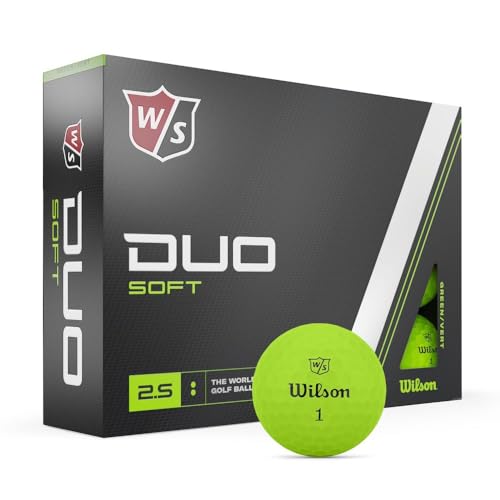
6. Wilson Duo Soft+ — Best for Slow Swing Speeds
Do you have a swing speed under 85 mph? Are you a senior golfer or someone who prioritizes smooth tempo over raw power? The Wilson Duo Soft+ was made for you.
At roughly 35 compression, this is one of the softest golf balls on the market. Period. For golfers with slower swing speeds, a low-compression ball is absolutely critical — it compresses more easily, which means you get more distance out of swings that wouldn’t fully compress a harder ball.
The “+” in the name refers to the updated Velocity Layer Technology that adds a bit more speed compared to the original Duo Soft. Wilson managed to make it slightly longer without sacrificing that pillow-soft feel.
Don’t let the Wilson name fool you into thinking these are cheap department-store balls. The Duo Soft+ is a serious golf ball that happens to be incredibly affordable. It’s an absolute gem for the right player.
Pros:
- Ultra-low 35 compression — softest on this list
- Perfect for swing speeds under 85 mph
- Great value for a quality 2-piece ball
- Very comfortable feel on putts
Cons:
- Too soft for faster swing speeds — will balloon
- Limited greenside spin
What Makes a Good Golf Ball for High Handicappers?
Before you click “buy,” let me quickly explain why these balls work for higher handicaps. Understanding the basics will help you pick the right one for your specific game.
Compression: Lower Is (Usually) Better
Compression measures how much a golf ball deforms at impact. Lower compression balls (30-60) compress more easily, which means slower swing speeds can still generate good distance. If your driver swing speed is under 95 mph (which includes most high handicappers), you’ll benefit from a ball under 60 compression.
Spin: Less Off the Driver, More Around the Green
High handicappers generally want low spin off the driver — this reduces slices and hooks and helps the ball fly straighter. The tradeoff is less greenside spin, but honestly? Most high handicappers aren’t hitting enough greens in regulation to worry about spin on approach shots. Focus on getting the ball in play first.
Construction: 2-Piece vs 3-Piece
Most balls on this list are 2-piece (core + cover) because they’re designed for maximum distance and durability. The Bridgestone e6 is the exception with its 3-piece design, which adds a mantle layer for better spin separation. For most high handicappers, 2-piece is the way to go.
Feel: It’s Personal
Some golfers love a super-soft feel (Callaway Supersoft, Wilson Duo Soft+), while others prefer a slightly firmer click (Srixon Soft Feel, Titleist TruFeel). There’s no wrong answer here — the best-feeling ball is the one that gives you confidence. If you feel good over the ball, you’ll make better swings.
Frequently Asked Questions
What compression golf ball should a high handicapper use?
Most high handicappers benefit from golf balls with compression ratings between 35 and 60. If your driver swing speed is under 85 mph, aim for 35-45 compression (like the Callaway Supersoft or Wilson Duo Soft+). If you’re between 85-95 mph, a 50-60 compression ball like the Srixon Soft Feel works great.
Do expensive golf balls really make a difference for beginners?
Honestly? No. Premium balls like the Pro V1 are designed for swing speeds and skill levels that most high handicappers don’t have. You’ll see more improvement from a properly fitted budget ball and putting that saved money toward lessons or a good rangefinder.
How many golf balls should I bring per round?
If you’re a high handicapper, bring at least a dozen. Seriously. There’s no shame in losing balls — it happens to everyone. Buying affordable balls means you can stock up without breaking the bank and play with less anxiety about losing them.
Should high handicappers use colored golf balls?
Absolutely — if it helps you find your ball faster! Many of the balls on this list come in yellow, orange, and matte colors. Matte yellow balls are particularly easy to spot in the rough. Anything that speeds up your pace of play is a win.
When should I switch to a more premium golf ball?
Once you’re consistently breaking 90 and your swing speed exceeds 95 mph, it might be time to look at mid-range options like the Callaway Chrome Soft or Titleist Tour Speed. But until then, these budget-friendly balls will serve you better than any premium option.
Final Verdict: Which Golf Ball Should You Buy?
Here’s my honest take after testing all of these:
For most high handicappers, grab the Callaway Supersoft. It’s the perfect blend of distance, forgiveness, feel, and value. There’s a reason it’s been the best-selling golf ball in its category for years running.
If you’re on a tight budget and losing a lot of balls, go with the Vice Drive. If you have a slower swing speed (under 85 mph), the Wilson Duo Soft+ is unbeatable. And if your main issue is a nasty slice, give the Bridgestone e6 a try.
Stop wasting money on Pro V1s that end up in the water. Get the right ball for your game, spend the savings on range time, and watch your scores drop. That’s the real secret to getting better.
Happy golfing! 🏌️